

Keyword relevance is the fit between a searcher's query and the page that answers it. Exact words still matter, but the stronger signal is whether the whole page proves the same job: intent, format, headings, examples, internal links, crawl access, and the next action all point in one direction.
That makes keyword relevance less like keyword placement and more like page quality control. If a page targets the right phrase but serves the wrong task, hides the useful answer, or cannot be crawled cleanly, the relevance promise is weak before rankings ever enter the conversation.
What Keyword Relevance Should Prove
Keyword relevance should prove that a page deserves to be considered for a specific search task. A useful page does not merely repeat the query. It makes the query easy to understand, answers the likely intent, and gives search systems enough structure to connect the content with related needs.
Google's public explanation of ranking signals says Search looks at meaning, relevance, quality, usability, and context, and that exact keyword matches are only a basic relevance signal. The operational lesson is simple: put the primary phrase where it belongs, then prove the page is actually the right answer.
| Relevance layer | What it should prove | Common failure |
|---|---|---|
| Query meaning | The page understands the task behind the words | The article repeats the keyword but misses the intent |
| Page type | The format matches what the searcher needs | A blog post tries to satisfy a tool, template, or product-page query |
| Visible promise | Title, H1, intro, and sections agree | The title promises one job while the body drifts into a broader topic |
| Supporting evidence | Examples, tables, links, and sources make the answer useful | Advice stays generic and cannot be acted on |
| Crawl state | Search systems can access and understand the live URL | The page is blocked, canonicalized away, thin in rendered HTML, or poorly linked |
| Measurement | The team can see whether the page attracts the intended queries | Success is judged only by a broad ranking check |
This is why keyword relevance sits between search intent in SEO, on-page execution, and measurement. It is the connective tissue that keeps a page from becoming a phrase-matching exercise.
Start With The Page Job
Before optimizing copy, name the page job in one sentence. The job is the outcome the visitor expects after clicking the result. For "keyword relevance," the job is not "learn a definition" alone. The better job is "understand why a page feels relevant or irrelevant, then know what to inspect and fix."
This distinction matters because adjacent keywords often need different assets:
| Query shape | Likely page job | Better page type |
|---|---|---|
| "what is keyword relevance" | Define the concept and show examples | Explainer article |
| "how to improve keyword relevance" | Diagnose and fix a page | How-to workflow |
| "keyword relevance vs keyword density" | Compare old and modern optimization models | Comparison article |
| "keyword relevance checker" | Produce a score or output | Tool page |
| "keyword relevance for ecommerce categories" | Apply the workflow to a page type | Child article or ecommerce SEO guide |
That first split prevents cannibalization. A keyword strategy article can decide which topic enters the roadmap. A keyword relevance article should explain how to make one approved page prove its fit. A keyword research article should help find and qualify demand. They share a cluster, but they do not serve the same job.
Audit The Signals That Carry Relevance
Once the page job is clear, audit the signals that carry it. Do this before rewriting paragraphs, because weak relevance often comes from mixed signals rather than weak prose.
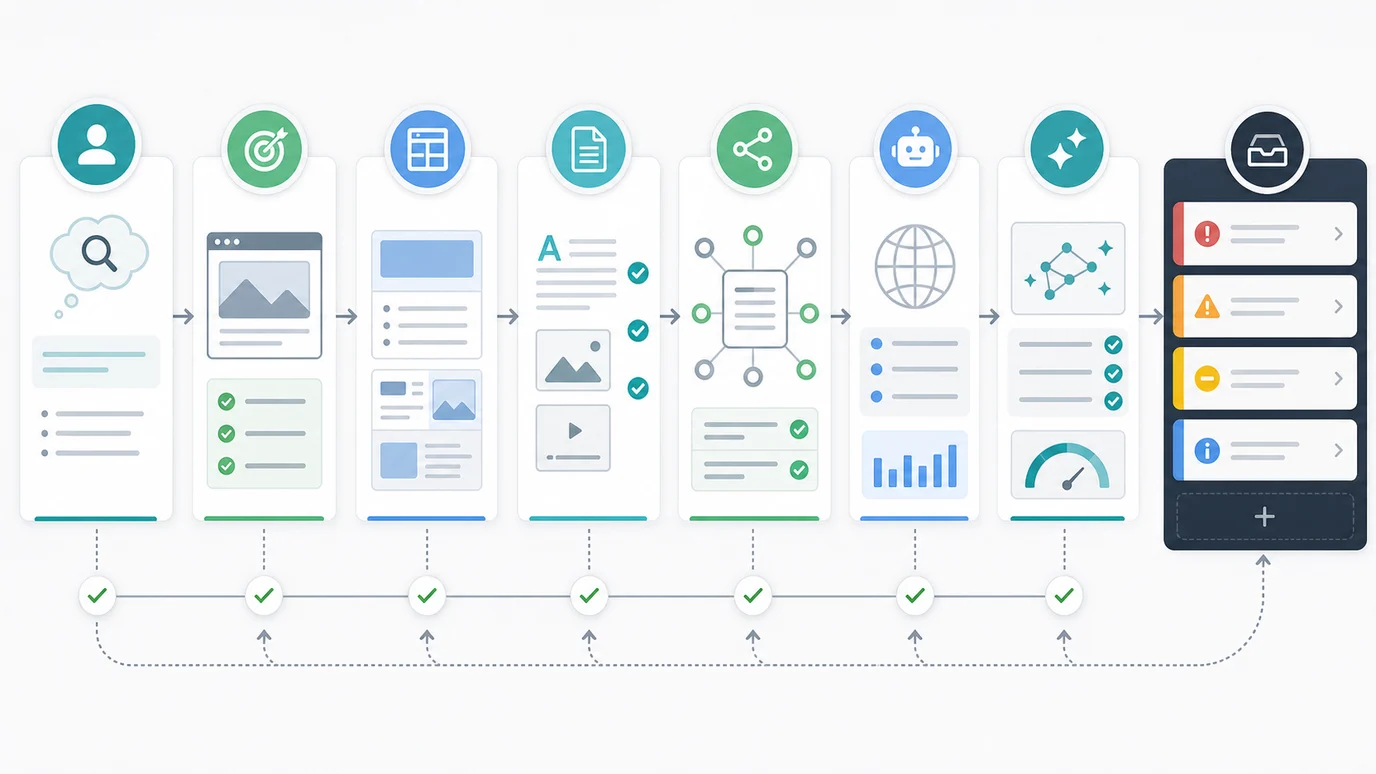
Use this sequence:
- Read the query and close variants.
- Decide whether the searcher needs an answer, comparison, tool, product, checklist, or template.
- Check the title, H1, intro, and first H2 for the same promise.
- Review whether examples, tables, screenshots, or steps prove the promise.
- Inspect internal links going into and out of the page.
- Confirm the live URL is crawlable, indexable, canonical, and present in the right sitemap context.
- Compare Search Console query data against the intended page job after launch.
Google's SEO starter guide frames SEO around helping search engines understand content and helping users decide whether to visit. That is a good relevance baseline because it ties content, structure, links, and crawlability together.
Separate Relevance Gaps From Quality Gaps
Relevance and quality overlap, but they are not identical. A high-quality article can still be the wrong page for the query. A technically reachable page can still answer the wrong task. Keep the diagnosis clean so the fix does not become guesswork.
| Symptom | Likely issue | Better fix |
|---|---|---|
| Impressions for an adjacent query, weak clicks | Title and intro do not match the query job | Rewrite the visible promise or route the query to a better page |
| Rankings split across two similar URLs | Same keyword, type, and user job overlap | Merge, consolidate, or assign one canonical target |
| Page gets crawled but not discovered deeply | Internal-link context is weak | Add descriptive links from stronger cluster pages |
| Page ranks for broad terms but not task-specific terms | Sections are too generic | Add examples, checklists, and decision support for the task |
| AI answer systems cite competitors, not you | Source clarity or extractable evidence is weak | Add concise definitions, factual examples, tables, and named entities |
| Content looks useful but has no visibility | Crawl or indexability issue may be upstream | Validate status, canonical, robots, rendered HTML, and sitemap inclusion |
Google's helpful content guidance asks whether a page provides original value, clear sourcing, and enough information for readers to achieve their goal. That is a quality lens. Keyword relevance adds a routing lens: does this exact URL satisfy this exact search task better than the alternatives in your own site?
Use Internal Links As Context, Not Decoration
Internal links help relevance when they describe the relationship between pages. They hurt the workflow when they are added only because a keyword appears somewhere in the copy.
Good relevance links answer three questions:
- Why is the source page sending the reader here?
- What job will the destination page help complete?
- Does the anchor describe the destination without forcing exact-match repetition?
For example, an on-page workflow can naturally link to a deeper on-page SEO article because the reader may need a full page-level audit. A page about keyword relevance can also link to search intent because the intent decision happens before copy optimization. It does not need to link every keyword-related article on the site.
Use this internal-link test before publishing:
| Link question | Pass condition |
|---|---|
| Source context | The sentence explains why the reader needs the next page |
| Destination job | The linked page covers a distinct task, not the same article again |
| Anchor clarity | The anchor says what the page is about in natural language |
| Crawl support | Important cluster pages are linked from discoverable pages |
| Cannibalization check | The new page does not duplicate same-keyword, same-type, same-job coverage |
The goal is not more links. The goal is a cluster that makes the page's role obvious to readers and crawlers.
Validate Relevance After Publishing
Keyword relevance is not proven in the draft. It is proven after the live page can be crawled, indexed, linked, and measured.

Run this validation loop after a page ships:
- Crawl the live URL and confirm status, canonical, indexability, title, H1, meta description, headings, internal links, images, and schema.
- Check the rendered HTML, not only the CMS draft, especially for JavaScript-heavy templates.
- Confirm the page appears in the intended sitemap and is linked from relevant cluster pages.
- Wait for enough data, then review Search Console queries, pages, countries, devices, CTR, and average position.
- Compare actual queries against the intended page job.
- Decide whether the page needs a title rewrite, section expansion, internal links, consolidation, or a different page type.
- Re-crawl after fixes and document the decision.
The Search Console Performance report is useful because it lets teams compare query and page data instead of judging relevance from one ranking snapshot. Use it with crawl evidence so you can tell the difference between "wrong intent," "weak snippet," and "not eligible yet."
Add AI Search Readiness To The Same Review
AI search does not replace keyword relevance. It raises the bar for clarity. Pages that are easy to cite usually make entities, definitions, sources, steps, and decisions visible in the text instead of hiding the useful logic inside vague paragraphs or decorative images.
Add these checks when the topic may appear in AI answers, summaries, or comparison-style search experiences:
| AI-search readiness check | What to improve |
|---|---|
| Clear definition | Answer the main concept in the opening lines |
| Named entities | Name products, page types, tools, and sources plainly |
| Extractable structure | Use tables, steps, and lists for decision logic |
| Source support | Link to official docs when a claim depends on a public rule |
| Page role | Make the canonical page for the task obvious inside the cluster |
| Update loop | Re-check mentions, citations, and query mix after changes |
This is where relevance becomes a content operations habit. The page should be useful for people, understandable to classic search systems, and structured enough for AI answer systems to recognize the role it plays.
Where Searvora Fits
Searvora AI SEO Consultant fits keyword relevance work when mixed signals need to become an action queue. The local product page positions it around pattern-based diagnosis, priority scoring, fix-ready guidance, and execution alignment. That maps directly to relevance decisions: classify the gap, decide whether the fix is content, links, crawl access, or page type, then assign the next action.
Use the AI SEO consultant when a page has many possible fixes but only one or two should ship first:
| Input | Relevance decision | Output |
|---|---|---|
| Query and page data | Is the page attracting the intended task? | Keep, rewrite, split, merge, or monitor |
| Crawl signals | Can search systems understand the live URL? | Technical fix queue before content expansion |
| Content structure | Does the page prove the promise? | Section, table, source, or example improvements |
| Internal-link map | Does the cluster explain the page role? | Add, remove, or rewrite supporting links |
| AI-search checks | Is the answer extractable and source-backed? | Definition, entity, citation, and evidence updates |
A Practical Keyword Relevance Checklist
Use this checklist before approving a new page or refreshing an existing one:
- Name the primary keyword and the user job in one sentence.
- Decide whether the query needs an article, hub, landing page, tool, template, or comparison.
- Confirm title, H1, intro, and first H2 all support the same task.
- Add examples, tables, steps, or screenshots where the answer is too abstract.
- Check whether internal links explain the page's role in the cluster.
- Remove same-keyword, same-type, same-job overlap before creating a new URL.
- Validate crawlability, indexability, canonical, rendered HTML, and sitemap inclusion.
- Link to official sources when public rules or platform behavior matter.
- Review query and page data after launch.
- Decide whether the next action is monitor, refresh, expand, merge, or change page type.
- Add AI-search readiness checks for definitions, entities, extractable tables, and source clarity.
- Record the decision so the next page in the cluster does not repeat the same work.
Keyword relevance gets stronger when every page has a job, every signal supports that job, and every shipped fix can be validated. Treat it as a workflow, not a phrase count, and the page becomes easier to rank, easier to cite, and easier for your team to improve.