

If you are deciding how to audit an ecommerce site for international markets, start with the URLs that should serve each country or language, then prove that search engines can crawl, index, canonicalize, and connect those pages correctly. Do not begin by translating copy. Begin by checking whether each market has the right page owner, technical signals, product coverage, and validation path.
The practical audit is a market-by-market workflow: inventory the pages, separate collections from products and guides, validate hreflang and canonicals together, review faceted URLs, then turn the findings into a fix queue. International ecommerce SEO fails when those systems are checked in isolation.
Start With Market URL Inventory
An international ecommerce audit needs a clean inventory before it needs recommendations. List the URL patterns that should rank in each market and separate them by page job.
| URL group | Market question | Audit evidence |
|---|---|---|
| Country or language home pages | Does each market have a clear entry point? | Status code, canonical, hreflang cluster, internal links |
| Collections and categories | Are localized shoppers landing on the right product range? | Crawl depth, title/H1, indexability, product availability |
| Product pages | Can product-specific demand find the correct market version? | Canonical, stock state, structured data, localized copy |
| Buying guides and blog posts | Does informational demand route to useful commercial pages? | Internal links, query fit, market examples, next step |
| Faceted and filtered URLs | Which refinements deserve crawl or index access? | Parameter rules, canonical targets, demand, duplicate risk |
Google's ecommerce SEO guidance frames store discovery around product data, site structure, and how shoppers encounter products in Search. For international work, the inventory layer is what makes that guidance executable.
Separate Page Types Before Checking Hreflang
Hreflang problems often look technical, but the root issue is usually page-type mismatch. A French collection page should not alternate with an English buying guide. A Canadian product variant should not canonicalize to a US product page if the Canadian page is meant to rank.
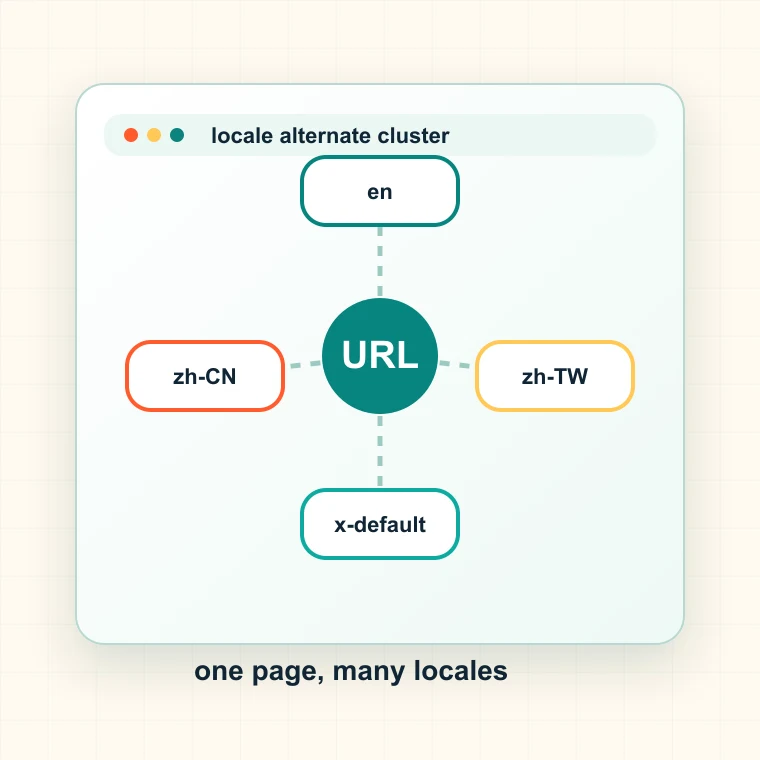
Use this page-type map before validating tags:
| Page type | Good alternate match | Common failure |
|---|---|---|
| Collection | Same collection job in another language or country | Alternates point to a broader category or a search-results page |
| Product | Same product or equivalent market version | Out-of-stock market page canonicalizes away without a replacement plan |
| Guide | Same informational task for the same buyer stage | Localized URL answers a different query or links to the wrong collection |
| Campaign | Same campaign and offer window | Expired local pages remain indexable after the campaign ends |
| Support page | Same support task for that market | Support content alternates with commercial pages |
The hreflang tags workflow is useful when the cluster itself is valid but the implementation needs a cleaner HTML, HTTP header, or XML sitemap format. The free hreflang tag generator can help prepare the snippet, but the audit still needs to prove that every alternate URL is the right page.
Audit Hreflang, Canonicals, And Sitemaps Together
International ecommerce audits break when hreflang, canonicals, and sitemaps are reviewed in separate spreadsheets. These signals must agree on the same market owner.
Google's localized versions documentation explains that alternates should reference equivalent pages. That is the baseline. The operational audit goes further and checks whether the crawl evidence supports the same cluster.
Use this signal check:
| Signal | Pass condition | Fix when it fails |
|---|---|---|
| Self-canonical | The market URL canonicalizes to itself when it should rank | Remove cross-market canonicals or choose one canonical owner deliberately |
| Hreflang return tags | Each alternate references the full cluster back | Rebuild the cluster from the URL inventory, not from memory |
| Sitemap inclusion | Canonical, indexable market URLs appear in the right sitemap | Remove blocked, redirected, noindexed, or duplicate URLs |
| Internal links | Market navigation links to the intended local pages | Fix language switchers, menus, breadcrumbs, and guide links |
| Robots and noindex | Important market URLs are not blocked from crawling or indexing | Separate crawl control from duplicate management |
For canonical conflicts, pair this review with the canonical tags audit workflow. International pages are especially sensitive because a canonical can quietly erase the market page that hreflang is trying to expose.
Inspect Collections, Products, And Facets
International ecommerce SEO is not only about alternate tags. The pages still need enough local usefulness to deserve search visibility.
Start with collections because they usually own category demand. Check whether the market version has localized category copy, relevant product coverage, useful filters, local shipping or availability context, and links to supporting guides. Then inspect representative product pages for unique titles, descriptions, structured data, product availability, image alt text, and variant rules.
Faceted URLs need a stricter decision. Some filters deserve indexable pages because shoppers search for them. Others should remain user-facing but stay out of the index.
| Ecommerce pattern | Audit question | Default decision |
|---|---|---|
| Market-specific collection | Does it match local demand and inventory? | Keep indexable when the page has unique value |
| Language-only copy swap | Does the page still sell the same product set? | Validate hreflang and canonical consistency |
| Currency or shipping variant | Is there enough market-specific content to rank separately? | Keep canonical rules deliberate and documented |
| Color, size, or price filter | Does search demand justify an indexable URL? | Noindex or canonicalize weak combinations |
| Seasonal collection | What happens after the season ends? | Plan redirect, refresh, or expiration before launch |
The broader ecommerce SEO workflow covers page-type strategy. This audit narrows the job to international market readiness: which URLs can be crawled, which ones should be indexed, and which page owns each market query.
Use Crawl Evidence To Build The Fix Queue
The output should not be "international SEO reviewed." It should be a small queue of fixes that an owner can ship and validate.

Use this handoff format:
| Finding | Owner | Evidence | Fix | Validation |
|---|---|---|---|---|
| German collection canonicalizes to the US URL | Engineering | Crawl export and rendered canonical | Set self-canonical on the German collection | Re-crawl sample and sitemap |
| Spanish product pages missing from sitemap | SEO or platform owner | Sitemap export and crawl inventory | Add canonical, indexable products to the market sitemap | Re-submit sitemap and crawl |
| UK guide links to US collections | Content | Internal-link crawl and guide review | Update links to UK collections and products | Crawl internal links and check anchors |
| Faceted URLs indexed without demand | SEO and merchandising | Indexability report and query data | Noindex or canonicalize low-value filter combinations | Re-crawl and monitor index coverage |
| Hreflang cluster missing return tags | Engineering | Hreflang validation export | Rebuild alternates from the market URL map | Re-run hreflang validation |
This is where Searvora SEO Spider Crawler fits naturally. It can inspect crawl access, indexability, canonicals, sitemap behavior, metadata, internal links, and page groups before the team decides which international fixes are safe to ship.
Final International Ecommerce Audit Checklist
Use this checklist before launching a new market, fixing localized pages, or reviewing a traffic drop:
- List every market URL pattern by page type.
- Confirm that important URLs return 200 status codes and render the expected content.
- Check self-canonicals, hreflang clusters, return tags, and x-default behavior.
- Verify that market sitemaps contain only canonical, indexable URLs.
- Review collection pages for local product coverage, filters, copy, and internal links.
- Inspect product pages for unique metadata, availability, structured data, and variant handling.
- Decide which faceted URLs can be crawled, indexed, canonicalized, or blocked.
- Check guide and blog links so informational pages route shoppers to the right market pages.
- Group findings by owner, page type, severity, and validation method.
- Re-crawl after fixes ship instead of closing issues from screenshots or assumptions.
That is how to audit an ecommerce site for international markets without reducing the work to a translation review. The goal is to prove that each market has a crawlable, indexable, useful set of pages, then keep the validation loop close enough that fixes can be trusted.