

Keyword difficulty is an estimate of how hard it may be to rank for a query. It is useful, but it is not a content strategy. A score can warn you that the SERP is competitive. It cannot decide whether the right response is a new article, a product page, a comparison, a refresh, or a technical fix.
The Ahrefs article that surfaced this opportunity frames keyword difficulty as a way to estimate ranking chances. Searvora's information gain is the operating layer around that score: check SERP shape, content format, authority gap, business value, crawl readiness, internal links, and AI-search visibility before assigning work.
Start With The Job Behind The Keyword
The first mistake is reading keyword difficulty before reading the search task. A high score on a broad definition query and a high score on a high-intent comparison query do not mean the same thing. One may be a weak fit for Searvora. The other may justify a stronger page because the user is closer to a decision.
Use this first pass before you care about the number:
| Question | What it tells you | Better decision |
|---|---|---|
| What is the user trying to do? | Learn, compare, fix, buy, validate, or generate an output | Choose article, landing, tool, or refresh path |
| What page type dominates? | Guides, tools, product pages, listicles, docs, or forums | Avoid writing the wrong asset |
| Can Searvora add information gain? | Workflow, evidence, screenshots, crawl checks, or decision tables | Approve only if the page can beat generic coverage |
| Is there an existing Searvora URL? | Parent, child, adjacent, or same-job overlap | Link, refresh, merge, or create |
| Can the page be validated after launch? | Crawl, index, internal links, and measurement owner | Prevent content from becoming orphaned work |
This is why keyword difficulty belongs inside a keyword research workflow, not on a standalone spreadsheet tab. Research finds possible demand. Difficulty helps size the effort. Strategy decides what should ship.
Read The Score As A Warning Label
Most SEO tools calculate difficulty differently. Some lean heavily on backlink profiles. Some mix ranking domains, content strength, or proprietary SERP signals. That means the score is best used as a warning label, not as an absolute truth.

Read the score this way:
| Difficulty signal | What it may mean | What to check next |
|---|---|---|
| Low score | The SERP may be easier, less linked, or less mature | Still confirm search intent and page type |
| Medium score | The topic may be reachable with strong fit and internal support | Check information gain and internal links |
| High score | Strong incumbents may control the SERP | Look for narrower child jobs or a better angle |
| Volatile score | Results may shift or tools may disagree | Sample the SERP and compare page types |
| Branded or navigational query | A tool may show demand, but not transferable intent | Reject or use fair support/intercept framing |
A low score should not automatically create a brief. A high score should not automatically kill one. The right question is whether the keyword can become a page that helps the reader and can realistically earn visibility.
Check SERP Shape Before You Assign A Page
Keyword difficulty does not tell you what kind of page Google is rewarding. The SERP does.
If the top results are product pages, a blog post may not satisfy the query. If the top results are tutorials, a thin landing page will struggle. If the SERP has listicles, "best" modifiers, and comparison tables, the article needs to be a real roundup. If forums dominate, the query may need concrete experience, troubleshooting depth, or a more candid decision framework.
Use this SERP shape check:
- Identify the repeated page type in the top results.
- Note whether the query wants a definition, process, tool, list, template, or product evaluation.
- Check whether AI answers or SERP features already summarize the basic answer.
- Decide what new evidence would make a Searvora page worth citing.
- Pick the page type before writing a title.
This is also where long-tail keywords become useful. A difficult head term may be too broad, but a child query can expose a clearer job and a better page type.
Separate Difficulty From Cannibalization
A keyword can look hard because the SERP is competitive. It can also look hard because your own site already has overlapping pages that confuse the job.
The safe rule is strict: a new Searvora article is risky only when an existing URL already serves the same core keyword, same page type, and same user task. Parent-child overlap is normal. A keyword research guide can link to a keyword difficulty article. A long-tail keyword article can link back to a broader planning workflow. That is architecture, not cannibalization.
Use this comparison before approving a new page:
| Existing coverage | Risk level | Action |
|---|---|---|
| Same keyword, same article type, same reader task | High | Refresh or merge the existing URL |
| Same cluster, different job | Low | Create the child page and link both ways |
| Product page already covers commercial intent | Medium | Add a support section or comparison, not a generic article |
| Parent article mentions the concept briefly | Low | Create a deeper article if information gain is clear |
| No relevant URL exists | Low | Create only if page type and validation are ready |
For harder overlap calls, use the stricter keyword cannibalization workflow before the brief moves into writing.
Build A Difficulty Decision Map
Keyword difficulty becomes useful when it feeds a decision map. Do not ask "Can we rank?" in isolation. Ask which conditions have to be true before the work is worth assigning.

Score each opportunity across four lanes:
| Lane | Pass condition | Warning sign |
|---|---|---|
| Ranking feasibility | The SERP has a reachable format or a weaker angle you can improve | Every result is a strong authority page with the same answer |
| Content format fit | Searvora can produce the page type searchers expect | The query wants a tool, template, or pricing page, but the brief says blog |
| Business value | The topic supports SEO, GEO, content ops, crawl validation, or reporting | Traffic would not help Searvora's audience |
| Technical readiness | The URL can be crawled, indexed, linked, and measured | The page would launch without internal links or a validation owner |
If one lane fails, the answer is not always "reject." It may be "narrow the keyword," "refresh an existing page," "build a tool," or "wait until product support exists."
Turn The Score Into A Work Queue
The final output should be an action, not a number.
Use this workflow:
- Start with a keyword group, not one exact phrase.
- Confirm the user job and likely page type.
- Read keyword difficulty as effort risk.
- Check the SERP shape and the strength of the current winners.
- Compare existing Searvora pages for same-job overlap.
- Define the information gain in one sentence.
- Validate crawl, indexability, internal links, and measurement plan.
- Assign create, refresh, merge, tool, landing page, or no action.
This keeps difficult keywords from becoming vague ambition and keeps easy keywords from becoming low-value content. The score becomes one input in a decision your team can explain.
Where Searvora Fits
Searvora fits after the score is known, when the team needs to choose what to do with it.
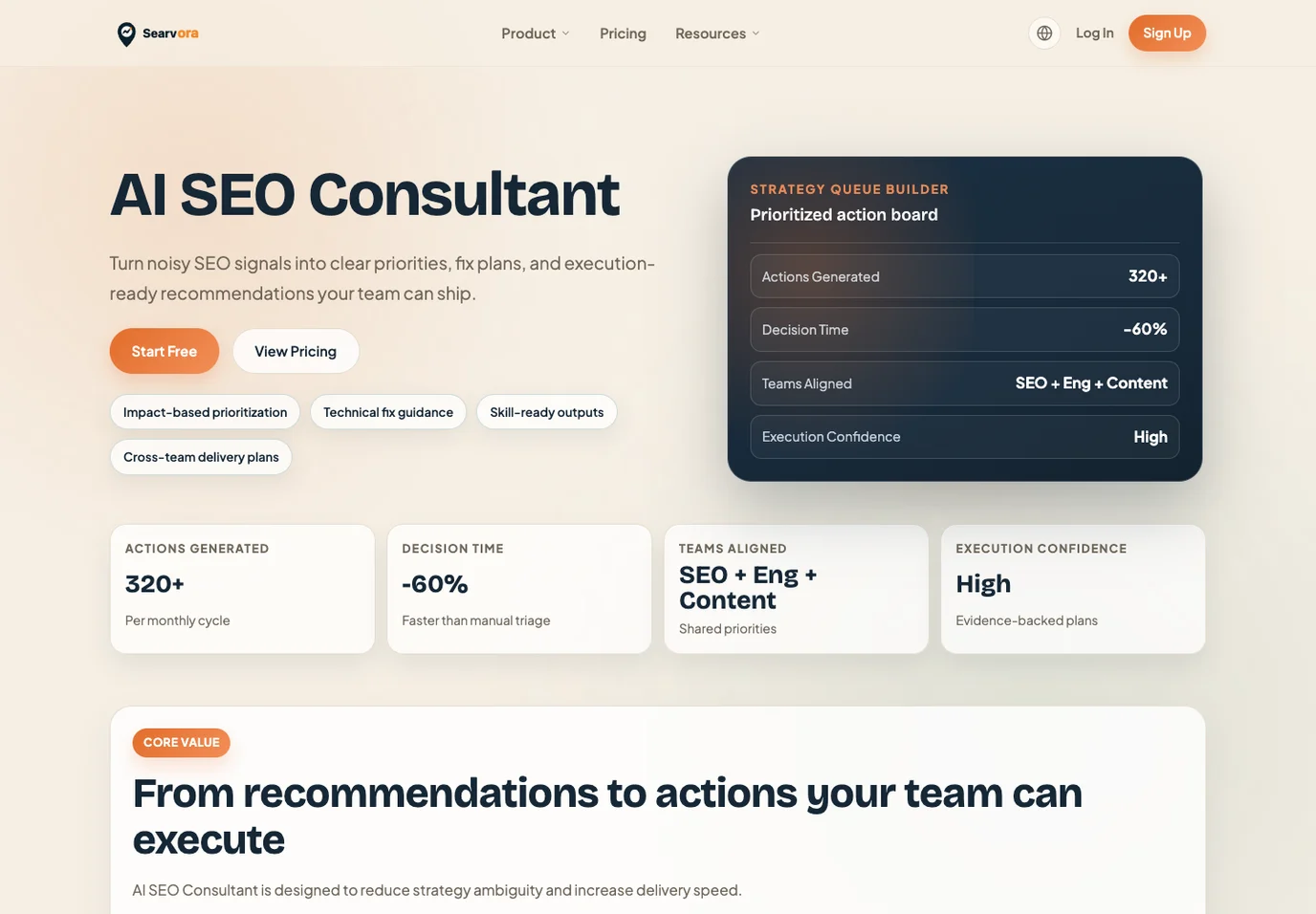
Use the AI SEO consultant to convert keyword difficulty, SERP evidence, overlap checks, crawl constraints, and business value into a ranked action queue. The useful output is not "KD 72." It is "refresh this URL," "create this child guide," "build a template," "add internal links first," or "do not pursue this query yet."
That matters because keyword difficulty is only honest when it stays connected to execution. A team can rank for harder topics when the page type is right, the angle is better, the site can support the URL, and the work has an owner. A team can waste months on easy topics when those conditions are missing.
Use This Approval Checklist
Before a keyword difficulty score becomes a brief, confirm:
- The target keyword has one primary user job.
- The expected page type matches the SERP shape.
- Existing Searvora coverage was checked for same keyword, type, and task.
- The information gain is stronger than a generic explanation.
- The page can be crawled, indexed, internally linked, and measured.
- A high score has a realistic angle or narrower child opportunity.
- A low score still has business fit and reader value.
- The final action is create, refresh, merge, tool, landing page, or no action.
Keyword difficulty is helpful when it slows down bad decisions. Let it warn you about effort, then let intent, page type, information gain, and validation decide what your team should ship.