

If you need to know how to measure brand awareness, stop treating it like one vague score. The useful job is to track whether more people search for the brand, mention it, cite it, visit from trusted sources, and convert after they have seen enough evidence.
Start with a small evidence ledger. Separate branded search demand, share of voice, AI-answer mentions, referral proof, and business outcomes. Then review the same segments every week so the team can decide what to improve next.
The Short Answer
To measure brand awareness, track signals that show recognition, source ownership, and action:
| Signal | What it tells you | Better next action |
|---|---|---|
| Branded search demand | Whether more people are actively looking for the brand | Improve branded SERP coverage, product pages, and comparison answers |
| Search share of voice | Whether the brand appears beside competitors for category queries | Strengthen source pages and category content |
| AI-answer mentions | Whether AI systems name the brand for relevant prompts | Audit the cited source pages and missing evidence |
| Referral and backlink growth | Whether outside sources are sending qualified attention | Build better proof pages and internal links |
| Direct and returning traffic | Whether people remember or revisit the brand | Compare with campaign dates and source-page changes |
| Conversions and pipeline | Whether awareness is turning into business movement | Segment by landing page, channel, and audience intent |
The Ahrefs page that surfaced this opportunity lists several brand-awareness measures, including search share of voice, AI and LLM brand growth, branded keywords, mentions, referrals, and conversions. Searvora's information gain is the operating layer after that: turn those measures into a weekly search evidence loop with owners and next actions.
Build The Brand Awareness Ledger
Brand awareness measurement gets messy when every team reports from a different tool. PR talks about mentions. SEO talks about branded queries. Demand generation talks about direct traffic. Sales talks about influenced pipeline. AI-search teams talk about prompts and citations.
That can all be useful, but only if the fields stay clear.
Use this starting ledger:
| Ledger field | Example source | What to record |
|---|---|---|
| Market and audience | CRM segment, campaign plan, site locale | Who the awareness signal should represent |
| Query group | Search Console, rank tracking, keyword tools | Brand, product, competitor, category, and problem queries |
| Source page | Homepage, product page, article, comparison page | The owned URL that should explain the brand |
| Visibility state | Search results, AI answers, review pages, directories | Seen, missing, cited, misdescribed, or competitor-owned |
| Traffic proof | GA4, Search Console, referrer data | Clicks, sessions, engagement, and return behavior |
| Business proof | CRM, forms, trials, assisted pipeline | Whether the audience did anything meaningful |
| Next action | SEO, content, product marketing, engineering | The smallest fix or monitoring decision |
The goal is not perfect attribution. The goal is enough consistent evidence to know whether the brand is becoming easier to find, understand, trust, and choose.
Separate Recognition From Source Ownership
Recognition means people or AI systems know the brand exists. Source ownership means the right owned page is strong enough to explain the brand when a searcher, AI answer, journalist, buyer, or reviewer needs proof.
Those are different jobs.
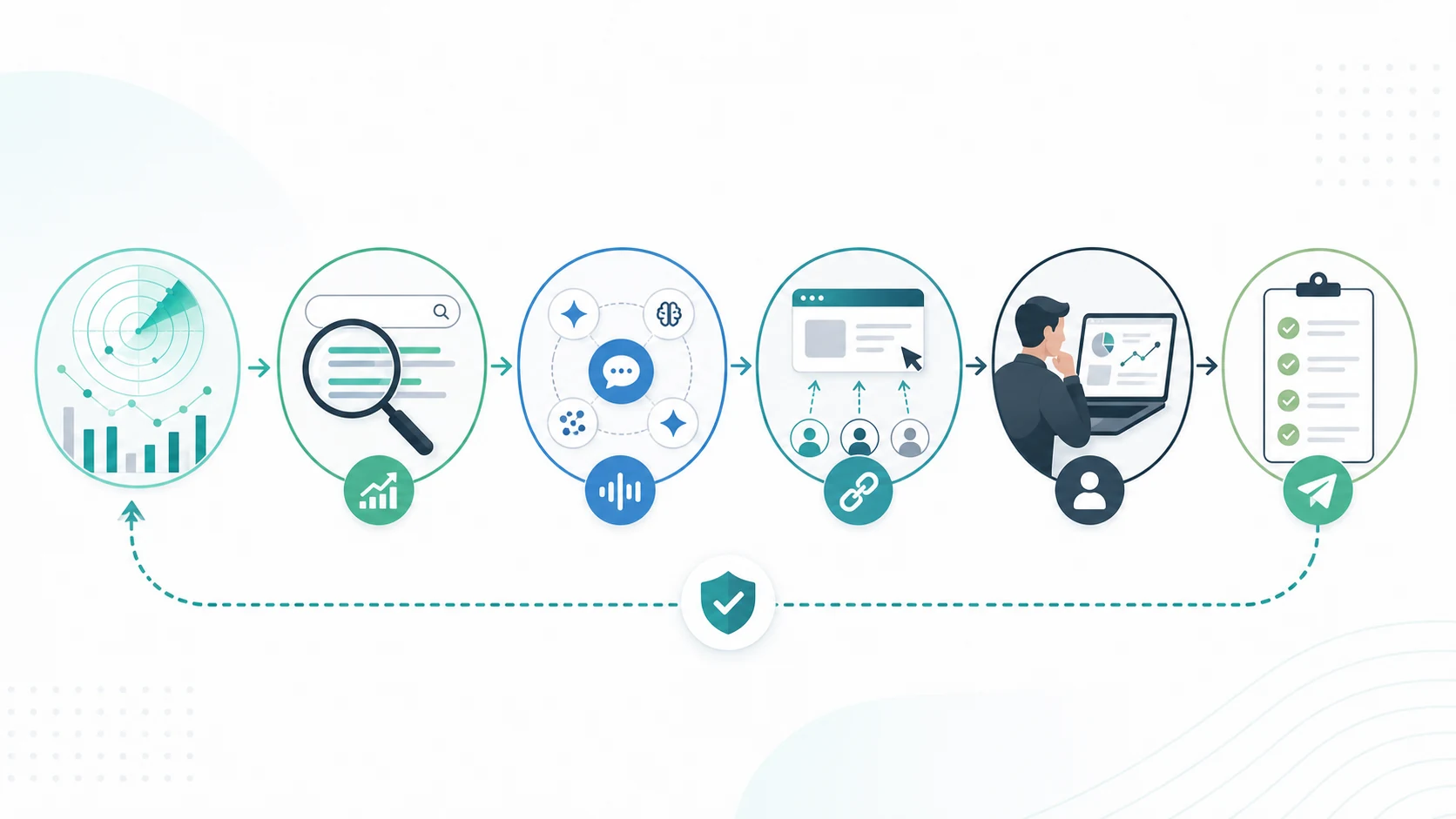
Use this split before you celebrate a spike:
| Pattern | What it usually means | Better action |
|---|---|---|
| Branded searches rise, but branded pages have weak snippets | Demand is growing faster than your owned result quality | Improve title tags, meta descriptions, sitelinks, and support pages |
| AI answers mention the brand but cite third-party pages | Entity awareness exists, but source ownership is weak | Strengthen the official page that should support the answer |
| Referral traffic rises from a review or partner page | Third-party proof is working | Make sure the landing page answers the same job and has a next step |
| Direct traffic rises after a campaign | Recall may be improving, but attribution is incomplete | Compare dates, markets, landing pages, and returning users |
| Category visibility rises but conversions do not | Awareness may be too top-of-funnel or poorly routed | Check intent match, page type, CTA, and qualification path |
This is where brand SEO matters. Brand SEO gives search systems and AI answers consistent owned-source evidence. Brand awareness measurement tells you whether that evidence is being seen and acted on.
Measure Search Demand With Owned Data
Branded search is one of the cleanest awareness signals because it shows active recall. Someone remembered the brand, product, founder, campaign, or comparison question well enough to search.
Google's Search Console performance reports are useful because they show how often users saw links to your site in Google surfaces, whether they clicked, and metrics such as impressions, clicks, CTR, and position. Use those signals to segment branded demand, not to pretend Search Console captures the entire market.
Start with query groups:
| Query group | Examples | What to watch |
|---|---|---|
| Brand | Searvora, Searvora login, Searvora pricing | Demand, CTR, branded SERP coverage |
| Product | Searvora AI SEO Dashboard, Searvora crawler | Product recognition and page routing |
| Competitor plus brand | Searvora vs another tool, Searvora alternative | Comparison intent and missing decision pages |
| Category plus brand | AI SEO dashboard Searvora, brand visibility Searvora | Whether category education is creating recall |
| Support or trust | Searvora reviews, Searvora safe, Searvora docs | Proof gaps, objections, and public-source needs |
Google Trends can add context when you need relative interest across markets or time windows. Google's Trends comparison guidance notes that teams can compare multiple terms or groups of terms, but the setup matters. Keep markets, date ranges, terms, and topics consistent before you draw a conclusion.
For a safer keyword workflow, pair this with Google Trends keyword research. Trends helps with direction and timing; Search Console helps with owned visibility; neither one is a complete brand awareness system by itself.
Add AI Mentions Without Double Counting
AI-search visibility changes brand awareness measurement because a user may see the brand in an answer without clicking. That does not make clicks useless. It means mentions, citations, and owned-page traffic should live in separate ledgers.
Track three states:
| AI-search state | What to record | Action it can trigger |
|---|---|---|
| Brand mentioned | The prompt, market, wording, and whether the description is accurate | Entity and positioning cleanup |
| Owned URL cited | Which official page supports the answer | Source-page improvement and internal links |
| Competitor cited instead | Which source page the competitor owns | Gap analysis and better owned evidence |
The brand mentions in AI answers workflow goes deeper on prompt sampling, citation logging, and source-page checks. For brand awareness, keep the metric narrower: did the brand become more visible for the query group, and did that visibility point to a page you can improve?
Avoid one common mistake: do not add AI mentions, Search Console impressions, referral sessions, and conversions into a single awareness number. The same person can appear in several ledgers. Keep the signals separate, then look for repeated movement across the same audience, market, and page set.
Connect Awareness To Traffic And Conversions
Brand awareness matters because it should eventually make the right audience easier to reach. That does not mean every awareness touch has a clean last-click conversion.
GA4 can help you separate source behavior. Google's User acquisition and Traffic acquisition report guidance explains the difference between user-scoped acquisition and session-scoped acquisition. Google's direct traffic guidance also notes that direct traffic represents sessions without a clear referral source, so it should not be treated as pure brand recall without context.
Use a practical connection table:
| Awareness signal | Traffic check | Conversion check |
|---|---|---|
| Branded query impressions rise | Branded clicks, CTR, landing page mix | Trial starts, contact forms, pricing visits from branded pages |
| Category visibility rises | Non-branded sessions to source pages | Assisted conversions from educational pages |
| AI mentions rise | Referral traffic from AI/chat sources when available, plus cited-page traffic | Returning users and conversion paths after source-page visits |
| Third-party mentions rise | Referral sessions, backlink quality, engaged sessions | Lead quality from partner, review, or media traffic |
| Campaign recall rises | Direct and returning sessions around campaign dates | Branded-search lift and conversion lag windows |
This is a measurement workflow, not a courtroom proof standard. The signal is useful when it changes a decision: improve a source page, add a comparison page, fix a branded SERP issue, strengthen internal links, or keep watching.
Where Searvora Fits
Searvora's AI SEO Dashboard fits the review layer of brand awareness measurement. The product page positions it around segment-first monitoring, anomaly and trend detection, opportunity scoring, and cross-team reporting. Those are the controls a team needs when brand visibility changes across query groups, page types, locales, and owners.
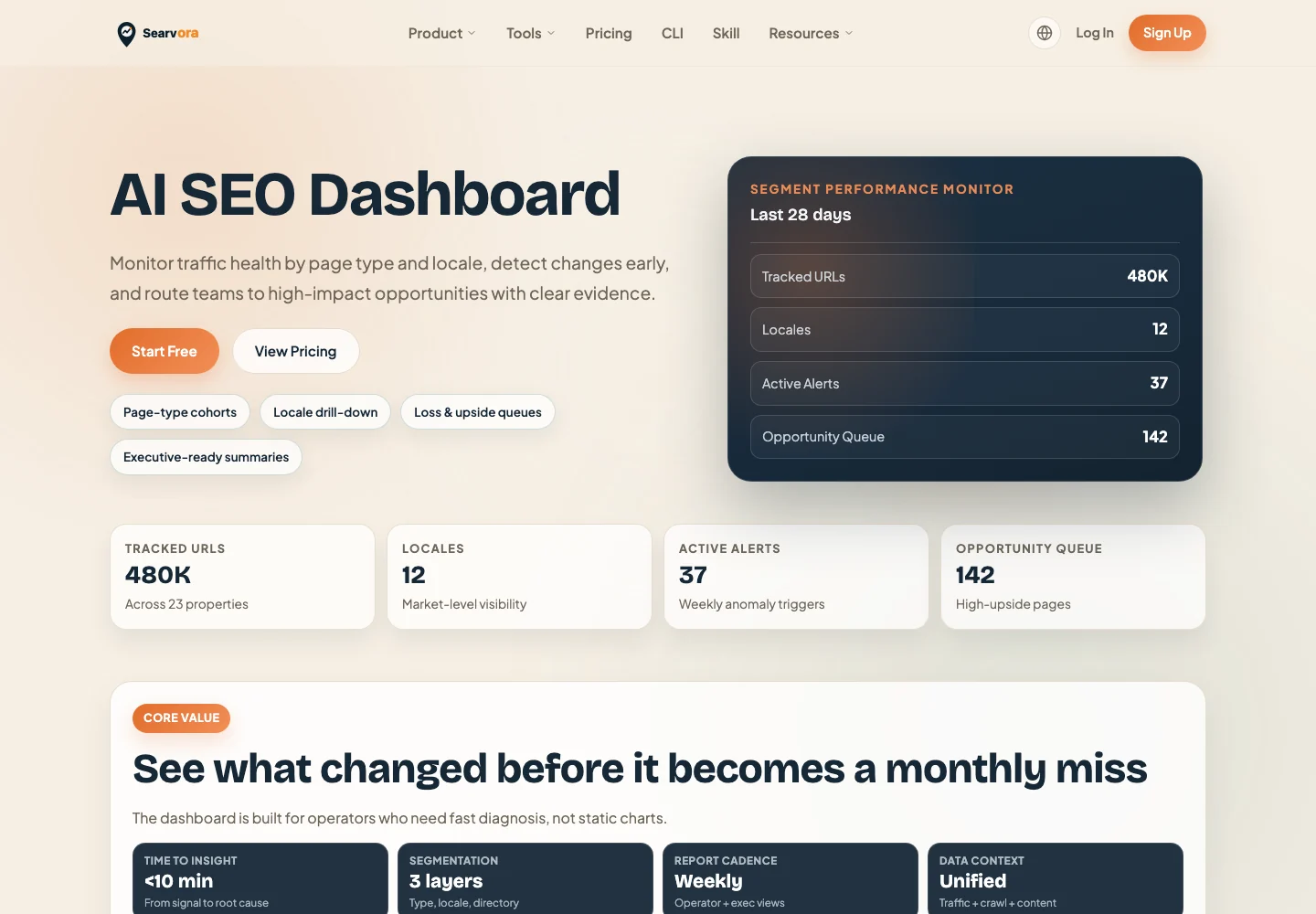
Use the dashboard to keep brand awareness from turning into a pile of screenshots:
| Searvora layer | How it helps brand awareness measurement |
|---|---|
| Segment-first monitoring | Separate branded, category, comparison, and AI-search evidence |
| Anomaly and trend detection | Spot movement before a monthly report hides it |
| Opportunity scoring | Decide which source page, branded result, or content gap deserves work |
| Cross-team reporting | Give SEO, content, PR, and leadership the same evidence trail |
When the team cannot decide what to do next, use the consultant layer to turn dashboard and crawl evidence into prioritized actions. Keep the roles clear: monitoring shows what changed; the action queue decides what ships.
Run The Weekly Brand Awareness Review
Use a weekly cadence when the brand is in an active campaign, category push, AI-search program, or competitive visibility sprint. Use a monthly cadence for lower-priority markets.
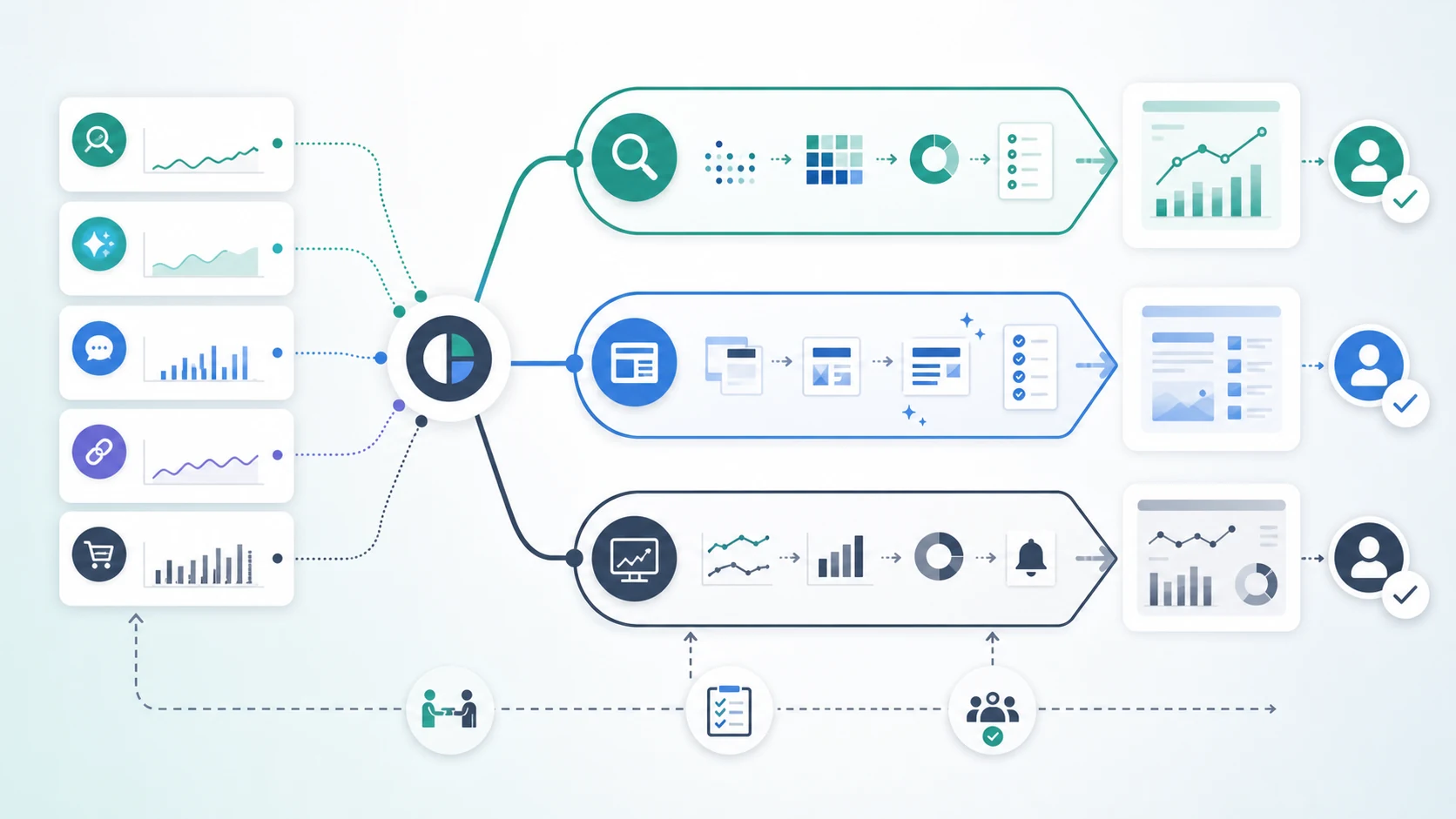
Run the review in this order:
- Pick one market, language, product line, and audience segment.
- Review branded search queries separately from category and comparison queries.
- Check whether AI answers mention the brand, cite an owned page, or cite only competitors.
- Compare referral traffic, direct traffic, returning users, and campaign dates without merging them into one score.
- Inspect the owned pages that should explain the brand, product, or category.
- Assign one action per evidence gap.
- Record the owner, shipped change, and recheck date.
- Keep watchlist signals separate from action-ready signals.
Use this decision table:
| Evidence pattern | Better decision |
|---|---|
| Branded demand up, CTR down | Improve branded SERP titles, descriptions, and support coverage |
| AI mentions up, citations weak | Strengthen the owned source page and internal links |
| Referral traffic up, conversion weak | Align the landing page with the source's promise |
| Category visibility up, brand search flat | Improve memory hooks, comparison content, and product-page clarity |
| Direct traffic up after a campaign | Compare markets, returning users, and branded search before claiming recall |
| No signal moves after a major push | Recheck audience fit, source quality, crawl access, and campaign distribution |
Brand awareness measurement should end with a decision, not a slide. If the signal is too noisy, keep monitoring. If the same pattern appears across search, AI mentions, referrals, and owned pages, assign the work and remeasure after it ships.