

Local keyword research is the process of finding how people search for nearby services, products, and businesses, then mapping that demand to the right profile or page. The useful output is not a list of city-modified phrases. It is a service-by-location plan that says which URL should exist, which queries it should satisfy, and how the team will validate it.
Start with the business inventory, expand it with real local language, confirm local intent, group terms by user job, and assign one destination to each cluster. That sequence prevents two common failures: missing valuable service demand and publishing dozens of near-duplicate location pages that compete with one another.
Start With a Service and Location Inventory
Do not begin by appending every city name to a generic keyword. Begin with what the business can actually deliver and where it can credibly deliver it.
Build two inventories:
| Inventory | What to record | Why it matters |
|---|---|---|
| Services | Core services, sub-services, problems solved, emergency jobs, product categories, eligibility limits | Reveals specific demand that a broad business label can hide |
| Locations | Physical locations, verified service areas, neighborhoods, cities, regions, travel limits | Prevents pages for places the business cannot support |
A plumbing company may think its keyword is simply “plumber.” The service inventory may reveal boiler repair, drain unblocking, leak detection, radiator installation, and emergency callouts. Those jobs can have different intent, conversion value, proof requirements, and destination pages.
For a multi-location business, record which services are available at each location. A service-location pair should not enter the content plan just because the words can be combined. It needs a real offer, a reachable customer area, and enough distinct evidence to support a useful page.
Build Local Keyword Patterns Without Creating a Cartesian Product
Use the service inventory as the base, then expand it with modifiers that reflect how local customers actually describe the job.
| Modifier group | Examples | What it can reveal |
|---|---|---|
| Place | City, neighborhood, district, county, “near me” | Geographic demand and local-result intent |
| Problem | Leaking pipe, broken boiler, missing tooth | Symptom-led searches that may map to a service page |
| Urgency | Emergency, same day, open now | Time-sensitive intent and operating-hour requirements |
| Audience | Residential, commercial, family, enterprise | Different proof, pricing, and service expectations |
| Qualifier | Affordable, licensed, specialist, mobile | Decision criteria that the page must substantiate |
Expansion is a discovery step, not an instruction to publish every combination. “Emergency boiler repair in Bristol” and “same-day boiler repair Bristol” may belong to one page if they share the same service, user task, and expected result. “Boiler installation Bristol” deserves separate consideration because the job, proof, and conversion path are different.
Use existing customer language as evidence. Sales calls, support tickets, on-site search, Business Profile categories and services, Search Console queries, and competitor page patterns can all reveal phrasing that a generic keyword database misses. Keep each source labeled so observed demand does not become a fabricated volume claim.
Confirm That the Query Has Local Intent
A place name does not automatically make a query local, and a query without a place name can still trigger local results. Confirm the result type before deciding what to build.
Check whether the query usually produces:
- a local pack or Maps result;
- nearby business profiles;
- local service or location pages;
- directories and review platforms;
- informational articles;
- ecommerce, product, or booking pages.
Google explains that local results are mainly shaped by relevance, distance, and prominence. Keyword selection can improve relevance, but it cannot remove the distance constraint or manufacture prominence. The page plan must reflect the real market and business evidence.
When the result shape is mixed, label the ambiguity instead of forcing a page. A query such as “roof repair cost in Leeds” may need an informational cost article with a local conversion path, while “roof repair Leeds” is more likely to need a service or location page. The words are adjacent; the page jobs are not.
Map Each Cluster to One Primary Destination
The central local keyword research decision is not which phrase to put in a title. It is which asset should own the user job.
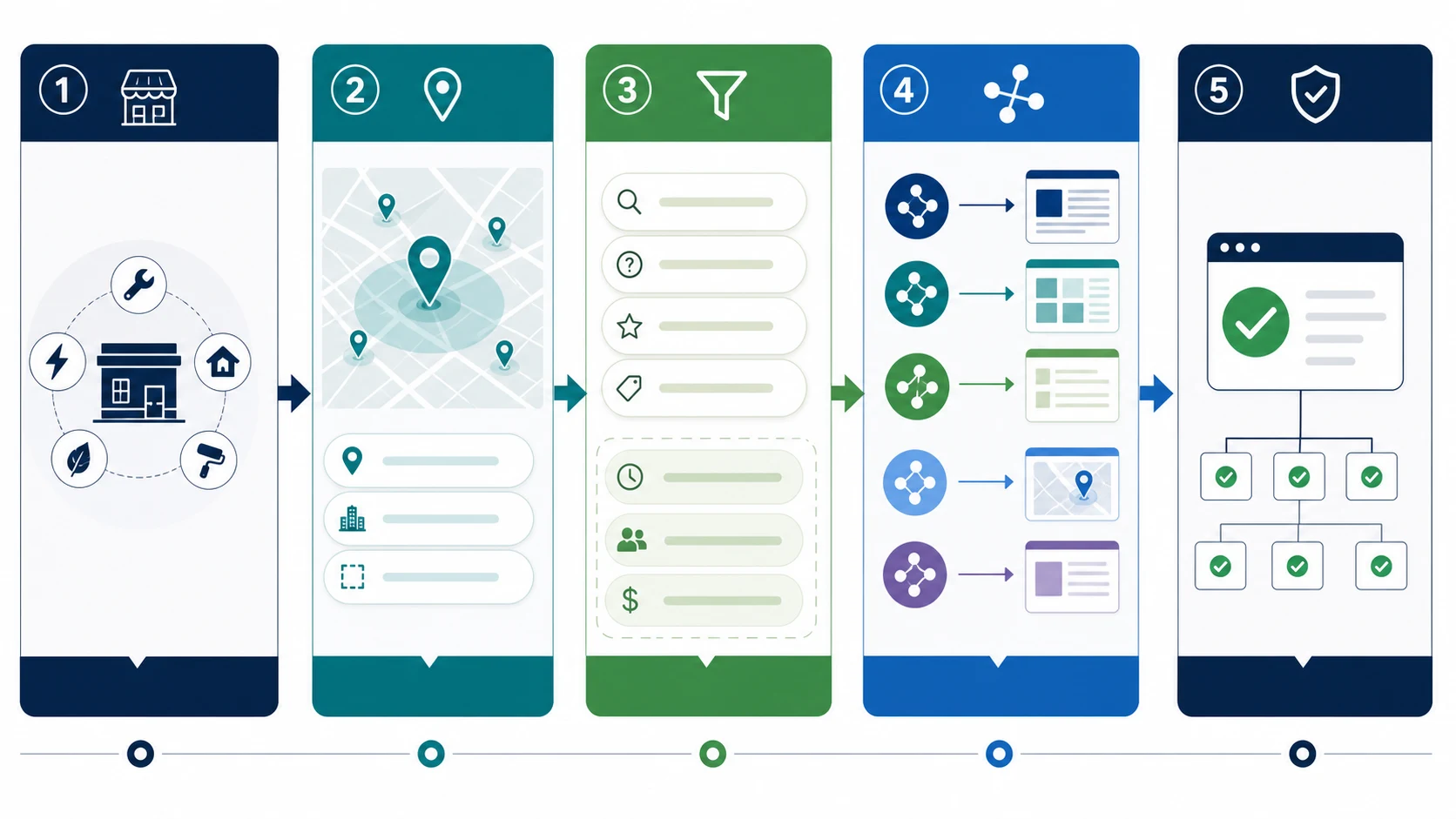
Use this routing table:
| Query job | Primary destination | Evidence the destination needs |
|---|---|---|
| Find the business or confirm basic facts | Business Profile and homepage | Accurate name, category, location or service area, hours, contact details |
| Hire one service across the main market | Core service page | Clear offer, process, proof, eligibility, conversion path |
| Choose a branch or provider in one place | Location page | Unique location facts, local team or facility evidence, services, directions or service area |
| Hire one distinct service in one place | Service-location page only when justified | Local availability, specific proof, unique constraints, useful local detail |
| Understand a local problem before buying | Supporting article or guide | Direct answer, local context, next step to the relevant service page |
| Compare options or providers | Comparison or decision page | Fair criteria, current public evidence, transparent limitations |
One cluster should have one primary owner. Secondary variations can support the same page when they express the same intent and expected answer. If two existing URLs already rank for the same cluster, decide which one should own it before adding another page.
This is where the general keyword research workflow becomes more specific. Local research adds service coverage, geographic truth, profile alignment, and multi-location page governance to the normal intent and page-type checks.
Protect Multi-Location Sites From Duplicate Pages
Location pages are useful when the place changes the answer. They become risky when the site swaps a city name while keeping the same claims, examples, proof, headings, and conversion path.
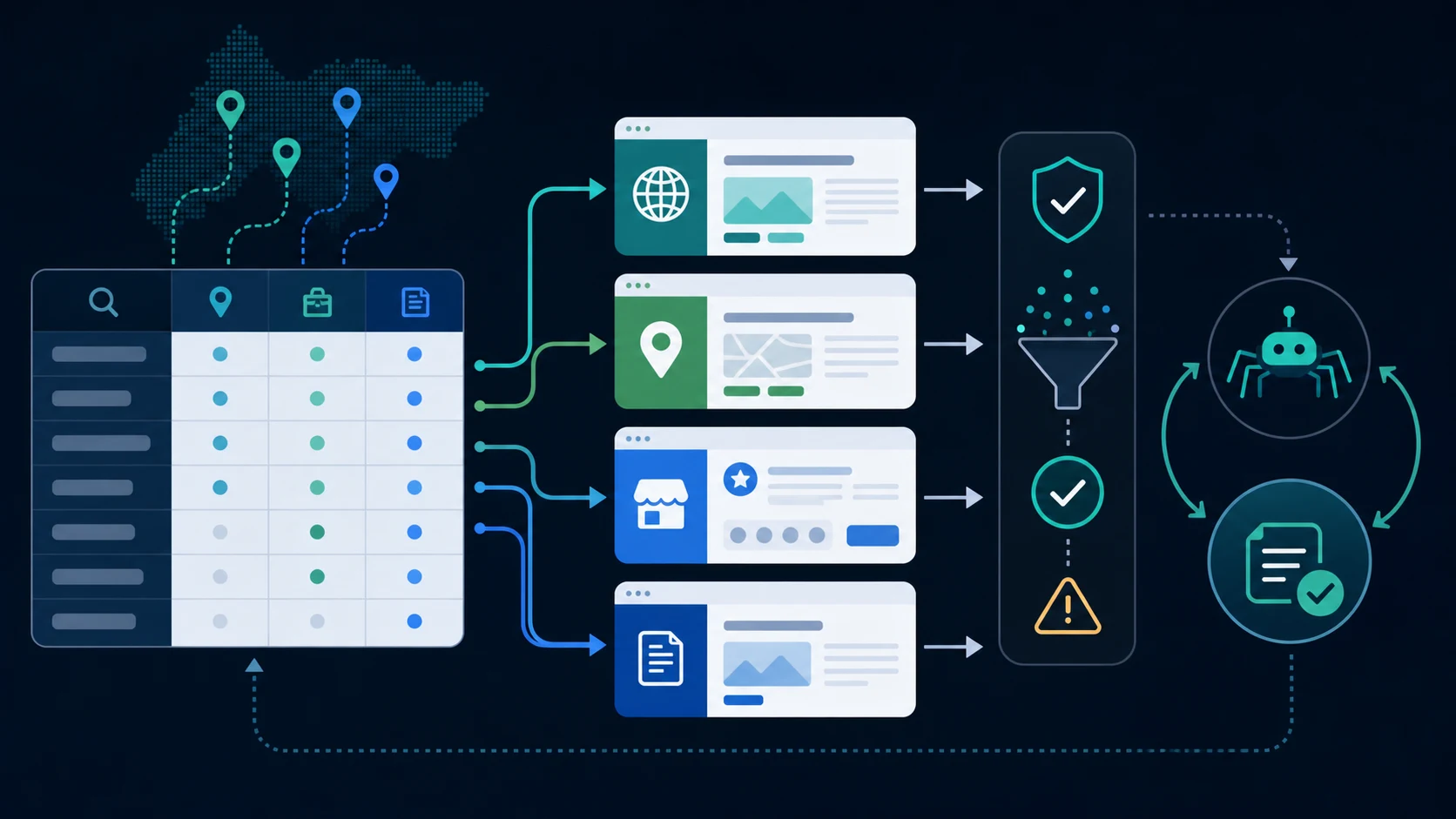
Before approving a location or service-location page, require enough local evidence to answer these questions:
- Is the service genuinely available in this place?
- Does the location have different staff, facilities, service constraints, inventory, hours, travel times, or proof?
- Can the page show relevant local examples, testimonials, projects, regulations, landmarks, or customer questions without inventing them?
- Does the page have a distinct conversion route or operational owner?
- Can internal links reach the page from a useful hub, service page, or location directory?
If the only unique field is the city name, keep the demand in a regional page, profile, or service-area section until the business can support a genuinely useful URL. More pages do not create more local relevance when the pages say the same thing.
The parent local SEO workflow is useful for profiles, reviews, entity consistency, and ongoing market monitoring. Local keyword research is the child workflow that decides which service and location demand deserves which destination.
Validate the Page Map Before Publishing
A keyword map can look clean in a spreadsheet while producing technical conflicts on the live site. Validate the planned destinations against the current URL inventory before briefs move to writing or development.
Check each proposed owner for:
- an existing page serving the same core keyword, page type, and user task;
- indexability and canonical status;
- status code and redirect behavior;
- internal-link source and crawl depth;
- sitemap inclusion policy;
- title, H1, and visible service or location promise;
- structured data that matches the visible business facts;
- locale or regional variants that may already own the market.
Google’s LocalBusiness structured data documentation is useful for representing facts such as address, hours, telephone, and business type. Markup does not rescue a weak or duplicated location page. It should describe visible, accurate information on a page that already satisfies the local task.
Use the search intent workflow when a cluster could map to multiple formats. Use a crawl inventory when the main risk is duplicate ownership, buried location pages, conflicting canonicals, or broken internal paths.
Turn the Research Into an Owner-Ready Brief
Every approved cluster should leave research with a brief that is small enough to execute and specific enough to review.
| Brief field | What to record |
|---|---|
| Primary job | The service or local decision the searcher needs to complete |
| Primary cluster | One core keyword plus closely related same-intent variations |
| Market | Location, service area, language, and any operating limits |
| Page type | Profile, homepage, service, location, service-location, article, comparison, or update |
| Existing owner | Current URL to keep, refresh, merge, redirect, or retire |
| Required proof | Local facts, examples, people, reviews, policies, photos, credentials, or process evidence |
| Internal links | Parent service, location directory, related guide, and next conversion page |
| Technical gate | Canonical, indexability, sitemap, crawl path, structured data, and rendering checks |
| Measurement | Query group, page cohort, profile action, lead type, and review date |
Do not hand a writer a list of keyword variants and ask for natural usage. Hand the team a page job, evidence requirements, page ownership decision, and acceptance checks. That makes the keyword research useful even when the correct outcome is updating an existing URL instead of publishing a new one.
Measure Local Demand by Query, Page, and Market
Local performance is easy to overstate because rankings vary by searcher location, device, language, and result type. Keep measurements segmented and describe their limits.
Google Search Console’s Performance report groups data by query, page, country, device, search appearance, and date. Use those dimensions to compare the same page groups over time, but do not pretend country-level data is a precise neighborhood rank grid.
Review four evidence lanes:
| Evidence lane | What it can tell you | What it cannot prove alone |
|---|---|---|
| Search Console | Query, page, impression, click, CTR, country, and device movement | Exact map-pack position for every searcher |
| Business Profile performance | Profile discovery and customer actions | Whether a website page owns the organic query |
| Local rank sampling | How results differ across defined locations and devices | Total demand or business impact |
| Leads and conversions | Whether local discovery turns into calls, bookings, visits, or revenue | Which single ranking factor caused the outcome |
For AI search, keep mentions and citations in a separate evidence lane. A local business may be named in an answer without receiving a click, or a third-party directory may be cited instead of the owned page. Record the prompt, market, answer surface, cited URL, and date before turning the observation into content work.
Where Searvora Fits
Searvora AI SEO Consultant fits the decision layer of local keyword research. The current product surface is designed to group mixed SEO signals, score opportunities by impact and effort, and turn decisions into owner-ready action queues.
Use it after the service and market evidence is collected: compare candidate clusters, choose the page job, record whether an existing URL should be updated, and route the result to content, SEO, or engineering. Keep Business Profile facts, local proof, crawl evidence, and performance data attached to the decision rather than asking AI to guess them.
Local Keyword Research Checklist
Before approving a local keyword cluster, confirm:
- The service and location are real and operationally supported.
- The keyword reflects a clear local user job, not just a place-name variation.
- The result shape supports the proposed profile or page type.
- One primary destination owns the cluster.
- Parent and child topics are separated without creating same-job duplicates.
- A location page has unique local proof beyond a swapped city name.
- The planned URL is crawlable, indexable, internally linked, and canonically consistent.
- Structured data matches visible business facts.
- The brief names an owner, evidence requirements, and a validation date.
- Search, profile, local-rank, lead, and AI-answer evidence remain separate.
Local keyword research succeeds when the page map becomes clearer, not larger. Find the demand, confirm the local task, assign the right destination, and keep the cluster open until the live page and measured outcome support the decision.