

A non-indexable canonical happens when a page nominates a canonical target that search engines cannot reasonably index. The target may be blocked by robots.txt, marked noindex, redirected, returning an error, or canonicalized again to a different URL.
The fix is not to replace the tag on the first URL you see. First prove why the target is non-indexable, decide which URL should own the search job, repair the shared source rule, and then recrawl the affected pattern. That makes this a narrower technical-fix workflow than a broad canonical tags audit: the question here is whether the nominated target can actually be the indexable representative.
Confirm That the Canonical Target Is Non-Indexable
Start with a small evidence set for the source URL and its nominated target. Record the final response, redirect chain, source and rendered canonical values, indexability state, sitemap presence, and meaningful internal links. A canonical only helps when its destination is a valid representative for the cluster.
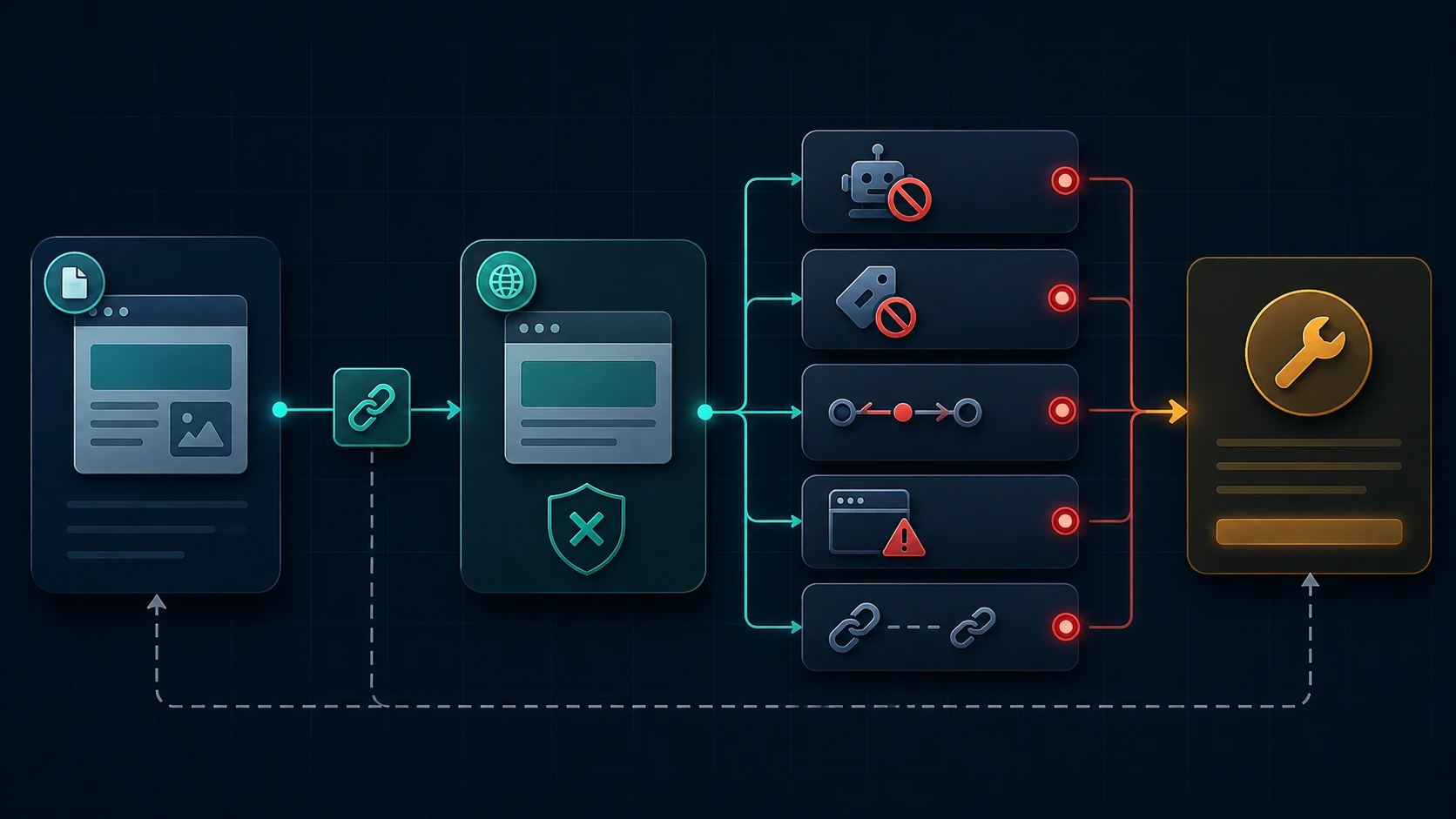
| What blocks the target | What to inspect | The likely repair direction |
|---|---|---|
robots.txt disallow | Whether the crawler can fetch the selected target and whether the restriction was intentional | Remove the conflicting crawl restriction when the target should be indexable, or nominate an indexable destination instead |
noindex | Source HTML and rendered HTML, plus the CMS or template rule that emits the directive | Remove an accidental directive from the canonical owner, or change the canonical relationship if the page should remain out of search |
| Redirect | Final URL, status code, and every hop in the redirect chain | Point the source at the final indexable URL or replace the chain with one direct canonical policy |
| Client or server error | Live response, deployment history, and whether the failure affects a template or only one URL | Restore a stable indexable response before using the URL as a canonical target |
| Another canonical | The target's own canonical, rendered output, and the larger duplicate cluster | Resolve the chain to one indexable representative instead of letting pages nominate one another |
Trace the Finding Back to the Owning Rule
The URL where the problem appears is often only a symptom. A non-indexable canonical can come from a product template, a faceted-navigation rule, a CMS default, a locale condition, or JavaScript that changes metadata after the initial HTML loads.
Work from the target back to the source:
- Confirm the target's final indexability state and the reason it fails.
- List every source URL that nominates that target.
- Group the sources by template, page type, locale, or CMS field rather than treating each URL as an unrelated ticket.
- Compare source HTML with rendered HTML when client-side metadata can change the canonical.
- Write one expected rule in plain language: which page type owns the canonical, which URL is indexable, and which owner must fix the rule.
This prevents a common bad repair: changing one canonical tag while the same component keeps generating hundreds more. It also stops teams from correcting a source URL when the real failure is that the nominated destination still returns a redirect or carries noindex.
| Evidence field | Why it matters | Useful owner question |
|---|---|---|
| Source URL and page type | Shows where the canonical relationship starts | Which template or CMS rule created this target? |
| Target URL and final response | Separates a bad target from a bad declaration | Is this URL meant to be indexable at all? |
| Rendered canonical | Catches client-side or integration drift | Does live HTML agree with source output? |
| Sitemap and internal-link destination | Shows whether the rest of the site supports the same URL | Are important links and discovery signals pointing to the intended representative? |
| Pattern scope | Turns one alert into a measurable release risk | Which template, locale, or directory needs a focused recrawl? |
Choose the Repair That Matches the Page Relationship
The desired end state is not always a self-canonical page. It depends on whether the source and target are true duplicates, accessible alternates, distinct pages, or a broken URL-policy combination.
| If the real relationship is | Repair the canonical system by | Avoid |
|---|---|---|
| One indexable page with disposable duplicates | Redirecting disposable variants when users should not access them, then pointing links and sitemaps to the final representative | Leaving the canonical source pointed at an intermediate redirect |
| An accessible alternate that must remain available | Keeping its canonical aligned to a clean, indexable representative and removing contradictory indexability directives | Using noindex, a redirect, and a competing canonical without deciding which policy owns the URL |
| Two pages with distinct user jobs | Rewriting the architecture so each page can stand on its own, with self-canonicals where appropriate | Canonicalizing away a page that users and searchers actually need |
| A target blocked by a shared CMS or platform rule | Fixing the owning rule, testing a sample across the pattern, and confirming that the target becomes a stable indexable response | Patching one URL while the template keeps emitting the same invalid target |
| A target that points to another canonical | Collapsing the chain to the final chosen representative and aligning source, rendered HTML, links, and sitemap entries | Maintaining a long canonical chain that makes ownership ambiguous |
The distinction matters because canonicalization cannot repair a page-purpose problem. If the source and target serve different search tasks, the work may be content or information architecture, not metadata. If the URLs are genuinely duplicate, the selected target must be a page that can be crawled, indexed, and supported by the rest of the site.
Validate the Repair as a Pattern
A successful deploy changes the HTML. A successful technical SEO fix proves that source URLs, target URLs, crawl paths, and sitewide signals now agree. Recheck the target first, then expand to the template or directory that generated the issue.
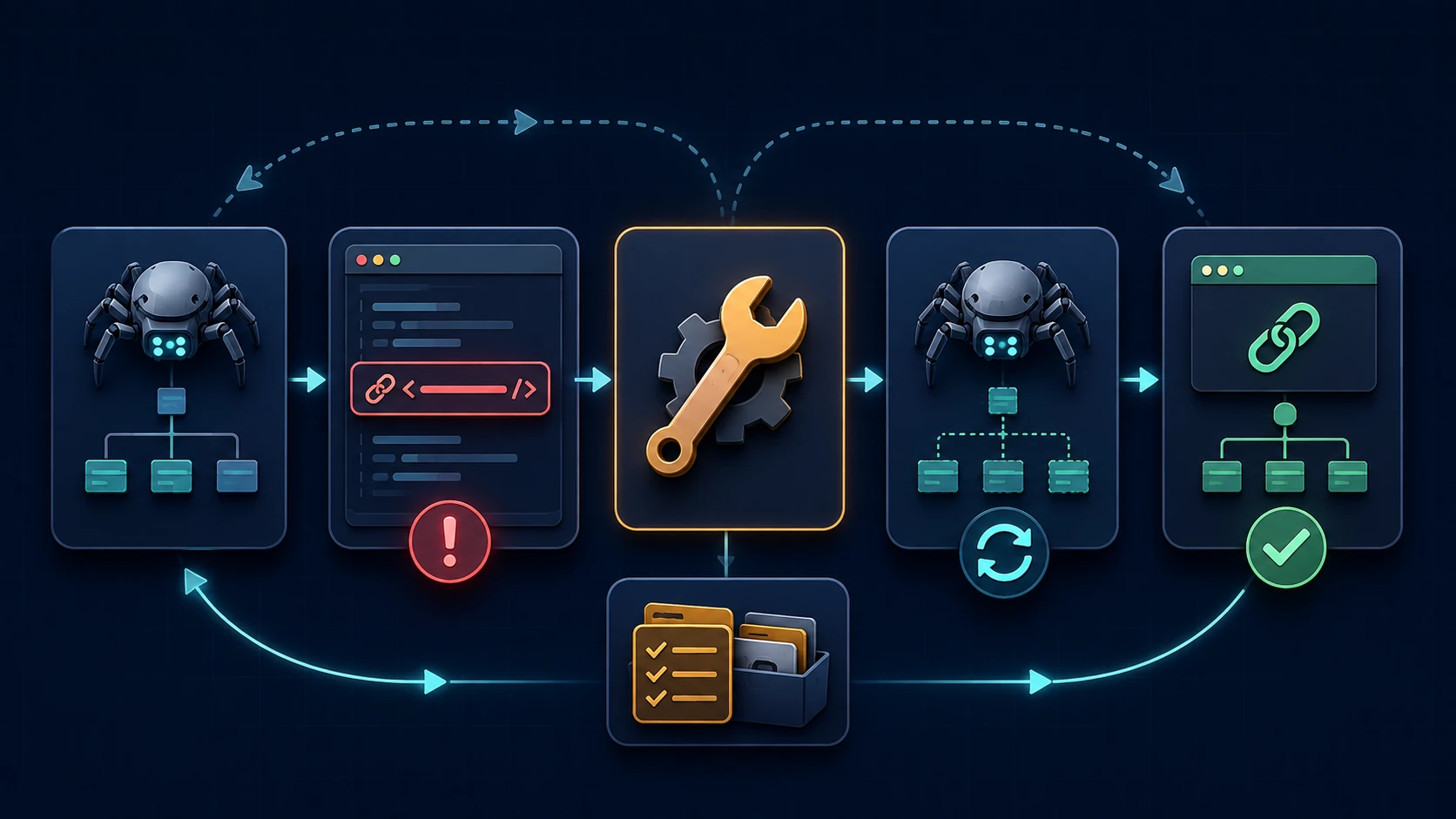
Use this validation sequence:
- Fetch the source and target URLs to confirm their final status codes and redirect destinations.
- Check that both source HTML and rendered HTML nominate the intended canonical URL.
- Confirm the canonical target is crawlable and indexable under the intended policy.
- Verify that XML sitemap entries and important internal links favor the chosen representative.
- Recrawl the affected template, directory, or locale group instead of validating one example page.
- Reinspect priority URLs in Search Console after the live crawl evidence is clean and search systems have time to process the change.
If search systems later select a different canonical even though the target is healthy, move to the user-declared canonical not selected workflow. That is a separate problem: the target is technically viable, but competing page and site signals still favor another representative.
Turn the Diagnosis Into an Owner-Ready Fix Queue
For larger sites, make each finding actionable rather than storing a list of bad targets. A good queue states the source pattern, selected target policy, blocking signal, owner, and proof required after the change.
| Queue field | Example acceptance condition |
|---|---|
| Affected pattern | Every product-filter variant from the same template points to one indexable category URL |
| Blocking signal | The chosen target no longer carries a conflicting robots, noindex, redirect, error, or canonical-chain state |
| Owner | The CMS, platform, engineering, localization, or SEO owner responsible for the shared rule |
| Release check | Source and rendered canonicals match on a representative sample across the changed pattern |
| Recrawl scope | All URLs affected by the template or rule, not only the initial alert |
| Search follow-up | Priority URLs are reinspected after the clean recrawl confirms the live state |
Searvora's SEO Spider Crawler is a natural fit for this workflow because its product surface is built around indexability, canonical, redirect, sitemap, and page-structure checks that can be grouped into a prioritized fix queue. Use the crawl to collect site-side evidence; keep the ownership and validation criteria with the change so the same defect does not return in the next release.
Release Checklist for Non-Indexable Canonicals
- The selected canonical target returns the expected final response and is allowed to be indexed.
- Source and rendered HTML agree on one canonical destination.
- The target is not blocked by an accidental robots rule,
noindex, redirect, error response, or another canonical chain. - Internal links and sitemap entries support the selected representative.
- Pages with genuinely different user jobs are not collapsed into an invalid duplicate cluster.
- The owning template or CMS rule has been fixed, not only one observed URL.
- A focused recrawl covers the full affected pattern and records any remaining exceptions.
- Priority URLs are reinspected after search systems have had time to process the repaired state.
The durable outcome is not a changed tag. It is a canonical system where the selected representative is technically eligible, the whole site agrees with that choice, and the next crawl can prove the rule still holds.