

Secondary keywords are closely related queries that support the primary search task on a page. They are not a secret list of phrases to repeat. Used well, they help you decide which sections the page needs, which examples belong in the body, which internal links should support the page, and how to validate coverage after publishing.
The Ahrefs article that surfaced this opportunity explains the basic idea: a strong page can rank for many related terms, not only one exact keyword. Searvora's information gain is the operating workflow around that idea. Treat secondary keywords as section evidence, not copywriting garnish.
What Secondary Keywords Should Do
The primary keyword names the page job. Secondary keywords clarify the supporting jobs that help the page satisfy that promise.
For example, a page targeting "keyword mapping" may need to address "map keywords to pages", "keyword mapping template", and "keyword cannibalization check". Those secondary terms do not need separate articles by default. They help shape the sections inside the owner page.
Use this split before drafting:
| Keyword role | What it decides | Example output |
|---|---|---|
| Primary keyword | The canonical page job | A new article about secondary keywords |
| Secondary keyword | Supporting section, example, or question | A section on using secondary terms in H2s |
| Adjacent keyword | Related page or internal link | A link to keyword mapping or keyword research |
| Duplicate keyword | Same job already owned elsewhere | Refresh or merge instead of creating a page |
| Tool or template keyword | Different page type | Plan a tool, template, or landing page |
This is why secondary keyword work belongs close to keyword research, but it is not the same task. Keyword research finds and qualifies demand. Secondary keyword planning decides how one approved page should cover related intent without turning into a bloated catch-all guide.
Start With One Page Job
Before collecting secondary phrases, write the page job in one sentence. This protects the brief from drifting into every related term in the cluster.
For this article, the job is simple: help SEO teams use secondary keywords to build better page structure and coverage without stuffing, duplication, or cannibalization.
That job rules out several tempting moves:
| Temptation | Why it fails | Better move |
|---|---|---|
| Add every related phrase to the draft | The page becomes unfocused | Keep only terms that support the page job |
| Repeat secondary keywords in every section | It reads like stuffing | Use terms naturally where the answer needs them |
| Create one article per variation | It splits authority | Assign related terms to the same owner URL when the job matches |
| Ignore secondary terms completely | The page may miss important sub-questions | Use them to plan sections and examples |
| Let the tool choose the outline blindly | It may group words, not intent | Review whether each phrase reflects a real user task |
Google's SEO starter guide frames content around helping people and making pages understandable to search engines. Secondary keyword work should follow the same principle. The phrase matters because it reveals a need, not because the page must hit a repetition quota.
Map Secondary Keywords To Sections
Once the page job is clear, sort secondary terms by what they should change in the article.
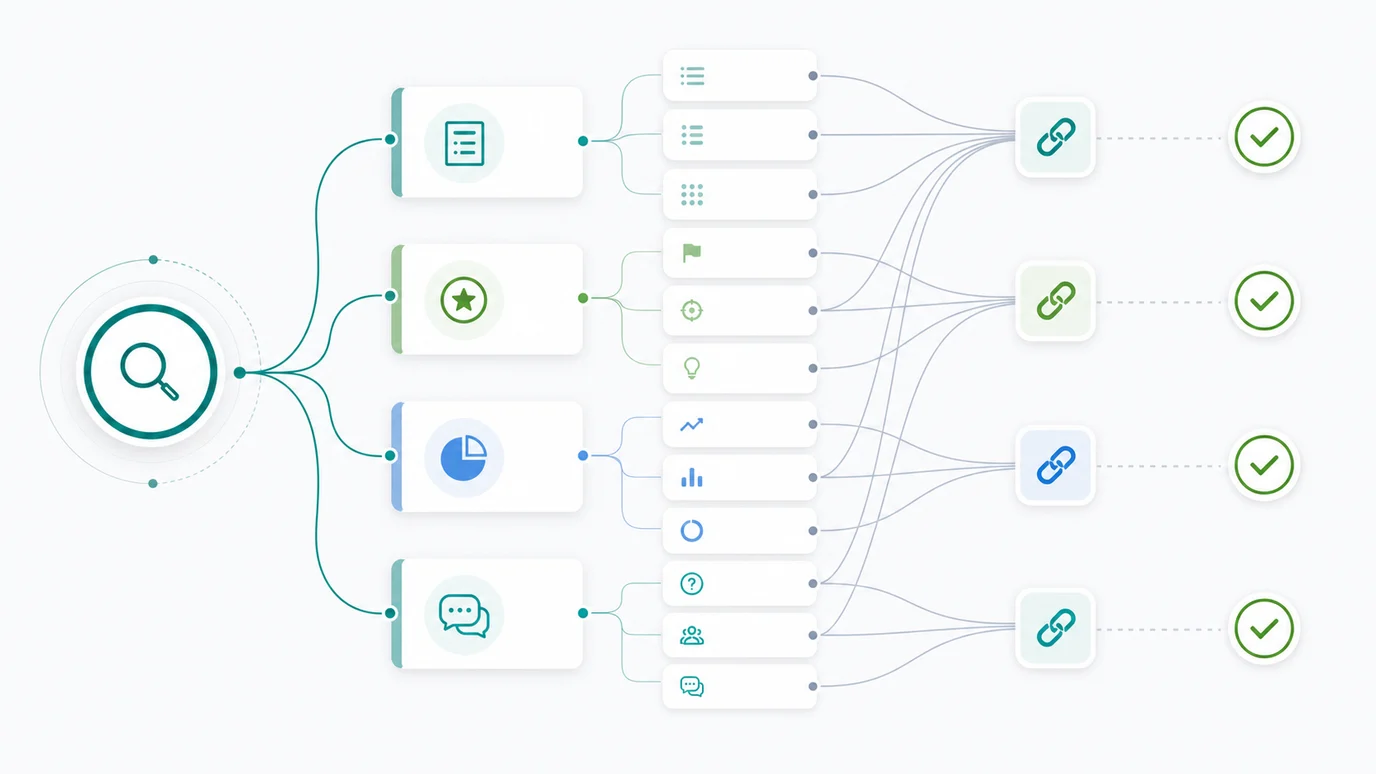
Use this routing model:
| Secondary keyword signal | What to do with it | Example |
|---|---|---|
| The term asks a sub-question | Add or improve an H2/H3 section | "how to find secondary keywords" becomes a workflow section |
| The term needs an example | Add a concrete example or table | "primary vs secondary keywords" becomes a comparison table |
| The term belongs to another page | Add one natural internal link | "keyword mapping" links to the mapping workflow |
| The term implies a tool output | Consider a template or tool page | "keyword clustering tool" may not belong in this article |
| The term repeats the same job | Fold it into existing copy | Use natural language, not a forced heading |
This keeps the outline searchable and useful. It also makes the writer's job easier because each secondary term has a reason to exist.
Keep The Cluster From Cannibalizing Itself
Secondary keywords are useful until they blur page ownership. The risk is not that pages share a topic. The risk is that two pages target the same core keyword, same page type, and same user task.
Before approving a new page or section, check the relationship:
| Relationship | Safe action |
|---|---|
| Same core keyword, same page type, same user task | Refresh, merge, or consolidate |
| Same cluster, broader parent topic | Link from the parent and keep the child focused |
| Same cluster, different workflow stage | Keep both pages if each has a clear job |
| Same term, different page type | Choose the page type that searchers need |
| Supporting phrase only | Use it as a section cue, not a new URL |
This article can coexist with keyword mapping because the user jobs differ. Keyword mapping assigns query groups to owner URLs. Secondary keyword planning decides how one owner URL should cover supporting terms inside the page.
The same distinction applies to keyword cannibalization. Cannibalization diagnosis happens when ownership is already confused. Secondary keyword planning should prevent that confusion before production starts.
Use Secondary Keywords In The Brief
A good brief does not dump a keyword list at the bottom. It tells the writer what each supporting term is supposed to do.
Use this brief structure:
- Primary keyword and page job.
- Secondary keyword groups by section.
- Questions that must be answered directly.
- Terms that should become examples, not headings.
- Internal links that support distinct jobs.
- Terms to avoid because another Searvora URL already owns them.
- Validation checks after publishing.
Here is a practical example:
| Brief field | Good entry |
|---|---|
| Primary keyword | secondary keywords |
| Page job | Explain how to use supporting terms without stuffing or duplicate pages |
| Section terms | find secondary keywords, primary vs secondary keywords, secondary keywords in SEO |
| Example terms | search intent, H2 structure, internal links |
| Internal links | keyword research, keyword mapping, keyword cannibalization |
| Avoid as main angle | keyword clustering tool, keyword map template |
| Validation | Check query mix, internal links, canonical, sitemap, and AI-search extractability |
That structure turns secondary terms into editorial decisions. The page becomes easier to write, easier to review, and easier to validate.
Write For Coverage Without Stuffing
Secondary keyword usage should feel like normal expert writing. If the phrase sounds awkward, rewrite the sentence. If a section exists only to include the phrase, remove it.
Use these writing rules:
| Rule | Why it matters |
|---|---|
| Put the primary promise in the title, H1, intro, and canonical topic | Searchers and crawlers need a clear owner page |
| Use secondary terms where they match a real subtask | The section earns its place |
| Vary language naturally | Related terms should support clarity, not keyword density |
| Keep examples specific | Search systems and AI answers can extract concrete relationships |
| Keep internal links descriptive | Links should explain page roles inside the cluster |
| Avoid repeating the same list in multiple pages | Duplication weakens page ownership |
The best secondary keyword sections often answer questions a reader would ask anyway. "How do I find secondary keywords?" and "How do I know whether a secondary keyword deserves its own page?" are real planning questions. They belong in the article even if the exact phrase appears only once.
Validate Coverage After Publishing
Secondary keyword planning is not finished when the draft passes review. It is finished when the live page starts showing whether the intended query mix is landing on the right URL.
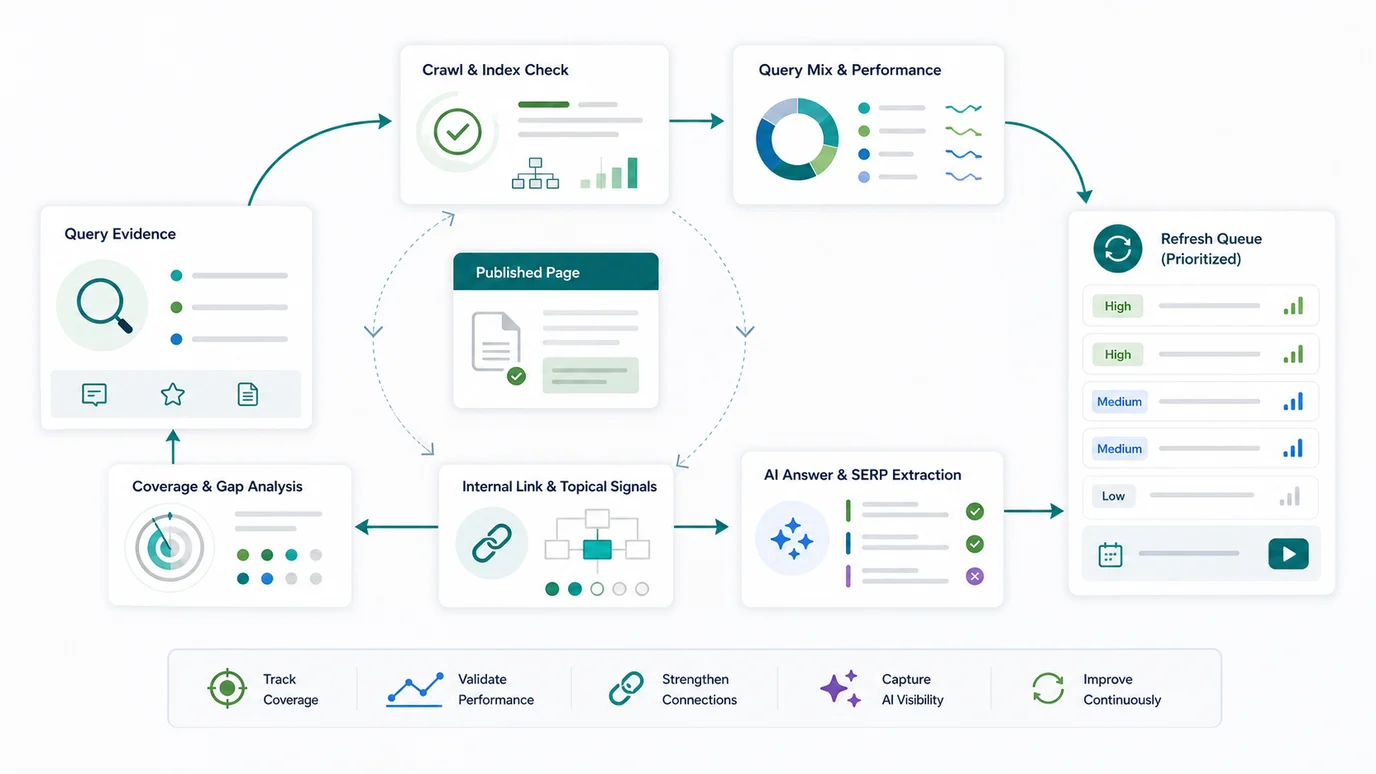
Run this validation loop:
- Crawl the published URL and confirm it is indexable, canonical, internally linked, and included in the sitemap.
- Check the rendered title, H1, headings, body visuals, and internal links.
- Review Search Console query data after the page has had time to collect impressions.
- Compare actual queries against the intended primary and secondary keyword groups.
- Look for unwanted overlap with adjacent pages.
- Check whether AI answer surfaces can extract the definition, examples, and decision tables.
- Decide whether to strengthen a section, add an internal link, split a true child page, or leave the page alone.
The Search Console performance report is useful here because it lets teams compare query and page evidence. The question is not "did the page rank for every secondary keyword?" The question is "are related queries landing on the URL that should own this job?"
Where Searvora Fits
Searvora fits after the keyword list exists, when the team needs to turn related terms into decisions.
The AI SEO consultant is positioned around pattern-based diagnosis, priority scoring, fix-ready guidance, and execution alignment. That maps directly to secondary keyword work: group supporting terms, decide which ones change the outline, flag same-job overlap, and turn the result into an action queue.
Use it when a keyword cluster has too many plausible directions:
| Input | Decision to make | Output |
|---|---|---|
| Primary and secondary keyword list | Which URL should own the job | Create, refresh, merge, monitor, or defer |
| Existing article inventory | Which terms are already covered | Avoid duplication and choose internal links |
| Crawl and sitemap evidence | Whether the owner URL can be validated | Technical checks before publication |
| Query and AI-search evidence | Whether coverage is landing correctly | Strengthen sections or adjust internal links |
| Production capacity | What should ship next | Prioritized work instead of a generic content backlog |
Secondary Keyword Checklist
Use this checklist before a page moves from brief to draft:
- The primary keyword and page job are written in one sentence.
- Each secondary keyword is mapped to a section, example, internal link, or validation check.
- Same-keyword, same-page-type, same-user-task overlap has been checked.
- Parent and child topics are separated instead of treated as automatic duplicates.
- The outline answers real sub-questions, not just phrase variations.
- Internal links point to distinct supporting jobs.
- External source claims are linked to public sources when needed.
- The page can be crawled, indexed, rendered, and included in the sitemap.
- Query mix and AI-search extractability will be reviewed after publishing.
- The next action is clear: publish, refresh, split, merge, link, or monitor.
Secondary keywords make pages stronger when they clarify structure. Use them to understand the supporting tasks searchers care about, then turn those tasks into sections, links, and validation checks your team can actually maintain.