

SEO copywriting is the practice of writing content that satisfies a searcher's task while staying clear, useful, and persuasive for human readers. The mistake is treating it as keyword placement with nicer prose. Good SEO copywriting starts before the first paragraph, with intent, page type, evidence, internal links, metadata, and review criteria.
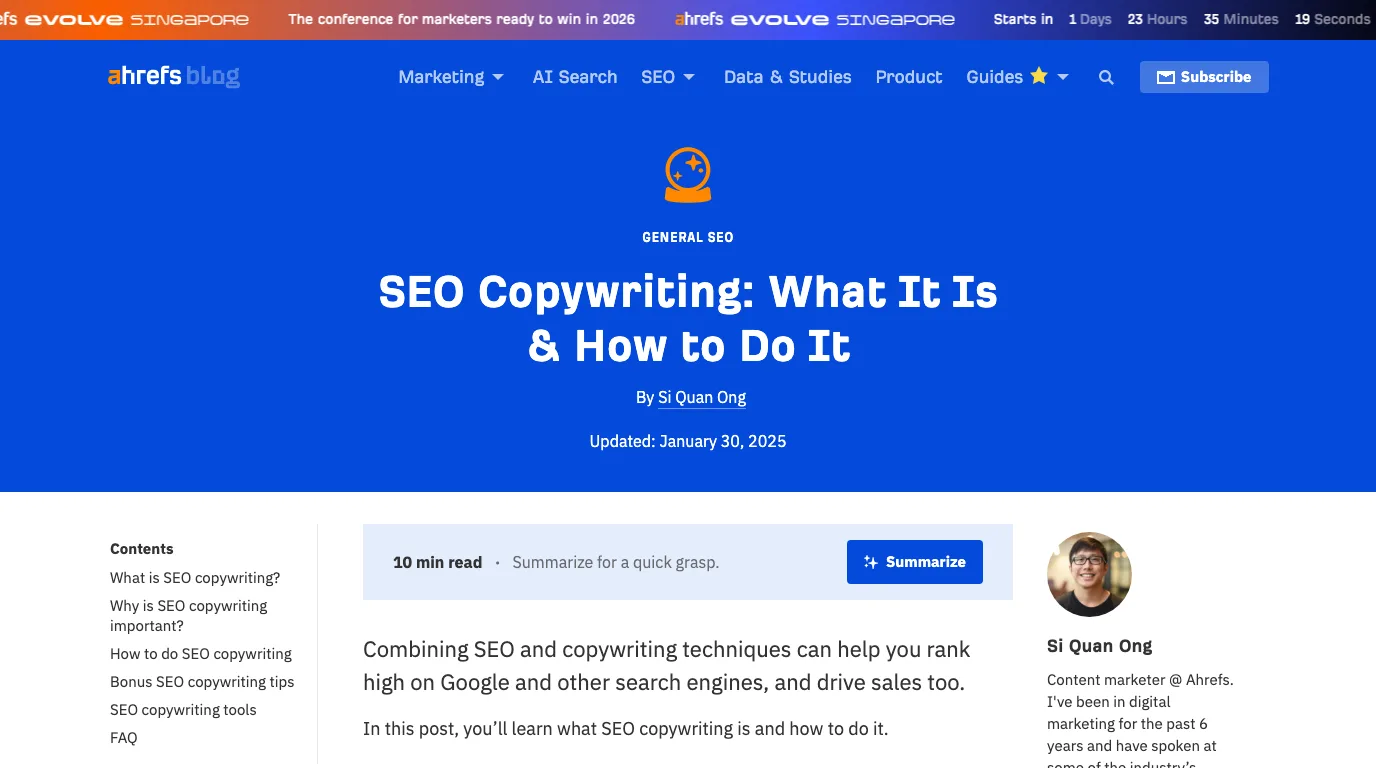
The public Ahrefs SEO copywriting guide explains the topic as writing for both search engines and users. Searvora's information gain is the workflow behind that idea: how a content team decides what the page must do, builds a draft around proof, checks it before publication, and routes it into a repeatable content production system.
Start With The Page Job
SEO copywriting does not begin with a headline. It begins with the job the page must perform.
Use the target keyword as a clue, then define the reader task in plain language. For SEO copywriting, the reader usually wants to understand the concept, learn a repeatable writing process, and avoid content that ranks for a few weeks but fails review, conversion, or refresh work later.
| Planning question | Strong answer | Weak answer |
|---|---|---|
| What does the reader need first? | A practical writing workflow | A long definition of copywriting |
| What page type fits? | How-to article with QA gates | Generic thought leadership |
| What must the article prove? | Intent fit, outline quality, evidence, metadata, internal links | That keywords were used often |
| What comes after reading? | Brief, draft, review, publish, refresh | "Write better content" |
| What Searvora product fits? | Blogify for structured Shopify blog production | A vague AI writing promise |
This is where SEO copywriting connects to search intent. If the page job is wrong, better sentences will not save the article. A "what is" query needs a clear definition and examples. A "how to" query needs steps and validation. A "best tools" query needs a real comparison, not an essay pretending to be a roundup.
Build The Outline From Intent And Evidence
A useful outline is not a list of headings. It is the first quality-control layer.
Build it in this order:
- Define the short answer the intro must give.
- List the decisions the reader needs to make.
- Add the evidence required for each decision.
- Choose one table, checklist, example, or workflow visual that makes the page easier to use.
- Pick internal links that help the reader move deeper into the same job.
- Choose the product handoff only after the reader has a real next step.
The outline should also remove sections that are only there because competitors have them. If a competing page has "bonus tips," decide whether those tips help the current reader task. If they do not, replace them with a stronger decision table, editorial checklist, or source-backed example.
For teams standardizing production, the blog post templates workflow is useful here. Templates help only when they make the article type explicit. They become risky when every keyword gets the same intro, same H2s, and same CTA.
Write For Search Systems Without Sounding Mechanical
Search systems need clarity. Readers need momentum. SEO copywriting has to serve both without turning the page into a keyword exercise.
Use this working sequence:
| Draft layer | What to do | What to avoid |
|---|---|---|
| Opening | Answer the query directly in the first few paragraphs | A slow brand story before the answer |
| Headings | Make each H2 a decision, step, or checkpoint | Vague headings such as "Benefits" and "Conclusion" |
| Examples | Use concrete page, product, or workflow examples | Generic examples that could fit any industry |
| Keywords | Use natural variants where they help clarity | Repeating the same phrase to chase density |
| Metadata | Match the actual page promise | Writing a title the article cannot satisfy |
| Internal links | Route readers to the next useful page | Linking every related article just because it exists |
Google's guidance on helpful, reliable, people-first content is a useful baseline: content should help people, not just search engines. For operators, that means the draft needs a reader-visible reason to exist. It should add a workflow, example, comparison, source check, or decision aid that the current results do not provide clearly enough.
Good SEO copywriting also makes refresh easier. When headings map to decisions, editors can see which section has drifted. When claims are tied to sources, updates are cleaner. When internal links are intentional, the article can support a cluster without creating duplicate page jobs.
Add A Pre-Publish QA Gate
SEO copywriting should not move straight from draft to publish. It needs a pre-publish gate that checks whether the page still matches the original job.
Use this QA pass before approval:
- The title includes the primary keyword naturally and avoids formula patterns.
- The intro answers the query before asking for patience.
- Each H2 advances the workflow instead of padding the article.
- The article includes at least one table, checklist, or decision aid.
- External claims point to official or public sources when needed.
- Internal links support the reader's next step and are not repeated.
- Product mentions appear only where the reader is ready for that action.
- Metadata matches the content promise and stays within review limits.
- Visuals explain the workflow or document source/product context.
- The refresh trigger is clear enough for a future editor to act.
This gate is especially important for AI-assisted drafting. The faster the first draft appears, the more explicit the review criteria need to be. Otherwise the team ships fluent pages that have weak intent fit, duplicated advice, or no measurable next action.
For broader planning before a brief is approved, use content gap analysis to compare existing pages, competitor evidence, and information gain. SEO copywriting works best after that strategy layer has already decided that a new article is the right page type.
Where Searvora Fits
Searvora fits when SEO copywriting has to become repeatable production. Blogify is the natural execution layer for Shopify teams because the product page positions it around store-aware topic intelligence, structured SEO drafting, editorial controls, multilingual output, and a Shopify draft workflow.
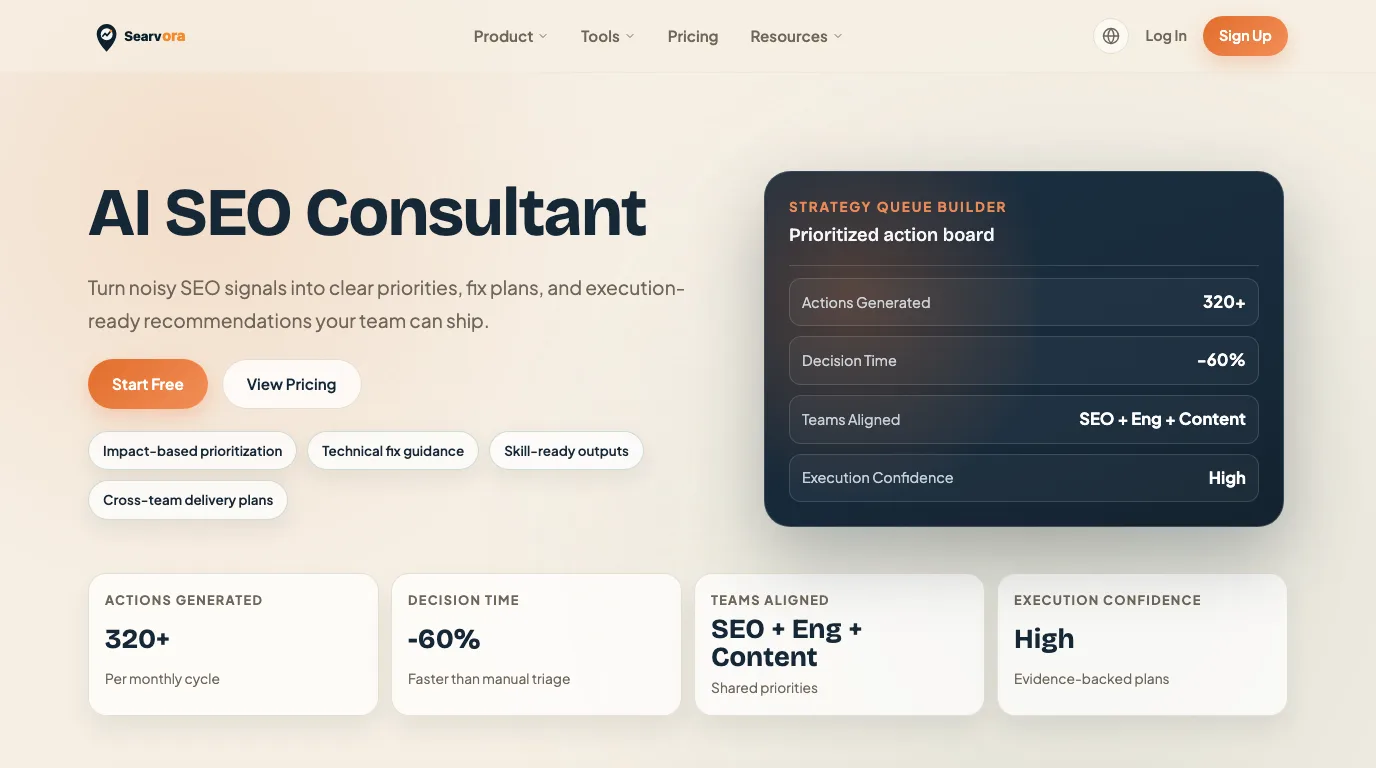
The AI SEO Consultant supports the strategy layer before drafting. It is positioned around pattern diagnosis, priority scoring, fix-ready guidance, and execution alignment. That is useful when a team has many possible topics and needs to decide which brief deserves production first.
Use the stack like this:
| Workflow stage | Searvora fit | Output |
|---|---|---|
| Opportunity review | AI SEO Consultant | Approved brief, page type, and information gain |
| Draft production | Blogify | Structured Shopify blog draft with SEO blocks |
| Technical validation | SEO Spider Crawler when crawl evidence matters | Crawl, metadata, link, and indexability checks |
| Performance review | AI SEO Dashboard | Segment-level monitoring and refresh signals |
For this topic, keep the primary CTA focused on Blogify. The reader has moved from "what is SEO copywriting" into "how do we produce this reliably?" That is a content operations problem, not just a strategy question.
A Practical SEO Copywriting Checklist
Use this checklist when a brief is ready to become a draft:
- Write the reader job in one sentence.
- Confirm the page type from the query and competitor page shape.
- Choose the title from 3-5 options and reject formula titles.
- Put the short answer in the opening section.
- Build H2s around decisions, steps, or validation checks.
- Add evidence before making broad claims.
- Include one table, checklist, example, or workflow aid.
- Use internal links only where they help the reader continue.
- Add a natural product handoff after the workflow is clear.
- Check metadata, canonical, images, and external link behavior.
- Define what would trigger a refresh later.
SEO copywriting is not the final polish on an SEO article. It is the operating discipline that keeps search intent, editorial usefulness, product context, and publish readiness in the same workflow. Treat it that way, and the content team gets pages that are easier to write, easier to review, and easier to improve.