

An SEO proposal is not a list of services with a price attached. It is a decision document: it shows what is happening now, what work is in scope, who will do it, what can be checked, and which assumptions still need a client answer.
Use the template below when you need to turn search, crawl, content, and AI-search evidence into a proposal a prospective client can actually evaluate. It is deliberately built to avoid a common failure mode: promising rankings before the baseline, constraints, owners, and validation method are clear.
Copy This SEO Proposal Template
Start with the sections below. The proposal should be short enough to read in one sitting and specific enough that a client can approve, change, or decline a scope line.
| Proposal section | What to include | Decision it supports |
|---|---|---|
| Client context and goal | Business model, priority audience, target market, page types, and the decision this engagement should change | Whether the work is tied to a real growth objective |
| Baseline evidence | Search performance, page cohorts, crawl findings, content coverage, and observed AI-search evidence | Which problems are evidence-backed rather than assumed |
| Priority scope | The pages, templates, workflows, and exclusions included in the first phase | What the team will and will not deliver |
| Workstreams | Technical, content, information architecture, authority, and measurement work | Which specialist owns each class of work |
| Milestones | Early outputs, review points, dependencies, and validation windows | When the client will see proof of progress |
| Measurement plan | Signals to watch, comparison period, affected page groups, and decision thresholds | How the team will tell whether a change helped |
| Roles and access | Client owner, SEO owner, engineering contact, content contact, and required access | Who can unblock work before it stalls |
| Assumptions and commercial terms | Inputs, approvals, third-party costs, and terms reviewed separately with the right stakeholders | Which conditions must hold for the scope to remain valid |
Use this header before you write narrative copy:
Client / property:
Primary business decision:
Priority audience and market:
Priority page cohorts:
Baseline period and comparison period:
Evidence reviewed:
First-phase scope:
Client dependencies:
Milestone and validation cadence:
Establish the Baseline Before You Write Scope
The baseline is not a vanity-metric slide. It is the smallest set of evidence that lets both sides agree on the problem before anyone prescribes the fix.
For organic-search performance, Google's Search Console Performance report provides clicks, impressions, CTR, and average position across selectable dimensions. Treat those numbers as diagnostic signals: a click decline may point to demand, snippet, page-fit, or technical changes, not automatically to a need for more content.
For technical scope, the Page Indexing report can help establish which URLs Google has crawled and indexed, along with reasons some URLs were not indexed. Pair it with a crawl and an affected-page inventory before presenting a large remediation estimate.
| Evidence | What it can support | Question to answer before scoping work |
|---|---|---|
| Clicks, impressions, CTR, and query/page groups | A search-demand or snippet hypothesis | Is the movement isolated to a page type, directory, locale, or query family? |
| Indexing, canonical, redirect, and internal-link findings | A technical remediation hypothesis | Which templates or business-critical pages are affected? |
| Content inventory and intent coverage | A content or consolidation hypothesis | Should the next action be a new page, a refresh, a merge, or no page? |
| Observed AI-search citations or prompt results | An answer-readiness hypothesis | Which owned source page needs clearer evidence, structure, or entity context? |
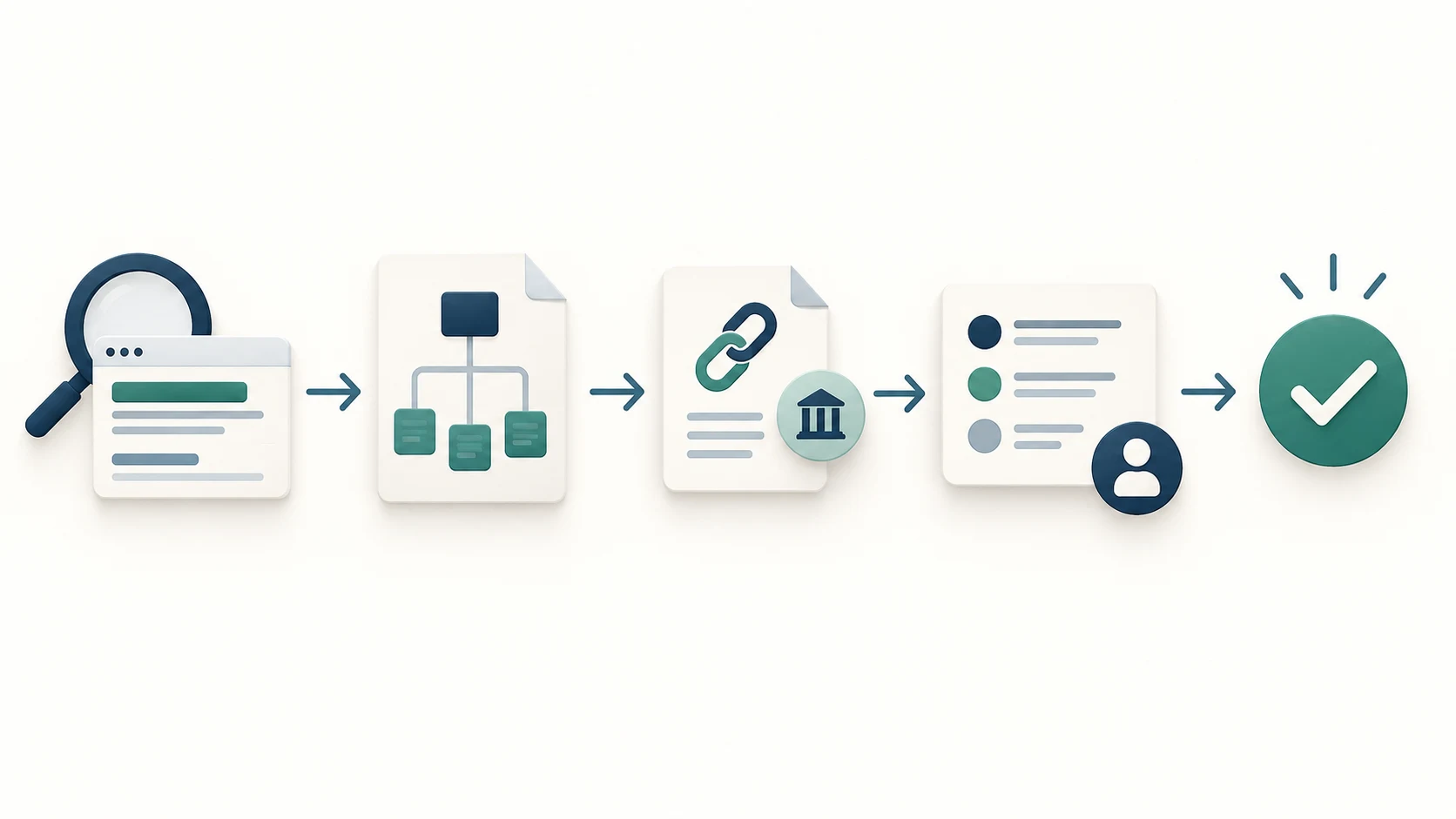
Do not call a baseline a promise. It gives you a defensible starting point and a way to recognize when the evidence changes.
Turn Evidence Into an Acceptable Scope
Clients can approve a scope when it describes work in their language. A proposal should separate the finding from the implementation and the expected learning.
| If the baseline shows | Scope the work as | Avoid saying |
|---|---|---|
| Important templates are non-indexable or canonicalized incorrectly | Audit affected templates, document the root cause, prepare implementation requirements, and validate a recrawl | Every excluded URL must be indexed |
| High-impression pages have weak CTR or mismatched query intent | Review titles, snippets, page promise, and intent alignment for a named page cohort | Rewriting titles will guarantee a traffic increase |
| Similar pages compete for the same search job | Map page roles, choose retain/merge/redirect paths, and validate internal links and canonicals | Deleting content is always the fastest answer |
| Content lacks source-ready evidence for AI-search answers | Create or strengthen definitions, examples, citations, and page structure on the most relevant owned pages | A content edit will force an AI system to cite the site |
The output is a proposal that can be signed off as a sequence of decisions, not a vague promise to “optimize SEO.” For the broader delivery cadence after approval, use the SEO process that turns signals into shipped work as the companion operating model.
Write Scope Lines With Owners and Acceptance Criteria
Each scope line needs four parts:
- Finding: the evidence and affected pages or templates.
- Work: the deliverable your team will produce or implement.
- Owner: the party responsible for the next decision or change.
- Acceptance and validation: how the team will verify completion and when it will review the result.
For example:
Review the non-indexed product-template URLs identified in the agreed baseline; document the canonical, robots, sitemap, and internal-link cause for each priority group; provide implementation requirements to the client engineering owner; then verify the agreed sample after release through a recrawl and Search Console follow-up.
That is clearer than “fix indexing issues” because it names the evidence, the boundary, the handoff, and the check. It also avoids presenting another team's deployment as an automatic result of the SEO engagement.
Use Milestones That Can Be Validated
A 30/60/90-day structure works well when it represents delivery checkpoints rather than ranking guarantees. Adjust the cadence to the client's release process, data lag, and approval rhythm.
| Phase | Delivery focus | Evidence to review | Decision at the checkpoint |
|---|---|---|---|
| First 30 days | Baseline, inventory, priority scoring, and implementation-ready brief | Page cohorts, issue samples, intent map, owners, dependencies | Confirm the first work package and its exclusions |
| Days 31–60 | Ship agreed technical and content work; maintain the action queue | Released changes, affected URLs, content status, owner progress | Continue, adjust scope, or unblock a dependency |
| Days 61–90 | Validate the work and plan the next package | Crawl confirmation, index status, search movement, AI-search evidence where observed | Keep, revise, expand, or retire the next initiative |

For recurring client communication, the SEO report template can turn the same evidence and ownership model into a decision-ready review instead of a disconnected status deck.
Separate Commitments From Assumptions
Proposals become hard to manage when outcomes, inputs, and deliverables are blended together. Keep the distinction visible.
| Category | Good proposal language | Why it matters |
|---|---|---|
| Committed delivery | “Provide a prioritized crawl finding brief for the agreed templates.” | The team controls the work product. |
| Client dependency | “Client provides Search Console access and confirms the release owner.” | The work can pause without falsely appearing late. |
| Measurement condition | “Compare the affected page group after an agreed period with no major release confounder.” | The team avoids reading noise as proof. |
| Business outcome | “Improve qualified organic opportunity over time.” | It remains the goal, not a guaranteed output. |
Use legal, pricing, and contract language only after the appropriate commercial and legal review. An SEO proposal can make work measurable, but it should not pretend to replace those disciplines.
Where Searvora Fits
Searvora's AI SEO Consultant is designed to turn SEO and AI-search signals into prioritized, execution-ready recommendations. Its public product materials describe pattern-based diagnosis, impact-and-effort prioritization, technical and content guidance, and shared handoff workflows.
Use it to organize the evidence behind a proposal, rank the first work package, and preserve the logic from signal to assigned action. Pair that with the client-facing template in this article so the proposal makes ownership, scope, and validation explicit.
SEO Proposal Checklist
Before sending an SEO proposal, confirm that it:
- Names the business decision and the priority audience.
- Separates baseline evidence from assumptions.
- Identifies the page cohorts, templates, or workflows in scope.
- Includes exclusions so the first phase stays credible.
- Connects every high-priority scope line to an owner.
- States which client access, approvals, or releases are dependencies.
- Defines a milestone cadence without promising rankings.
- Explains how technical, content, and AI-search evidence will be reviewed.
- Makes acceptance criteria and validation dates visible.
- Leaves commercial and legal terms to the appropriate review process.
The strongest SEO proposal does not try to predict every result. It makes the next decision, the first work package, and the proof of completion unambiguous.