

Google Web Guide is an experimental Google Search experience that uses AI to organize web links into topic groups instead of presenting only one flat list of results. It is designed for complex or open-ended searches where a person may need to explore several aspects of the same task.
For SEO teams, the practical change is not a new markup trick. It is a different way to observe discovery. One query can fan out into several subtopics, and different pages may earn visibility in different groups. The response should be a clearer page-cluster strategy, reliable source pages, and a measurement loop that separates visibility from useful clicks.
What Google Web Guide Is
Google introduced Web Guide in July 2025 as a Search Labs experiment. Google says it uses a custom version of Gemini to understand both the query and web content, groups links around aspects of the search, and uses query fan-out to issue several related searches at the same time.
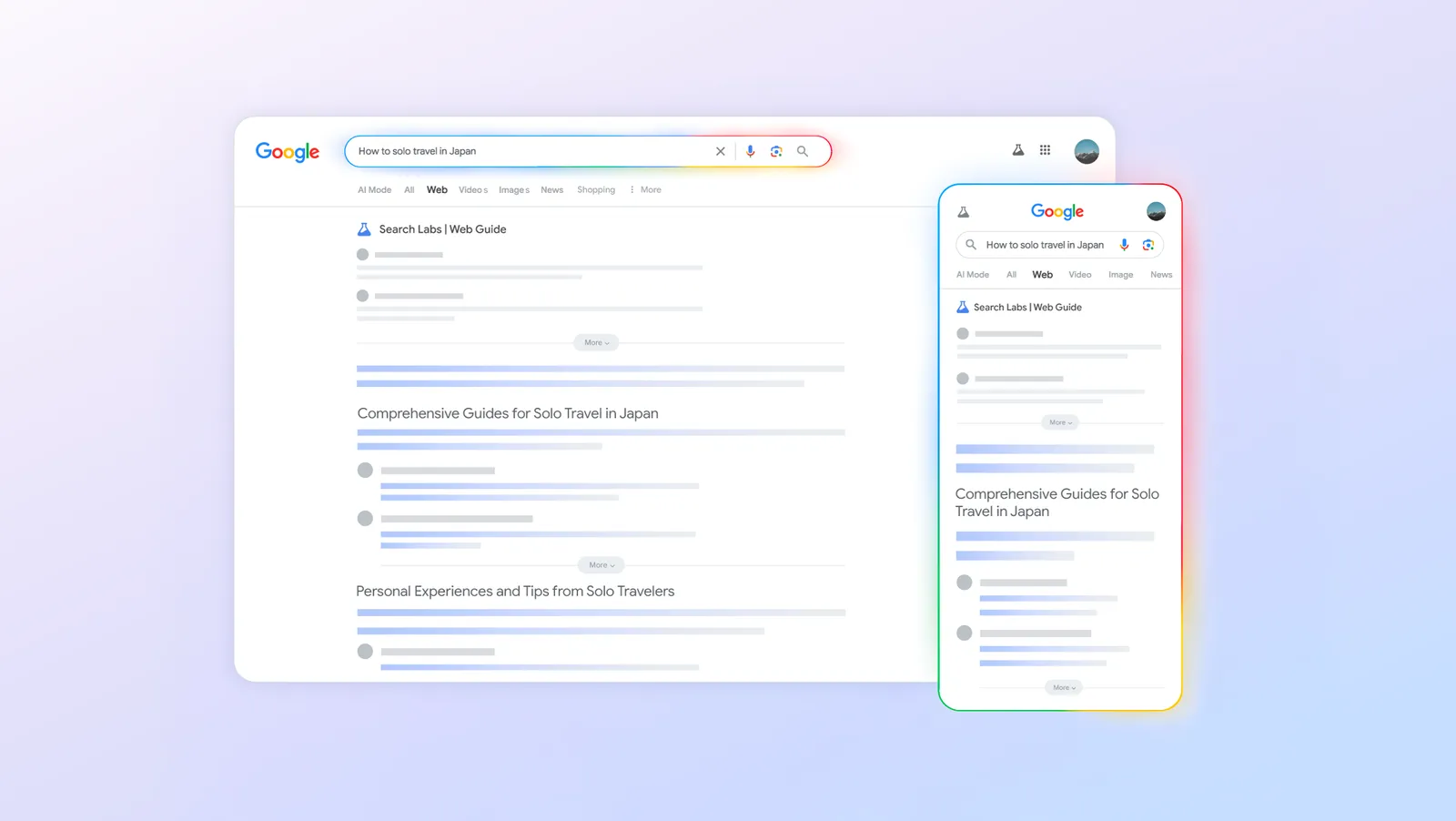
The initial experiment appeared in the Web tab for opted-in users. In December 2025, Google said it had made Web Guide faster and was showing it for more searches in the All tab for people enrolled in the experiment. That status matters: Web Guide is an evolving experiment, so a layout or availability observation should always carry a date, query, country, device, and account context.
Web Guide is also distinct from AI Overviews and AI Mode. Those surfaces may all use AI and query fan-out, but they present different experiences. The Google AI Overviews workflow covers answer summaries and supporting links. Web Guide is better understood as an AI-organized route into groups of web pages.
How Query Fan-Out Changes the Page Opportunity
A classic rank-tracking habit starts with one query and one ordered result list. Query fan-out makes that model incomplete. Google can break a complex question into related searches, find supporting pages for those subtopics, and organize the links into several discovery paths.
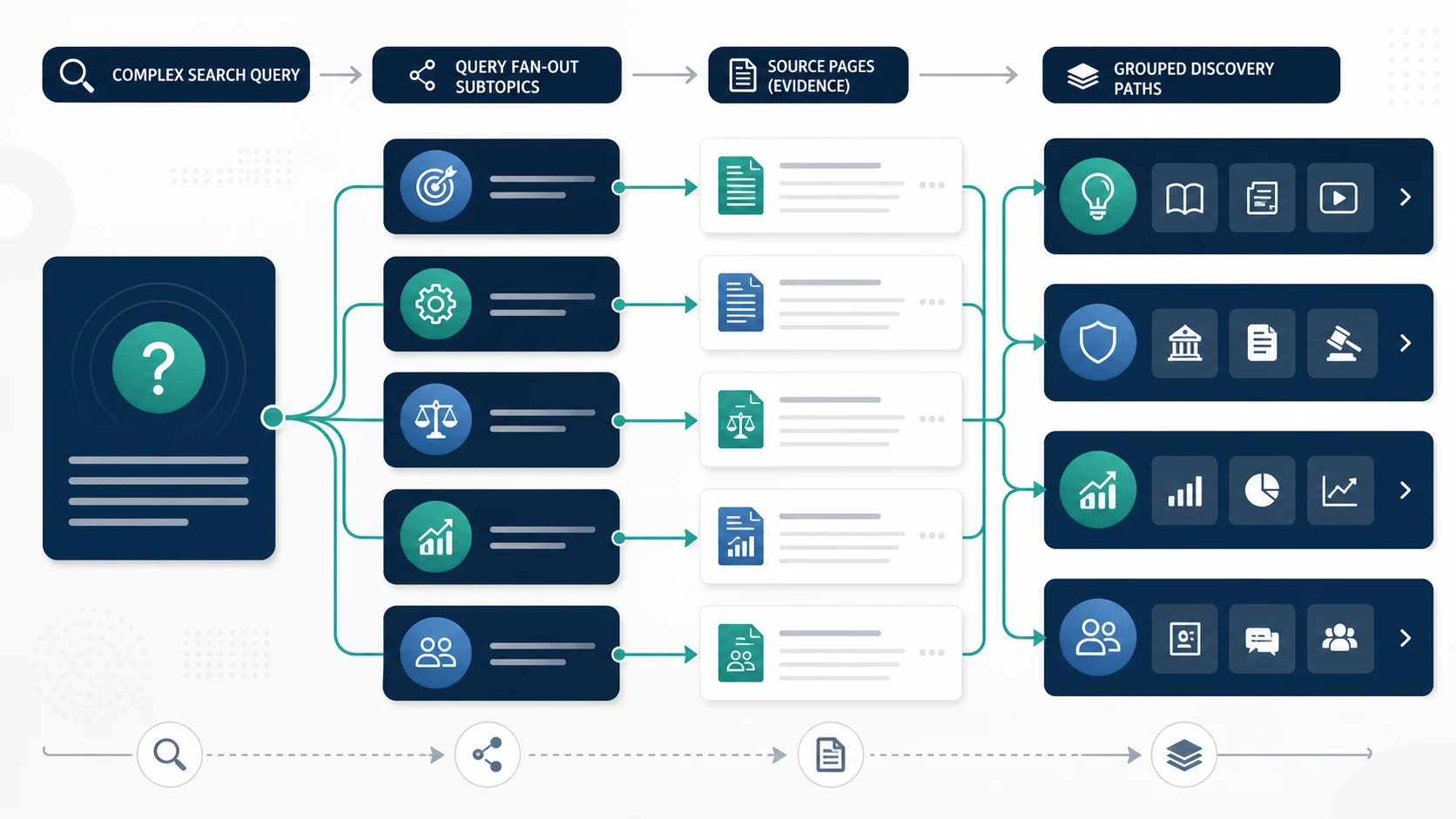
That creates three useful SEO questions:
- Which subtopics or user tasks appear as separate groups?
- Which URL on your site is the best source for each task?
- Does the site have a coherent cluster, or several pages competing to answer the same job?
Do not turn every observed group into a new article. First decide whether the group needs a parent guide, a focused child article, a product or service page, a comparison, or an update to an existing URL.
| Observed group pattern | Likely page decision | Check before creating anything |
|---|---|---|
| Broad orientation group | Parent explainer or hub article | Existing parent coverage, internal links, and distinct child jobs |
| Specific how-to group | Focused workflow article | Whether a current page already serves the same task |
| Product or provider group | Landing, review, or comparison page | Commercial intent, current facts, and fair evidence |
| Community or lived-experience group | Forum, discussion, or first-party experience | Whether your site can add authentic evidence |
| Current-data group | Maintained resource or tool | Refresh source, update owner, and date sensitivity |
This page-type discipline is the information gain. It prevents a team from reacting to Web Guide by publishing a broad article that repeats existing coverage.
What You Can Optimize and What You Cannot Promise
Google has not published a special Web Guide optimization specification. The safest inference is to start with the same search fundamentals Google documents for its AI search features: pages should be crawlable, indexed, eligible to show a snippet, easy to find through internal links, and useful to people.
Google's AI features guidance for site owners says AI Overviews and AI Mode do not require extra technical requirements or special optimization beyond foundational SEO. That documentation does not guarantee Web Guide inclusion, but it is a sound technical baseline for any page Google must discover, understand, and show as a web result.
Use this readiness checklist for a candidate source page:
- The page has one clear user job and an indexable canonical URL.
- The main answer is available as text, not hidden inside an image or interaction.
- The title, H1, intro, and section structure agree on the task.
- Internal links connect the page to its parent and relevant child topics.
- Supporting claims are current, attributable, and easy to verify.
- Overlapping pages have distinct jobs rather than near-identical summaries.
- The page offers a useful next step after the searcher clicks.
Avoid claims that schema, an llms.txt file, a prompt list, or exact-match subheadings will force inclusion. Eligibility is not selection, and an experimental surface can change without notice.
Build a Web Guide Observation Sheet
Web Guide needs observation before optimization. Create a small, repeatable query set around real customer jobs, then record what the experience actually shows.
| Field | What to record | Why it matters |
|---|---|---|
| Query and task | Exact query plus the decision or action behind it | Keeps keyword wording separate from user intent |
| Context | Date, country, language, device, account, and Labs status | Makes experimental results reproducible |
| Group label | The theme or subtask represented by each group | Reveals the fan-out model you can observe |
| Source URLs | Domains and pages shown in each group | Identifies page types and evidence patterns |
| Searvora URL | Best existing owner, update target, or documented gap | Prevents duplicate page creation |
| Action | Keep, update, consolidate, link, create, or monitor | Turns an observation into one owned decision |
| Recheck date | A defined review window | Stops one observation from becoming a permanent rule |
Sample a stable query set instead of chasing every layout change. Include a few broad exploratory questions, a few specific operational questions, and a few commercial decisions. Keep Web Guide observations separate from AI Overview, AI Mode, and normal result observations so the team does not merge different surfaces into one visibility number.
The AI Mode traffic workflow is a useful companion for measurement discipline. It keeps observed search-surface presence separate from Search Console movement and analytics behavior.
Turn Grouped Results Into One Page-Level Action
The most common failure is converting every missing group into a writing request. A grouped result can reveal a content gap, but it can also reveal a crawl problem, weak internal linking, ambiguous page ownership, outdated evidence, or simply a result pattern that is not yet stable.
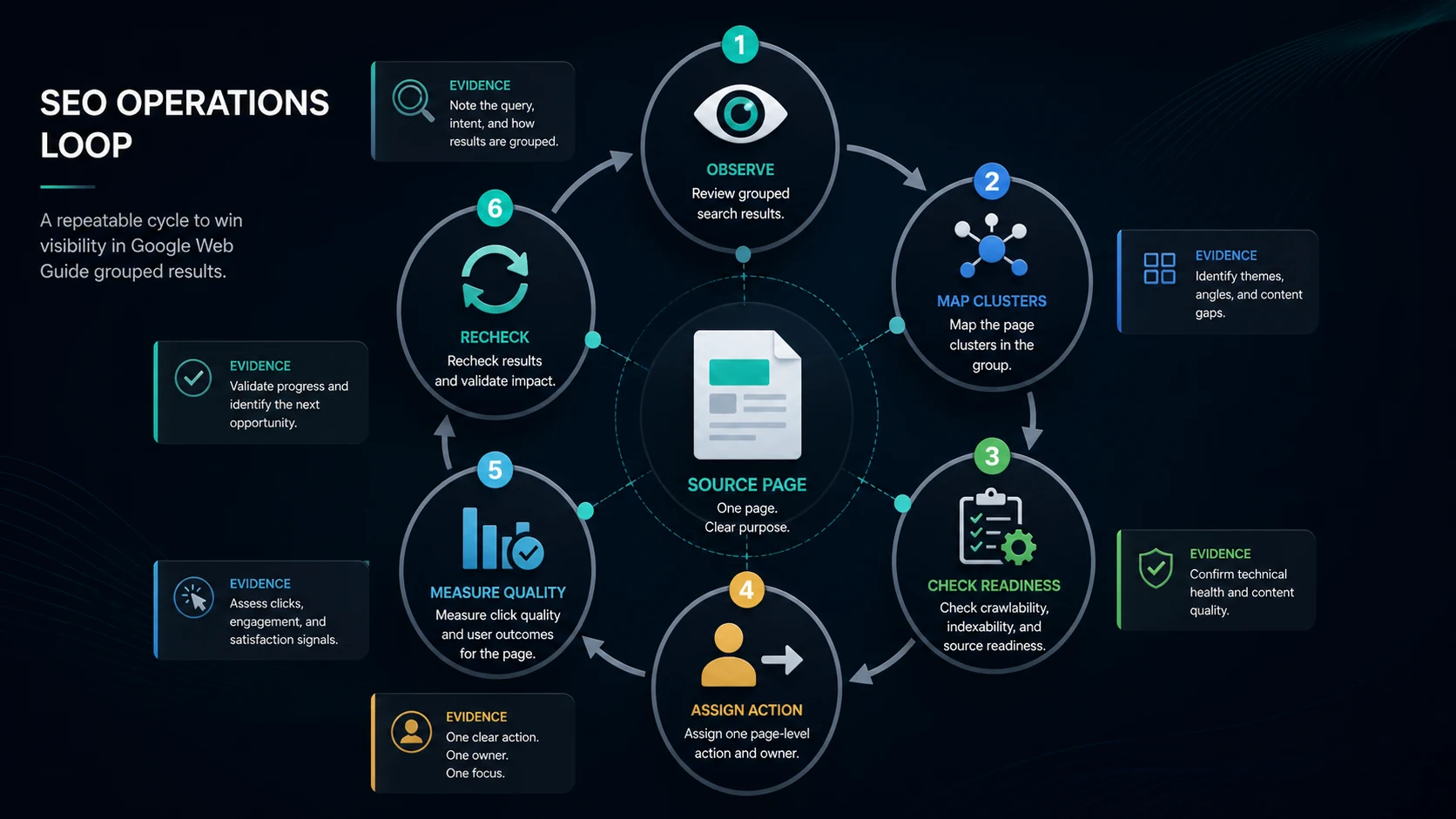
Use this action sequence:
- Observe the group. Record the query, context, group theme, and source pages.
- Map the page cluster. Identify the parent, child, commercial, and support jobs represented.
- Check source readiness. Confirm crawl access, canonical ownership, indexability, internal links, and answer clarity.
- Assign one action. Give one owner a page-level update, consolidation, new-page brief, or watchlist decision.
- Measure click quality. Review impressions, clicks, landing-page engagement, conversions, and assisted brand demand without claiming perfect Web Guide attribution.
- Recheck the same query set. Compare the observed groups and outcomes after enough time has passed.
The source-ready AI Overview workflow can help with answer clarity and query coverage, but Web Guide adds a cluster-level question: does the site have the right page for each grouped discovery path?
Measure Visibility Without Inventing a Web Guide Metric
Search Console and analytics do not automatically provide a clean, universal Web Guide report. Until a dedicated and verified dimension exists, use precise language about what each evidence source can support.
| Evidence | Useful conclusion | Conclusion to avoid |
|---|---|---|
| Dated Web Guide observation | A URL or competitor appeared in a defined group for a defined query | The page has a permanent Web Guide ranking |
| Search Console query and page movement | Search visibility or clicks changed for the monitored page set | Web Guide alone caused the change |
| Analytics landing-page behavior | Visitors who reached the page engaged or converted in a certain way | Every visit originated from Web Guide |
| Cluster coverage review | The site has or lacks a clear source page for a subtask | Publishing more pages will guarantee inclusion |
The useful outcome is not a synthetic visibility score. It is a reviewed queue where each item names the query group, source page, evidence gap, owner, expected result, and recheck date.
Where Searvora Fits
Searvora's AI SEO dashboard fits the monitoring and handoff layer. Its current product surface is organized around page-type and locale performance, change detection, drill-downs, and prioritized opportunities. Those are the right building blocks for keeping Web Guide observations tied to real pages rather than a detached prompt spreadsheet.
Use the dashboard to segment the candidate page set, compare performance movement, and route one evidence-backed action. Keep the raw Web Guide observation attached to the action because the dashboard should not be asked to infer an experimental surface that was never recorded.
Google Web Guide Checklist
Before changing a page because of Google Web Guide, confirm:
- The observation includes the query, date, market, device, account, and experiment status.
- Each result group has been translated into a distinct user task.
- One existing URL has been considered as the primary source for each relevant task.
- New content is approved only when no current page serves the same keyword, page type, and job.
- Candidate pages are crawlable, indexable, canonical, internally linked, and text-readable.
- Claims and examples are current enough for an experimental search surface.
- Web Guide, AI Overviews, AI Mode, and classic results remain separate evidence lanes.
- Measurement separates observed visibility, Search Console movement, clicks, and conversions.
- Every action has one owner, expected outcome, and recheck date.
- No one promises a special optimization or guaranteed placement that Google has not documented.
Google Web Guide changes the shape of discovery more than the fundamentals of SEO. Map the grouped tasks, choose the right source page, fix readiness problems, measure what happens after the click, and recheck the same query set before you scale the response.