

SEO reporting for agencies works when it is a reporting contract, not a monthly data dump. The contract tells each client what the team will review, which decisions the report should support, which exceptions need an escalation, and how the next action will be checked.
That is a different job from choosing a dashboard, automating data collection, or handing someone a generic report template. Agencies need one underlying evidence model, but they also need different reporting depth for a focused local account, a growing multi-channel account, and a complex enterprise engagement. The report is useful only when the client can see what matters, decide what changes next, and hold the right owner to a validation date.
Start With The Client Decision
Begin every reporting plan by writing the decision the client should be able to make after the meeting. A report that cannot name that decision is usually a dashboard export wearing a cover page.
Typical agency decisions include:
- Continue, pause, or reprioritize a content, technical, or authority initiative.
- Approve a scoped fix for a page group or template rather than react to a sitewide trend.
- Decide whether a change is material enough to involve product, engineering, sales, or a regional team.
- Agree on the evidence that would validate the work in the next reporting window.
Use the same five fields in every client-facing decision:
| Field | What the agency records | Why the client needs it |
|---|---|---|
| Decision | The approval, tradeoff, or priority being discussed | Keeps the review from becoming a metric tour |
| Evidence | The page cohort, query group, crawl pattern, release note, or business context behind it | Lets the client challenge the reasoning, not just the conclusion |
| Confidence | Confirmed, likely, watchlist, or insufficient evidence | Prevents a weak signal from becoming a promise |
| Owner | The named client or agency person responsible for the next move | Turns the report into delivery work |
| Validation | A date, source, and expected signal to recheck | Makes the next report a continuation instead of a reset |
Set The Reporting Contract By Account Tier
The best reporting format follows decision complexity, not the size of a retainer alone. A lean account may need a short progress review and a clear next experiment. A complex account may need separate views for markets, page types, stakeholder groups, and delivery dependencies.

Use a simple tiering model before deciding how much data to collect:
| Account shape | Reporting contract | What belongs in the main review | What stays in working evidence |
|---|---|---|---|
| Focused account | One market, a small set of priority pages, and a short delivery loop | Progress against the current priority, one or two material blockers, and the next decision | Query exports, issue samples, and low-impact movement |
| Growing account | Several page groups, recurring content and technical work, and more than one client owner | Cohort movement, shipped work, risks, owner status, and a ranked action list | Segment detail, anomaly notes, and supporting crawl evidence |
| Complex account | Multiple markets, templates, teams, or business lines with competing priorities | Executive outcome, cross-team dependencies, decision log, and exceptions that need sponsorship | Market views, release notes, technical inventories, and per-team queues |
This structure protects both sides. The agency does not spend hours producing detail that cannot change a decision. The client does not receive a thin summary when an important technical or organizational dependency is hiding underneath it.
For a single-report layout that a client can fill in today, use the companion SEO report template. Keep that template inside the wider account contract rather than treating the document itself as the reporting system.
Build An Evidence To Action Agenda
Every recurring review should move through the same sequence: what changed, where it changed, what could explain it, what the client needs to decide, and what the team will verify next. The agenda can be short, but the order matters.
1. Freeze scope before collecting data
Name the market, reporting window, priority page groups, business objective, and any material releases or campaigns. Do not switch from a product-page cohort to the whole site halfway through the review. A stable scope makes comparisons more useful and helps the agency avoid explaining movement that belongs to a different part of the business.
2. Separate evidence from interpretation
Report observations as observations. A click change, crawl finding, query shift, or ranking movement is evidence. The explanation is a hypothesis until the team can check it against page changes, releases, search-result context, and the next validation window.
3. Attach each finding to a client decision
Write a decision sentence beside every material finding. For example:
| Finding | Decision sentence | Owner | Validation |
|---|---|---|---|
| Clicks fell in one commercial page group while impressions stayed stable | Approve a snippet and page-intent review before expanding content | Content lead | Recheck CTR and query mix after the next complete reporting window |
| New non-indexed URLs appeared after a template release | Prioritize a technical diagnosis before publishing more pages from the same template | Engineering lead | Re-crawl the affected template and compare canonical, status, and sitemap behavior |
| A content cluster gained impressions but did not move qualified traffic | Keep the cluster under observation and test the page promise before funding a larger expansion | SEO strategist | Compare query intent, landing-page behavior, and the next cohort review |
4. Record a visible no-action decision
Some movements deserve monitoring rather than production work. Add a watchlist state when the impact is low, the evidence is incomplete, or the client has a more urgent priority. This keeps the report honest and makes it clear that “not yet” was a deliberate decision.
Run A Multi Client Review Cadence
The agency should maintain one operating rhythm, then vary the view by client tier. A practical cadence has four moments:
- Prepare: collect the agreed evidence, note releases, and flag exceptions before the meeting.
- Review: work from the client decision agenda instead of screen-sharing every available dashboard.
- Commit: confirm the action, owner, due date, and any dependency on the client side.
- Validate: recheck the same cohort, source, and expected signal in the next review.
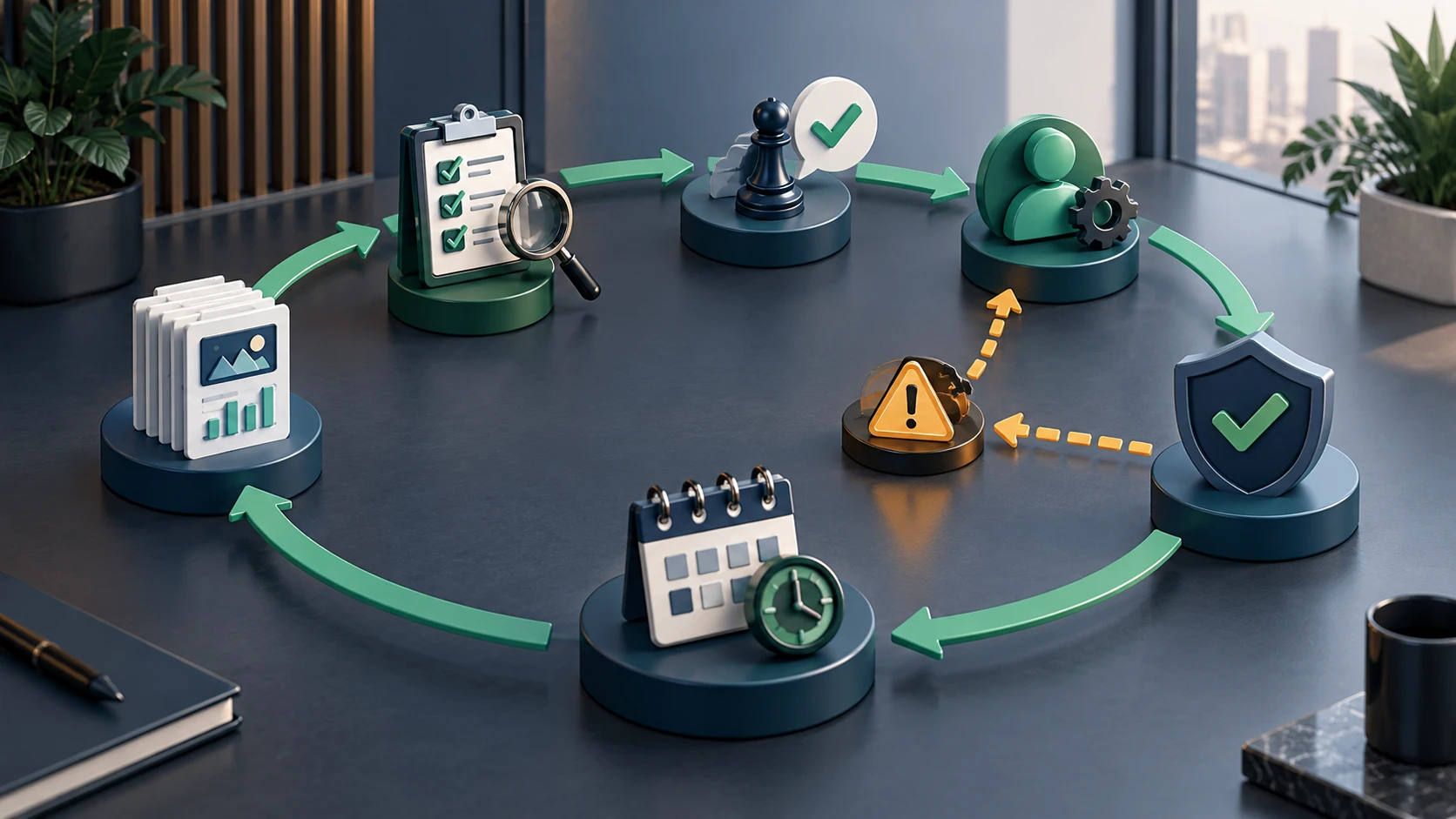
The cadence is where reporting becomes client delivery. A monthly executive review may summarize the decisions from shorter weekly operator checks. A complex account may use the same evidence model in a content planning meeting, an engineering handoff, and an executive status view, but each audience should see only the depth needed for its decision.
Automated SEO reporting is the useful companion for recurring collection and anomaly triage. Keep the automation focused on stable inputs and preparation; the agency and client should still own the explanation, tradeoff, and final priority.
Escalate Exceptions Before They Become Surprises
An exception is not simply a bad number. It is a condition that changes the reporting contract: a data source went unavailable, a major release changed the comparison set, a client approval is blocking work, or a material visibility movement has no credible explanation yet.
Set the escalation rule before the next incident:
| Exception | Escalate to | What to show | What not to claim |
|---|---|---|---|
| Measurement gap | Client analytics or platform owner | Missing source, affected period, and which decisions are limited | That the absence proves performance changed |
| Release-linked movement | Engineering and SEO owners | Affected templates, timing, evidence, and a reproduction or crawl check | That the release caused the movement before validation |
| Priority conflict | Client sponsor and delivery leads | Options, tradeoffs, effort, and the consequence of delaying each path | That every issue needs an immediate fix |
| Uncertain opportunity | Agency strategist and client lead | Hypothesis, upside, evidence gap, and a small test or watchlist plan | That an estimated upside is guaranteed |
This makes difficult conversations easier. The report does not hide uncertainty, but it also does not turn uncertainty into a vague disclaimer. It states what is known, what needs a decision, and when the team will know more.
Where Searvora Fits
Searvora's AI SEO Dashboard fits the shared monitoring and action-routing layer of an agency reporting contract. Its public product information describes performance views by page type and locale, anomaly and trend detection, opportunity scoring, cross-team reporting, structured exports, and timestamped evidence.
Use the dashboard to keep the client’s agreed cohorts and evidence beside the next action. The agency can then present a focused client view while retaining the segment detail needed by SEO, content, and engineering owners. It supports the reporting workflow; it does not replace the agency's judgment about scope, tradeoffs, or client priorities.
SEO Reporting For Agencies Checklist
Before sending the next client report:
- Name the client decision the report must support.
- Freeze the market, page cohorts, reporting window, and material release context.
- Match the reporting depth to the account's decision complexity.
- Separate observations from explanations and label confidence honestly.
- Write one decision sentence beside each material finding.
- Assign an owner, due date, and validation method to every approved action.
- Keep a visible watchlist for deliberate no-action decisions.
- Escalate measurement gaps, release risks, approval blockers, and priority conflicts before the client review.
- Recheck the previous report's actions using the same cohort and evidence source.