

Should you buy backlinks for SEO? If the payment is meant to influence rankings, the safest answer is no. Google classifies buying or selling links for ranking purposes as link spam. The apparent shortcut creates policy risk, weakens your ability to judge whether a link has real editorial value, and can leave the team paying for placements that search systems ignore.
Paying for advertising or sponsorship is a different transaction. A legitimate paid placement can send referral traffic or support a campaign when the relationship is disclosed and the link is qualified with rel="sponsored" or nofollow. The decision should start with the business purpose, not the promise of authority metrics.
Separate Advertising From Ranking Manipulation
The phrase “buy backlinks” hides two very different jobs. One is buying media exposure. The other is buying an unqualified link because someone claims it will improve rankings.
Google's current spam policies list buying or selling links for ranking purposes among link-spam examples. Google's outbound-link guidance says advertisements and paid placements should use rel="sponsored"; nofollow remains acceptable, although sponsored is preferred.
Use this first-pass distinction:
| Placement | Primary purpose | Link treatment | SEO decision |
|---|---|---|---|
| Display ad or sponsored editorial | Reach a relevant audience | rel="sponsored" or nofollow | Evaluate as media spend |
| Affiliate or partner placement | Track referral or commercial value | Disclose and qualify the link | Evaluate as partnership spend |
| Editorial citation earned on merit | Help the source page explain or support a claim | Normal editorial link | Treat as earned authority |
| Paid insertion sold as “dofollow authority” | Manipulate ranking signals | Seller resists qualification | Reject |
| Package of placements with controlled anchors | Manufacture a repeatable ranking pattern | Exact-match or forced anchors | Reject |
The useful test is simple: would you still buy the placement if it could not pass ranking credit? If the answer is yes, it may be a defensible advertising decision. If the answer is no, the purchase depends on manipulating search signals.
Run A Paid Backlink Risk Triage
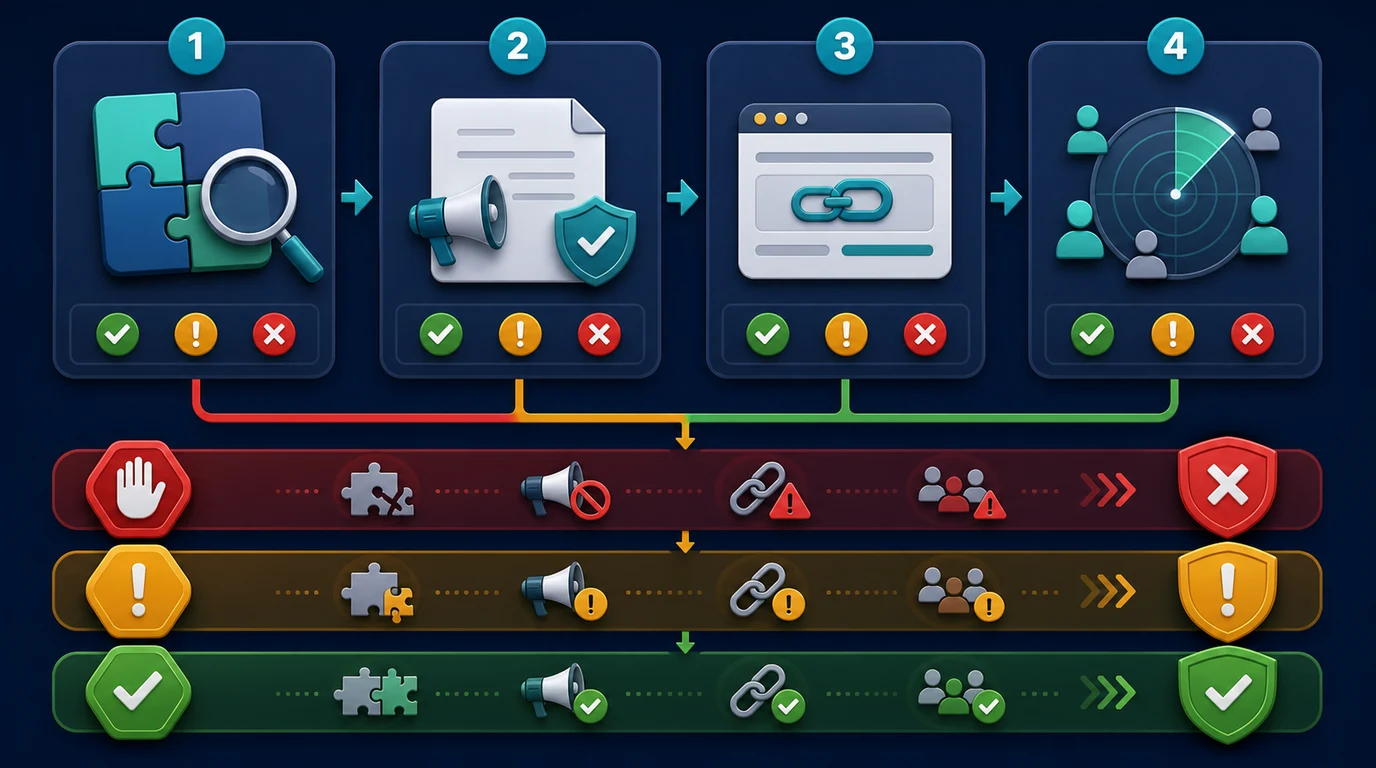
Do not let a domain metric, traffic screenshot, or placement list make the decision. Review the proposal across four evidence layers.
| Evidence layer | Lower-risk signal | Stop signal |
|---|---|---|
| Editorial fit | The source page and audience genuinely need the reference | The site is unrelated and sells links across many topics |
| Commercial disclosure | The seller accepts sponsorship disclosure and qualified links | The seller promises ranking value only if the link stays unqualified |
| Anchor control | The publisher chooses natural wording in context | The package requires exact-match anchors across placements |
| Placement footprint | The site has maintained, useful, audience-led content | Pages exist mainly to host paid links or thin guest posts |
| Business value | Referral traffic, reach, or partnership value is measurable | The only outcome is a claimed authority score |
| Change control | The agreement records owner, URL, disclosure, and review date | The link can move, disappear, or change without notice |
One red flag can be enough to stop. A vendor that refuses sponsored, guarantees ranking gains, controls exact-match anchors, or sells the same inventory at scale is not offering ordinary advertising. It is selling dependence on a search-policy violation.
Audit The Vendor Proposal Before Money Moves
A responsible review should be possible from public evidence and a written proposal. You do not need to pretend you have hands-on proof of how a vendor's private network works.
Ask for:
- The exact source URL and proposed destination URL.
- The page's audience, topic, and reason the link improves the article.
- Whether the placement is new content, an existing-page edit, advertising, or sponsorship.
- The final anchor policy and whether the publisher chooses the wording.
- The disclosure and
relattribute that will be used. - The placement term, removal policy, and change owner.
- The business outcome being purchased beyond ranking credit.
Then inspect the public site:
- Does it publish unrelated guest posts across high-value commercial niches?
- Are outbound links concentrated in awkward exact-match phrases?
- Do articles exist to answer real user tasks, or mainly to create inventory?
- Are authors, updates, corrections, and commercial relationships transparent?
- Would the page still be useful if every paid link were removed?
Do not turn this into a fake precision score. A checklist makes the evidence visible; it does not convert a manipulative placement into a safe one.
Choose Safer Ways To Earn Links
Rejecting paid ranking links does not mean waiting passively. It means moving budget toward assets and outreach that have an editorial reason to succeed.
Start with link building for SEO without risky shortcuts when the team needs the broader campaign workflow. Stronger alternatives include:
| Alternative | Why a publisher might link | What the team must produce |
|---|---|---|
| Original data or benchmark | It gives writers a citable source | Methodology, limitations, and maintainable results |
| Calculator, template, or checker | It helps readers complete a task | Reliable output, crawlable explanation, and upkeep |
| Expert explanation | It clarifies a difficult or changing topic | Verifiable expertise and a quotable answer |
| Reference hub | It organizes a fragmented subject | Clear page roles, sources, and internal links |
| Digital PR asset | It creates a timely story | News value, evidence, and focused outreach |
| Resource-page outreach | It improves an existing curated page | A genuinely better resource and a specific pitch |
The asset should be useful before outreach starts. If it cannot earn attention without the promise of reciprocal value, improve the asset or choose a different campaign.
Treat Qualified Paid Links As Media
There are legitimate reasons to pay for exposure: launching research, reaching a professional audience, supporting an event, or sponsoring a publication that serves your market. Keep that work separate from SEO authority claims.
For every paid placement:
- Define referral, reach, lead, or partnership goals.
- Require clear disclosure.
- Use
rel="sponsored"ornofollow. - Avoid exact-match anchor instructions.
- Record the source, destination, campaign, owner, start date, and review date.
- Measure the placement as media, not as guaranteed ranking lift.
The nofollow attribute workflow explains how to classify sponsored, user-generated, and other qualified outbound links. That technical treatment protects the distinction between a commercial relationship and an editorial ranking signal.
Monitor Links Without Inventing Causality
Whether a link was earned, sponsored, or inherited, record what happened before claiming it changed rankings.

Use a five-stage loop:
- Baseline the target page. Record indexability, canonical, internal links, impressions, clicks, and the query/page group before the placement.
- Maintain a link ledger. Store source URL, target URL, relationship, disclosure, anchor, owner, and discovery date.
- Validate the destination. Confirm the target returns the intended status, remains canonical, and is linked into the site appropriately.
- Review performance in context. Compare page and query changes with content releases, technical changes, seasonality, and SERP shifts.
- Reassess the relationship. Keep useful qualified placements, improve earned-link assets, and route suspicious patterns to remediation.
Do not attribute a ranking change to one backlink because the timing looks convenient. Search performance can change with content quality, crawlability, intent fit, competition, algorithm updates, and many other signals.
Know What To Do If Paid Links Already Exist
Do not panic and upload a disavow file after finding one questionable placement. Start with evidence.
Google's Manual Actions report guidance explains that buying links to manipulate rankings can lead to an unnatural-links action. If a real pattern exists:
- Inventory the paid or controlled placements.
- Ask publishers to remove the links or qualify them so they no longer pass ranking credit.
- Preserve correspondence and change evidence.
- Check Search Console for a manual action.
- Use disavow only when the risk is material and the official criteria are met.
The Google disavow links workflow covers that last-resort process. Random spam links and ordinary ranking volatility are not enough to assume the site needs a disavow.
Where Searvora Fits
Searvora does not sell backlinks or promise rankings from purchased links. Its role is the decision and execution layer around organic growth: turn evidence into a prioritized action queue, connect link opportunities to page readiness, and keep risk, ownership, and validation visible.
Buy Backlinks Decision Checklist
Before approving any paid link, answer these questions:
- Is the business buying audience reach or ranking credit?
- Would the placement still be valuable with
rel="sponsored"ornofollow? - Does the source page have genuine editorial and audience fit?
- Is the commercial relationship disclosed?
- Does the publisher control natural anchor text?
- Is the vendor avoiding ranking guarantees and bulk placement patterns?
- Can the team name a measurable outcome beyond an authority metric?
- Are the source URL, target URL, relationship, owner, and review date recorded?
- Is the target page crawlable, canonical, useful, and internally supported?
- Is there a stronger asset, outreach, PR, or partnership use for the same budget?
If the purchase depends on an unqualified link passing ranking credit, do not buy it. Build or sponsor something that creates value even when the relationship is transparent.