

The nofollow attribute is a rel value for links you need to include without asking Google to associate your site with, or crawl from, the destination. It belongs in a broader link qualification workflow with sponsored, ugc, and plain crawlable links, not in a blanket rule that marks every external link as suspicious.
The practical job is simple: classify why the link exists, apply the smallest accurate rel value, audit the template or CMS field that creates the link, then re-crawl the changed pages so the fix is visible in live HTML.
Qualified links are not an absolute crawl-control mechanism. Google says these links generally will not be followed, but the destination can still be discovered through sitemaps or links from other sites. Use robots.txt when you need to prevent fetching on your own site, and use noindex when the goal is to keep a crawlable page out of Google Search.
What The Nofollow Attribute Actually Decides
Google's official outbound link qualification guidance separates normal links from links that need extra relationship context. Regular editorial links do not need a rel value. Paid placements should use sponsored, user-generated links should use ugc, and nofollow is a fallback when you do not want to imply endorsement.
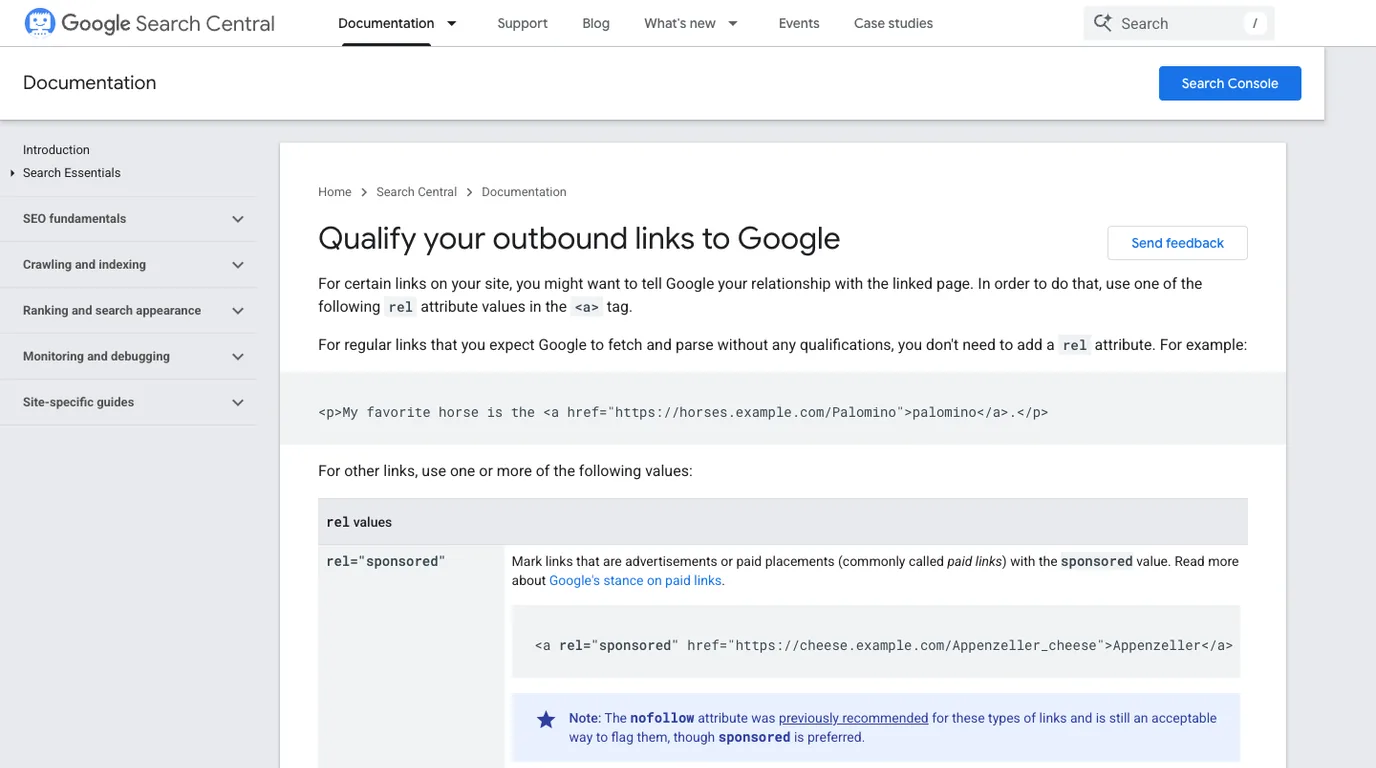
Use this table before changing templates:
| Link situation | Better rel choice | Why |
|---|---|---|
| You cite a useful source because it helps the reader | No added attribute | A normal editorial link is the cleanest signal. |
| A partner, advertiser, paid placement, or affiliate link is involved | rel="sponsored" | The relationship is commercial and should be labeled directly. |
| Comments, forums, reviews, profiles, or community submissions create the link | rel="ugc" | The link came from user-generated content rather than editorial review. |
| You need to link to a page without endorsing it | rel="nofollow" | The link is useful for context, but you do not want to vouch for the destination. |
| A link needs more than one label | Combine values, such as rel="ugc nofollow" | The relationship may be user-generated and still not endorsed. |
The nofollow attribute is not a content-quality fix. It does not make a weak page better, repair a spammy link campaign, or replace the need to keep important internal links crawlable.
Start With A Link Inventory
The Screaming Frog nofollow attribute article that surfaced this opportunity explains the attribute, when it is used, and how crawlers can help find nofollow links. Searvora's information gain is the operating layer around that: nofollow decisions should become an audit queue, not a one-off code change.
Pull these fields before editing links:
| Crawl or CMS field | Why it matters |
|---|---|
| Source URL | Shows which page is responsible for the link. |
| Destination URL | Separates trusted references, risky pages, ads, profiles, and user submissions. |
| Link placement | Distinguishes body copy, author bios, comments, footer links, product modules, and widgets. |
Current rel value | Reveals missing labels, outdated nofollow usage, and over-applied rules. |
| Anchor text | Helps explain whether the link is editorial, commercial, navigational, or user-generated. |
| Template or component | Shows whether one CMS field creates the same issue across many pages. |
| Indexability and canonical state | Prevents teams from changing links on pages that have a larger crawl or canonical problem. |
If you cannot answer source, destination, relationship, and template ownership, you are not ready to change the link rule yet.
Choose The Right Link Attribute
Nofollow decisions get messy when teams try to use one attribute for every risk. Separate the use cases instead.
| Question | If yes | If no |
|---|---|---|
| Was money, product access, affiliate value, or sponsorship involved? | Use sponsored; add nofollow only when your policy also avoids endorsement. | Continue. |
| Did a user create the link through comments, forum posts, reviews, or profiles? | Use ugc; combine with nofollow if you do not trust the contribution yet. | Continue. |
| Is this an editorial citation you are comfortable standing behind? | Use a normal crawlable link. | Continue. |
| Is the link needed for context but not endorsement? | Use nofollow. | Review whether the link belongs on the page at all. |
| Is the link inside your own navigation or body copy? | Audit carefully before using nofollow; internal discovery may suffer. | Apply the external-link rule. |
This makes the markup easier to explain later. A future reviewer should be able to look at the page and understand why the value exists without reverse-engineering an old SEO habit.
Audit Internal Nofollow Separately
Internal nofollow deserves its own review because it can hide a deeper architecture problem. If you do not want a page indexed, use the right indexing control. If you do not want a page discovered through a specific route, fix the navigation, canonical strategy, robots rules, or page value problem.
Use this internal-link triage before leaving nofollow in place:
| Internal nofollow pattern | What to check | Better next step |
|---|---|---|
| Product or collection links are nofollowed | Whether important revenue pages are being weakened by a template rule | Remove the blanket rule and validate crawl paths. |
| Faceted or filtered URLs are nofollowed | Whether crawl traps, canonicals, or robots controls are doing the real work | Use a crawl strategy that matches the indexation plan. |
| Pagination or related-article modules are nofollowed | Whether discovery and cluster paths are being blocked accidentally | Rebuild the module rule, then re-crawl. |
| Login, cart, account, or utility pages are nofollowed | Whether the pages should be blocked, noindexed, or simply not linked from SEO-critical templates | Treat them as utility routes, not ranking targets. |
The internal links for SEO workflow is the companion check here. A nofollow attribute can be technically valid on one link and still harmful when it appears across a template that controls discovery for an entire section.
Validate The Change After It Ships
Link attribute work should end with evidence. The live page has to contain the intended markup, the affected template should stop creating repeat issues, and crawl paths should still support the pages that matter.
Use this validation loop:
- Re-crawl the changed URL set after deployment.
- Confirm the
relvalues appear in live HTML, not only in the CMS preview. - Group results by template, directory, locale, and page type.
- Check whether important internal links remain crawlable and point to canonical URLs.
- Review external links with commercial, user-generated, or non-endorsement context.
- Record the rule owner so future writers and developers know why the attribute exists.
- Monitor affected pages for crawl, indexability, and search visibility changes.
Searvora's technical SEO crawler fits this step because the work is not just about one link. The crawler layer helps teams inspect page structure, link graphs, canonicals, metadata, and fix queues after a template or content workflow changes.
Keep Nofollow Separate From Link Risk Cleanup
The nofollow attribute is one signal. Link cleanup is a different workflow. Do not confuse them.
| Problem | Nofollow role | Better workflow |
|---|---|---|
| You added a paid or affiliate link | Label it with sponsored, and optionally nofollow if policy requires | Update the template and writer checklist. |
| A comment section attracts spam links | Use ugc or ugc nofollow by default | Moderate submissions and protect the community workflow. |
| Your backlink tool labels inbound links as risky | Nofollow on your outbound links does not solve inbound link risk | Use a toxic backlinks triage before acting. |
| You think a past campaign created unnatural backlinks | Nofollow on your site is not a cleanup file | Use the Google disavow links workflow only when evidence is strong. |
| Important internal pages are hard to discover | Internal nofollow may be part of the problem | Rebuild crawlable internal links and validate the graph. |
Google's spam policies are the better reference when the concern is manipulative link behavior. Nofollow can label an outbound relationship, but it will not make a bad campaign safe after the fact.
A Practical Nofollow Attribute Checklist
Use this checklist before closing a link-attribute ticket:
- List every affected source URL and destination URL.
- Mark each link as editorial, sponsored, user-generated, untrusted, utility, or internal discovery.
- Use
sponsoredfor paid or affiliate relationships. - Use
ugcfor user-generated links. - Use
nofollowwhen the link is necessary but not endorsed. - Leave normal editorial references unqualified.
- Avoid internal nofollow unless the architecture review proves it is intentional.
- Update the template, CMS field, or writer rule that created the pattern.
- Re-crawl live pages and confirm the markup.
- Record the owner, rule, and validation date.
The safest nofollow attribute workflow is boring: classify the relationship, choose the right value, ship the template change, and prove the live site still sends clear crawl and endorsement signals.