

Small business SEO is the work of making a business easy to find, trust, and choose in search. The useful version is not a pile of one-off tactics. It is a weekly queue that connects business profile signals, service pages, crawl health, reviews, content gaps, AI visibility, and reporting into work the team can actually ship.
The Ahrefs small business SEO article that surfaced this competitor opportunity gives practical starter tips. Searvora's information gain is the operating layer after the tips: how a lean team decides what belongs in the queue, what can wait, and what proof will show whether the work helped.
What Small Business SEO Should Decide
Small business SEO should answer a simple question every week: which visibility problem deserves attention now?
That decision is harder than it sounds because the signals come from different places. A business profile may be incomplete. A service page may be thin. A review theme may reveal missing proof. A page may be blocked from indexing. A dashboard may show impressions rising while clicks stay flat.
Use this first-pass decision table before creating tasks:
| SEO signal | What it means | Work it should create |
|---|---|---|
| Business profile gaps | Searchers may not understand the business, service area, hours, or offer | Profile cleanup, category review, service updates, photo refresh |
| Weak service pages | The website does not prove the business can solve a specific customer job | Page refresh, proof section, FAQ, internal links, clearer title and H1 |
| Crawl or indexability issues | Search systems may not reach or keep the right page | Technical QA, sitemap check, canonical fix, redirect cleanup |
| Review themes | Customers are telling you what proof, questions, or objections matter | Review response workflow, trust copy, FAQ update, local proof |
| AI-search gaps | The business may not be easy for answer systems to summarize or cite | Clear definitions, entity consistency, source-worthy page sections |
| Reporting drift | The team cannot tell whether shipped work changed visibility | Weekly dashboard review, owner assignment, validation date |
Build The Evidence Layer First
Small businesses often start with the visible tasks: claim a profile, write a few pages, add photos, ask for reviews. Those tasks matter, but they should sit on top of a clear evidence layer.
Start by collecting the facts search systems and customers need to verify:
| Evidence field | Why it matters | Common issue |
|---|---|---|
| Business name, category, and services | Defines the entity and the work it actually performs | Categories chosen for volume instead of accuracy |
| Address, service area, hours, and contact paths | Helps searchers act without friction | Profile and website facts do not match |
| Service and location pages | Gives organic search a useful destination beyond the profile | Generic pages with no proof or local context |
| Reviews and repeated customer language | Shows trust signals and real objections | Reviews are collected but never turned into page improvements |
| Crawl and indexability status | Confirms important URLs can be discovered and kept | Good pages are missing from sitemaps or canonicalized away |
| Performance and AI visibility | Shows whether the business is becoming more findable | Rankings are tracked without page groups or next actions |
Google's Business Profile guidelines are the guardrail for profile accuracy. Google's SEO starter guide is a useful baseline for making pages crawlable, understandable, and helpful. The operator job is to connect those references to the business's actual pages, not to turn them into a giant checklist with no owner.

If the business serves local markets, pair this article with the local SEO workflow. Local SEO goes deeper on profiles, location pages, reviews, and market signals. This article stays broader: the weekly operating model for all small-business SEO work.
Protect Service Pages With Crawl Checks
Small business SEO fails surprisingly often for technical reasons. A service page can have the right copy and still underperform because it is not linked clearly, is missing from the sitemap, has a weak title, points canonical elsewhere, or sits behind a redirect chain.
Run these checks before asking the team to rewrite content:
| Check | Pass condition | If it fails |
|---|---|---|
| Indexability | Important pages return 200, are not noindexed, and are allowed by robots rules | Fix access before editing copy |
| Canonical | Each service or location page points to itself unless consolidation is intentional | Decide whether the page should exist or merge |
| Sitemap | Useful canonical pages are included and stale URLs are removed | Refresh sitemap rules and resubmit if needed |
| Internal links | Service pages are reachable from relevant hubs, navigation, and supporting articles | Add links before expecting search systems to infer importance |
| Titles and H1s | Each page clearly names the service, market, or user job | Rewrite metadata and headings around the actual page job |
| Structured data | Markup matches visible facts and does not invent business details | Align schema with real page content |
The technical SEO workflow is useful when the same crawl issue appears across many templates. For a small site, keep the crawl check simple but non-negotiable: prove that the page is discoverable, indexable, and internally supported before spending another week polishing copy.
Turn Reviews And Content Into Search Proof
Reviews are not only reputation assets. They are also a source of language, objections, and proof. A small business can use them to strengthen pages without inventing claims.
Look for repeated review themes:
| Review theme | Page improvement | Validation signal |
|---|---|---|
| Customers praise speed or responsiveness | Add a service-process section with realistic expectations | More branded and service-page clicks |
| Customers mention a specific service detail | Add that detail to the relevant service page or FAQ | More impressions for specific service queries |
| Customers ask the same pre-sale question | Add a short answer near the conversion path | Better engagement and fewer support questions |
| Customers mention local context | Add authentic local proof to a location or service-area page | More local relevance and trust |
| Customers compare providers | Add clear decision criteria without attacking competitors | Better commercial-intent page quality |
For AI search visibility, the same proof matters in a different format. Answer systems need clear facts, concise definitions, consistent entity signals, and source pages that explain the business without vague marketing language. A small business does not need to chase every AI answer. It needs a few pages that are easy to summarize and verify.
Prioritize The Weekly Queue
Once the evidence layer is visible, score each task by impact, confidence, and effort. This keeps the queue from becoming a mix of easy chores and noisy opinions.
Use this scoring model:
| Score | High score means | Low score means |
|---|---|---|
| Impact | The task touches a high-value service, location, page group, or conversion path | The task is cosmetic or affects low-priority traffic |
| Confidence | Data clearly explains why the task matters | The task is based on a generic tip or a guess |
| Effort | The task can ship with available owners and low implementation risk | The task depends on unresolved design, engineering, legal, or operations work |
Then route each task into one lane:
| Lane | Example task | Owner |
|---|---|---|
| Profile | Update categories, services, photos, hours, or contact paths | Owner, operations, or marketing |
| Page | Refresh a service page, add proof, answer a common question, improve title and H1 | Content or SEO |
| Technical | Fix indexability, sitemap, redirects, canonicals, or internal links | SEO and engineering |
| Trust | Respond to reviews, add proof, clarify credentials, improve FAQs | Marketing or operations |
| Measurement | Review page groups, profile actions, search queries, and AI visibility | SEO operator or founder |
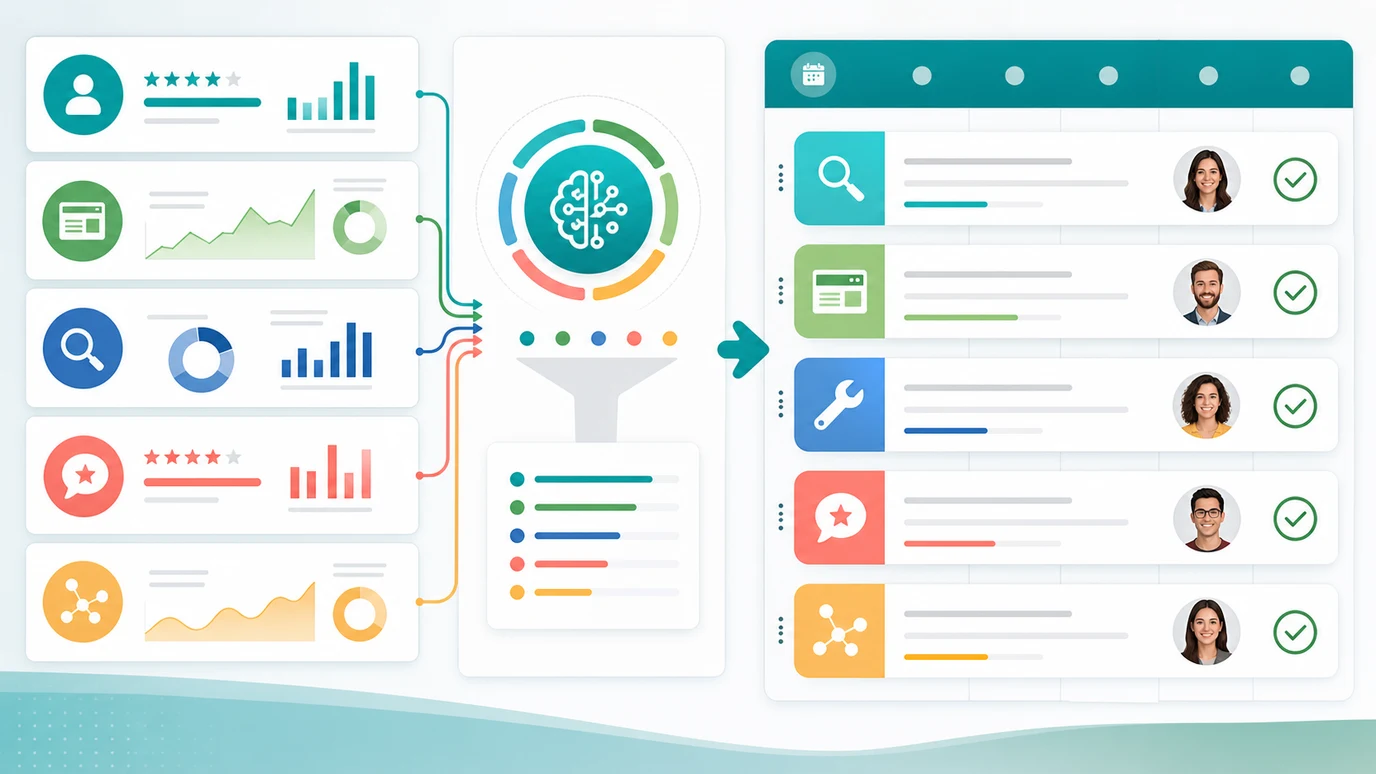
Google's Search Console performance report is a good source for query and page movement. The missing layer is usually segmentation: service pages, location pages, blog posts, product pages, and profile-adjacent pages should not all be judged by the same traffic line.
Where Searvora Fits
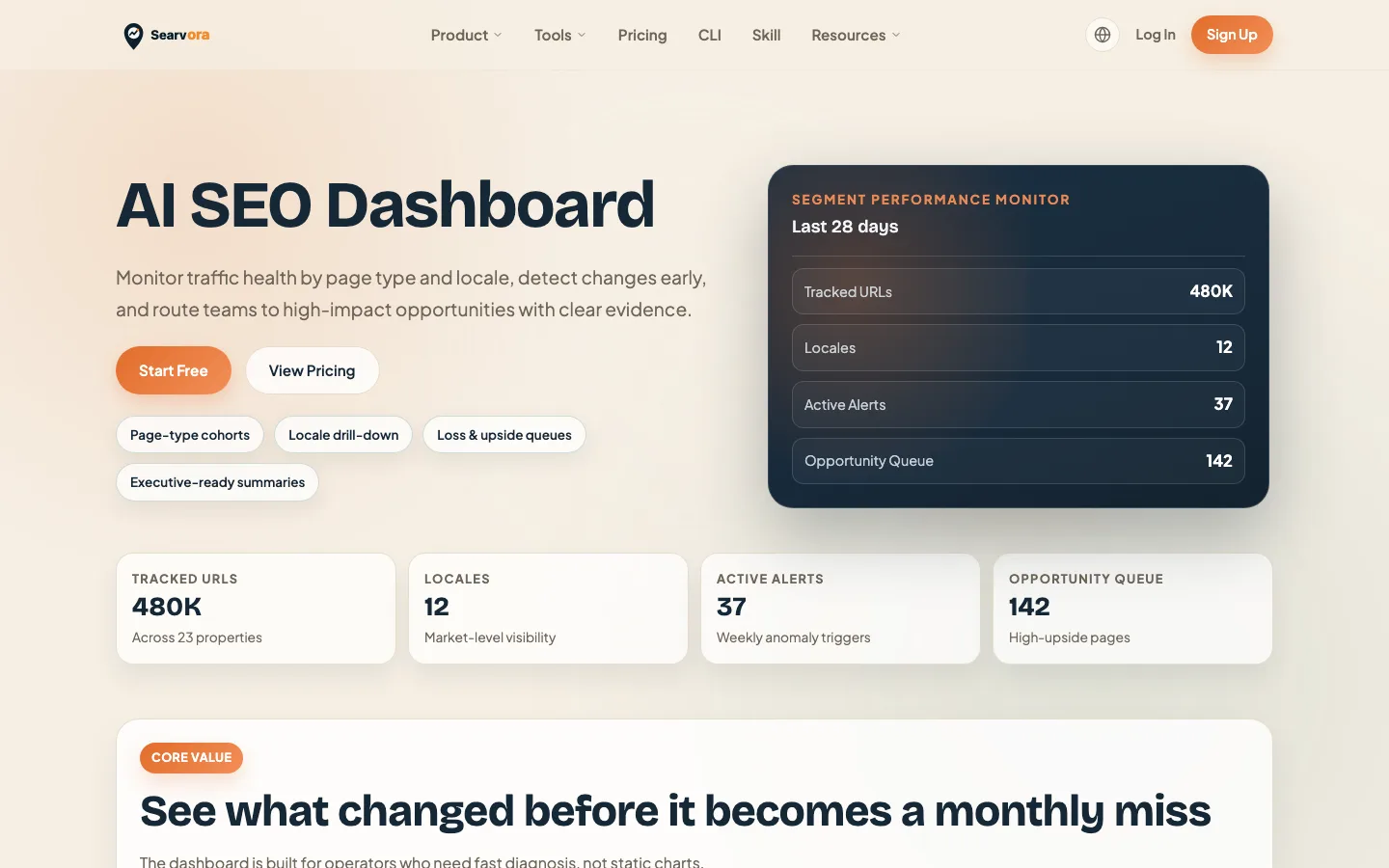
Searvora's AI SEO dashboard fits the monitoring and action-routing part of small business SEO. The product page positions it around page-type cohorts, locale drill-down, loss and upside queues, and executive-ready summaries. That is useful when a small team needs to know which page group moved, what evidence explains the movement, and what should enter the next weekly queue.
Use the dashboard to group signals before assigning work:
| Dashboard finding | Better next action |
|---|---|
| Service pages have impressions but weak clicks | Review title, description, H1, intro, and page promise |
| Local or market pages decline together | Check profile facts, local proof, internal links, and crawl eligibility |
| Blog posts attract traffic but no business action | Re-map internal links and CTA fit to service or product pages |
| AI visibility is weak for a core service | Add concise definitions, proof, FAQs, and consistent entity language |
| Technical warnings rise on one template | Run a focused crawl and assign the fix before rewriting pages |
A Practical Small Business SEO Checklist
Use this checklist when the team needs a repeatable cadence:
- Confirm business profile eligibility, categories, services, hours, contact paths, and service area.
- Match profile services to real service, product, or location pages on the website.
- Review whether each important page has a distinct job, clear title, useful H1, proof, FAQ, and conversion path.
- Validate indexability, canonicals, sitemap inclusion, redirects, robots rules, and internal links before rewriting copy.
- Turn review themes and customer questions into page proof, FAQs, and trust signals.
- Check Search Console page and query movement by page type, not only sitewide traffic.
- Review whether important pages are easy to summarize for AI answer systems.
- Score tasks by impact, confidence, and effort.
- Assign each task to profile, page, technical, trust, or measurement lanes.
- Recheck the result in the next reporting cycle and remove stale tasks from the queue.
Small business SEO works when it becomes a habit the team can keep. Profiles create public facts. Pages explain the offer. Crawl checks protect eligibility. Reviews add proof. Reporting decides what deserves the next hour of attention. Put those pieces into one queue and the work becomes easier to prioritize, ship, and validate.