

If the task is how staffing companies can improve visibility in ai-powered search results, start by deciding which search job the company should be visible for. Employer searches, candidate searches, job-category searches, and local market searches need different source pages. Treating them as one broad AI visibility prompt creates noisy checks and weak fixes.
Staffing companies improve AI search visibility when their public pages explain services, hiring categories, markets, expertise, and proof clearly enough for answer systems to reuse. The workflow is practical: map query groups, strengthen source pages, confirm crawl eligibility, route fixes, and recheck the same markets.
Separate Employer, Candidate, And Job-Category Queries
Staffing firms serve at least two audiences at once. Employers may search for recruiting help, hiring timelines, niche skill coverage, or local staffing partners. Candidates may search for job types, pay guidance, application steps, or agency reputation. AI search systems can mix those jobs if the website does not keep page roles clear.
Use this split before making any content changes:
| Query group | Searcher job | Source page that should support it |
|---|---|---|
| Employer service | Find a staffing partner for a role, industry, or market | Employer service page, industry page, or hiring solution page |
| Candidate access | Understand job categories, application flow, and support | Candidate hub, job category page, and application guidance |
| Local market | Find staffing support in a city, region, or service area | Location page and market-specific service page |
| Industry expertise | Verify whether the firm understands a hiring vertical | Industry page, case proof, and role taxonomy |
| Brand trust | Decide whether the staffing company is credible | About, reviews, testimonials, policies, and support pages |
The B2B AI search visibility gap workflow is a useful parent process. Staffing companies need the same evidence discipline, but with clearer separation between employer and candidate intent.
Build Source Pages AI Answers Can Use
The best source page is the page that answers the searcher's job without forcing an answer system to stitch together vague copy from five places. For staffing companies, that usually means service pages, role pages, industry pages, market pages, and support pages that reinforce each other.
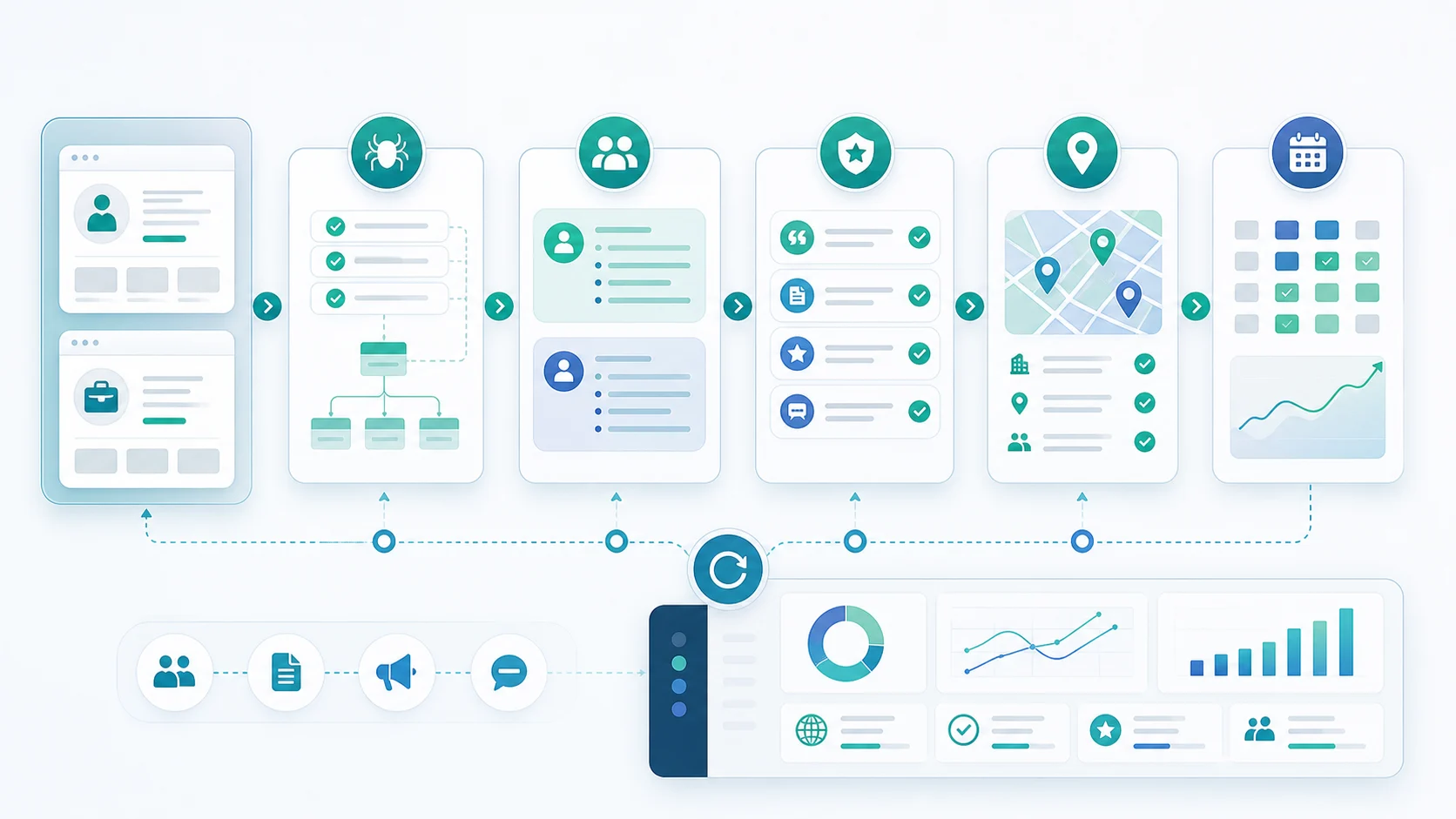
Start with these page layers:
| Page layer | What it should prove | Fix when weak |
|---|---|---|
| Employer service page | What hiring problem the firm solves, for whom, and in which market | Add specific roles, timelines, process steps, and proof |
| Job-category page | Which roles are covered and how candidates or employers should act | Clarify categories, requirements, internal links, and next steps |
| Industry page | Why the firm understands that hiring segment | Add use cases, examples, vertical constraints, and owner context |
| Location page | Where the firm operates and what is locally available | Keep NAP, service areas, local links, and market language current |
| Trust page | Why a searcher should believe the firm | Connect reviews, policies, testimonials, credentials, and support paths |
Avoid publishing another generic "AI staffing trends" article when the real source gap is a service or job-category page. AI search visibility improves when the page that should win becomes easier to understand, crawl, and cite.
Check Crawl Eligibility And Page Roles
Before rewriting a staffing page, confirm that the page can actually support search. Some staffing sites put job listings, candidate resources, location details, or application steps behind scripts, filters, or duplicate templates that weaken crawl and source ownership.
Run this pass:
| Check | Pass condition | Staffing risk when weak |
|---|---|---|
| Indexability | The source page is indexable and canonical | AI answers may rely on job boards, directories, or competitors |
| Canonical ownership | The canonical URL matches the intended page role | Employer, candidate, and location pages split the same query |
| Rendered content | Important service details appear in HTML | Dynamic job widgets may hide the useful answer |
| Internal links | Industry, role, location, and support pages link descriptively | Pages look isolated and weakly supported |
| Listing hygiene | Job URLs, expired roles, and filters do not flood the index | Search systems may find stale or thin URLs first |
| Sitemap coverage | Priority service and location pages are discoverable | Current pages can lose to older or lower-value URLs |
The SEO spider crawler is useful when the issue is technical page discovery, duplicate templates, internal links, or sitemap coverage. Use crawl evidence before assigning another rewrite.
Turn AI Search Findings Into Staffing Fixes
AI search checks should become a fix queue, not a loose list of prompts. Each finding needs a source page, owner, fix type, and recheck date.
| Finding | Likely meaning | Better next action |
|---|---|---|
| Competitor named for a hiring query | Your service page may not explain the role or market clearly | Improve employer service evidence |
| Job board cited instead of owned page | Candidate or role pages may be thin or hard to crawl | Strengthen job-category pages and internal links |
| Wrong location appears | Market pages and profiles may be inconsistent | Fix location evidence and service-area language |
| Brand appears without a useful URL | Source ownership is weak | Improve canonical pages and citation-worthy sections |
| AI answer mixes candidates and employers | Page roles are unclear | Separate candidate and employer source pages |
| Answer changes every check | Query group is unstable or too broad | Narrow the market, role, or audience before rewriting |
The fix queue should be small enough for a staffing team to use in a weekly cadence. One page gets improved, one crawl issue gets fixed, one proof gap gets added, or one unstable query stays on watchlist.
Where Searvora Fits
Searvora AI SEO Dashboard fits the monitoring and handoff layer. Use the AI SEO dashboard to group employer queries, candidate queries, job categories, market pages, cited sources, and owner-ready fixes.
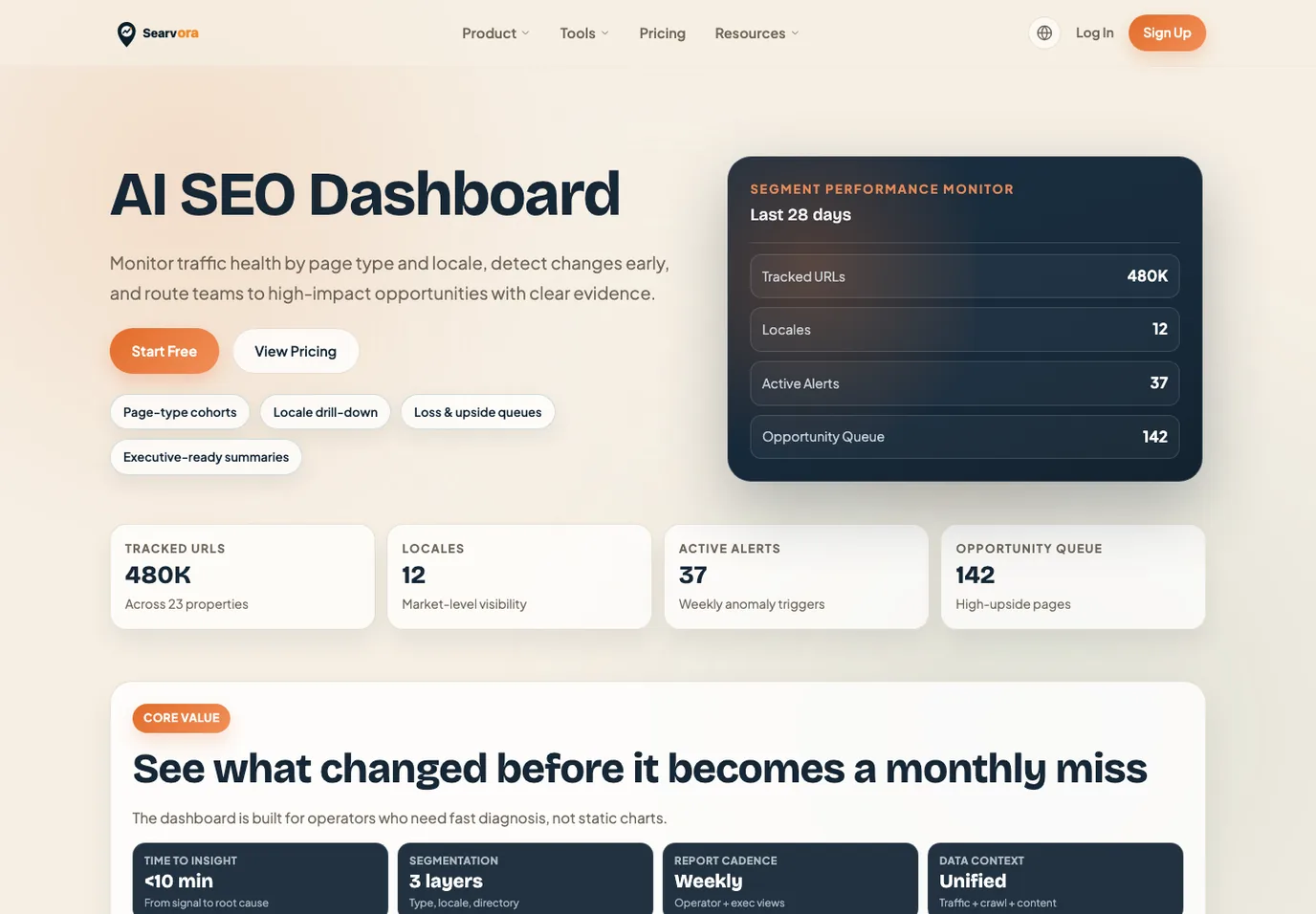
The dashboard should not replace job board operations, recruiter judgment, or local market knowledge. It should keep AI search evidence tied to the pages and owners that can actually improve visibility.
Recheck The Same Markets
Staffing visibility is market-sensitive. Recheck the same role, audience, and location before declaring a win.
Use this sequence:
- Choose one query group, such as "IT staffing agency in Austin" or "warehouse staffing partner for peak season."
- Decide whether the searcher is an employer, candidate, or mixed audience.
- Name the source page that should support the answer.
- Record whether AI answers mention the brand, cite the owned page, cite competitors, cite job boards, or cite directories.
- Check indexability, canonical, rendered content, internal links, listing hygiene, and sitemap coverage.
- Ship one fix with one owner.
- Recheck the same role and market after the page can be crawled and reused.
Staffing companies improve visibility in AI-powered search results when they stop treating AI visibility as a prompt exercise. The durable work is cleaner source pages, crawlable job and service evidence, clearer market ownership, and a recheck loop the team can repeat.