
If you need to know how to identify gaps in ai search visibility b2b, start by comparing the queries your buyers ask, the brands and sources AI answers use, and the owned pages that should support those answers. A gap is not just "we were not mentioned." A useful gap names the query group, missing source page, competitor advantage, technical blocker, and next owner.
B2B AI search visibility work gets messy because buying committees ask different questions at different stages. One query may be about a pain point, another about a category, another about vendor risk, and another about implementation. The gap workflow has to preserve those jobs instead of flattening everything into one visibility score.
Start With Buyer Query Groups
Build the gap check around query groups, not random prompts. The question is not whether the brand appears once. The question is whether the brand and its source pages appear where a real B2B buyer would need evidence.
Use this starting map:
| Query group | Buyer job | Gap to look for |
|---|---|---|
| Problem queries | Understand the pain or risk | Competitors explain the problem better |
| Category queries | Find the right class of solution | The brand is missing from category framing |
| Comparison queries | Compare vendors, workflows, or approaches | Competitors appear with clearer proof |
| Implementation queries | Understand how the work gets done | Source pages lack steps, screenshots, or constraints |
| Branded queries | Confirm what the company does | Answers use outdated or inconsistent descriptions |
The AI visibility evidence loop is the parent workflow. For B2B teams, the important addition is buyer stage: every query group should map to a buying committee question and a source page that can answer it.
Capture Mentions, Citations, And Source Ownership
For each query group, record three separate signals:
- Mentions: which brands, products, people, or categories are named.
- Citations: which URLs support the answer when sources appear.
- Source ownership: which owned page should have supported the answer.
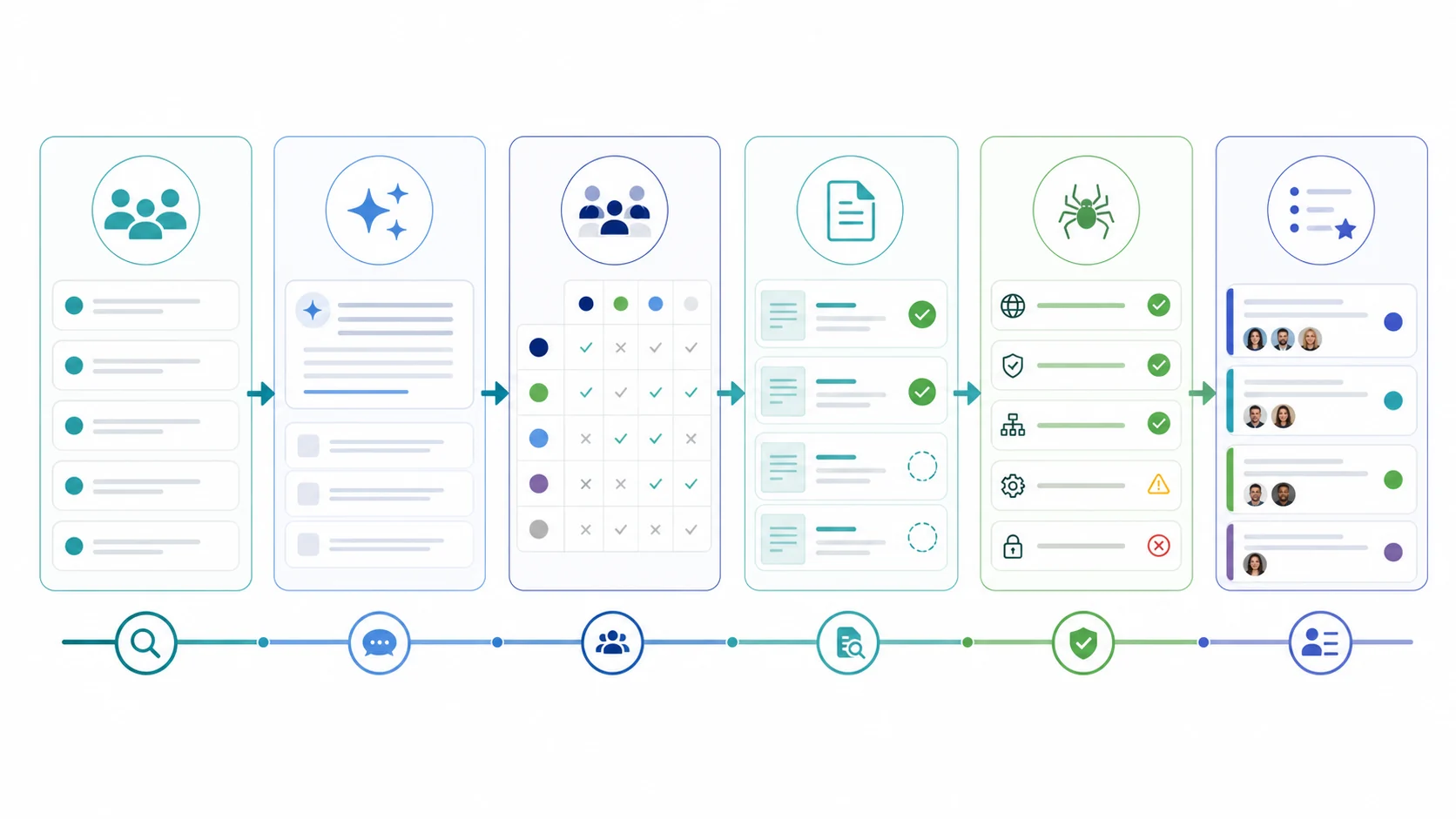
This split matters because the fix changes by signal:
| Evidence pattern | What it usually means | Better next action |
|---|---|---|
| Competitor mentioned, your brand absent | The answer understands the category without you | Strengthen category and comparison source pages |
| Your brand mentioned, no owned URL cited | Entity awareness exists but source ownership is weak | Improve the likely citation target |
| Third-party URL cited for your category | External sources explain the topic better than owned pages | Build a clearer neutral explainer or proof page |
| Owned page cited but wrong message appears | Source page exists but messaging is stale or vague | Refresh category language and examples |
| Brand appears only for branded queries | Non-branded discovery coverage is weak | Create or improve problem and category pages |
Compare Against The Competitor Set
Do not compare against every competitor in the market. Compare against the brands and sources that actually appear for the query group.
Use a simple matrix:
| Check | What to record | Why it matters |
|---|---|---|
| Appearing brands | Vendors, agencies, publishers, directories, and communities named in answers | Shows the visible alternative set |
| Cited sources | Owned URLs, competitor URLs, analyst pages, directories, reviews, or articles | Shows who owns answer evidence |
| Missing owned page | The Searvora or company URL that should answer the task | Creates a fix target |
| Message gap | Definition, proof, example, comparison, or implementation detail missing | Shapes the content brief |
| Technical gap | Crawl, canonical, noindex, rendering, sitemap, or internal-link issue | Prevents editorial work from hiding access problems |
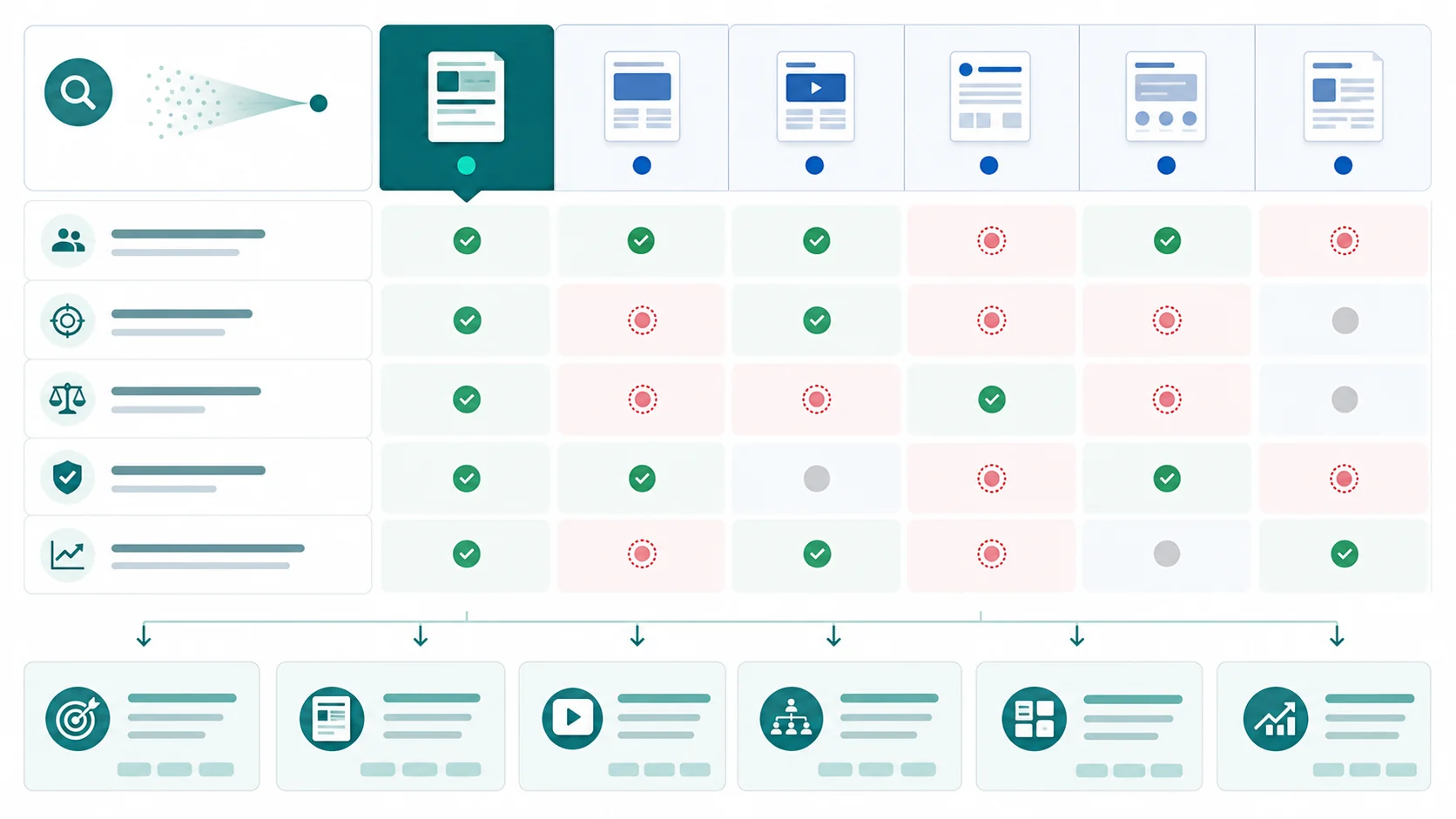
The brand visibility comparison workflow is useful when the competitor set is the main question. This gap article is narrower: it turns the comparison into specific source-page fixes.
Diagnose The Page Before Writing More
Many B2B teams react to an AI visibility gap by approving another article. That can split intent when an existing source page only needs a stronger answer, clearer proof, or a technical fix.
Check the page that should support the answer:
| Source-page check | Pass condition | Fix when weak |
|---|---|---|
| Page job | The page has one clear buyer task | Rewrite the intro and H2 structure around that task |
| Answer depth | Definitions, steps, proof, and limitations are visible in text | Add concise sections, tables, examples, or constraints |
| Entity clarity | Product, category, audience, and use case are named consistently | Normalize wording across product, about, and comparison pages |
| Citation usefulness | The page can support one answer better than competitors | Add source-ready examples and comparison context |
| Crawl eligibility | The page is indexable, canonical, linked, and in the sitemap | Fix access before assigning content work |
| Validation plan | The team knows how and when to recheck | Add a query group, owner, and date |
The AI search citation audit is the right supporting process when the gap is source ownership. Use it before creating a new page just because a competitor is cited.
Route Each Gap To One Fix
A useful gap report should be short. It should not become a prompt museum. Each finding needs one owner-ready action.
Use this routing table:
| Gap type | Page action | Owner |
|---|---|---|
| Missing category presence | Build or refresh a neutral category source page | SEO or product marketing |
| Weak comparison proof | Add fair comparison criteria and support links | Content or product marketing |
| Citation loss | Improve the page that should be cited | SEO lead |
| Technical blocker | Fix canonical, noindex, robots, rendering, or internal links | Technical SEO or engineering |
| Message inconsistency | Align homepage, product page, about page, and supporting content | Product marketing |
| Low-confidence signal | Keep the query group on watchlist | SEO operations |
The route is the difference between "AI visibility is down" and "this product comparison page needs a clearer category definition, two proof examples, and a crawl check before the next review."
Where Searvora Fits
Searvora AI SEO Dashboard fits the monitoring and handoff layer for B2B gap checks. The local product page positions it around page-type cohorts, locale drill-down, anomaly and trend detection, opportunity scoring, cross-team reporting, and action queues. Those are the views a B2B team needs when AI visibility changes across a buying journey.
Use the AI SEO dashboard to keep query groups, source pages, and owner queues together:
| Workflow layer | Dashboard role | Team output |
|---|---|---|
| Query grouping | Monitor priority topics by buyer stage and market | A stable review set |
| Source-page mapping | Tie visibility changes to URLs and page cohorts | A specific page owner |
| Opportunity scoring | Rank gaps by upside, confidence, and effort | A shorter fix queue |
| Reporting | Show what changed, who owns it, and when to recheck | A weekly B2B SEO handoff |
Run The B2B Gap Review
Run this once a week for one market, one product line, or one buyer segment:
- Pick five to ten problem, category, comparison, implementation, and branded queries.
- Record mentioned brands, cited URLs, missing owned pages, and repeated competitor sources.
- Map every meaningful finding to a page job.
- Check crawl, canonical, sitemap, internal links, and visible page evidence.
- Decide whether the fix is refresh, new source page, technical repair, internal linking, messaging alignment, or watchlist.
- Assign one owner and one validation window.
- Recheck the same query group after the fix has time to be crawled and reused.
B2B AI search visibility gaps become useful when they stop being screenshots and start being decisions. Name the buyer query, name the source page, name the missing evidence, and route one fix at a time.