

Learning how to increase website authority is not the same as making a third-party score go up. The safer job is to make the site easier to trust, crawl, cite, link to, and measure. That usually means better pages, stronger internal links, credible external references, cleaner technical foundations, and a monitoring loop that proves the work changed something.
The Ahrefs article on this topic frames website authority through Domain Rating and backlink strength. That is a useful starting point. The practical question is the operating workflow around the score: diagnose which authority constraint exists, choose the right fix, and measure whether the page or cluster became stronger.
Start With Authority Signals, Not Authority Scores
Authority scores help teams notice patterns, but they are not direct instructions. A score can suggest that competitors have stronger link profiles. It cannot prove that your page is useful, indexable, internally supported, or ready to be cited in search and AI answer surfaces.
Use authority metrics as a question generator:
| Authority signal | What it can tell you | What to check before acting |
|---|---|---|
| Domain-level score | Competitors may have stronger backlink profiles | Whether the ranking page actually matches intent better |
| Referring domains | More sites may reference the domain | Whether those links point to pages that matter |
| Link velocity | A topic may be earning attention | Whether the source pages are relevant and editorial |
| Brand mentions | People may discuss the company or asset | Whether the mention deserves a link for the reader |
| AI answer citations | A page may be easy to summarize or cite | Whether definitions, evidence, and entities are clear |
The Domain Rating workflow is the right companion when the question is what a score means. This article starts one step later: what should the team do when authority looks like a real growth constraint?
Diagnose a Page Before Budgeting for Authority
Use this synthetic review of a small software site. Its domain score is lower than a competitor's, but that comparison does not identify the next fix.
| Page | Observation in the example | Decision before buying more research or outreach |
|---|---|---|
/guides/backup | Returns 200, but the canonical names an old guide | Resolve the preferred page and its URL signals |
/compare/backup-tools | Technically eligible, but offers claims without evidence or dated criteria | Add a reproducible comparison method and verify the product facts |
/research/restore-lab | Has a useful original fixture but no link from the guides hub | Add the relevant internal route and check the live anchor |
/pricing | Already linked from the main navigation; users ask about a feature it does not explain | Clarify the buying decision before treating the problem as link scarcity |
For each row, the reviewer can inspect something controlled by the team. None requires a prediction that a metric will increase. Once the technical path, reader answer, and supporting links are sound, external references become a more defensible hypothesis.
Keep the distinction explicit in reporting: Ahrefs describes Domain Rating as its proprietary domain-level backlink metric. A change in that metric is an Ahrefs observation. A change in Search Console clicks, an earned source citation, and a completed purchase are separate observations. Do not turn them into one invented authority score or assume one caused another.
An authority brief can now say, for example, “maintain the restore lab and investigate relevant references” rather than “increase DR by ten points.” It names an asset and a reader reason that an editor can evaluate. See the downloadable repair lab for a small, explicitly synthetic asset format you can adapt to your own expertise.
Diagnose The Constraint Before You Build Links
Authority problems are often mislabeled. A page can lose because the domain is weaker, but it can also lose because the page has thin evidence, weak internal links, crawl barriers, poor title alignment, or a topic cluster that does not explain why the site deserves trust.
Run this diagnostic sequence before starting outreach:
| Diagnostic gate | Question | If the answer is weak |
|---|---|---|
| Search job | Does the page answer one clear user task better than alternatives? | Rewrite the page promise, structure, or page type |
| Crawl access | Can search engines reach, render, canonicalize, and index the page? | Fix robots, canonicals, redirects, sitemap, or template issues |
| Internal support | Do relevant pages link to the target with descriptive anchors? | Add links from hubs, guides, product pages, and supporting articles |
| Source depth | Does the page include examples, definitions, data, or official references? | Add proof before asking anyone to cite it |
| External relevance | Are link prospects topically aligned with the page? | Narrow outreach to sources where the page helps the reader |
| Measurement | Can the team see whether the work changed impressions, links, citations, or revenue context? | Define a baseline and a review cadence before launching work |
This protects the team from a common failure mode: chasing links for a page that should have been fixed first. A technical SEO workflow is especially important when authority work points at pages with crawl, canonical, redirect, or internal-link issues.
Choose Authority Work That Deserves Attention
Once the constraint is clear, choose the smallest useful authority-building action. Do not run every tactic at once. Match the action to the evidence.
| Constraint | Better authority work | Skip when |
|---|---|---|
| Thin source depth | Add original examples, templates, screenshots, data notes, or public references | The page still does not serve a distinct search job |
| Weak internal support | Link from relevant hubs and sibling articles with descriptive anchors | The target page is not the best canonical answer |
| Few credible references | Build a linkable asset, guide, checklist, or research page | The asset is mostly promotional |
| Unlinked brand mentions | Request a link only when it helps the source page's readers | The mention is passing, low quality, or not citation-worthy |
| Poor topic coverage | Add or update pages only for distinct user jobs | Existing pages already serve the same task |
| Low AI-search citability | Add concise definitions, comparison tables, evidence blocks, and entity clarity | The page lacks real expertise or useful evidence |
The Link Building for SEO article covers the risk controls around outreach. For website authority, the key point is narrower: build or improve something worth referencing before asking for references.
Google's spam policies are the safety boundary. Authority work should not become paid links, scaled exchanges, automated outreach spam, or anchor-text manipulation. A useful authority plan earns trust by improving the page and the source relationship.
Protect The Page Before Outreach
Authority does not help much if the target page leaks value through technical and content issues. Before outreach or digital PR, make sure the page is healthy enough to receive attention.
Use this preflight checklist:
- Confirm the page is indexable and canonicalized to itself or the correct preferred URL.
- Check the title, H1, meta description, and opening section against the search job.
- Review internal links from the most relevant pages in the cluster.
- Fix broken outbound citations, stale screenshots, and unsupported claims.
- Add clear definitions, examples, and comparison tables where they help AI answer systems understand the page.
- Validate that the page appears in the sitemap and is not blocked by robots or noindex rules.
This is where authority work connects to crawl evidence. A site audit can show whether the page is buried, orphaned, redirected through unnecessary hops, missing metadata, or surrounded by weak internal links. Those fixes often improve the return on authority work before the team sends a single email.
Measure Website Authority As A Maintenance Loop
Website authority grows slowly, so measurement needs more than one score. Track the signals that explain whether the work is creating durable value.
Build a monthly authority review around five layers:
| Review layer | What to track | Why it matters |
|---|---|---|
| Link quality | Relevant referring pages, anchor context, source freshness | Shows whether links support the right topics |
| Page visibility | Impressions, clicks, ranking movement, CTR changes | Connects authority work to search demand |
| Crawl health | Indexability, canonicals, redirects, internal links, sitemap coverage | Prevents technical waste |
| Content proof | Updated evidence, examples, public sources, expert clarity | Makes pages easier to trust and cite |
| AI-search visibility | Brand mentions, answer citations, extractable definitions, comparison readiness | Shows whether authority is visible beyond classic blue links |
This is also where the Topical Authority workflow matters. A single stronger page helps, but authority compounds when the whole cluster has clear page jobs, proof depth, and internal links.
Where Searvora Fits
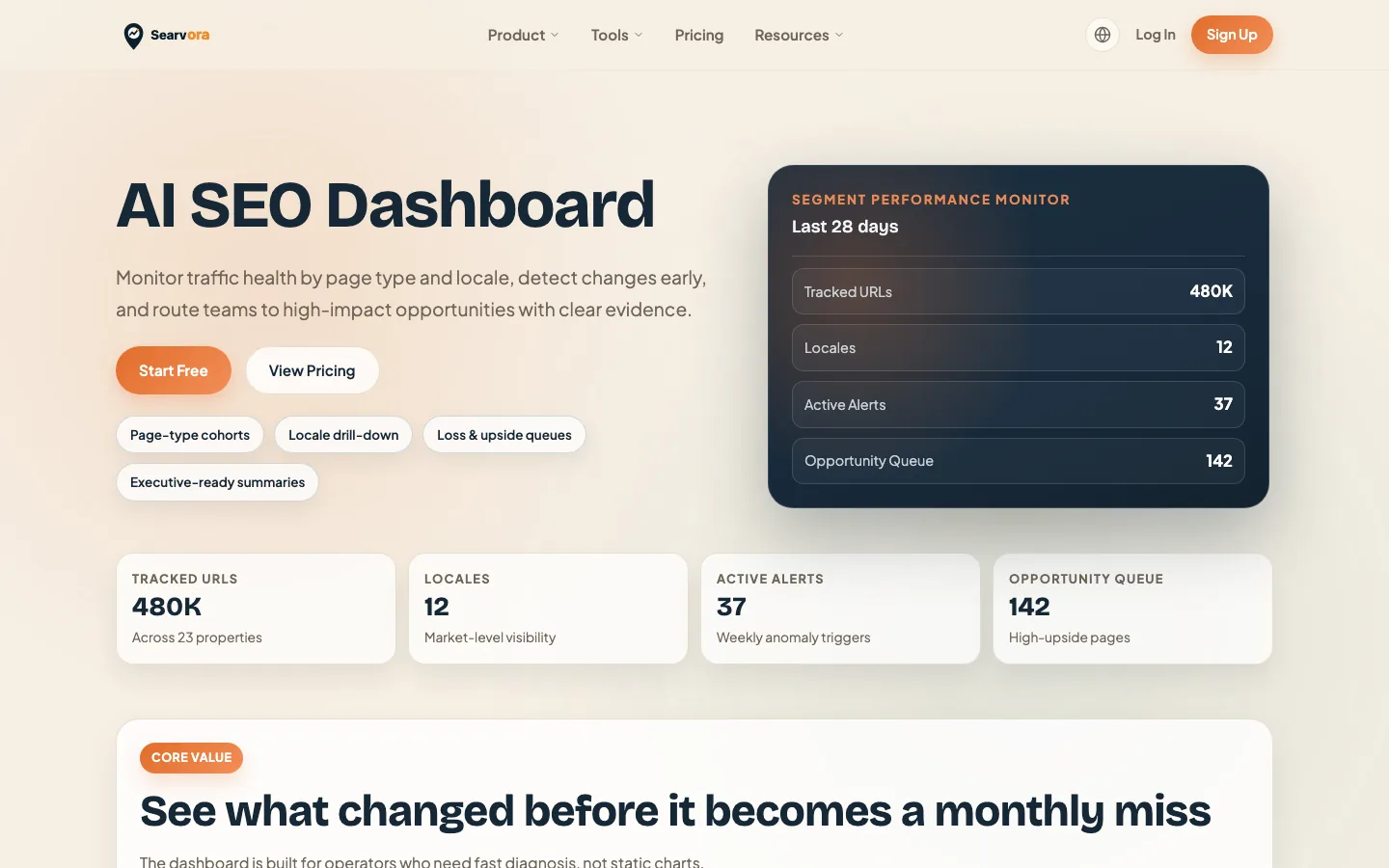
Searvora fits after the authority diagnosis is clear enough to become work. The AI SEO Consultant product page describes a workflow around pattern-based diagnosis, priority scoring, fix-ready guidance, and execution alignment. That is the planning layer authority projects need when the options include content refreshes, internal links, technical fixes, digital PR assets, and measurement tasks.
Use the consultant to turn authority evidence into an action queue:
| Evidence | Searvora workflow decision |
|---|---|
| Strong competitors, weak page proof | Refresh the page with better examples, sources, and decision tables |
| Good content, poor crawl access | Route fixes through technical SEO and crawler diagnostics |
| Good page, weak cluster support | Add internal links and hub context |
| Good asset, few references | Plan targeted outreach or digital PR around reader value |
| Authority work shipped | Monitor the page and cluster for visibility, citation, and crawl changes |
The useful goal is not to increase website authority as an abstract number. The useful goal is to make important pages more credible, easier to crawl, easier to cite, and easier for the team to improve on a repeatable cadence.