

What is domain rating? Domain Rating, often shortened to DR, is an Ahrefs authority metric that estimates the relative strength of a domain's backlink profile on a 0 to 100 scale. It is useful as a backlink context signal, but it should not become the goal of your SEO program.
The safe way to use Domain Rating is to treat it as one input in a decision. It can help you compare link environments, qualify prospects, and understand why some competitors may be harder to outrank. It cannot tell you whether a page is useful, indexable, aligned with intent, or ready for AI-search visibility.
Start With What Domain Rating Measures
Ahrefs' public help page for Domain Rating describes DR as a metric based on backlink profile strength relative to other sites in its database. The article also explains that the number is relative, not an absolute quality grade.
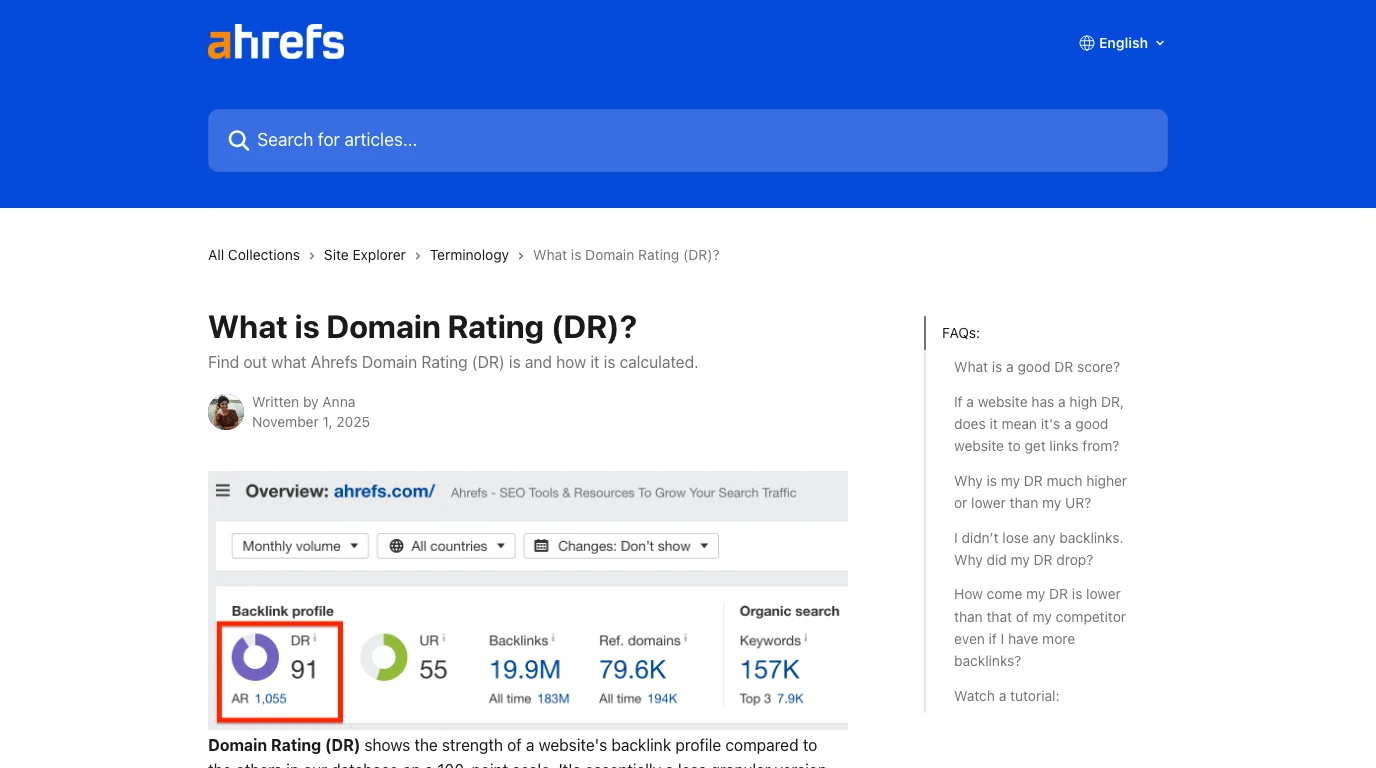
That distinction matters. A DR score can rise or fall because the wider link graph changes, because linking sites gain or lose strength, or because a domain earns more followed links. It does not inspect your content quality, crawlability, conversion path, internal links, or search intent fit.
Use this simple framing:
| Domain Rating can help you ask | Domain Rating cannot prove |
|---|---|
| Is this domain in a stronger backlink neighborhood than ours? | That a specific page deserves to rank |
| Are competitor sites winning with a much stronger link base? | That their content is better |
| Is a link prospect worth deeper review? | That the prospect is relevant or safe |
| Does this site need more credible external references? | That link building is the next priority |
| Is authority a possible constraint for this cluster? | That technical or content issues are absent |
Know When A High Or Low DR Actually Matters
A high DR can be meaningful when you are comparing competitors in the same market, screening relevant link opportunities, or deciding whether a young site should pursue lower-competition topics first. It is less useful when the decision is page-level, technical, or content-quality specific.
Ahrefs' own Domain Rating article frames DR as prominent but easy to misuse if you do not understand what it covers. That is the right mindset for SEO teams. The number can inform a hypothesis, but it should not replace diagnosis.
Use DR in these situations:
- Compare similar competitors before choosing the difficulty of a content cluster.
- Sort link prospects before checking relevance, editorial quality, traffic, and spam risk.
- Explain why a newer domain may need narrower long-tail topics before broad head terms.
- Spot whether authority is a likely bottleneck after content and crawl checks look clean.
- Monitor whether authority-building work is moving in the expected direction.
Be careful in these situations:
| Situation | Why DR can mislead | Better next check |
|---|---|---|
| A competitor outranks you with similar DR | The page may match intent better or have stronger internal links | Compare page type, H1, title, content depth, and internal links |
| Your DR rises but traffic is flat | The links may not support the pages that need demand | Review query mix, page-level links, and content priorities |
| A high-DR site offers a link | The site may be irrelevant, low quality, or risky | Check topical fit, outbound link patterns, and editorial context |
| A low-DR site ranks well | It may serve a narrow intent with better content | Study the page job before dismissing it |
| DR drops without lost backlinks | The relative scale may have shifted | Check page performance and link data before reacting |
Run Five Evidence Gates Before Turning DR Into Work
Domain Rating becomes operational only when it points to a specific action. Before you create content, pursue links, or rewrite strategy, pass the signal through five evidence gates.
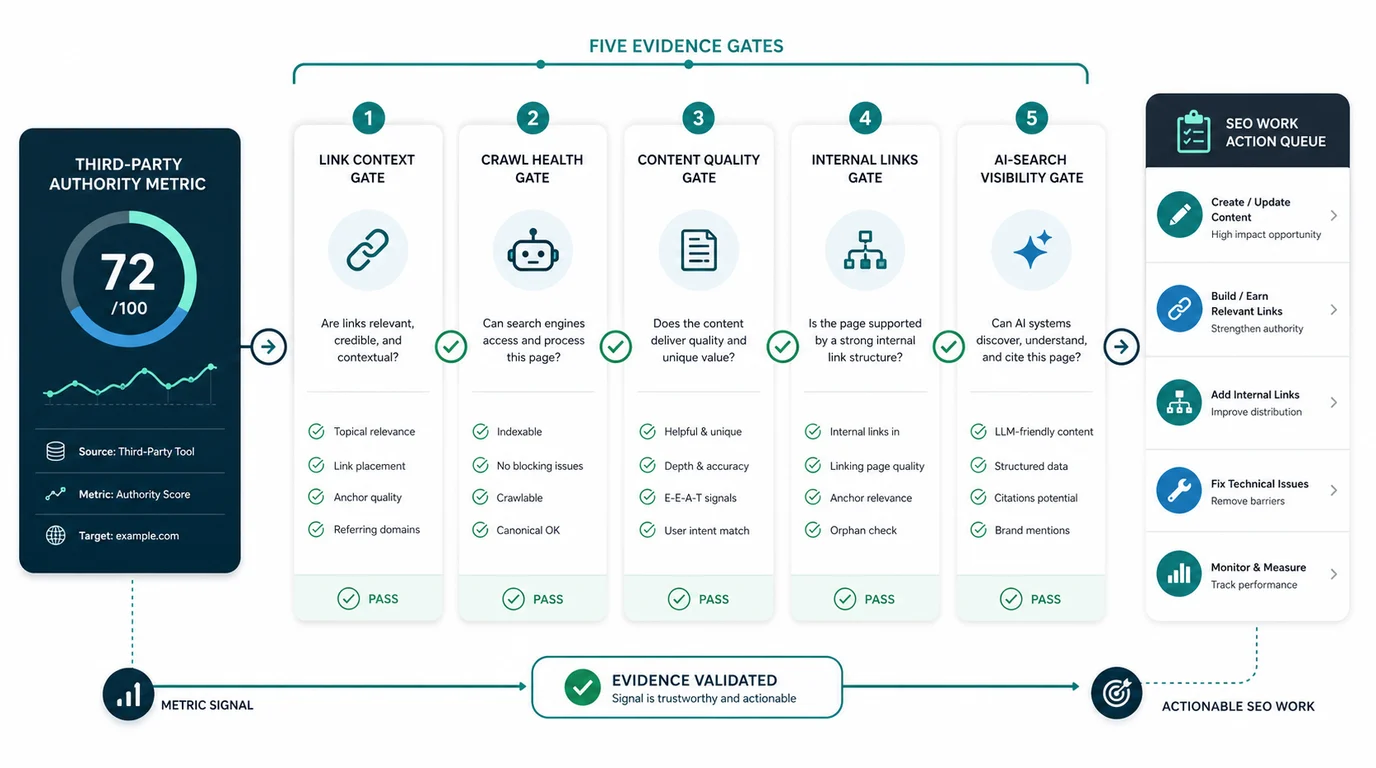
| Evidence gate | Question to answer | Action if the answer is weak |
|---|---|---|
| Link context | Are links relevant, credible, and placed in useful editorial context? | Do not chase the score; qualify the source first |
| Crawl health | Can search engines access and process the affected page? | Fix indexability, canonical, redirects, robots, or sitemap issues |
| Content quality | Does the page satisfy a real search job better than alternatives? | Improve the page or choose a better page type |
| Internal links | Is the important page supported by descriptive internal links? | Add links from relevant hubs, guides, and product pages |
| AI-search visibility | Can answer systems understand, summarize, and cite the page? | Add definitions, tables, examples, and clearer evidence |
This gate system prevents the common mistake of turning every authority score into link building. Sometimes the next action is a content refresh. Sometimes it is a crawl fix. Sometimes it is internal linking. Sometimes the honest move is to stop, because the metric is not connected to a page that matters.
For technical evidence, pair DR review with a crawl. A page with authority but blocked rendering, bad canonicals, broken links, or poor metadata can still underperform. The technical SEO workflow is the better companion when the issue might be access or template health.
Compare DR With Better Page-Level Signals
Domain Rating works at the domain level. Search performance usually changes at the page, template, or query-cluster level. That mismatch is why DR needs supporting metrics.
Use page-level signals to decide what to do next:
| If DR says | Check next | Likely decision |
|---|---|---|
| Competitors have much stronger domains | Their ranking pages, intent match, and linkable assets | Choose narrower topics or stronger information gain |
| Your site has enough authority but pages underperform | Crawl eligibility, title promise, content quality, and internal links | Fix the page before chasing more links |
| A link prospect has a high score | Topical relevance, traffic quality, outbound links, and editorial standards | Pursue only if it strengthens the right page cluster |
| A cluster has weak authority | Existing internal links and source depth | Build better references, examples, and link-worthy assets |
| AI answers ignore your brand or page | Extractable definitions, evidence, schema, and citations | Improve answer readiness, not just backlink count |
The broader SEO metrics to track workflow is useful here. It keeps authority metrics beside demand, snippets, access, experience, AI visibility, and revenue context instead of letting one score dominate the review.
Avoid Chasing DR With Risky Link Tactics
Domain Rating is link-based, so it can tempt teams into risky shortcuts. Do not buy links, build scaled link schemes, or judge prospects only by their score. Google's spam policies describe link spam as links created primarily to manipulate rankings, which is exactly the failure mode a score-chasing process can create.
Use this safer order:
- Build pages worth referencing.
- Add useful internal links from relevant pages.
- Earn mentions through original data, tools, templates, examples, or strong explanations.
- Qualify outreach prospects by relevance before authority.
- Track whether the linked page, not only the domain score, improves.
If a link issue looks risky, do not jump straight to panic cleanup. The Google disavow links workflow explains when link risk is serious enough to document, remove, or disavow. For everyday authority work, relevance and usefulness are the safer starting points.
Where Searvora Fits
Searvora fits after a third-party metric raises a question. The useful job is not to worship the DR number. The useful job is to turn the signal into a prioritized action: create a better page, improve internal links, fix crawl barriers, strengthen source depth, or monitor AI-search visibility.
Use the AI SEO consultant layer when a Domain Rating review produces several possible actions. It can help teams compare the affected page, user job, crawl evidence, content gap, link context, and validation method before assigning work.
Use Domain Rating carefully. Let it sharpen your questions about authority, competition, and link context. Then make the final decision from page-level evidence, technical eligibility, content quality, internal support, and the work your team can actually ship.