
If you are asking what is ziptie ai search analytics, the short answer is that ZipTie is a visibility monitoring workflow for checking how a brand appears across AI search surfaces, especially Google AI Overviews, ChatGPT, and Perplexity. The useful question is not only what ZipTie tracks. It is whether the data helps your team decide which source page, query group, or content fix should move next.
The public ZipTie.dev homepage positions the product around AI Search Intelligence, brand and product visibility, AI search monitoring, competitive landscape insights, and content optimization. That makes it relevant for teams moving from classic rank tracking into AI answer monitoring.
What ZipTie Appears To Track
ZipTie presents itself as an AI search visibility platform. Its public page says it helps monitor brand performance across Google AI Overviews, ChatGPT, and Perplexity, with guidance around query discovery, content optimization, country coverage, and performance views.
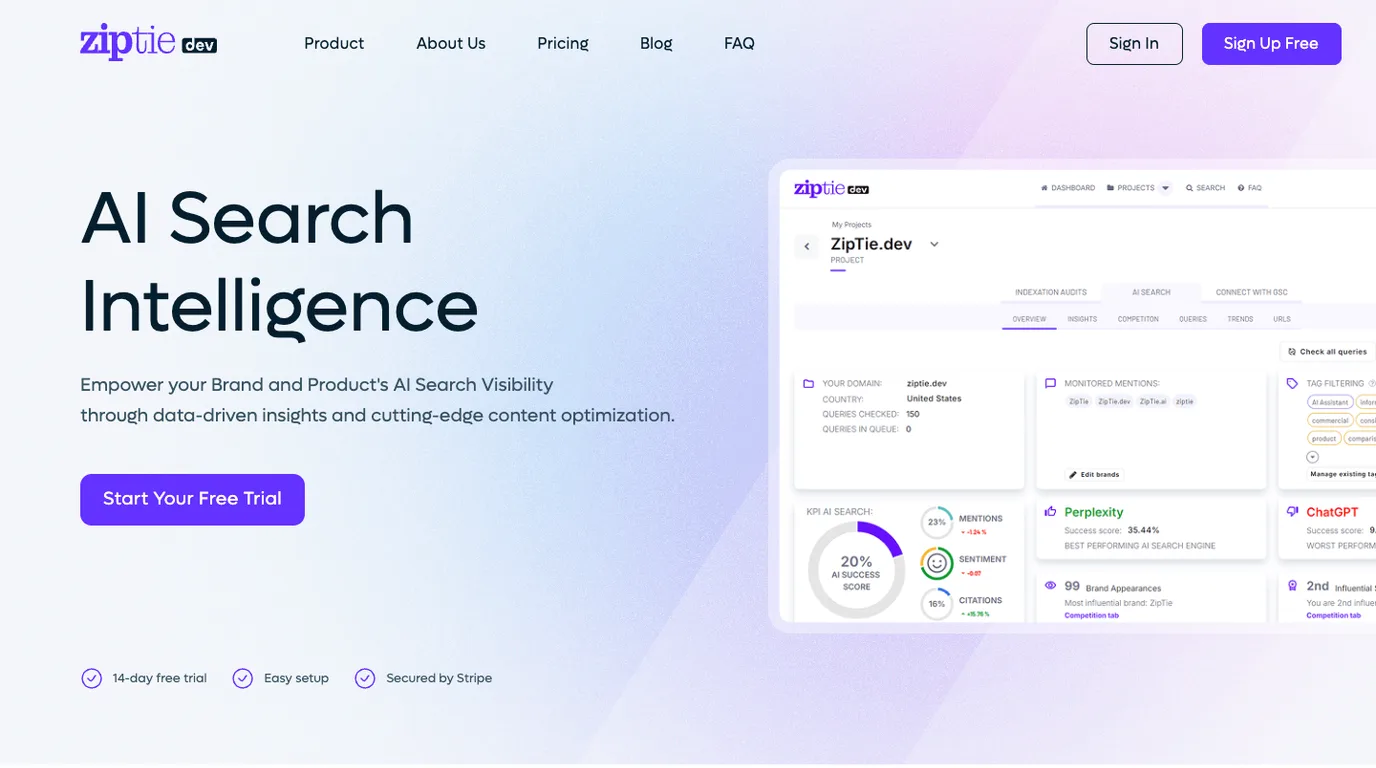
From a buyer's point of view, that puts ZipTie in the AI visibility and AI search analytics category, not in classic keyword rank tracking alone.
| Publicly visible capability area | What the SEO team should verify | Why it matters |
|---|---|---|
| AI search surface coverage | Which engines, countries, and query types are tracked | Coverage decides whether the data matches your market |
| Brand appearance monitoring | Whether mentions, citations, and source URLs are separated | A mention without a source page creates a different action than a citation gap |
| Query discovery | How suggested prompts are generated and controlled | Noisy prompts can make visibility look better or worse than it is |
| Content optimization guidance | Whether recommendations map to real source-page work | The team needs fixes, not just a score |
| Competitive views | How competitors are selected and grouped | Bad competitor sets create misleading trend lines |
When ZipTie Is A Good Fit
ZipTie is worth evaluating when the team needs a dedicated view of AI answer visibility. That usually happens when leadership is already asking whether the brand appears in AI answers, whether competitors are being cited instead, and whether new search surfaces are changing demand.
Use it when the job is:
- Build a repeatable prompt or query set.
- Monitor whether the brand appears across AI answer surfaces.
- Track competitors in the same answer set.
- Watch changes by country, category, or query group.
- Find pages that may need stronger source evidence.
Do not choose it only because the phrase "AI search analytics" sounds current. The product category is still young, and every team needs a different balance of prompt monitoring, source citation review, classic Search Console evidence, crawl health, and content execution.
What To Verify Before You Rely On It
The first mistake is treating AI visibility as one blended score. A useful AI search analytics setup separates the evidence before it creates recommendations.
| Evaluation question | Strong answer | Risky answer |
|---|---|---|
| Can we control the query set? | Queries are grouped by market, intent, product, and source page | The tool only generates broad prompts the team cannot audit |
| Are mentions separated from citations? | Brand mentions, owned source URLs, and competitor sources are separate fields | The report shows one visibility number with no source URL |
| Can we recheck the same observation? | The platform stores answer samples, dates, surfaces, and query variants | The team gets a weekly score but cannot inspect the evidence |
| Does the output create work? | Findings map to content, crawl, internal-link, or entity actions | Findings stop at "optimize content" |
| Can we compare with search data? | AI observations sit beside Search Console, analytics, and page cohorts | AI visibility is treated as a replacement for SEO measurement |
Google's guidance for AI features in Search keeps this practical: pages still need normal SEO foundations such as crawl access, internal links, helpful content, and index eligibility. OpenAI's ChatGPT Search help also explains that searched responses may show citations or source panels when sources are available. A monitoring tool should help you inspect that evidence, not replace the underlying page work.
How Searvora Frames The Same Problem
Searvora AI SEO Dashboard is useful when the AI search analytics question has to become a weekly SEO operating cadence. The dashboard product page is built around segment-first monitoring, anomaly and trend detection, opportunity scoring, and cross-team reporting.
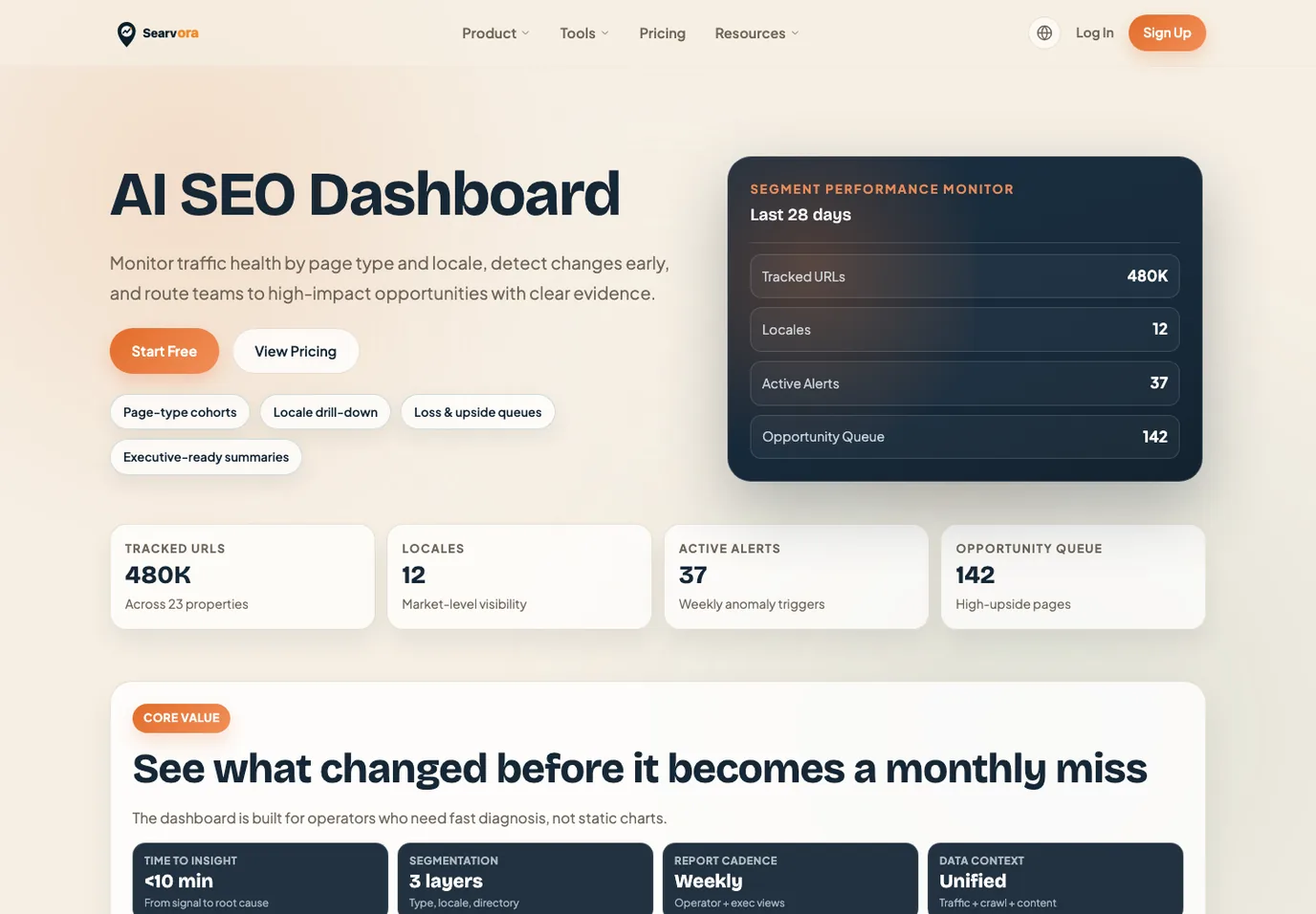
That is a different center of gravity. ZipTie is a candidate for dedicated AI answer monitoring. Searvora is strongest when the team needs to connect visibility changes with page groups, crawl evidence, owners, and shipped fixes.
Use this split:
| Team need | Better primary workflow |
|---|---|
| Watch brand presence in AI answers across several engines | Dedicated AI search analytics monitoring |
| Diagnose which page group lost visibility or needs work | Searvora AI SEO Dashboard |
| Turn observations into a prioritized roadmap | Searvora AI SEO Consultant plus dashboard evidence |
| Compare broad AI visibility tools before choosing a stack | Start with the best AI visibility tools roundup |
| Build a reusable AI visibility evidence loop | Use the AI visibility workflow as the parent process |
The Practical Buying Checklist
Before choosing ZipTie or any AI search analytics platform, run this short proof:
- Pick ten queries that represent real buying, support, and category tasks.
- Map the owned source page that should support each query.
- Check whether the tool records the answer state, brand mention, citation URL, and competitor source.
- Compare findings with Search Console and analytics movement for the same page group.
- Assign one fix for every gap: source-page rewrite, internal link, crawl issue, comparison page, or third-party evidence update.
- Recheck the same query set after the page has been crawled and the change has had time to appear.
If the tool makes that loop faster, it belongs in the stack. If it only creates a new score to explain in meetings, keep evaluating.
Bottom Line
ZipTie AI search analytics is best understood as a dedicated way to monitor brand and product visibility across AI search surfaces. It can be useful when the team needs AI answer evidence, competitor visibility, and query-level observations.
The decision comes after the screenshot, not before it. Ask whether the data can be rechecked, whether it separates mentions from citations, whether it points to the right source page, and whether your team can turn the result into a fix queue. That is where AI search analytics becomes SEO work instead of another dashboard to watch.