

Accurate search volume is the wrong goal if "accurate" means a single number you can trust without context. Keyword tools estimate demand from different sources, time windows, match rules, markets, and models. The safer SEO job is to decide whether a topic deserves a new page, an existing-page update, or quiet monitoring.
Treat search volume as a directional input. Then validate it against intent, owned performance data, existing coverage, crawl readiness, and business value before you approve a content brief.
The Short Answer
Search volume helps you compare demand, not prove the future value of a page. A keyword with higher volume can still be a bad page decision when the intent is wrong, the SERP is not article-led, the site already has a stronger URL, or the page cannot be crawled and measured after launch.
The Ahrefs page that surfaced this opportunity argues against chasing perfect search-volume accuracy. Searvora's information gain is the operating layer after that: turn imperfect volume into a repeatable decision workflow.
Use this rule:
Use Search Volume As A Range
The useful mental model is a confidence band. A keyword tool estimate is not a census of future visitors. It is a signal with a source, a date range, a geography, a match method, and a margin of uncertainty.
Google Ads Help describes Keyword Planner as a way to discover keyword ideas, view estimates of the searches they receive, and forecast campaign performance. It also notes that actual performance depends on factors such as bid, budget, ad quality, location targeting, products, industry trends, and customer behavior. That is enough to treat the number as useful, but not exact.
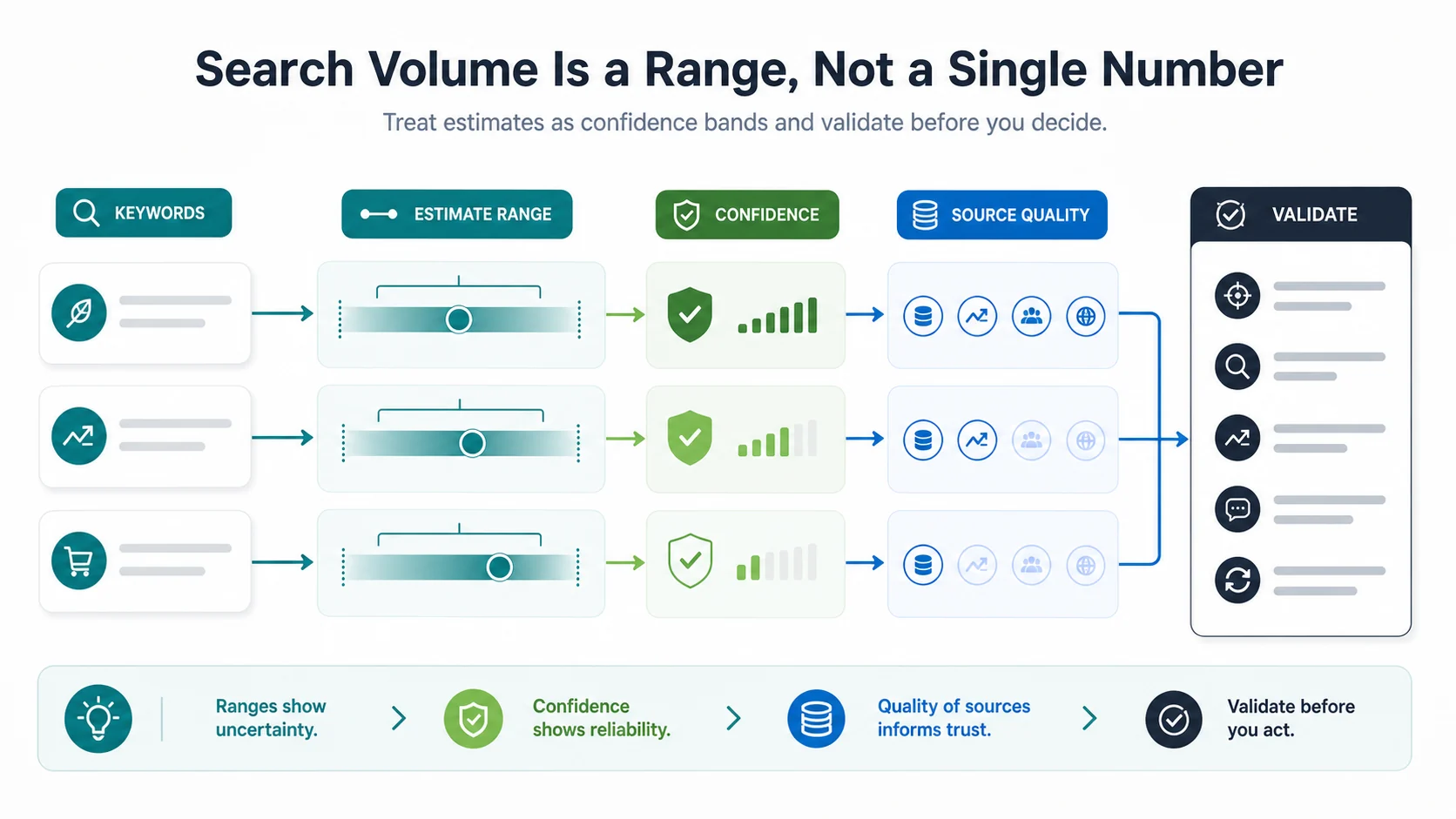
| Signal | Better use | Risk if you treat it as exact |
|---|---|---|
| Average monthly searches | Compare rough demand between keyword groups | Over-forecasting traffic from a rounded estimate |
| Trend direction | Spot rising, falling, or seasonal demand | Mistaking a spike for durable opportunity |
| Keyword difficulty | Estimate effort and competition | Replacing page quality and intent review with one score |
| Search Console impressions | See owned visibility for real queries | Assuming impressions equal available clicks |
| AI-search demand estimates | Decide what deserves monitoring | Mixing prompts, citations, referrals, and classic search into one metric |
If you need a tool-specific workflow, pair this article with the Google Keyword Planner for SEO guide. The point is not to ignore volume. The point is to keep it in the right lane.
Separate Demand From Page Value
Search volume is about demand. Page value is about the page that can satisfy that demand on your site.
Those are different questions:
| Question | Evidence to check |
|---|---|
| Is there demand? | Keyword tools, Trends, Search Console impressions, competitor traffic clues |
| What does the searcher want? | SERP shape, competitor page type, query modifiers, current ranking pages |
| Do we already answer it? | Published URL inventory, keyword map, title/H1 overlap, page task overlap |
| Can the page be discovered? | Crawlability, indexability, canonical status, internal links, sitemap inclusion |
| Is it worth the work? | Business fit, update effort, conversion path, expected measurement window |
This is why a low-volume keyword can still deserve a page and a high-volume keyword can still be deferred. The decision changes when the page task is specific, the current site has no same-job coverage, and the action after publishing is measurable.
For trend-heavy topics, Google Trends keyword research is a useful companion because Trends is built for relative interest, timing, geography, and topic comparison. It is not a replacement for volume or owned data.
Validate Estimates With Owned Evidence
Owned evidence keeps volume estimates from becoming spreadsheet theater.
Google's Search Console Performance report gives site-specific clicks, impressions, CTR, and average position. It will not tell you total market demand, and it does not include ad clicks, but it can show whether your verified site already has query or page evidence for a topic.
Use that owned evidence in four ways:
- Check whether an existing page already earns impressions for the target phrase or close variants.
- Compare CTR and average position before assuming volume can turn into traffic.
- Find pages with impressions but weak titles, snippets, internal links, or intent fit.
- Decide whether the next action is refresh, consolidation, internal linking, or a new page.
If the topic is also appearing in AI search discussions, keep that separate from classic search volume. The ChatGPT search volume measurement workflow explains why estimates, referrals, citations, crawlers, and Google Search data belong in different ledgers.
Decide Create, Update, Or Monitor
The output of keyword research should be a page decision. Search volume is one input in that decision.
Use this decision table:
| Evidence pattern | Better action |
|---|---|
| High estimate, article-led intent, no same-job Searvora page | Create a focused article with a clear validation plan |
| High estimate, same core keyword already covered | Update, consolidate, or strengthen internal links instead of splitting authority |
| Medium estimate, strong business fit, clear page job | Create or refresh if the page can be measured after launch |
| Low estimate, high buyer relevance, weak current coverage | Consider a precise child article or landing-page section |
| High estimate, tool or template intent | Build a tool, template, landing page, or downloadable asset instead of forcing a blog |
| Unclear estimate, unclear intent | Monitor, gather SERP evidence, or wait for owned impressions |
The key is to separate "people search this" from "we should publish a new URL." A topic can be valid and still not need a new article today.
Where Searvora Fits
Searvora's AI SEO Consultant is useful when keyword research needs to become a ranked action queue. The product page positions it around pattern diagnosis, priority scoring, fix-ready guidance, and execution alignment. Those are the exact controls needed when volume estimates disagree or feel too broad to trust.
Use Searvora to structure the decision:
| Searvora step | What it clarifies |
|---|---|
| Signal intake | Which keyword, Search Console, crawl, and content signals belong in the same review |
| Issue modeling | Whether the topic is a content gap, an overlap problem, a technical blocker, or a reporting question |
| Action ranking | Whether create, update, consolidate, or monitor is the highest-confidence next step |
| Team handoff | Who owns the brief, crawl check, rewrite, link update, or measurement window |
Do not use Searvora to claim a magic exact search volume. Use it to turn imperfect evidence into a decision the team can defend.
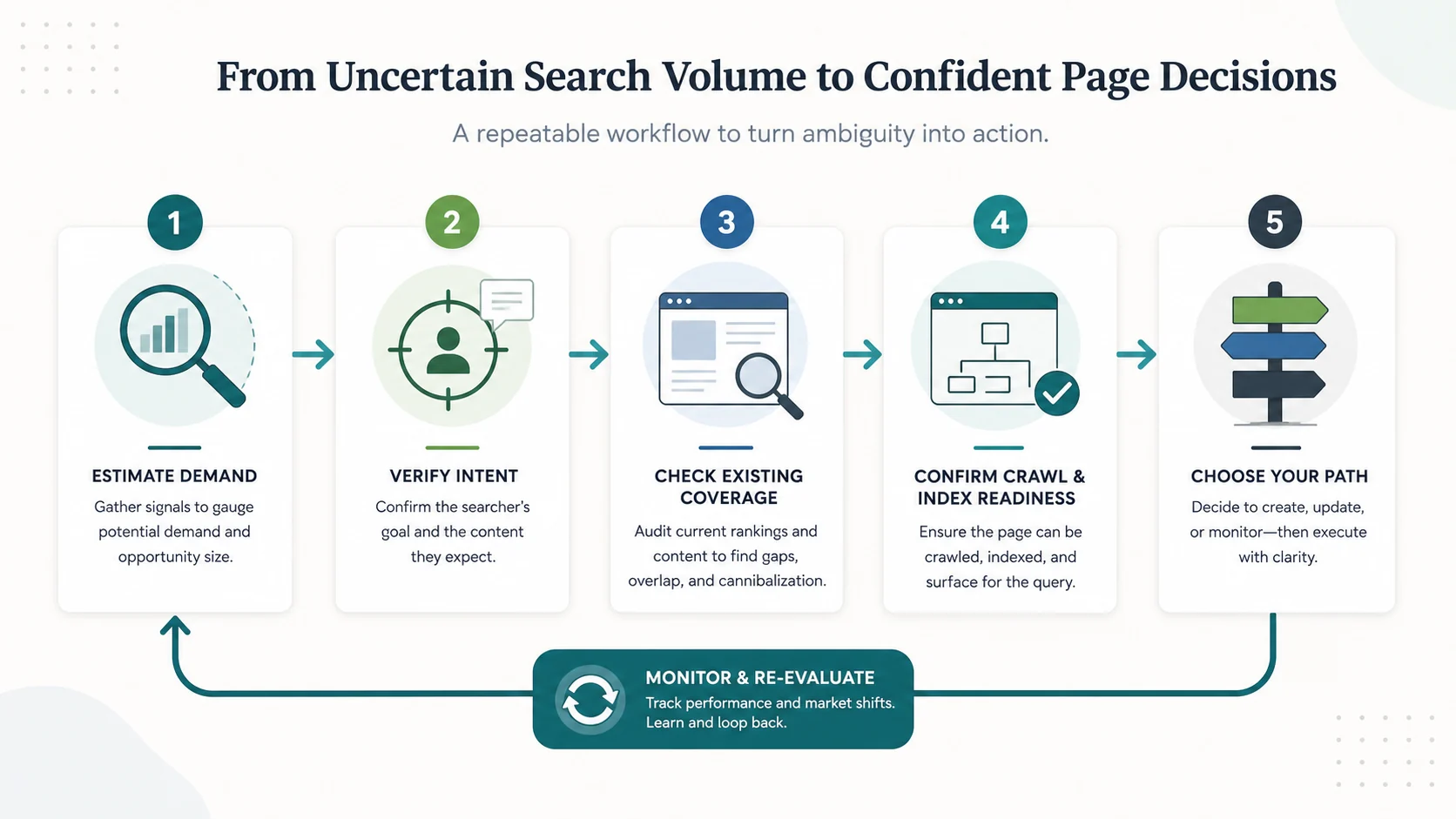
A Safer Search-Volume Workflow
Use this workflow when a keyword estimate looks tempting but uncertain:
- Record the source, date range, geography, and match assumptions.
- Treat the estimate as a range, not a promise.
- Confirm the user job and page type from the query and competitor page shape.
- Check whether an existing Searvora URL already covers the same keyword, page type, and task.
- Validate with Search Console impressions, clicks, CTR, and position when owned data exists.
- Check crawlability, indexability, canonical status, sitemap coverage, and internal links before assigning a new page.
- Decide create, update, consolidate, or monitor.
- Set a recheck window so the decision can be measured after shipping.
Accurate search volume is less important than decision quality. The best teams do not wait for perfect numbers. They use directional estimates, validate the page job, and ship the next action with enough evidence to learn.