

Ahrefs SEO metrics are useful when they help you ask sharper questions. They become risky when a team treats them as goals by themselves. A higher Domain Rating, lower Keyword Difficulty, bigger traffic estimate, or larger keyword count can all be useful signals, but none of them can decide what your site should ship next without page-level evidence.
Use Ahrefs metrics as a translation layer: first understand what each number is trying to measure, then connect it to a decision, a validation source, and an owner. That keeps the workflow practical and prevents third-party scores from replacing SEO judgment.
Start With The Job Behind The Metrics
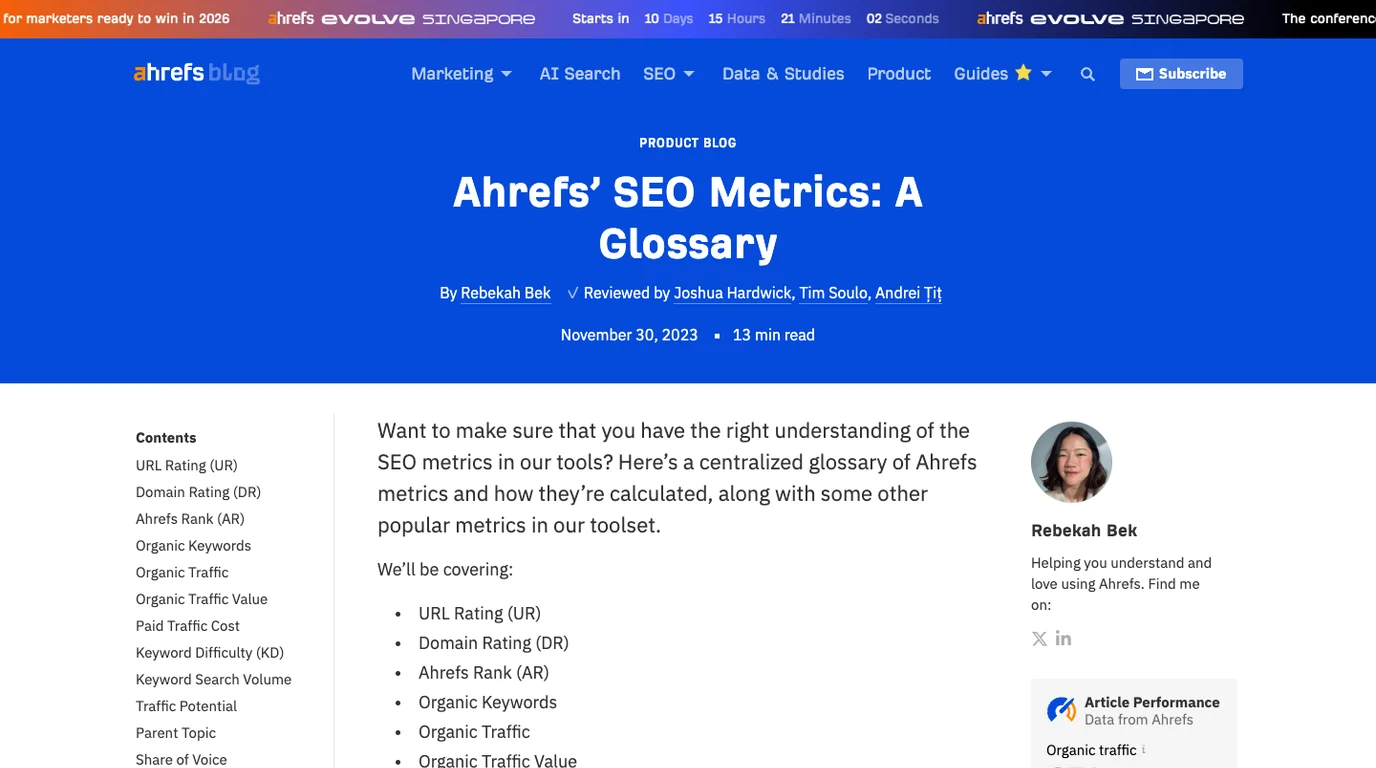
The official Ahrefs SEO metrics glossary explains Ahrefs-specific metrics such as URL Rating, Domain Rating, Ahrefs Rank, Organic Keywords, Organic Traffic, Organic Traffic Value, Paid Traffic Cost, Keyword Difficulty, Traffic Potential, Search Volume, Parent Topic, Share of Voice, Organic Pages, and Crawled Pages.
That page is useful because it centralizes the vocabulary. The Searvora workflow starts after vocabulary: what decision should the metric change?
Use this first-pass map:
| Ahrefs metric family | Useful question | Do not use it to prove |
|---|---|---|
| Link strength | Is authority or link context likely to affect this opportunity? | That a page deserves to rank |
| Keyword demand | Does the topic appear to have search demand? | That the keyword deserves a new page |
| Traffic estimates | Which pages or competitors deserve review first? | That the estimate is your actual traffic opportunity |
| Difficulty signals | How hard might the query be compared with alternatives? | That a low score makes the brief safe |
| Topic grouping | Which parent or sibling topics should be studied together? | That every related keyword needs its own URL |
| Crawl and page counts | Where should technical review start? | That all crawled pages are indexable, useful, or prioritized |
This is the main difference between reporting and operating. A report says the metric moved. An operating workflow says what the team should inspect, fix, or ignore because it moved.
Read Link Metrics As Context Signals
Ahrefs link metrics are most useful when they help you understand the competitive environment around a page or domain. Domain Rating can help you compare backlink profile strength at the domain level. URL Rating can help you inspect page-level link strength. Ahrefs Rank can provide another relative view of backlink profile strength.
Ahrefs' public Domain Rating help page describes DR as a backlink-profile strength metric. That source boundary matters. A link metric can support an authority hypothesis, but it does not inspect content usefulness, search intent fit, crawl eligibility, canonical state, or AI-search citability.
Use link metrics this way:
| If the metric shows | Check next | Safer action |
|---|---|---|
| Competitors have stronger domains | Their ranking pages, content structure, and source depth | Choose a narrower page job or stronger information gain |
| One page has stronger URL-level link context | Internal links, external references, and page usefulness | Improve support for the page that actually matters |
| A prospect looks strong by score | Topical relevance, editorial standards, and outbound link patterns | Qualify the source before outreach |
| Your authority score rises but traffic is flat | Query mix, CTR, index state, and affected pages | Diagnose the page cluster before chasing more links |
The companion Searvora article on Domain Rating goes deeper on that score. The short version is simple: use authority metrics to sharpen questions, not to end the conversation.
Treat Traffic And Keyword Metrics As Estimates
Organic Traffic, Organic Keywords, Traffic Value, Search Volume, Keyword Difficulty, Traffic Potential, and Parent Topic can help a team prioritize research. They are not first-party analytics and they are not a publishing mandate.
Use these metrics to decide what deserves inspection:
- Organic Keywords can reveal whether a page is winning one query or a broader cluster.
- Organic Traffic can help sort competitor pages for review, but it should not be copied into forecasts.
- Traffic Value can hint at commercial pressure, especially when paid search would be expensive.
- Keyword Difficulty can help compare topics, but the real barrier may be intent fit, page type, authority, or technical eligibility.
- Traffic Potential and Parent Topic can prevent over-fragmented briefs by showing when a broader page may serve the cluster.
Then validate with first-party or page-level evidence. Google's Search Console performance report is the natural baseline for owned pages because it shows queries, pages, countries, devices, clicks, impressions, CTR, and average position. Pair that with a crawl, title/H1 review, internal links, and the actual page job.
| Ahrefs signal | Decision it can support | Validation source before work starts |
|---|---|---|
| High competitor traffic | Review the page intent and structure | Page snapshot, SERP shape when needed, existing Searvora coverage |
| Many ranking keywords | Decide whether this is a hub, article, tool, or landing page | Query grouping, page type, internal link map |
| Low difficulty | Consider a faster publishing opportunity | Search intent, authority gap, content quality, crawl eligibility |
| Strong parent topic | Avoid splitting a cluster too early | Existing URL coverage, cannibalization check, hub plan |
| High traffic value | Prioritize commercial review | Funnel fit, CTA relevance, product page route |
The SEO metrics to track workflow is useful here because it keeps third-party estimates beside demand, snippets, access, authority, experience, AI visibility, and revenue context.
Translate Each Metric Into One SEO Decision
The safest way to use Ahrefs SEO metrics is to force every signal through the same decision frame. Do not ask "is this number good?" Ask "what should this number change?"
Use this operating table:
| Metric movement | Possible meaning | Decision to make | Validation check |
|---|---|---|---|
| Competitor page has high estimated traffic | The page may serve a valuable search job | Create, refresh, defer, or ignore based on page type | Same keyword, same page type, same user job check |
| Keyword count is broad | The page may act as a parent hub | Build a hub, child article, landing page, or no page | Cluster map and internal links |
| DR or UR gap is large | Authority may be a constraint | Narrow the topic, improve proof, or build references | Page-level links, relevance, source quality |
| KD looks low | The opportunity may be accessible | Approve only if intent and page type are clear | SERP review when URL/page evidence is ambiguous |
| Organic traffic estimate is falling | The competitor may be losing fit or demand | Study the change before copying the angle | Current page content, title, update date, query mix |
| Parent Topic differs from your draft keyword | The planned page may be too narrow | Merge, retitle, or route to a broader asset | Existing Searvora coverage and cannibalization risk |
This is also how the competitor URL lane should be judged. A high-traffic competitor page deserves deep review, but traffic alone is never approval. The useful output is a page decision with an information-gain angle.
Check Ahrefs Signals Against First-Party Evidence
Ahrefs can tell you where to look. First-party evidence tells you whether the work is real for your site.
Before assigning work, compare Ahrefs signals against four evidence layers:
- Search evidence: Search Console query, page, CTR, and position movement.
- Crawl evidence: indexability, canonical state, redirects, internal links, metadata, and status codes.
- Content evidence: page type, H1, title promise, source depth, examples, and intent match.
- Business evidence: product fit, funnel role, owner, and validation date.
If a metric cannot survive those checks, it should stay in research notes. If it survives, turn it into a task with a specific affected URL, owner, next action, and success signal.

For example:
| Ahrefs finding | Weak response | Better response |
|---|---|---|
| Competitor page has many keywords | Write the same article | Identify the user job, compare existing URLs, and define information gain |
| DR gap looks intimidating | Buy links or abandon the topic | Check page-level relevance, internal links, source depth, and easier child queries |
| KD is low | Approve a brief immediately | Confirm SERP intent, page type, and whether Searvora has a better answer |
| Traffic Potential is broad | Stuff every variant into one article | Choose parent hub, child page, or supporting article deliberately |
| Organic Traffic Value is high | Force a sales CTA | Match the CTA to the actual funnel stage and reader task |
The Ahrefs tutorial article uses the same principle for reports: tool output is a source signal, not the finished work queue.
Where Searvora Fits
Searvora fits after a third-party metric creates a question. The local AI SEO Consultant product page positions the product around pattern diagnosis, priority scoring, fix-ready guidance, and execution alignment. That is the missing layer when Ahrefs metrics create multiple possible actions.
Use the AI SEO Consultant workflow to:
- Convert Ahrefs metric movement into a page, cluster, or template hypothesis.
- Compare the hypothesis against existing Searvora URLs before drafting.
- Separate article opportunities from landing pages, tool pages, hubs, and updates.
- Score the work by impact, confidence, effort, and risk.
- Hand the task to SEO, content, product, or engineering with a validation method.
Metrics are valuable when they move work forward. They are dangerous when they become a scoreboard detached from pages, users, and validation.
Ahrefs SEO Metrics Checklist
Use this checklist whenever Ahrefs metrics enter a planning meeting:
- Name the metric and the Ahrefs source that defines it.
- Decide whether it is a link, keyword, traffic, difficulty, topic, or crawl signal.
- Write the decision it might change in one sentence.
- Check whether an existing Searvora URL already covers the same keyword, page type, and user job.
- Validate the signal with first-party performance, crawl, content, and business evidence.
- Decide whether the right response is create, refresh, merge, improve internal links, fix technical issues, monitor, or ignore.
- Assign an owner, next action, and validation date.
- Keep the metric in the workflow only if it changes future decisions.
Ahrefs SEO metrics are strongest when they help a team notice opportunity, risk, or context sooner. They are weakest when they become targets by themselves. Read the numbers, validate the evidence, and turn only the useful signals into work your team can actually ship.