

ChatGPT search volume is not one metric. It can mean estimated prompt volume, search-like prompts inside ChatGPT, referrals from AI answers, cited source appearances, crawler access, or demand that later returns through Google, branded search, direct traffic, or a sales conversation.
That distinction matters because a big estimate does not automatically mean a big traffic channel. Treat ChatGPT search volume as a hypothesis about demand and behavior. Then validate it against pages, citations, referrals, crawl access, and classic search performance before rewriting your content plan.
The Short Answer
Use ChatGPT search volume to ask better SEO questions, not to replace your existing reporting. The useful question is not "is ChatGPT catching Google?" The useful question is "which source pages, product pages, or articles should we improve because AI answer systems are changing how people discover information?"
The Ahrefs article that surfaced this opportunity frames the market around third-party estimates comparing ChatGPT demand with Google-driven website traffic. Searvora's information gain is the next step: separate the signals before deciding whether to create, refresh, consolidate, or monitor a page.
Use this split:
| Signal | What it can tell you | What it cannot prove alone |
|---|---|---|
| ChatGPT demand estimate | AI-search behavior may be growing for the topic | Your site will receive comparable clicks |
| AI referrals | Users clicked through from an AI surface | The full demand or citation picture |
| Citations and source panels | A page is being used as evidence | That the page drove a session or conversion |
| AI crawler access | Your site can be discovered by relevant bots | That the page is useful enough to cite |
| Search Console movement | Google clicks, impressions, queries, and pages | Whether an AI answer influenced the user earlier |
Separate Volume From Traffic
Search volume is demand. Traffic is click behavior. AI search makes the gap between those two larger because an answer can satisfy part of the task before the user visits a website.
OpenAI's ChatGPT Search help explains that search can use web information and show links to relevant sources. OpenAI's crawler documentation also separates OAI-SearchBot for ChatGPT search features from other crawler purposes. For SEO teams, that means eligibility, citation, and referral measurement are connected but not identical.
Google's AI features guidance keeps the baseline grounded in normal SEO: useful, accessible pages still matter. Google's Search Console Performance report remains the place to review Google queries, pages, clicks, impressions, CTR, and position.
That gives you a practical reporting model:
- Estimate demand with clear source notes and date ranges.
- Check whether AI search actually cites or links to your pages.
- Separate human AI referrals from crawler requests.
- Compare Google Search Console movement for the same page group.
- Ship one page improvement, then recheck the same signals.
Keep Five Ledgers Before You Decide
The fastest way to overreact is to let one ChatGPT search volume number explain every channel. Keep five ledgers first.
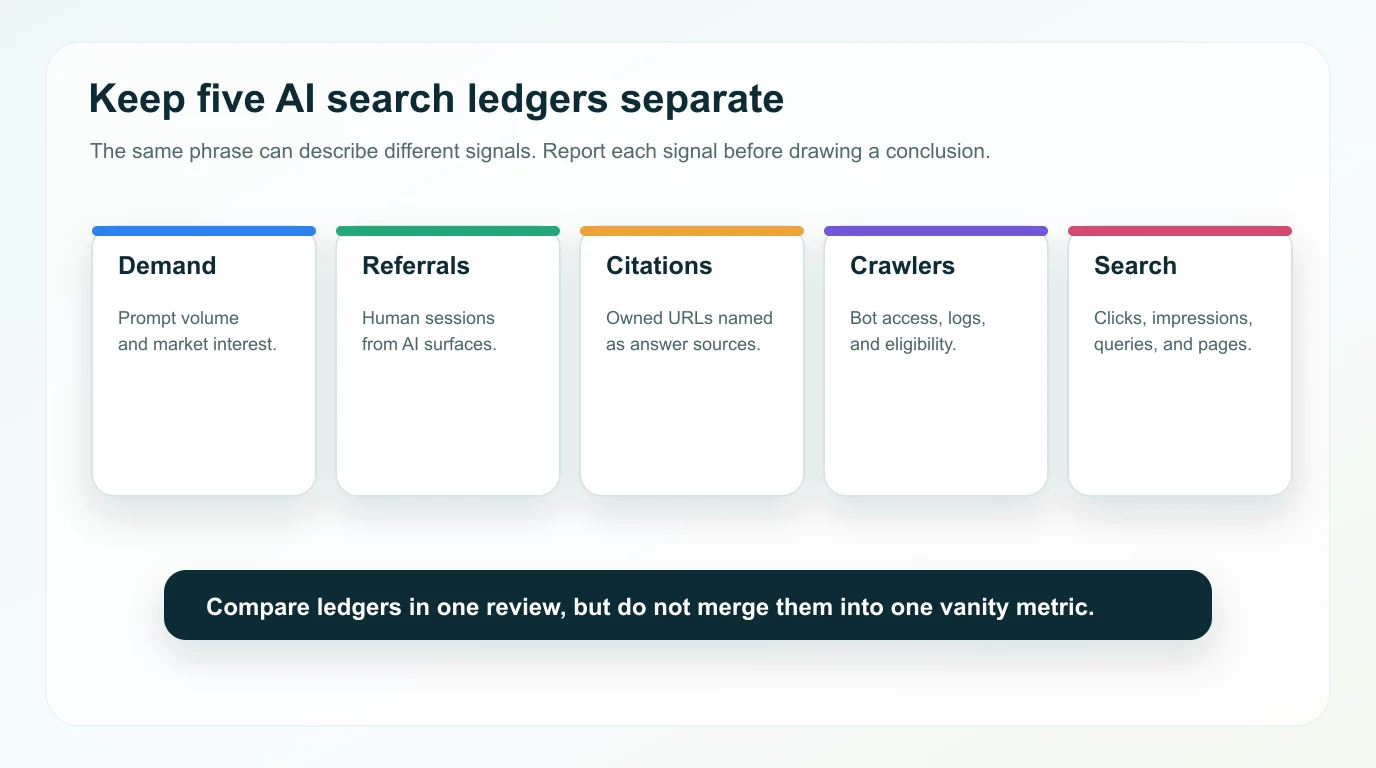
| Ledger | Include | Review question |
|---|---|---|
| Demand estimates | Source, method, date, geography, and whether the estimate is prompt volume or search-like intent | Is the topic worth monitoring or expanding? |
| AI referrals | Source names, landing pages, sessions, engagement, and conversion quality | Did users actually click from an AI surface? |
| Citation evidence | Query, answer surface, cited source URL, observed date, and answer context | Which page is being used as evidence? |
| Crawler access | OAI-SearchBot, GPTBot, Googlebot, server logs, robots.txt, and blocked paths | Can answer systems and search engines access the page? |
| Classic search | Search Console queries, pages, clicks, impressions, CTR, and position | Did Google demand or visibility move in the same window? |
If the question is specifically why AI traffic is smaller than Google traffic, pair this with the AI website traffic measurement workflow. If you need analytics implementation details, use the GA4 AI traffic tracking workflow.
Use The Number As A Hypothesis
A ChatGPT search volume estimate becomes useful when it changes the next review, not when it triggers a panic rewrite.
Use this decision table:
| Pattern | What it suggests | Next action |
|---|---|---|
| High estimated AI demand, no citations, weak crawl access | The topic may matter, but your pages may not be eligible or clear enough | Check robots rules, canonical status, internal links, and source-page specificity |
| High estimated AI demand, citations present, low referrals | AI visibility may be influencing research without many clicks | Improve cited pages and track branded search, product-page movement, and assisted demand |
| Low estimated AI demand, strong Google demand | Classic search still owns the channel | Keep normal SEO prioritization and monitor AI surfaces lightly |
| AI referrals rising, Search Console steady | AI may be adding incremental discovery | Review landing-page fit and conversion quality before expanding content |
| Both AI and Google signals declining | The issue is probably broader than ChatGPT | Run a page-quality, crawl, and intent review before creating new pages |
For a broader answer-system workflow, use the AI visibility evidence loop. It keeps the work tied to source pages, citations, crawl access, and rechecks rather than a single headline number.
Where Searvora Fits
Searvora's AI SEO dashboard is useful when ChatGPT search volume needs to become a repeatable review instead of a one-off debate. The product page positions the dashboard around page-type cohorts, locale performance, anomaly detection, opportunity queues, and executive-ready summaries. Those are the controls an SEO team needs when AI-search signals must be compared with organic performance.
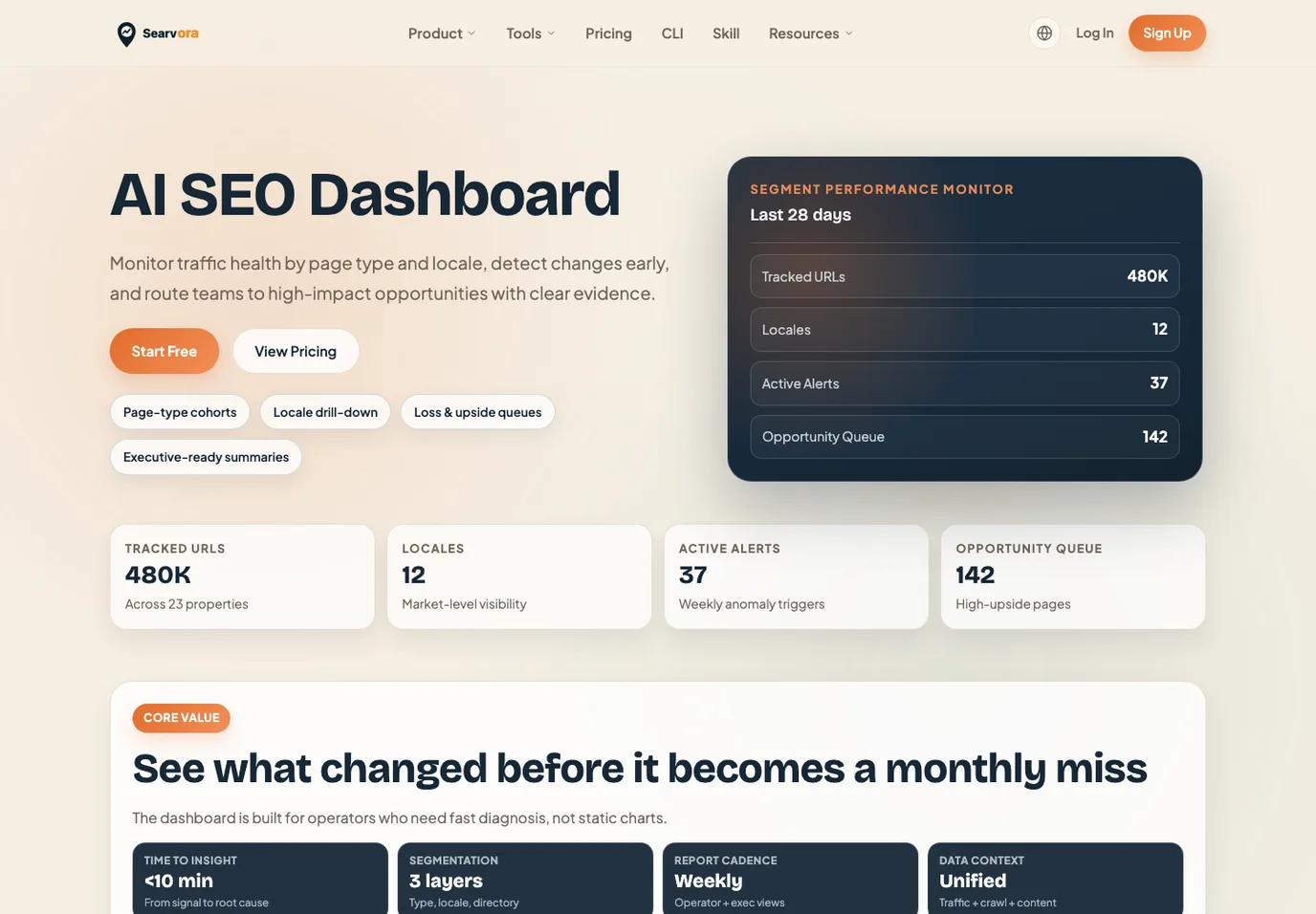
Use the dashboard layer to keep the review operational:
| Dashboard view | What to inspect | Decision it supports |
|---|---|---|
| Page-type cohort | Product, comparison, blog, support, or glossary page movement | Which page type deserves the next fix? |
| Locale drill-down | Market-level shifts in search and AI visibility | Whether the issue is global or market-specific |
| Loss and upside queues | Pages with movement and business value | Which page should get the owner and validation window |
| Executive summary | Signals separated by channel and page group | Whether leadership sees risk, opportunity, or noise |
Do not use Searvora as a magic answer to "how many ChatGPT searches exist." Use it to decide which pages should be measured, fixed, linked, refreshed, or left alone.
Turn Estimates Into A Validation Loop
The right response to ChatGPT search volume is a loop you can repeat.
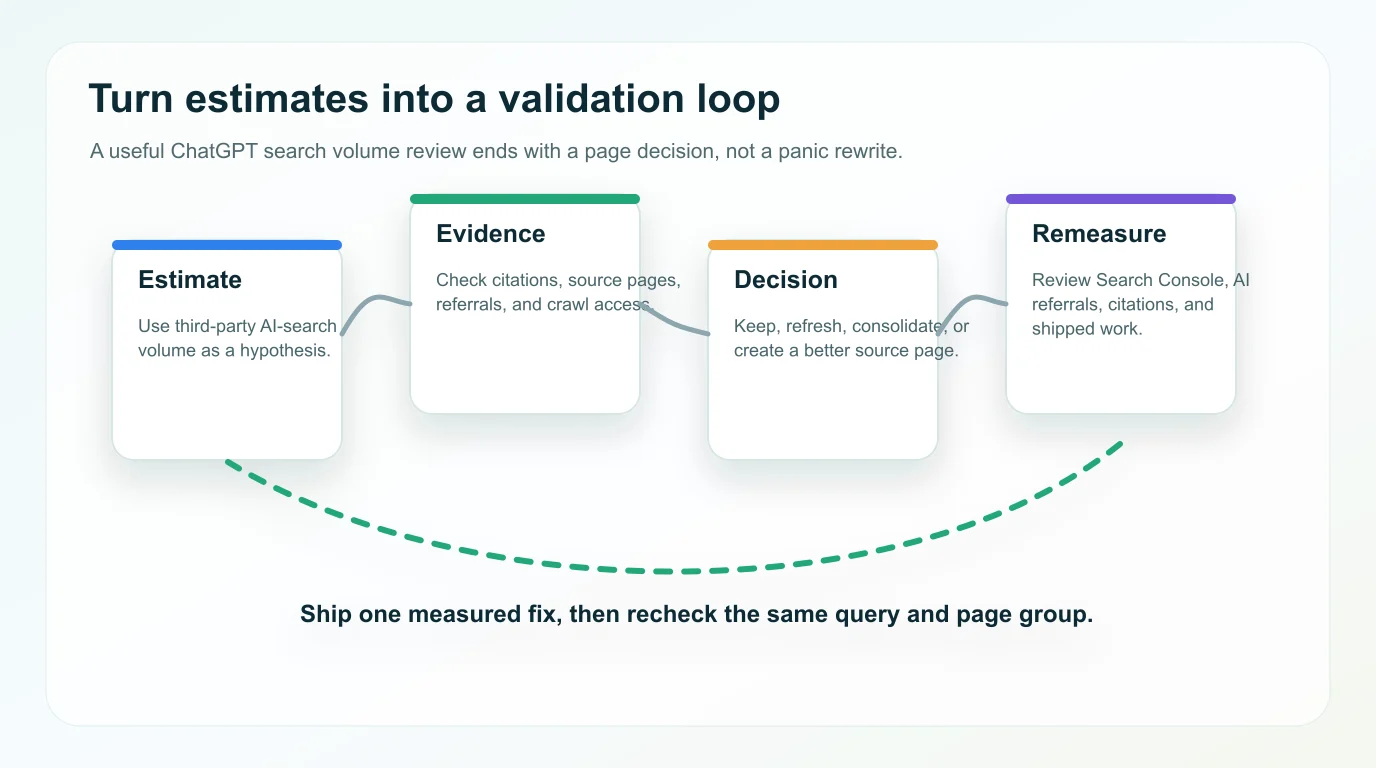
Run it like this:
- Write down the estimate source, method, date, and query category.
- Choose one page group that could reasonably satisfy that demand.
- Check crawl access, indexability, canonical status, and internal links.
- Log whether AI answers cite your page, a competitor, or no source.
- Compare Google Search Console movement for the same page group.
- Decide whether to keep, refresh, consolidate, create, or monitor.
- Assign one owner and one validation window.
The output should be a small action queue, not a vague AI-search strategy memo.
What To Report
Report ChatGPT search volume in plain language:
- What the estimate measures and where it came from.
- Which AI-search, crawler, citation, referral, and Google signals were checked.
- Which page group is affected.
- What action shipped or was intentionally skipped.
- When the same signals will be rechecked.
That is the safer way to use ChatGPT search volume. It can reveal changing demand, but it does not tell you which URL to rewrite by itself. Treat the number as an early signal, connect it to crawlable source pages, and let the validation loop decide the next SEO action.