

Affordable SEO services are small, clearly bounded engagements that solve one important search problem and leave behind evidence your team can use. They are not simply full-service SEO sold at the lowest monthly price.
The safest way to spend a limited budget is to buy the narrowest complete workflow: define the problem, inspect the right evidence, ship or assign the work, and verify the result. If a package stops at a generic report or hides the delivery method, a low invoice can create expensive cleanup.
The competing Ahrefs guide to affordable SEO services usefully separates audits, keyword research, and content as distinct purchases. This guide adds the procurement layer: which package fits which bottleneck, what proof should be included, and when a low-cost service is a false economy.
Start With One Bottleneck, Not a Discount Package
A lean budget cannot solve every technical, content, authority, local, and measurement problem at once. It can still fund useful SEO if the scope starts with a specific decision.
| Current bottleneck | Affordable first purchase | Required handoff | Avoid buying first |
|---|---|---|---|
| Search engines cannot reliably access or interpret important pages | Technical baseline and prioritized fix queue | Affected URLs or templates, evidence, severity, owner, validation method | A 100-page export with no priorities |
| The team does not know which pages should target which searches | Search-demand and page map | Keyword clusters, intent, page type, existing URL ownership, gaps | A raw keyword spreadsheet |
| Traffic exists but important pages are stale or weak | Priority-page refresh sprint | Before/after brief, source updates, internal-link changes, QA checklist | A fixed number of new posts |
| A local business has weak location visibility | Local search foundation | Business profile checks, location-page needs, citation issues, review process | Bulk directory submissions |
| Work ships but nobody can tell what changed | Measurement and validation setup | Baseline, change log, review window, owners, decision thresholds | A dashboard with no action rules |
The word affordable should describe the total path to a useful outcome. A cheap audit that requires another vendor to interpret it may cost more than a focused audit that includes priorities and a recrawl.
Five Affordable SEO Services Worth Buying First
These are service shapes, not universal bundles. Choose the one that resolves the constraint stopping your team today.
1. A technical SEO baseline with a fix queue
This package should crawl the site, identify the highest-impact access and indexability risks, group issues by template, and translate them into owner-ready actions. It is most useful before a redesign, migration, major content push, or recovery project.
The deliverable should name affected URLs, likely cause, business impact, implementation owner, and validation step. If the provider only exports every warning a crawler can find, the service is incomplete.
For a deeper view of audit scope and cost drivers, use the site audit cost framework.
2. A search-demand and page-ownership map
Keyword research becomes affordable when it prevents the wrong page from being created. Ask for clusters tied to intent, page type, existing URLs, and a clear create-versus-update decision.
The provider should show which query group belongs on a product page, landing page, article, comparison, tool, or existing section. That turns research into a controlled content queue and reduces future cannibalization.
3. A priority-page refresh sprint
Refreshing a small set of proven pages is often more defensible than buying a large batch of new articles. The scope should identify why each page deserves work, what evidence is stale or missing, which search task it should own, and how the update will be checked after publication.
Require a change log. A refresh should document updated claims and sources, structural changes, internal links, metadata, and the post-change review window.
4. A local search foundation
For a local business, a narrow foundation package can cover business information consistency, Google Business Profile hygiene, location-page ownership, review operations, and crawlability of key service areas.
Avoid packages that promise visibility through bulk directory submissions alone. The useful work is building consistent entity information, credible local proof, indexable location content, and a repeatable way to manage changes.
5. Measurement and validation setup
If recommendations already exist, the next affordable purchase may be measurement rather than more advice. Ask for a baseline, annotated change log, page or template segments, a review cadence, and decision rules for continuing, changing, or stopping a workstream.
Measurement should connect delivery to site evidence and search outcomes. Rankings or traffic alone cannot show whether a provider completed the agreed work, and task counts alone cannot show whether the work helped.
Use a Scope-to-Proof Workflow
The service should move through five gates: budget boundary, specific site problem, evidence, ownership, and validation.

- Set the boundary. Define the available budget, internal time, access, and implementation capacity.
- Choose one site problem. Name the page group, template, market, or workflow that needs a decision.
- Require evidence. Ask for crawl, Search Console, analytics, content, or public search evidence behind each recommendation.
- Assign ownership. Separate provider work from client engineering, content, design, analytics, and approval work.
- Validate the change. Agree on the recheck method and timing before implementation begins.
Check the Deliverables Before You Compare Prices
Two proposals with the same label can describe completely different work. Compare the acceptance evidence, not the package name.
| Deliverable | Weak version | Useful affordable version |
|---|---|---|
| SEO audit | Tool export with hundreds of warnings | Prioritized issues grouped by template, impact, owner, and recrawl rule |
| Keyword research | Volume and difficulty spreadsheet | Intent clusters mapped to page types, existing URLs, and create/update decisions |
| Content service | Monthly article count | Approved briefs, source requirements, cannibalization gate, QA, and refresh plan |
| Link service | Fixed number of links | Relevant prospects, editorial rationale, outreach record, quality and risk controls |
| Reporting | Traffic charts | Baseline, shipped changes, affected page cohort, owner, next decision |
Google's guidance on hiring an SEO tells site owners to ask for realistic estimates, understand the proposed changes, and be wary of guaranteed first-place rankings. Its spam policies also make cheap scale risky when it depends on manipulative links, hidden techniques, or low-value content created for ranking manipulation.
The guaranteed SEO services checklist explains the boundary in procurement terms: a provider can commit to work, evidence, communication, and validation, but it cannot control a search engine's final ranking decision.
Know When Cheap SEO Becomes Expensive
Pause when the business model only works if the provider hides the method or avoids implementation accountability.
Red flags include:
- guaranteed rankings, exact traffic lifts, or permanent positions;
- hundreds of pages, links, or listings without relevance and review gates;
- a technical report with no affected templates, priorities, or owners;
- keyword lists that ignore existing URL ownership and page type;
- content volume promised before duplicate and source checks;
- broad CMS, analytics, or Search Console access requested before scope is agreed;
- proprietary scores presented as proof of privileged search-engine access;
- no change log, recrawl, or post-publication review.
Low cost is not the problem. Hidden dependencies are. A provider can offer a genuinely lean service by limiting pages, workstreams, meetings, or implementation support while staying transparent about what is included.
Decide What to Self-Serve and What to Outsource
Self-service works when the team can collect the evidence, make the decision, and implement the change. Outsourcing makes more sense when the work needs specialist diagnosis, independent review, sustained production, or expertise the team cannot safely improvise.
Use this boundary:
| Situation | Better starting model |
|---|---|
| Team can implement but needs priorities | Software plus a scoped advisory review |
| Team lacks a reliable technical baseline | Specialist audit with implementation-ready findings |
| Team has strong pages but weak content governance | Refresh sprint and page-ownership rules |
| Team lacks writing or CMS capacity | Managed content work with source and QA gates |
| High-risk migration or manual-action concern | Experienced specialist with documented validation |
Do not pay a provider to reproduce capabilities the team already has. Do not force self-service where a mistake could affect an entire domain.
Where Searvora Fits in a Lean SEO Budget
Searvora is useful when the constraint is moving from mixed evidence to a prioritized action queue. It does not replace every consultant, developer, writer, or local SEO specialist.
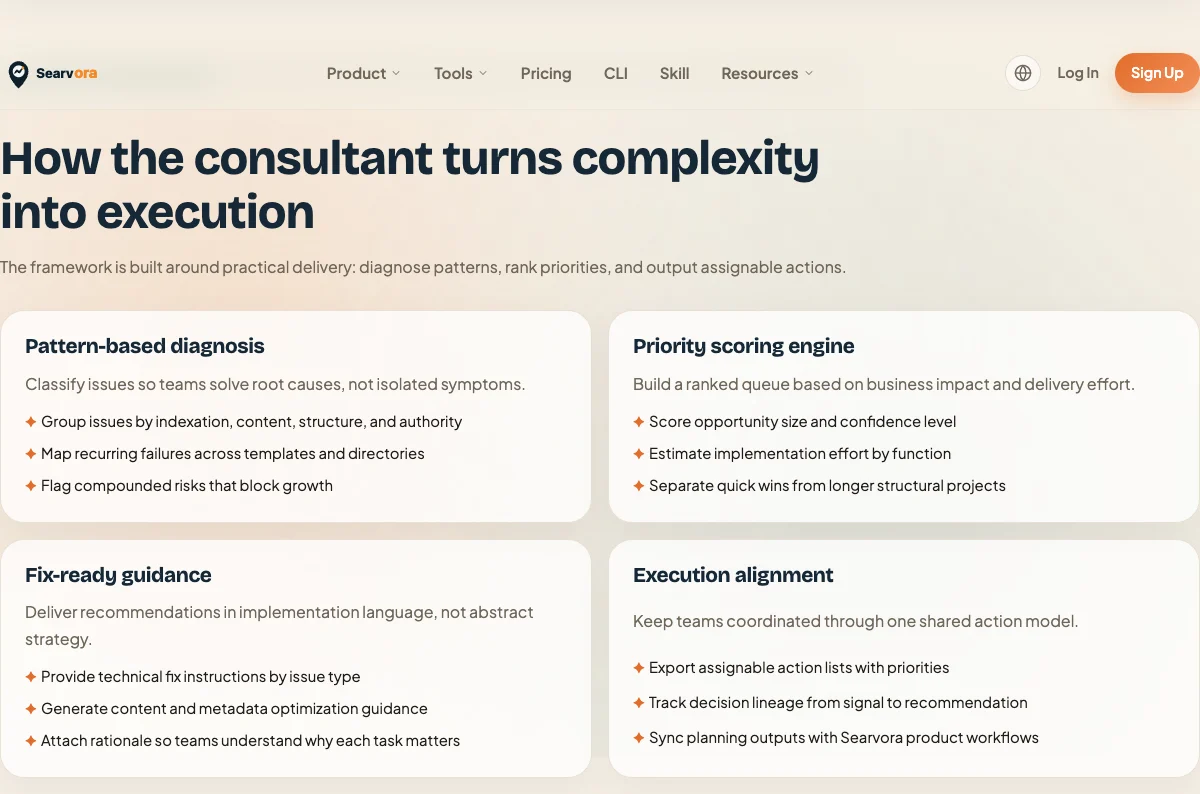
The AI SEO consultant helps teams group issues, score priorities, attach rationale, and turn recommendations into assignable work. That can reduce the amount of external time spent sorting a generic backlog and make a tightly scoped specialist engagement easier to review.
Use it to prepare for an affordable service purchase:
- organize the current crawl, content, and performance signals;
- identify the one bottleneck worth funding first;
- turn vague proposal language into explicit actions and owners;
- keep the decision lineage from evidence to recommendation;
- validate the next evidence cycle after work ships.
Affordable SEO Services Buying Checklist
Before approving a proposal:
- define one bottleneck and the pages or templates it affects;
- choose the smallest complete workflow that can resolve it;
- require evidence behind each major recommendation;
- compare deliverables and acceptance criteria, not package names;
- confirm what the provider will implement and what your team must ship;
- name owners and dependencies before work starts;
- reject ranking guarantees and hidden delivery methods;
- set a change log, recheck date, and validation source;
- make sure the result can guide the next decision without another translation project.
Affordable SEO services should create leverage, not ambiguity. Buy a narrow scope, demand inspectable proof, and keep enough budget and internal capacity to implement what the engagement discovers.