

Guaranteed SEO services cannot honestly guarantee a number-one ranking, a fixed traffic increase, or a permanent position in search results. Search engines control rankings, competitors keep changing, and a provider does not own the algorithm.
A credible SEO guarantee covers what the provider can control: the audit scope, deliverables, response time, implementation support, reporting cadence, documentation, and validation work. Buy those commitments. Treat promised rankings as a warning sign.
The competing Ahrefs article on SEO guarantees makes the essential distinction between risky outcome promises and defensible service commitments. This guide turns that distinction into a procurement scorecard buyers can use before signing a contract.
What Guaranteed SEO Services Can Honestly Promise
An SEO provider can promise to perform defined work to an agreed standard. It can commit to crawling a site, documenting findings, prioritizing issues, producing briefs, reviewing implementation, sharing change logs, and checking the site again after fixes ship.
It cannot control whether Google ranks a page first. Google's official guidance for hiring an SEO says no one can guarantee a number-one ranking. The same page tells buyers to ask about expected results, timeframes, measurement, prior work, Search Essentials compliance, and whether the provider will explain every recommended change.
Use this boundary when reviewing a proposal:
| Promise | Who controls it? | How to treat it |
|---|---|---|
| Deliver a technical audit by a stated date | Provider | Contractable |
| Document affected URLs, templates, severity, and evidence | Provider | Contractable |
| Create an owner-ready implementation queue | Provider and client | Contractable when responsibilities are explicit |
| Validate shipped fixes with a second crawl | Provider and client | Contractable |
| Rank number one for a keyword | Search engine and market | Reject as a guarantee |
| Increase organic traffic by an exact percentage | Search engine, demand, competitors, site, and execution | Use as a forecast, never a guaranteed outcome |
| Keep rankings permanently | No single party | Reject |
Use the Controllable Versus Uncontrollable Test
Every line in a proposal should pass one question: can the provider deliver and prove this without controlling Google or hiding a client dependency?
If the answer is yes, turn the line into an acceptance criterion. If the answer is no, rewrite it as a forecast with assumptions or remove it.
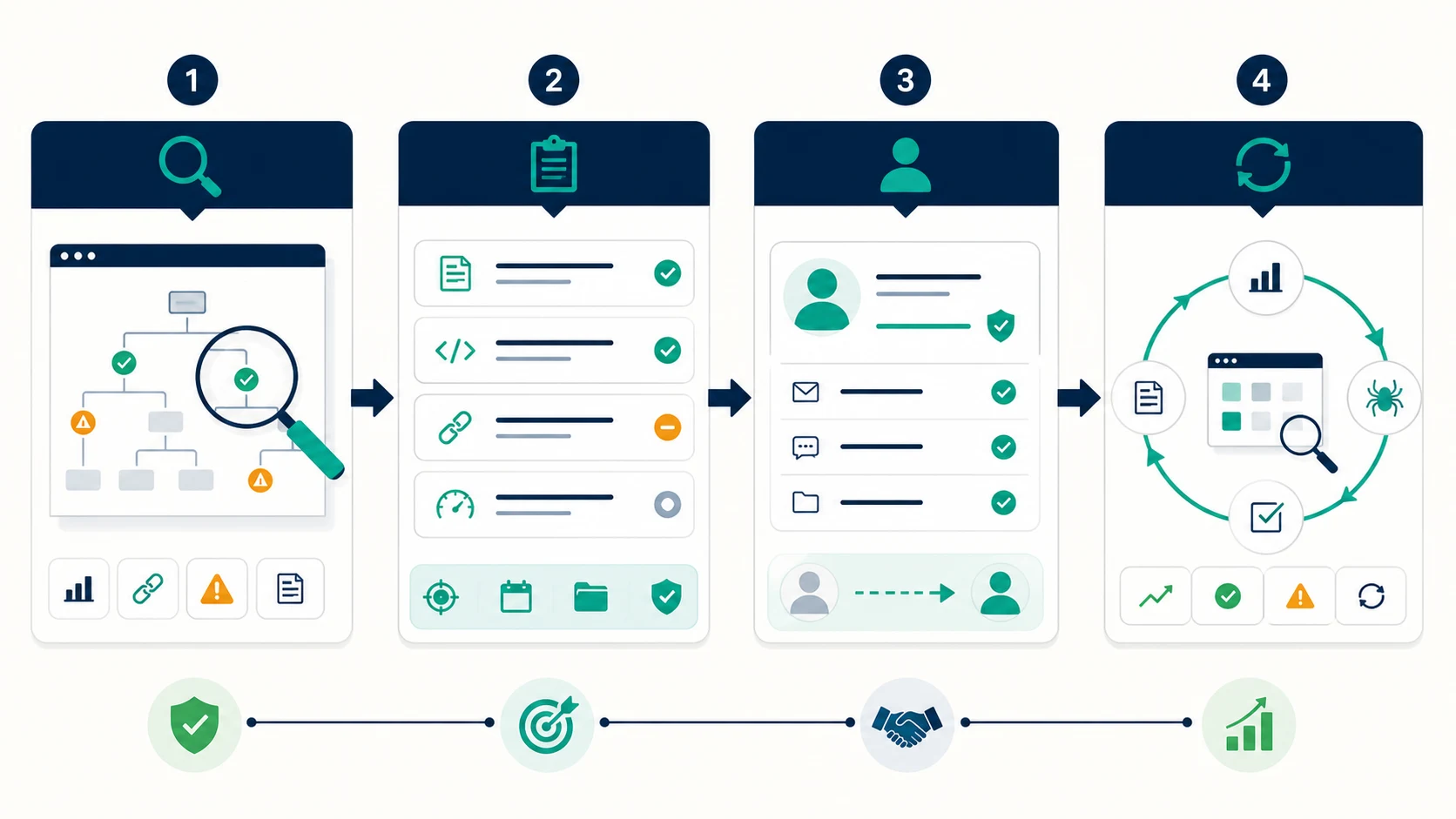
Use four gates:
- Evidence. Name the crawl, Search Console, analytics, content, or search evidence behind the recommendation.
- Scope. Define the affected pages, templates, markets, deliverables, and exclusions.
- Ownership. Assign who investigates, approves, implements, reviews, and validates each action.
- Verification. Set the recheck date, proof source, and acceptance rule before work begins.
The workflow should be specific enough that a different reviewer could tell whether the provider completed the work. "Improve technical SEO" fails that test. "Crawl the site, group indexability and canonical conflicts by template, issue owner-ready tickets, and validate the fixes in a second crawl" passes it.
The SEO pricing framework helps compare retainers, projects, advisory work, and software after the scope is clear. A cheap package with vague outputs is not automatically affordable. A focused engagement with evidence, implementation support, and a validation loop may cost less than months of activity reports.
Reject Guarantees That Hide Search Risk
Bad guarantees often move risk from the provider to the client's domain. The sales claim sounds safe, but the delivery method depends on tactics that can create cleanup work, manual actions, weak content, or an unusable site backlog.
Google's spam policies identify manipulative patterns such as paid links that pass ranking credit, excessive link exchanges, automated link creation, low-quality directory links, hidden links, and low-value content created to manipulate ranking signals. A refund clause does not make those tactics safe.
Pause the buying process when a provider:
- guarantees a fixed position or exact traffic lift;
- claims a special relationship, approval, or priority submission route with Google;
- refuses to explain how links or content will be created;
- measures success only by a proprietary score the provider controls;
- requests broad write access before an audit is agreed;
- promises hundreds of pages or links without relevance, quality, or ownership gates;
- cannot name what happens after recommendations are delivered;
- offers a refund but leaves the guarantee conditions vague.
The US Federal Trade Commission's advertising guidance for small businesses says advertising claims should be truthful, non-deceptive, and supported before they run. It also explains that a money-back guarantee does not replace substantiation and that important guarantee conditions should be disclosed clearly. That is a useful procurement principle even when a contract is governed elsewhere: read the conditions, limitations, and evidence, not just the headline promise.
Turn the Proposal Into a 90-Day Delivery Contract
A measurable engagement starts with a baseline and ends with a verified change log. The exact work varies by site, but the contract shape should remain concrete.
| Window | Provider commitment | Buyer acceptance evidence |
|---|---|---|
| Days 1-15 | Baseline crawl, analytics review, Search Console review, and business interview | Data sources, crawl settings, affected areas, known limits, and initial risks are documented |
| Days 16-30 | Prioritized roadmap with impact, confidence, effort, owner, and dependency | Every recommendation maps to evidence and an accountable owner |
| Days 31-60 | Implementation support for the agreed first workstream | Change log, briefs, tickets, code or CMS evidence, and blocked dependencies are visible |
| Days 61-90 | Recrawl, content review, performance check, and next-quarter plan | Shipped changes are validated; unresolved issues and next actions are ranked |
Do not make the final acceptance rule "rankings increased." Rankings can be an outcome metric, but delivery acceptance should use evidence the parties can inspect: fixes shipped, pages recrawled, redirects resolved, canonical rules corrected, briefs approved, content updated, reporting configured, and owners assigned.
If the engagement begins with an audit, compare the proposal against the site audit cost framework. An implementation-ready audit should do more than export issues. It should explain priority, affected templates, dependencies, likely effort, and how the team will validate the fix.
Ask These Questions Before Signing
Use the vendor call to test operating behavior, not presentation polish.
- Which result are you forecasting, and which deliverable are you guaranteeing?
- What site evidence supports the proposed scope?
- Which Google guidance supports the recommended tactic?
- What assumptions could make the forecast wrong?
- Which tasks are included, excluded, or dependent on our team?
- Who owns implementation for content, engineering, analytics, and approvals?
- Will you document every change and the reason for it?
- What access do you need during discovery, and why?
- How will links, content, and third-party contributors be reviewed?
- What will you recrawl or recheck after implementation?
- Which evidence triggers a strategy change?
- What exactly happens if the service-level guarantee is missed?
Google's third-party SEO guidance also warns that external tools do not have Google's internal ranking data and cannot guarantee performance. A useful tool or consultant can improve diagnosis and decisions. It should not present an internal score or prediction as privileged access to the ranking system.
Measure the Work Without Pretending to Control Rankings
Use three layers of measurement so delivery quality does not disappear inside a traffic chart.
| Measurement layer | Examples | Decision it supports |
|---|---|---|
| Delivery | Audits completed, briefs approved, fixes shipped, pages reviewed | Did the provider do the agreed work? |
| Site evidence | Crawl errors, indexability, templates affected, internal links, page ownership | Did the work change the intended system? |
| Search outcomes | Impressions, clicks, qualified visits, conversions, cited visibility | Did the market response improve enough to continue or adapt? |
Report all three. Delivery without site change is activity. Site change without outcome monitoring is incomplete. Outcome movement without a change log is difficult to learn from.
SEO outcomes also need an appropriate observation window. A redirect repair, title rewrite, new content cluster, and authority campaign do not mature at the same speed. Set review dates by workstream and record major external changes, releases, seasonality, and measurement gaps.
Where Searvora Fits
Searvora helps turn a proposal into prioritized, assignable work. It does not control rankings and should not be positioned as a ranking guarantee.
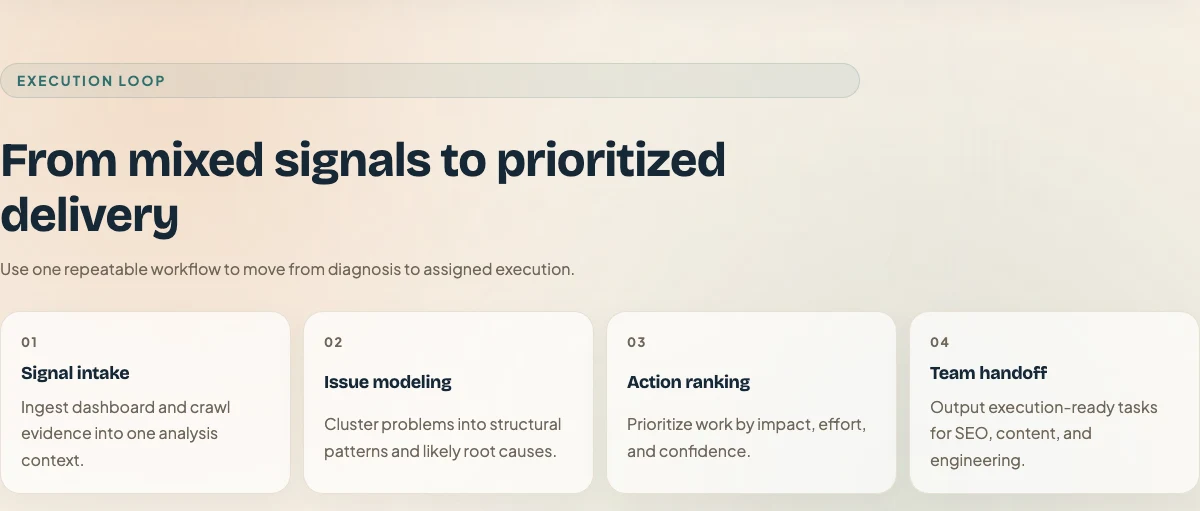
Use the AI SEO consultant when the team needs to move from mixed crawl and performance signals to a ranked action queue with rationale, effort, confidence, and ownership. That makes it easier to inspect whether an external proposal names the right problems and whether the promised work becomes implementation-ready tasks.
| Proposal question | Searvora workflow |
|---|---|
| Is the recommendation tied to evidence? | Bring crawl and dashboard signals into one analysis context |
| Which work should happen first? | Rank actions by impact, effort, and confidence |
| Can another team execute it? | Translate recommendations into assignable tasks and fix guidance |
| Did the engagement create progress? | Keep the decision lineage and validate the next evidence cycle |
Guaranteed SEO Services Procurement Checklist
Before signing:
- separate guaranteed deliverables from forecast outcomes;
- reject guaranteed rankings, fixed traffic lifts, and claims of special search-engine access;
- require evidence for every major recommendation;
- define scope, exclusions, dependencies, and access levels;
- assign owners for implementation and approval;
- document link, content, and technical quality rules;
- set a change log and communication cadence;
- define the baseline, recheck method, and acceptance evidence;
- read every refund, warranty, and service-credit condition;
- confirm what the provider will do when the original hypothesis is wrong.
The best SEO guarantee is not a ranking promise. It is a transparent delivery system: realistic estimates, documented work, accountable owners, safe methods, and a validation loop that shows what changed and what the team should do next.