

The latest Ahrefs new features span AI visibility reporting, bot verification, APIs, Site Audit localization, reporting widgets, and workflow navigation. The useful question is not whether every release sounds valuable. It is which changes alter a real team decision, data definition, integration, or delivery step.
When checked on July 15, 2026, the live Ahrefs changelog included entries dated through June 30. Treat this article as an operator's evaluation framework, not a substitute for the source: verify the current release note, test the affected workflow, and record what changed before you update a dashboard, script, or team process.
The Current Ahrefs Changes in One View
The official Ahrefs changelog is a maintained running list. Its recent entries cluster into three practical jobs rather than one product story.
| Change area | Recent public examples | What an SEO operator should check |
|---|---|---|
| AI visibility and citations | Combined Brand Radar platform views, separate cited and found-source filters, citation and history API support | Whether definitions, filters, or historical comparisons changed before reporting a trend |
| Crawl and automation | Bot Analytics verification, localized Site Audit, localized API docs, Rank Tracker competitor-domain API support | Whether the feature changes evidence quality, only changes access, or requires an integration update |
| Reporting and team workflow | Report Builder page breaks, Organic Pages widget, keyword tags, navigation improvements | Whether the update removes a manual step or merely changes where the same task happens |
This grouping matters because a release note can describe a new capability without proving that the capability belongs in your operating process. A combined view may simplify reporting. An API field may affect a production script. A navigation change may need no rollout at all.
Start With Data Definitions, Not The Feature Name
The highest-risk updates are the ones that change what a metric includes. Ahrefs' June entries say Brand Radar can combine supported platforms in one view and distinguish cited sources from sources that were found but not cited. Those changes can affect how a team interprets visibility, share of voice, and source coverage.
Before comparing a new period with an old one, answer four questions:
- Did the underlying data source change?
- Did a filter default, platform selection, or inclusion rule change?
- Was historical data recalculated under the new definition?
- Can the old and new views be exported with the same dimensions?
The same rule applies to tool-specific metrics. The Ahrefs SEO metrics workflow explains why Domain Rating, traffic estimates, and link metrics should trigger investigation rather than become targets by themselves.
Use a Small Feature Adoption Workflow
A new feature should earn a place in the workflow through evidence. Use one affected property, report, or integration as the pilot before changing team-wide documentation.
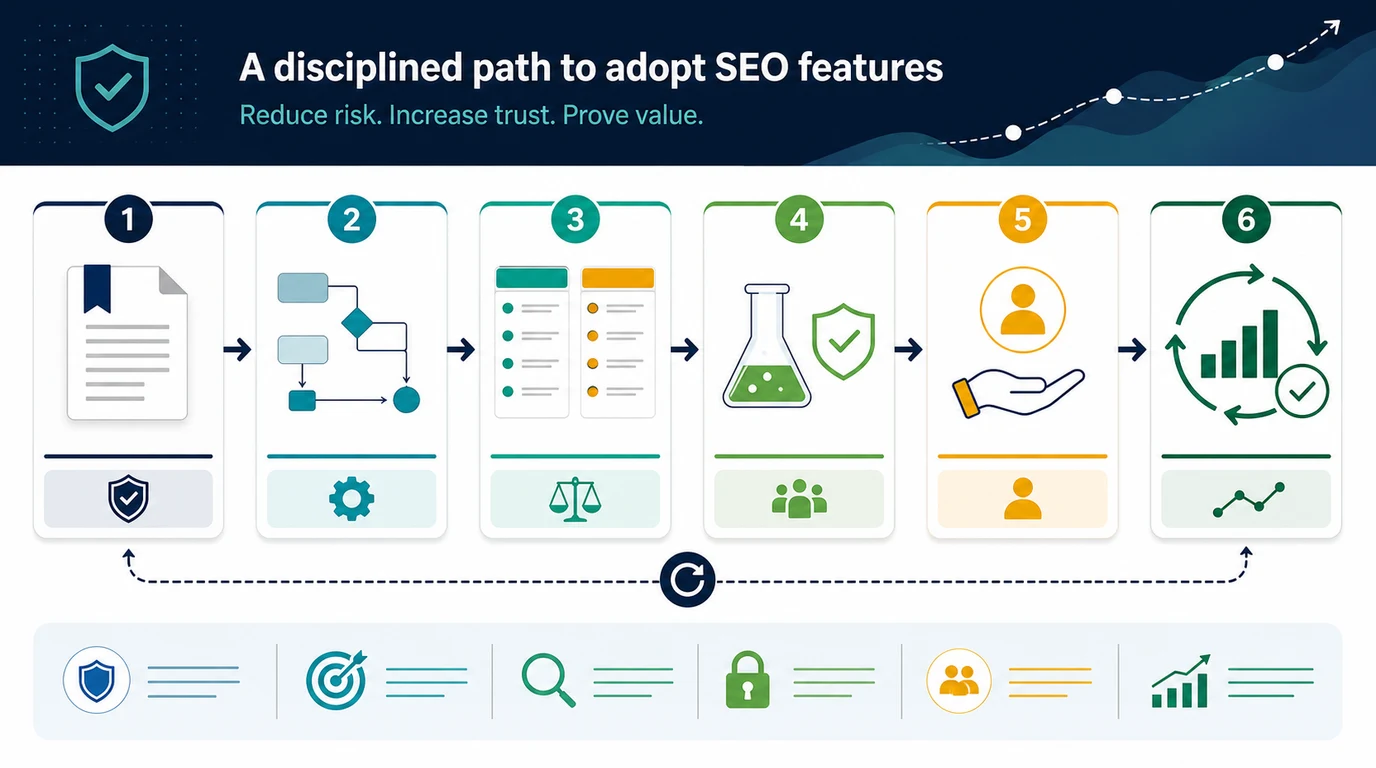
- Verify the source. Read the official entry and any linked documentation. Record the date checked.
- Name the affected job. Identify the report, API call, audit step, or owner that could change.
- Compare the data boundary. Check filters, fields, limits, attribution rules, and history behavior.
- Run a narrow pilot. Test one project or reporting cycle instead of changing every property.
- Measure the operational result. Look for time saved, better evidence, fewer handoff errors, or a new risk.
- Adopt, monitor, or skip. Assign an owner and next review date only if the change earns ongoing maintenance.
This is the missing layer in most changelogs. Release notes explain what shipped. They do not know your reporting contract, data warehouse, client promise, engineering capacity, or approval process.
Which Recent Updates Deserve Immediate Review
Not every team needs the same priority. Use the reader job to decide what should move first.
Review AI visibility changes if you publish GEO reports
Combined platform views and new citation-oriented API support can matter when a team monitors AI answers, cited pages, or source coverage. Verify how platform selection and cited-versus-found logic affect every chart or scheduled export before you update a benchmark.
If a report is meant to drive action, define the next step for each signal. A lost citation may call for source-quality review, page updates, entity clarification, or no action at all. A visibility chart without a decision rule is still a vanity report.
Review bot verification if crawler identity affects your analysis
The changelog says Bot Analytics now checks whether bots such as Googlebot or ChatGPT-user are legitimate and labels unverified traffic as spoofed. That can improve evidence quality, but it does not remove the need to inspect what the verified bot requested, whether the response was successful, and whether the page was eligible to be used.
Treat verification as one input. Keep response codes, blocked paths, canonical behavior, rendered content, and page value in the diagnostic record.
Review API changes if a production workflow depends on them
Recent entries mention competitor domains in Rank Tracker, Brand Radar citation and history data, keyword-tag management, and a Domain Rating endpoint with attribution requirements. An API feature is operational only after you check schema, quotas, permissions, error behavior, attribution, and backfill needs.
Use a staging request first. Save a representative response, diff the fields your code consumes, test failure handling, and update the owner-facing runbook before scheduling the change.
Decide Whether to Adopt, Monitor, or Skip
Use this decision table after the pilot.
| Decision | Use it when | Required evidence |
|---|---|---|
| Adopt now | The feature removes a real manual step, improves evidence quality, or enables an approved workflow | Successful pilot, named owner, documented metric definition, and rollback path |
| Monitor | The feature is relevant but definitions, history, limits, or team fit remain unclear | Review date, official-source watch, and a concrete open question |
| Skip for now | The change does not alter a current job or would add more maintenance than value | Short rationale so the team does not re-evaluate the same release every week |
| Replace an old step | The new feature makes an existing export, report, or manual process redundant | Side-by-side output comparison and confirmation from every downstream owner |
The Ahrefs tutorial for turning reports into SEO work provides the broader map: a tool report becomes useful when it produces a priority, owner, next action, and validation step. Use the same standard for every release note.
Keep Changelog Content Fresh Without Faking Freshness
An Ahrefs new features article has a maintenance obligation because the source changes. A durable page should separate current observations from evergreen evaluation rules.
- Put a checked date next to time-sensitive claims.
- Link to the official running changelog instead of pretending your summary is complete.
- Remove or rewrite claims when a beta, limit, metric definition, or access rule changes.
- Keep screenshots as dated evidence, not as proof of current private UI behavior.
- Re-run links, canonical, image, and metadata checks after a material update.
- Update the article only when the reader's decision changes, not merely to refresh the date.
The evergreen content refresh workflow goes deeper on source checks, update triggers, crawl validation, and the difference between a real revision and a cosmetic date change.
Where Searvora Fits
Searvora does not replace Ahrefs or certify how a third-party feature behaves inside a private account. Its role is the decision layer around the evidence: classify the signal, identify the affected page or workflow, rank the action by impact and effort, assign an owner, and define how the team will validate the result.
AI SEO Consultant is a fit when a release creates several plausible tasks but the team needs one prioritized action queue. Feed it verified public notes, your own crawl or performance evidence, and the operational constraints that the changelog cannot know. The output should be an adoption test, reporting change, technical fix, content task, monitoring item, or an explicit decision to do nothing.
Ahrefs New Features FAQ
Where should I check the latest Ahrefs features?
Start with the official Ahrefs changelog and any official documentation it links to. Record the date checked because the running list can change after this article is published.
Should I adopt every new Ahrefs feature?
No. Adopt a feature when it improves a real workflow and passes a narrow pilot. Monitor it when evidence is incomplete, and skip it when maintenance cost exceeds operational value.
Do new AI visibility reports make old benchmarks invalid?
They can if platform coverage, filters, citation definitions, or historical calculations changed. Confirm the measurement boundary before comparing periods.
Can I rely on a changelog screenshot as current product proof?
A screenshot is dated public evidence, not permanent proof of current private UI behavior. Verify the live official page and documentation before making a workflow or purchasing decision.
The practical way to follow Ahrefs new features is simple: verify the source, map the affected job, test the smallest useful slice, and only then change the team's process.