

Evergreen content is useful only when the page keeps answering the job people and search systems are trying to solve now. A definition, checklist, comparison, or how-to can stay relevant for years, but the evidence around it changes: query variants move, AI answers summarize more aggressively, examples get stale, screenshots age, internal links drift, and technical eligibility can quietly break.
That is why evergreen content in the age of AI search needs a refresh workflow, not a "publish once" mindset. The goal is not to rewrite every old article every month. The goal is to identify which pages still deserve to be durable assets, then maintain their facts, crawl access, answer-ready sections, internal links, and measurement loop.
The Short Answer
Evergreen content is content built around a durable user need. In AI search, it stays competitive when it remains accurate, easy to parse, internally supported, and useful beyond the summary an AI answer can produce.
Use this first read:
| Evergreen signal | What it means | First action |
|---|---|---|
| Stable topic, stale examples | The core concept still matters, but proof has aged | Replace examples, screenshots, stats, and source links |
| More impressions, fewer clicks | The page may be summarized, cited, or displaced by richer results | Segment queries and inspect AI/search result surfaces |
| Query variants expanded | The page is ranking for related tasks it may not answer well | Add answer-ready sections or split a child page |
| Technical checks degraded | Bots or users may not reach the updated asset cleanly | Validate status, canonicals, internal links, sitemap, and rendering |
| Competitors are cited instead | Other sources look clearer or more current | Add original examples, definitions, tables, and source-backed details |
This overlaps with the great decoupling SEO diagnosis, but the job is narrower. Here you are deciding how to keep durable content useful after the first publish window has passed.
What Actually Changed With AI Search
AI search did not make ordinary SEO controls disappear. Google's guidance for AI features and your website still points site owners back to core search fundamentals: allow crawling, make content findable through internal links, keep important content available as text, support it with useful media when relevant, and make structured data match visible content. Google also states that there is no special schema or new machine-readable file required for inclusion in these features.
That changes the maintenance job in a practical way. You are not adding an AI-only tag. You are making the page easier to understand, trust, crawl, summarize, and validate.
Google's ranking systems guide also describes freshness systems for queries where fresh material is expected. That does not mean every evergreen article needs constant novelty. It means you should know which parts of the page are timeless, which parts are date-sensitive, and which parts need a refresh when the market or query mix changes.
Build An Evergreen Inventory First
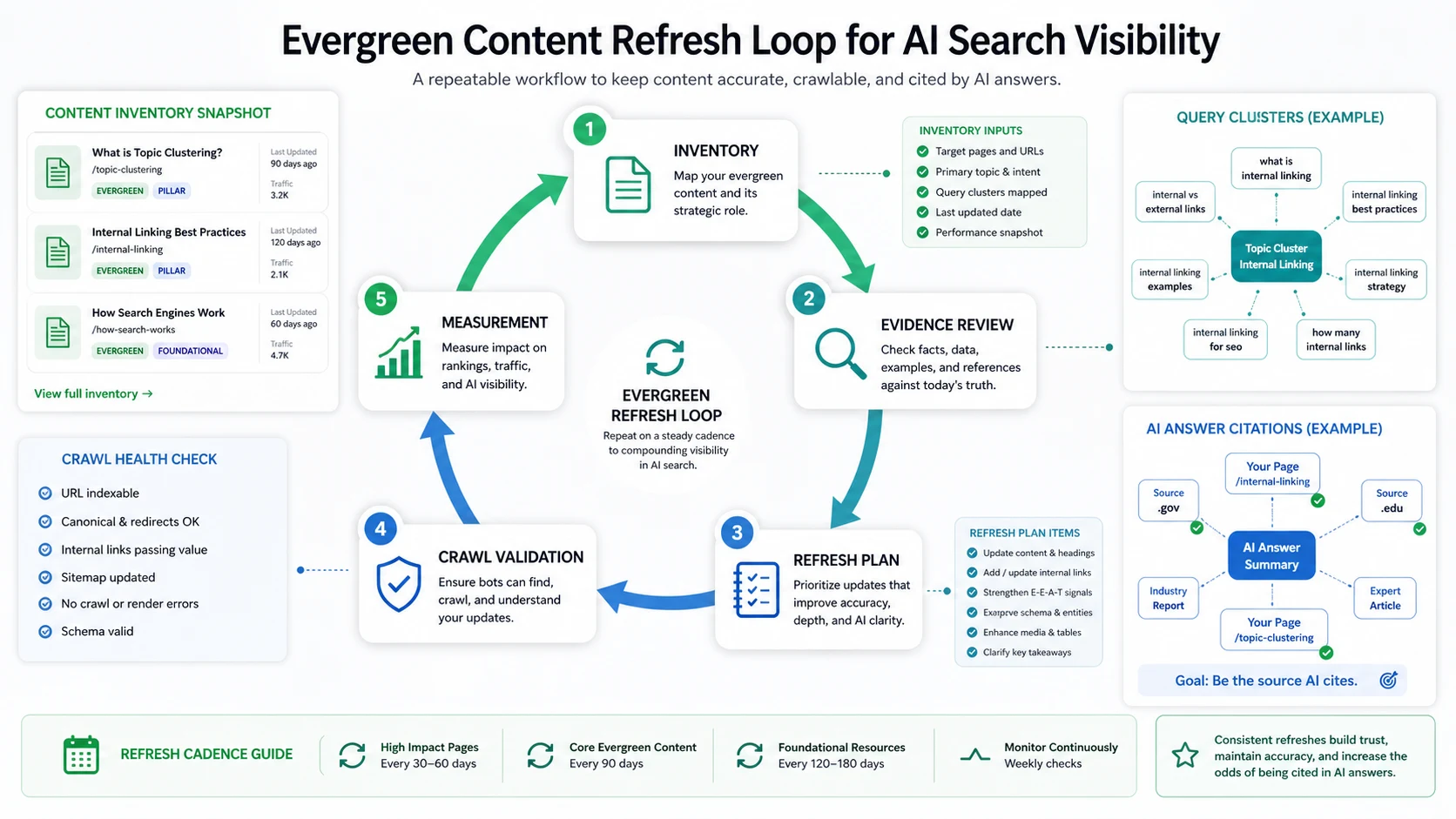
Do not start with a rewrite queue. Start with an inventory that separates true evergreen assets from pages that are merely old.
Classify each candidate page:
| Page class | Example | Maintenance rhythm |
|---|---|---|
| Foundational explainer | What is SEO, what is organic traffic, canonical basics | Review every 90 to 180 days |
| Operational workflow | SEO checklist, site audit workflow, content refresh process | Review every 60 to 120 days |
| Tool or software roundup | Best tools, platforms, alternatives | Review every 30 to 90 days, plus after product changes |
| Data-heavy resource | Benchmarks, statistics, market studies | Review when source data changes |
| Template or playbook | Briefs, outlines, checklists, handoff systems | Review after process changes or failed drafts |
| Support or troubleshooting page | Errors, status codes, indexing issues | Review after platform or documentation changes |
For each page, record the primary keyword, page type, user job, last meaningful update, internal links in and out, canonical URL, sitemap status, and the metric that would prove the page still works.
This prevents two common mistakes: refreshing everything because it is old, or ignoring important pages because the title still sounds evergreen.
Decide What A Refresh Must Prove
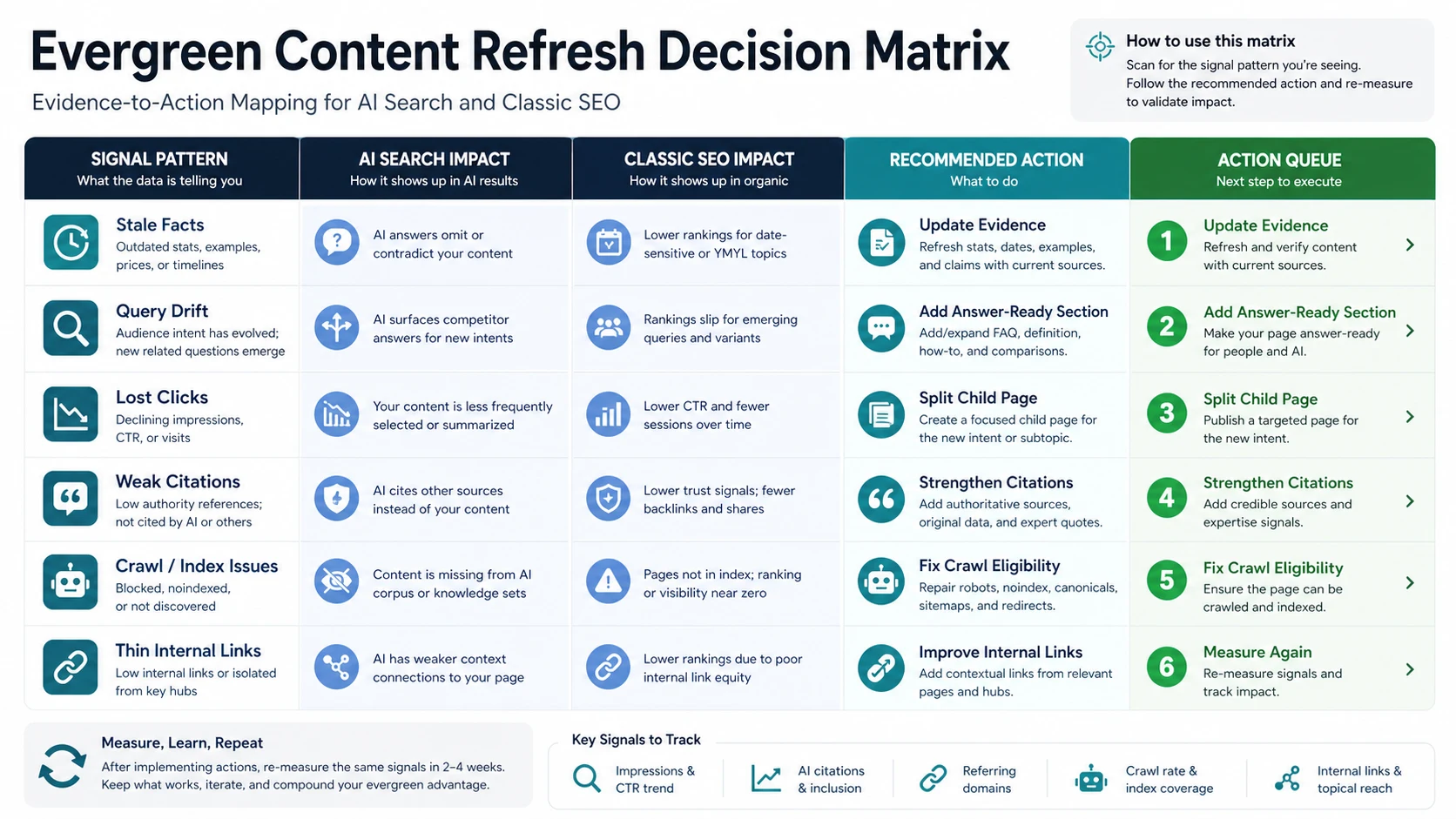
A useful evergreen refresh has a reason. Before editing, write the evidence that triggered the work.
Use this decision table:
| Trigger | What to inspect | Better refresh action |
|---|---|---|
| Facts or examples are outdated | Dates, screenshots, product details, source links | Update evidence and remove stale claims |
| AI answers cite other sources | Current answer surfaces and cited pages | Add clearer definitions, examples, tables, and source-backed sections |
| CTR fell while impressions held | Title link, meta promise, SERP layout, query mix | Improve opening promise and add a reason to click beyond a summary |
| New query variants appeared | Search Console query data and page intent | Add a concise section or create a child article |
| Internal links weakened | Parent hubs, related articles, orphan risk | Rebuild links from relevant pages and navigation surfaces |
| Crawl/index signals changed | Status, canonical, robots, noindex, sitemap, rendered content | Fix eligibility before rewriting content |
| The page competes with a sibling | Keyword, page type, and user task overlap | Merge, redirect, or clarify each page job |
Do not treat every movement as an editorial problem. If the page is blocked, canonicalized away, missing from the sitemap, or buried from internal links, writing more paragraphs will not fix the root cause.
Refresh For People And AI Answers
AI answers reward clarity because they need extractable, source-like information. People reward clarity because they need to make a decision. The same section can serve both when it is specific and useful.
Add or improve these elements:
- A short answer near the top that defines the concept without hype.
- A table that separates scenarios instead of flattening every case.
- A process or checklist that turns the idea into work.
- Current examples, screenshots, or source references where the topic depends on reality.
- Clear internal links to parent, child, and product pages.
- A validation step that tells the reader what to measure after the change.
This is where evergreen content differs from disposable SEO copy. The page should not merely repeat a definition. It should become the durable source a search result, AI answer, editor, or operator can rely on.
If your team already uses reusable structures, pair this with blog post templates so refresh work does not become ad hoc rewriting.
Validate Crawl And Index Eligibility
Before you call a refresh complete, prove that search systems can still reach the page and understand the update.
Run these checks:
| Check | Pass condition |
|---|---|
| HTTP status | Final URL returns a clean 200 and no surprise redirect chain |
| Canonical | Canonical points to the intended live URL |
| Robots and noindex | Important page is crawlable and indexable |
| Sitemap | Updated URL is present in the relevant sitemap |
| Internal links | Parent and related pages link to the refreshed asset |
| Rendered text | Important answer, table, and examples exist in rendered HTML |
| Structured data | Markup does not contradict visible content |
| Images | Useful images are local, loaded, and have descriptive alt text |
This is where a crawler matters. The content team can improve the answer, but the technical layer has to confirm that the page remains discoverable and eligible.
Measure The Refresh Without Overreading It
Google's core update guidance warns against shallow quick fixes and notes that improvements can take time to show in results. The practical takeaway is simple: log the change, wait for enough data, and compare the right segment.
Use a before-and-after measurement plan:
- Save the pre-refresh baseline for the page and its main query group.
- Record what changed: facts, sections, internal links, title, media, crawl fixes, or page split.
- Recheck crawl, canonical, sitemap, and rendered text after publish.
- Compare impressions, clicks, CTR, average position, and query mix after the validation window.
- Inspect AI answer or rich result evidence only for priority queries, not every long-tail variant.
- Decide the next action: keep, refresh again, split, merge, or stop monitoring closely.
The validation window depends on the page and crawl cadence. For high-value pages, inspect technical eligibility immediately and performance weekly. For stable foundational pages, a 30 to 90 day review rhythm is usually more useful than daily reaction.
Where Searvora Fits
Searvora's AI SEO dashboard fits the monitoring layer of evergreen content maintenance. Use it to track page-type cohorts, locale movement, high-impression low-CTR opportunities, and action queues instead of letting refresh work live in scattered spreadsheets.
The workflow is simple:
- Use the dashboard to find evergreen pages with changed signals.
- Use crawl evidence to separate technical eligibility from editorial decay.
- Use an AI SEO consultant workflow to turn the finding into a prioritized action.
- Use Blogify-style content operations when the page needs a structured refresh brief or new child article.
- Re-measure the same page group after the update.
This keeps the work connected: visibility signal, diagnosis, content change, crawl validation, and measurement all point to the same page job.
A Practical Refresh Checklist
Use this checklist before you mark an evergreen content refresh done:
- The page still has a clear primary keyword, page type, and user job.
- The opening answer satisfies the current search intent quickly.
- Date-sensitive facts, screenshots, examples, and source links are current.
- The page includes a table, checklist, workflow, or decision aid that is useful beyond an AI summary.
- Internal links connect the page to its parent cluster and relevant child pages.
- Technical checks confirm status, canonical, robots, noindex, sitemap, and rendered content.
- The title and meta description match the refreshed promise.
- Measurement has a baseline, a validation window, and a next decision.
Evergreen content is not timeless because nobody touches it. It becomes durable because the team knows what should stay stable, what should be refreshed, and how to prove the page still deserves visibility in search and AI answers.