

If the question is how AI crawlability impacts GEO rankings and search visibility, start with the source page. Answer systems still need usable pages, and if a page cannot be discovered, rendered, selected as canonical, internally supported, or summarized with clear evidence, it has a weaker chance of appearing in AI-assisted search results.
The practical job is not to invent a separate GEO checklist. Start with crawl eligibility, then connect it to source-page usefulness and citation evidence. That is the bridge between AI visibility and technical SEO.
Start With Crawl Eligibility
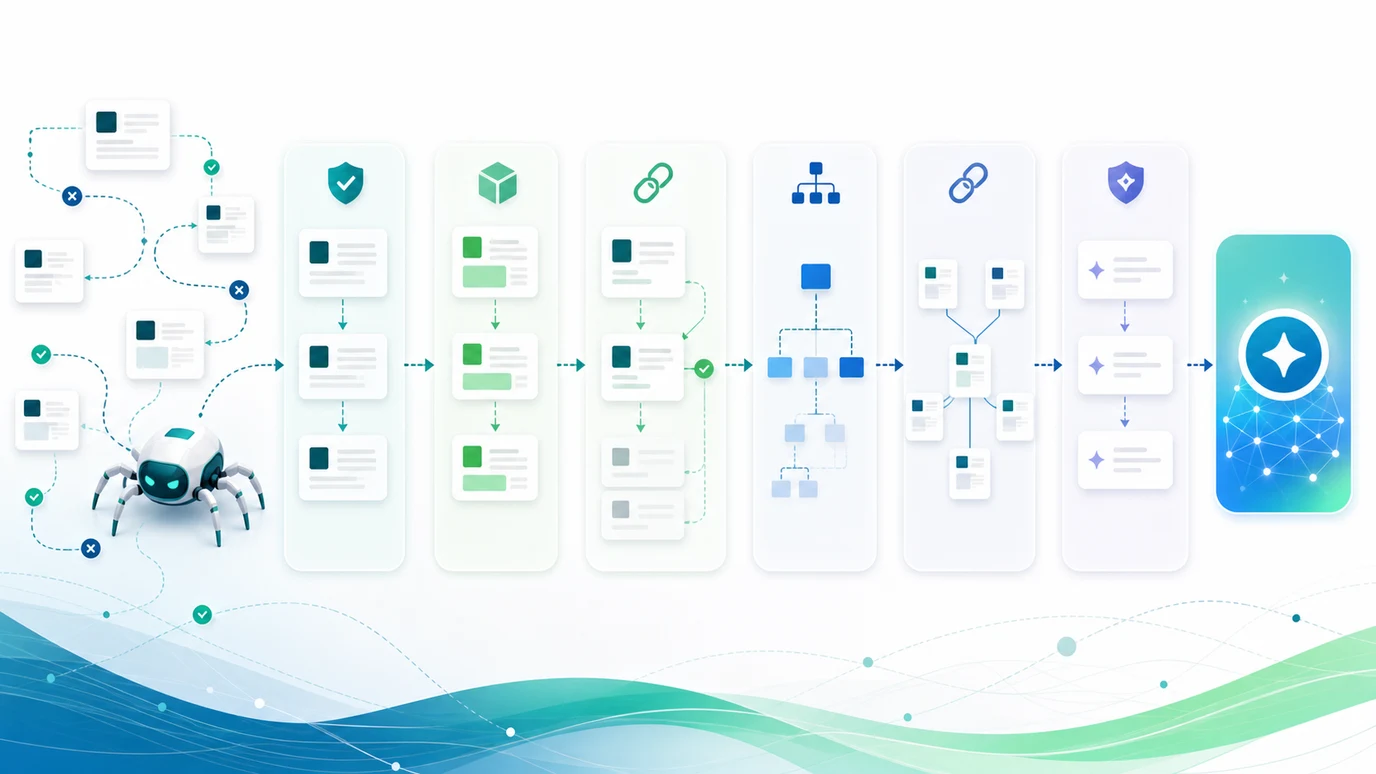
Before a page can support GEO visibility, it has to pass the same access checks that make normal search work. AI search visibility gets fuzzier, but the first layer is concrete.
Use this crawlability map:
| Layer | What to check | Why it affects GEO visibility |
|---|---|---|
| Discovery | Internal links, sitemap inclusion, crawl depth, orphan risk | The page has to be found before it can support an answer |
| Access | Status code, robots rules, noindex, redirects | Blocked or unstable URLs are weak source candidates |
| Selection | Canonical target, duplicate variants, URL consistency | Answer systems need the right source URL to represent the topic |
| Rendering | Main content, links, headings, and evidence visible in rendered HTML | Hidden or late-rendered evidence is harder to reuse |
| Meaning | Title, H1, examples, tables, schema, and internal anchors | The page needs to explain a specific task clearly |
| Validation | Recrawl, sitemap check, source citation review, Search Console trend | The team needs proof the fix changed the source page |
Separate Technical Access From Source Quality
A crawlable page is not automatically a good AI-search source. It is only eligible. The page still has to answer the search job with visible evidence.
Use this split when reviewing a page:
| Question | Technical access issue | Source quality issue |
|---|---|---|
| Can systems find it? | No internal path, missing from sitemap, high crawl depth | Page exists but is not linked from the cluster that explains it |
| Can systems use it? | Noindex, blocked resources, redirect chain, wrong canonical | The page answers too slowly or hides useful proof |
| Can systems summarize it? | Important content depends on fragile rendering | The page lacks definitions, examples, comparisons, or constraints |
| Can the team validate it? | Crawl export does not capture final rendered URL state | No stable query set, citation target, or owner handoff exists |
That separation prevents two common mistakes. Content teams should not rewrite a page that is blocked or canonicalized away. Technical teams should not mark a page "done" just because it returns 200 when the source evidence is thin.
The technical SEO workflow is the broader parent audit. This article is narrower: it asks whether crawlability gaps are holding back AI-search and GEO source eligibility.
Find The GEO Crawlability Failure Mode
Most AI-search crawlability issues fit one of five patterns.
| Failure mode | What it looks like | Better fix |
|---|---|---|
| Source page is hard to discover | Important explainer or product page sits deep with weak inlinks | Add contextual links from the parent topic, product page, and supporting articles |
| Wrong URL represents the source | Canonical points away from the page that should answer the query | Align canonical, sitemap, internal links, and metadata around the intended source URL |
| Evidence is not extractable | Proof, steps, or comparisons sit inside vague copy, images, or interactive blocks | Add visible tables, examples, screenshots, and concise answer sections |
| Cluster is technically fragmented | Similar URLs split crawls across filters, locales, or duplicates | Consolidate URL rules and make the canonical source page obvious |
| Fixes are never rechecked | The team changes copy but does not recrawl or review citations | Create a recheck window with crawl evidence and query observations |
These are not abstract GEO theories. They are normal crawl and source-page problems with a stricter evidence requirement. If the page should be cited, it should be easy to find, easy to trust, and easy to validate.
Turn Crawl Findings Into A GEO Fix Queue
A crawl export becomes useful when every finding ends with a page, owner, impact, and recheck date.
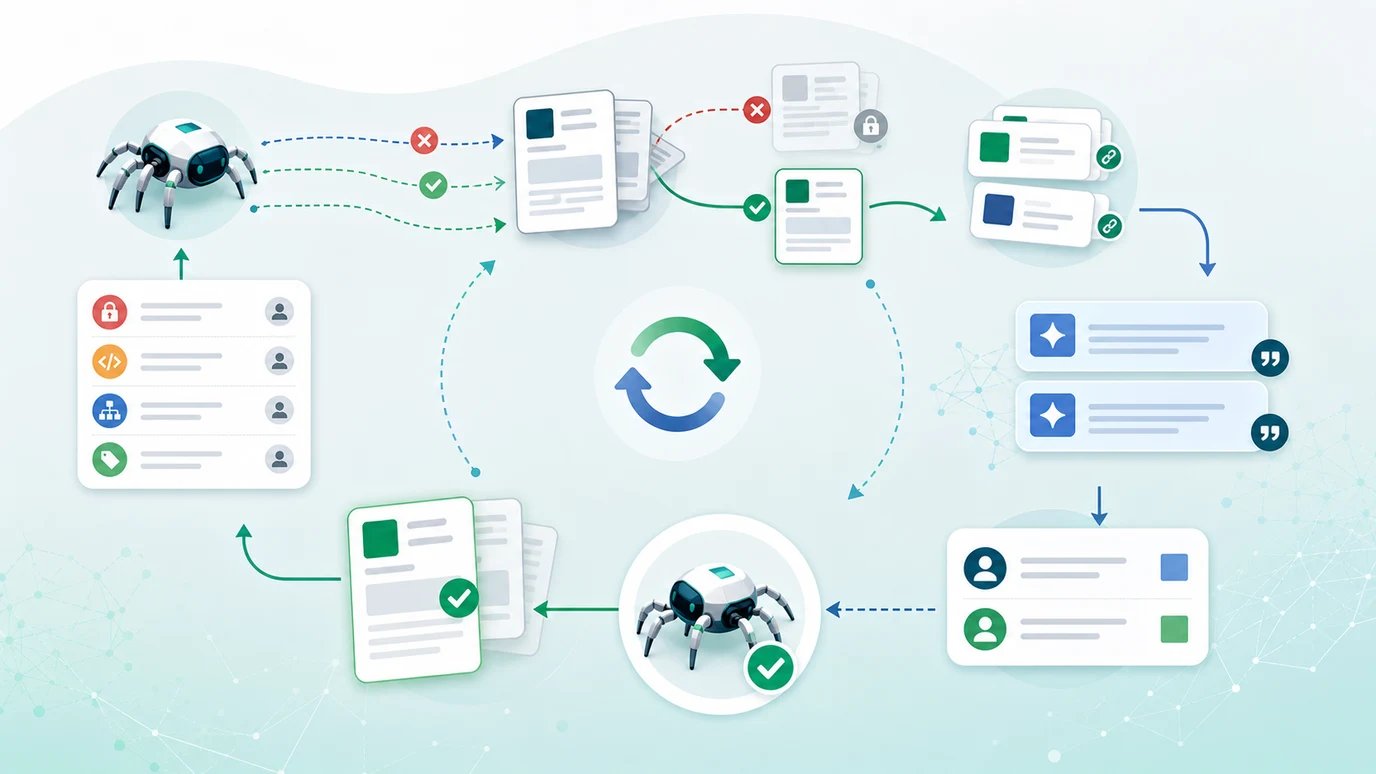
Use this queue format:
| Queue field | What to record | Example |
|---|---|---|
| Query group | The AI-search or GEO topic being reviewed | Category comparison prompts for a product line |
| Source page | The owned URL that should support the answer | Product page, explainer, comparison page, or docs page |
| Crawl evidence | Status, indexability, canonical, sitemap, inlinks, rendered content | Canonical conflict and weak internal support |
| Source evidence gap | What the page fails to prove | Missing comparison table and product constraints |
| Fix owner | SEO, content, engineering, product marketing, or CMS owner | Engineering fixes canonical, content adds source evidence |
| Recheck | What will prove the change | Recrawl plus same query group citation review |
This is where the AI search citation audit becomes a useful companion. Crawlability decides whether the source page is eligible. Citation review decides whether the answer surface is actually using it.
Where Searvora Fits
Searvora SEO Spider Crawler is the primary fit when the GEO problem starts with technical eligibility. The current product page describes crawl and discovery, rendering, sitemap discovery, robots parsing, indexability, canonicals, hreflang, metadata, image checks, issue clustering, and owner-ready action queues.
Use the SEO spider crawler when the team needs to move from "AI search visibility changed" to "which source page is technically weak?"
| Workflow step | Searvora role | Output |
|---|---|---|
| Crawl source pages | Collect status, indexability, rendering, links, sitemap, and canonical signals | Baseline eligibility evidence |
| Group issues | Cluster crawl findings by page type, template, directory, or owner | Shorter review queue |
| Prioritize fixes | Rank issues by severity, template footprint, organic impact, and confidence | Owner-ready action list |
| Validate changes | Recrawl after fixes and compare against the baseline | Proof the source layer improved |
Weekly AI Crawlability Checklist
Run this sequence for one topic cluster before approving another GEO content task:
- Pick the query group and the owned source page that should support it.
- Confirm the source URL is reachable, indexable, canonical, and in the sitemap.
- Check crawl depth, inlinks, and whether supporting articles point to the source page.
- Inspect the rendered HTML for the definition, evidence, examples, tables, and next-step links.
- Compare the page against competing sources that appear in AI search or organic results.
- Assign one fix at a time: technical access, source evidence, internal links, consolidation, or watch.
- Recrawl the page and its template peers after the change ships.
- Recheck the same query group and record whether the source URL appears, is cited, or still loses to another source.
AI crawlability impacts GEO rankings and search visibility when it changes source eligibility. The page that is easiest to discover, understand, cite, and recheck is usually the page your team can improve with the least guessing.