

If you need to know how to identify content losing visibility in AI search, start with page-level evidence, not a generic visibility score. The useful question is which page, query group, cited source, or answer surface changed enough to deserve work.
The workflow is simple: define the page cohort, collect repeatable AI-answer observations, compare them with classic search signals, diagnose the source-page gap, then assign the right fix. That prevents a content team from rewriting every article when the real problem is crawl eligibility, citation ownership, query drift, or a competitor source.
Start With The Losing Page Set
Do not begin by asking whether the whole site is more or less visible in AI search. That number is too blunt. Build a small review set that reflects how the site earns demand.
Use page cohorts that match real ownership:
| Cohort | What to include | Why it matters |
|---|---|---|
| Product and feature pages | Commercial pages that should explain the offer clearly | AI answers often need source pages that define the product, audience, and use case |
| Comparison and alternative pages | Pages meant to appear when buyers compare options | These queries expose whether competitors are being framed better |
| Blog and guide pages | Articles that should answer a specific problem query | A guide can lose visibility when the answer becomes stale or too vague |
| Support or documentation pages | Practical pages that answer setup, pricing, or integration questions | AI systems may cite the page that explains the task most directly |
| Local or market pages | Pages tied to a country, city, language, or segment | Visibility can move by market long before sitewide charts show it |
The AI visibility evidence loop is the parent workflow. This article is narrower: it focuses on finding content that is slipping and deciding whether to refresh, merge, monitor, or fix the page.
Compare AI Answer Evidence With Search Data
AI-search visibility needs its own ledger, but it should not float away from Search Console, crawl data, and page history.
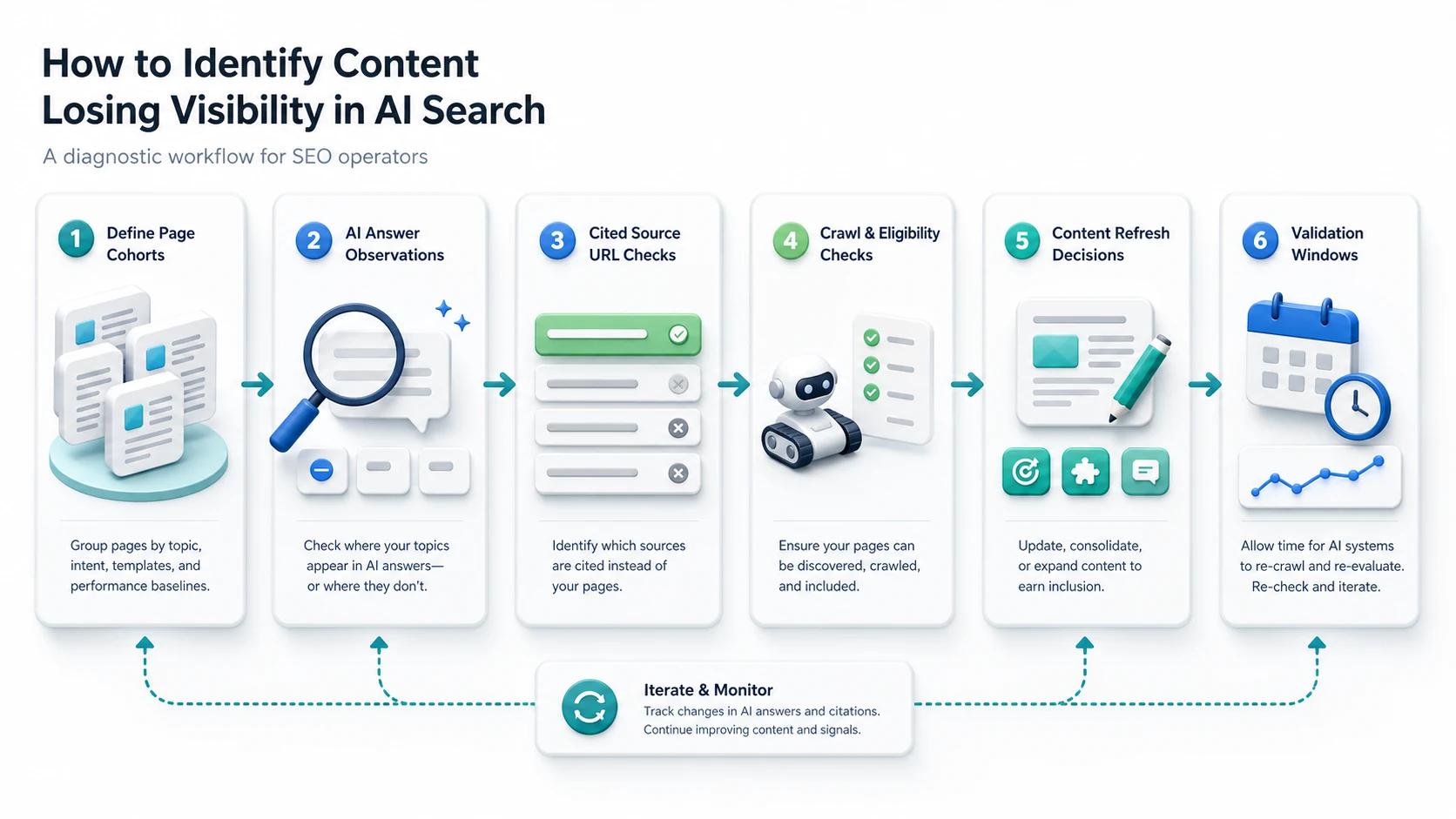
Record each observation in a small table:
| Field | What to record | Good enough for a decision |
|---|---|---|
| Query group | Category, comparison, problem, branded, or support query | Same prompt family has been checked more than once |
| Answer state | Brand mentioned, page cited, competitor cited, no source, or unstable answer | The result is repeatable enough to explain |
| Expected page | The Searvora-equivalent page that should support the answer | One URL has a clear job |
| Cited source | Owned URL, competitor URL, third-party guide, forum, marketplace, or no source | You can name the source gap |
| Search movement | Clicks, impressions, CTR, average position, or query mix | Classic search confirms or contradicts the AI observation |
| Crawl state | Status, canonical, noindex, robots, rendered text, internal links, sitemap | Technical access is not silently blocking the page |
Google's AI features guidance keeps this practical: useful, accessible pages still matter. Google's Search Console Performance report remains the place to review query, page, country, device, date, click, impression, CTR, and position movement. OpenAI's ChatGPT Search help also describes search responses with source links, which makes citation logging a real operating practice rather than a vague brand exercise.
Diagnose The Loss Before Rewriting
The fastest bad fix is a full rewrite with no diagnosis. A page can disappear from AI answers for several reasons that require different owners.
Use this triage table:
| Signal | Likely cause | Better action |
|---|---|---|
| The page is no longer cited, but a competitor guide is | Your page may answer too slowly, lack examples, or miss source-ready structure | Improve the section that should be cited and add clearer tables or steps |
| The brand is mentioned, but no owned URL is cited | Entity awareness exists, but the source page is weak | Strengthen owned source pages and internal links |
| Search impressions are stable, but AI-answer presence fell | The SERP or answer surface changed before classic search did | Monitor the query group and refresh extractable sections |
| Search clicks fell and AI answers cite another source | The page may have lost both snippet appeal and answer usefulness | Refresh title, intro, answer blocks, and source evidence |
| Crawl checks show noindex, canonical drift, broken links, or hidden rendered text | The content may not be eligible or easy to inspect | Fix technical access before asking writers for new copy |
| Multiple Searvora pages could answer the same query | Cannibalization may be confusing the source path | Merge, differentiate, or choose one canonical source page |
The AI search citation audit is the deeper child process when the cited URL is the main problem. The republishing content workflow is the next step when the page still owns the job but needs a meaningful editorial update.
Build The Fix Queue
After diagnosis, turn the finding into one action. Do not leave the row as "visibility down" because nobody can ship that.
Use this action vocabulary:
| Action | Use when | Owner |
|---|---|---|
| Refresh | The page still matches intent but needs stronger examples, definitions, links, metadata, or current evidence | Content or SEO |
| Expand | The page is strong but missing a source-ready section, table, example, or FAQ-style answer | Content |
| Fix access | Crawl, canonical, indexability, rendering, sitemap, or internal links are weak | Engineering or technical SEO |
| Consolidate | Two URLs serve the same user job and split authority | SEO plus content |
| Create child page | The query has a distinct job that the parent page cannot answer cleanly | Content strategy |
| Monitor | The signal is unstable, low-value, or not repeatable enough | SEO analytics |
A good fix row has five fields: URL, evidence, cause, action, and validation date. Add owner and priority if the team is larger than one person.
Do not prioritize only by traffic loss. A page with low classic clicks can still matter if it supports a product comparison, an AI-answer citation path, or a revenue-adjacent query group.
Where Searvora Fits
Searvora AI SEO Dashboard fits the monitoring layer of this workflow. The local product page positions it around page-type cohorts, locale drill-down, anomaly detection, opportunity scoring, and cross-team reporting. Those are exactly the views a team needs when AI-search visibility changes by page type, topic cluster, market, or owner.
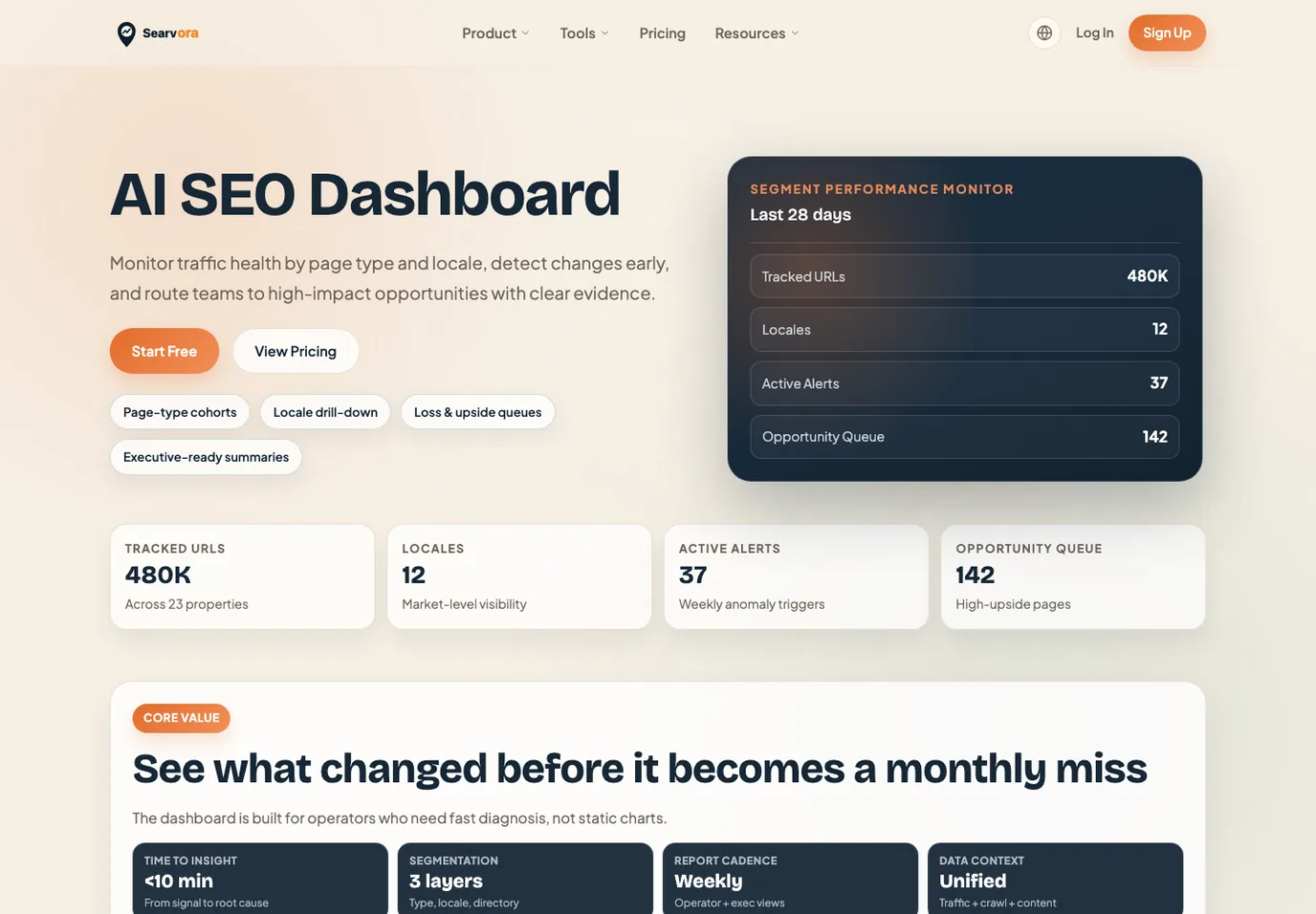
Use the AI SEO Dashboard to keep the review loop grounded:
| Dashboard view | Use it to find | Output |
|---|---|---|
| Page-type cohorts | Which templates or content types are moving | A focused review set |
| Locale and directory slices | Whether loss is market-specific or structural | A narrowed cause hypothesis |
| Anomaly and trend detection | Which drops deserve attention this week | A prioritized investigation queue |
| Opportunity scoring | Which pages combine upside, confidence, and feasible work | A ranked fix queue |
| Reporting layer | Whether the team shipped and rechecked the action | A decision history stakeholders can inspect |
Recheck Before Calling The Refresh Done
The job is not finished when the article is updated. It is finished when the same query group, page cohort, and source-page checks have been reviewed again.
Use this validation sequence:
- Re-crawl the page and affected template peers.
- Confirm status, canonical, robots, sitemap inclusion, internal links, and rendered body content.
- Review the title, H1, intro, H2s, tables, examples, images, and CTA against the page's current job.
- Recheck the same AI-answer query group after a meaningful window.
- Compare Search Console page and query movement over the same period.
- Record the result as improved, flat, worse, or inconclusive.
- Decide the next action: keep monitoring, refresh another section, consolidate, create a child page, or stop.
AI-search visibility loss is manageable when it becomes page-level work. The team does not need another vague score. It needs a repeatable way to see which content slipped, why it slipped, who owns the fix, and when the evidence will be checked again.