

SEO data is the evidence a team uses to decide what to fix, refresh, expand, consolidate, or monitor. It includes search performance, keyword demand, SERP context, backlinks, content quality, crawl health, and newer AI-search visibility signals.
The useful question is not whether you have enough data. Most teams already have too much. The useful question is which data source should change the next action, who owns that action, and when the team will validate the result.
The Ahrefs SEO data explainer that surfaced this opportunity groups SEO data into organic traffic, keyword, SERP, backlink, content, and technical SEO categories. Searvora's information gain is the operating layer: how to decide which source to trust for which job, then turn the signal into an owner-ready queue.
What SEO Data Should Tell You
SEO data should answer one of five questions:
| Question | Best evidence | Likely next action |
|---|---|---|
| Is there demand? | Impressions, query groups, keyword demand, and page exposure | Pick the right page type or refresh target |
| Can search systems access the page? | Crawl status, indexability, canonicals, robots, sitemap, and internal links | Fix technical blockers before rewriting copy |
| Does the page match the search task? | SERP shape, title, H1, intro, query mix, and competing page types | Rewrite, split, merge, or change the page format |
| Is the page trusted enough? | Backlinks, mentions, internal links, source clarity, and topical support | Improve proof, links, entity clarity, or authority assets |
| Did the work help? | Before/after windows, affected URL sets, crawl checks, and AI visibility observations | Validate, keep monitoring, or reopen the issue |
This framing keeps SEO data from becoming a trivia collection. A number belongs in the review only when it can change a page decision, owner, or validation window.
Map Data Sources By Reliability
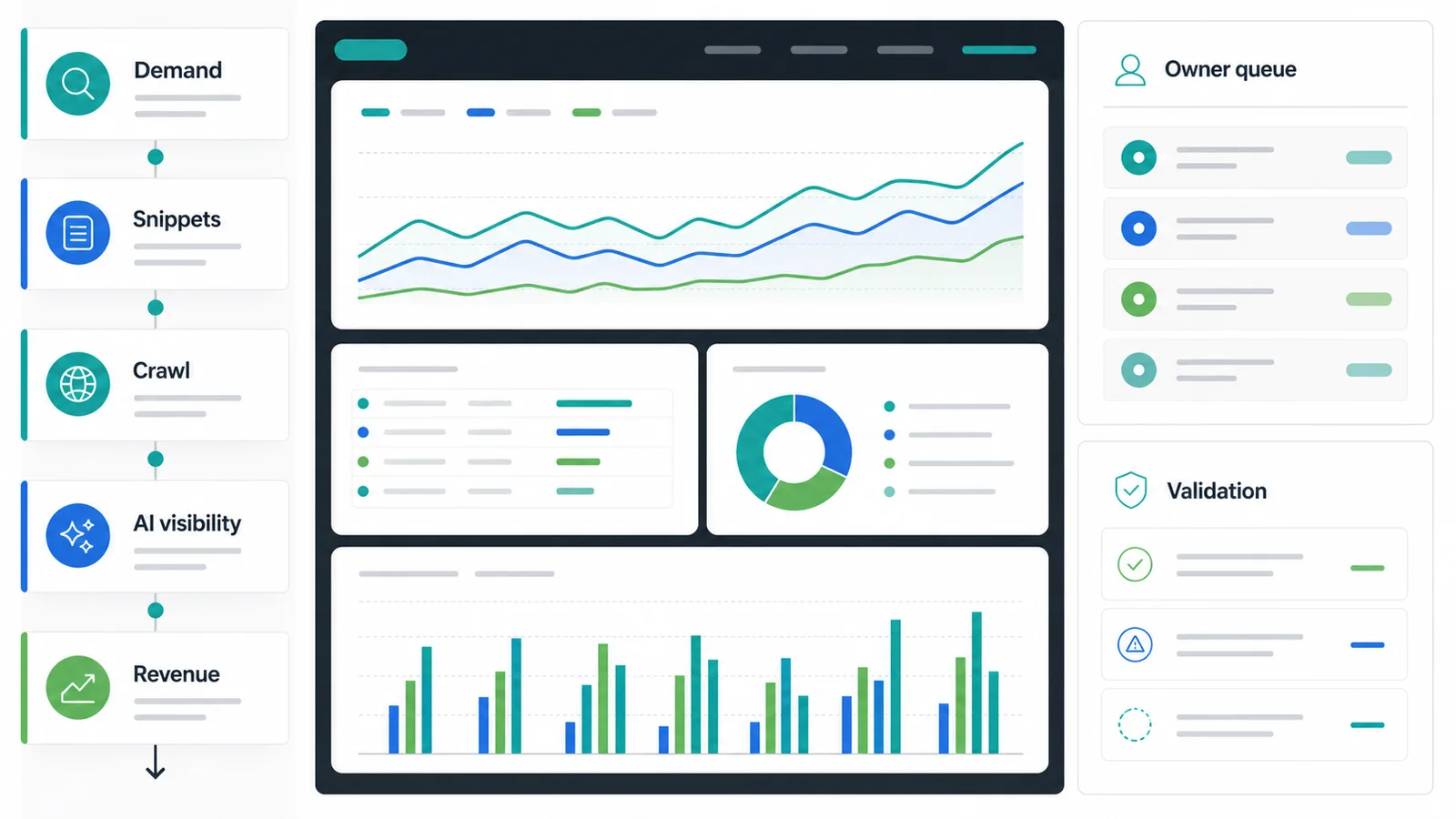
Different SEO data sources are good at different jobs. Treating every chart as equally reliable creates bad priorities.
| Data source | Strong for | Weak for | How to use it safely |
|---|---|---|---|
| Google Search Console | Owned-site clicks, impressions, CTR, query and page movement | Competitor demand, hidden queries, long-tail completeness | Segment by page type, country, device, directory, and date window |
| Keyword tools | Demand discovery, competitive research, difficulty estimates, topic sizing | Exact traffic forecasts or final page decisions | Use as market evidence, then confirm intent and page type |
| SERP observations | Page-type fit, featured result formats, competing angles, intent mix | Stable truth without periodic rechecks | Capture the shape before writing or rewriting a page |
| Crawl data | Access, status, canonicals, redirects, links, metadata, structured issues | Business value without performance context | Pair crawl findings with demand and page role |
| Backlink and mention data | Authority gaps, source quality, link-worthy assets, brand references | Whether a page is useful or conversion-ready | Separate authority work from content and technical fixes |
| AI visibility observations | Whether answer systems can understand, mention, or cite source pages | Guaranteed traffic or rankings | Treat as evidence of clarity, source depth, and citation readiness |
| Content inventory | Page ownership, age, intent, funnel role, format, and refresh candidates | Search demand by itself | Combine with Search Console and crawl data before assigning work |
Google's Search Console performance report is the baseline for owned search performance. It becomes more useful when the team looks at page groups instead of sitewide averages. The Page indexing report adds eligibility context, but it should still be paired with a crawl when the issue might come from templates, canonicals, redirects, or internal links.
For metric selection, pair this article with SEO metrics to track. Metrics tell you what deserves review; SEO data governance tells you which source should drive the action.
Use Each Data Type For A Different Decision
The fastest way to waste SEO data is to use the wrong source for the decision. Keyword volume cannot tell you whether a page is indexable. A crawl cannot tell you whether the market wants the topic. A backlink metric cannot prove the content satisfies the search task.
Use this routing table:
| If you need to decide | Start with | Confirm with | Avoid |
|---|---|---|---|
| Create a new article, hub, tool, or landing page | Keyword demand and SERP shape | Existing page overlap and product fit | Approving a page from volume alone |
| Refresh a declining article | Search Console page and query trends | SERP changes, content age, internal links, and crawl health | Rewriting before checking access or intent drift |
| Fix a technical issue | Crawl evidence and affected URL set | Search impact, template footprint, and index coverage | Ranking issues with no affected URLs |
| Merge or prune pages | Content inventory and cannibalization evidence | Query overlap, backlinks, internal links, and page role | Merging pages just because topics are adjacent |
| Improve AI-search visibility | Source-page clarity and AI answer observations | Entity consistency, examples, tables, citations, and crawl access | Treating AI visibility as a magic score |
| Report progress | Before/after windows by page group | Shipped changes and validation notes | Sitewide charts with no owner or action |
This is also how you avoid cannibalization mistakes. Two pages in the same cluster are not automatically duplicates. They become duplicates when the same core keyword, page type, and user task are already covered by an existing URL. A parent page can still be useful when it routes readers into narrower supporting articles.
Add Crawl And AI Visibility Evidence
Classic SEO data often overweights demand and backlinks because those charts are familiar. Modern SEO work needs two additional evidence layers close to the decision: crawl eligibility and AI-search clarity.
Crawl evidence answers whether search systems can discover, render, index, and understand the page. Check status codes, redirects, canonicals, robots directives, sitemap inclusion, internal links, title tags, descriptions, H1s, and duplicate patterns. If the page is blocked or non-canonical, content rewrites are premature.
AI visibility evidence answers whether the page can be summarized, mentioned, or cited by answer systems. The goal is not to chase one unstable surface. The goal is to make source pages easier to understand: clear definitions, consistent entity names, tables, examples, official-source links, and pages that load cleanly.
This is why an SEO data workflow should include both performance and eligibility:
| Signal pattern | Better diagnosis |
|---|---|
| Impressions fell across one directory | Check template, internal links, canonicals, sitemap, and release history |
| Clicks fell while impressions held | Inspect title promise, SERP layout, query mix, and intro fit |
| Rankings split across similar URLs | Test same keyword, same page type, and same user task before merging |
| AI answers omit the brand or source page | Improve entity clarity, evidence blocks, citations, and internal routes |
| Crawl warnings rise on pages with demand | Assign technical fixes before commissioning new content |
For deeper technical workflows, technical SEO is the companion page. It focuses on crawl, indexation, and validation; this article explains where that data sits in the broader decision system.
Turn SEO Data Into A Work Queue
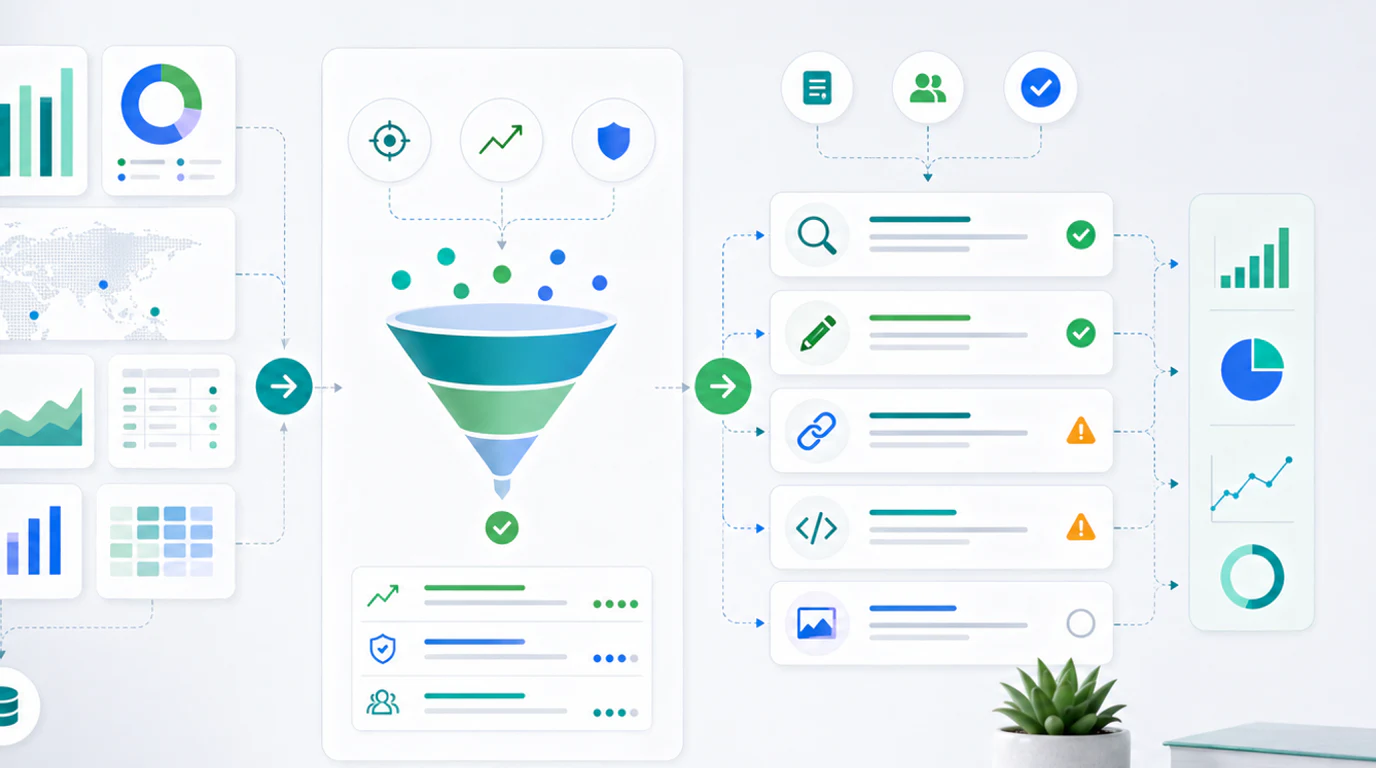
SEO data becomes useful when every important finding can move into a work queue. That does not mean every metric gets a task. It means the review process has a consistent way to convert evidence into decisions.
Use these fields:
| Queue field | What to record |
|---|---|
| Page group | Article cluster, product page set, localized directory, template, or URL batch |
| Trigger | Traffic shift, indexation change, crawl issue, AI visibility gap, or content decay |
| Evidence source | Search Console, crawl, SERP snapshot, keyword tool, content inventory, or AI observation |
| Likely cause | Demand shift, snippet mismatch, technical access, intent drift, weak authority, or missing evidence |
| Decision | Create, refresh, merge, prune, fix, monitor, or escalate |
| Owner | SEO, content, engineering, product marketing, regional lead, or agency team |
| Validation window | Next crawl, next index check, next reporting cycle, or a fixed post-release date |
This queue is where content audit and SEO data meet. A content audit identifies candidates. The data workflow decides whether the candidate deserves a refresh, merge, technical fix, or no action.
Where Searvora Fits
Searvora's AI SEO dashboard fits the monitoring and action-routing layer of this workflow. The product page positions it around page-type cohorts, locale drill-down, anomaly detection, opportunity queues, and executive-ready summaries. Those are the controls a team needs when raw SEO data must become weekly work.
Use Searvora to group data the way the team actually operates:
| Searvora layer | Data it helps organize | Better output |
|---|---|---|
| AI SEO Dashboard | Page cohorts, locale performance, anomaly detection, opportunity queues, and reports | A weekly evidence queue instead of scattered charts |
| AI SEO Consultant | Mixed signals, priority scoring, root-cause patterns, and owner handoffs | A ranked action plan with rationale |
| SEO Spider Crawler | Crawl access, links, metadata, redirects, canonicals, sitemap behavior, and issue groups | Technical fixes tied to affected URL sets |
| Blogify | Approved content opportunities, briefs, drafts, and quality gates | Search-led content shipped with validation context |
SEO Data Checklist
Before you trust an SEO data review, check the workflow:
- Name the decision before opening the export.
- Segment pages by type, directory, locale, template, owner, or funnel role.
- Separate demand, SERP, crawl, content, authority, and AI visibility evidence.
- Use Search Console for owned performance, not competitor forecasting.
- Use keyword tools for market discovery, not final publishing approval.
- Use crawl data before rewriting pages with technical risk.
- Treat AI visibility as a source-page clarity test, not a guaranteed traffic metric.
- Record the affected URL set, likely cause, owner, and validation window.
- Keep adjacent cluster coverage separate from true duplicate coverage.
- Remove metrics that never change priority, ownership, or action.
SEO data should shorten the path from signal to shipped work. Start with the decision, choose the source that can answer it, and make every important finding end with an owner and a validation plan.