

Automotive SEO is the work of making a dealership, repair shop, parts store, manufacturer, or multi-location auto business easy to find and evaluate in search. It combines local business accuracy, useful page types, inventory or service content, crawl health, reputation signals, and measurement.
The operational mistake is treating all of that as one generic checklist. A dealership inventory page has a different search job from a brake-repair service page. A location page has different evidence requirements from a parts category. The better workflow starts with the business model and page type, then turns the resulting signals into a prioritized fix queue.
Start With The Automotive Business Model
Automotive sites often mix several businesses inside one domain. Map those models before assigning keywords or opening a crawler.
| Business model | Pages that should carry demand | Primary search job | Common failure |
|---|---|---|---|
| Dealership | Location, make, model, category, inventory, finance, and contact pages | Find available vehicles and evaluate a local seller | Inventory churn creates expired, duplicate, or thin URLs |
| Repair shop | Location, service, vehicle-make, problem, pricing-context, and booking pages | Find a nearby provider for a specific repair | One generic services page tries to rank for every repair |
| Parts seller | Category, product, compatibility, brand, guide, and support pages | Find a compatible part and buy with confidence | Facets and variants create crawl waste or duplicate copy |
| Multi-location group | Brand, location, service-area, department, and local proof pages | Choose the right branch and verify local relevance | Locations reuse the same body copy and inconsistent entity data |
| Manufacturer or publisher | Model, specification, comparison, ownership, and support pages | Research a vehicle or solve an ownership question | Editorial pages are disconnected from commercial or support paths |
This is why the existing Searvora local SEO workflow is a parent topic rather than a duplicate. Automotive SEO adds vertical page-type decisions, inventory lifecycle controls, service-area boundaries, and automotive-specific ownership.
Make Local Entity Data Boring And Consistent
Dealerships and service businesses need a reliable connection between the real-world location, the Business Profile, and the website. Google's Business Profile guidelines emphasize accurate representation, precise addresses or service areas, specific categories, and one profile per eligible business or location.
Turn that guidance into a location QA table:
| Signal | Website check | Profile check | Owner |
|---|---|---|---|
| Business name | Matches signage and legal brand usage without keyword stuffing | Uses the same real-world name | Local operations |
| Address or service area | Correct on location and contact pages | Precise and eligible for the business model | Local operations |
| Category and services | Service pages support what the business actually provides | Primary category describes what the business is | Marketing and operations |
| Hours and phone | Location-specific and current | Matches customer-facing availability | Location manager |
| Reviews | Relevant review themes can be answered by useful pages | Requests and replies follow policy | Customer experience |
Google's review guidance allows businesses to remind customers to leave genuine reviews and encourages useful replies, while prohibiting incentives for positive or changed reviews. That boundary belongs in the workflow. Reputation work should improve service and response quality, not manufacture a signal.
Build Pages Around Inventory, Services, And Compatibility
The page inventory should reflect what customers can actually choose.
For a dealership, durable model and category pages can carry broader demand while individual vehicle detail pages serve exact inventory. When a vehicle sells, the team needs an explicit policy: keep a useful page with alternatives, redirect to the closest durable destination, or retire it cleanly. Leaving thousands of dead or near-empty vehicle URLs in the index is not a content strategy.
For repair shops, one page per real service is usually more useful than a page for every city-service permutation. A transmission repair page can explain symptoms, diagnostic steps, vehicle coverage, booking expectations, and local proof. Thin doorway pages that only swap a city name create maintenance risk without giving the reader a better answer.
For parts sellers, the workflow is closer to ecommerce SEO: category intent, product compatibility, variants, filters, stock status, internal links, and canonical rules all need to agree. Google's ecommerce structured-data guidance points to LocalBusiness, breadcrumbs, Product, and product-variant data as useful ways to describe store, hierarchy, and product information. Structured data supports the page; it does not rescue missing compatibility details or thin copy.
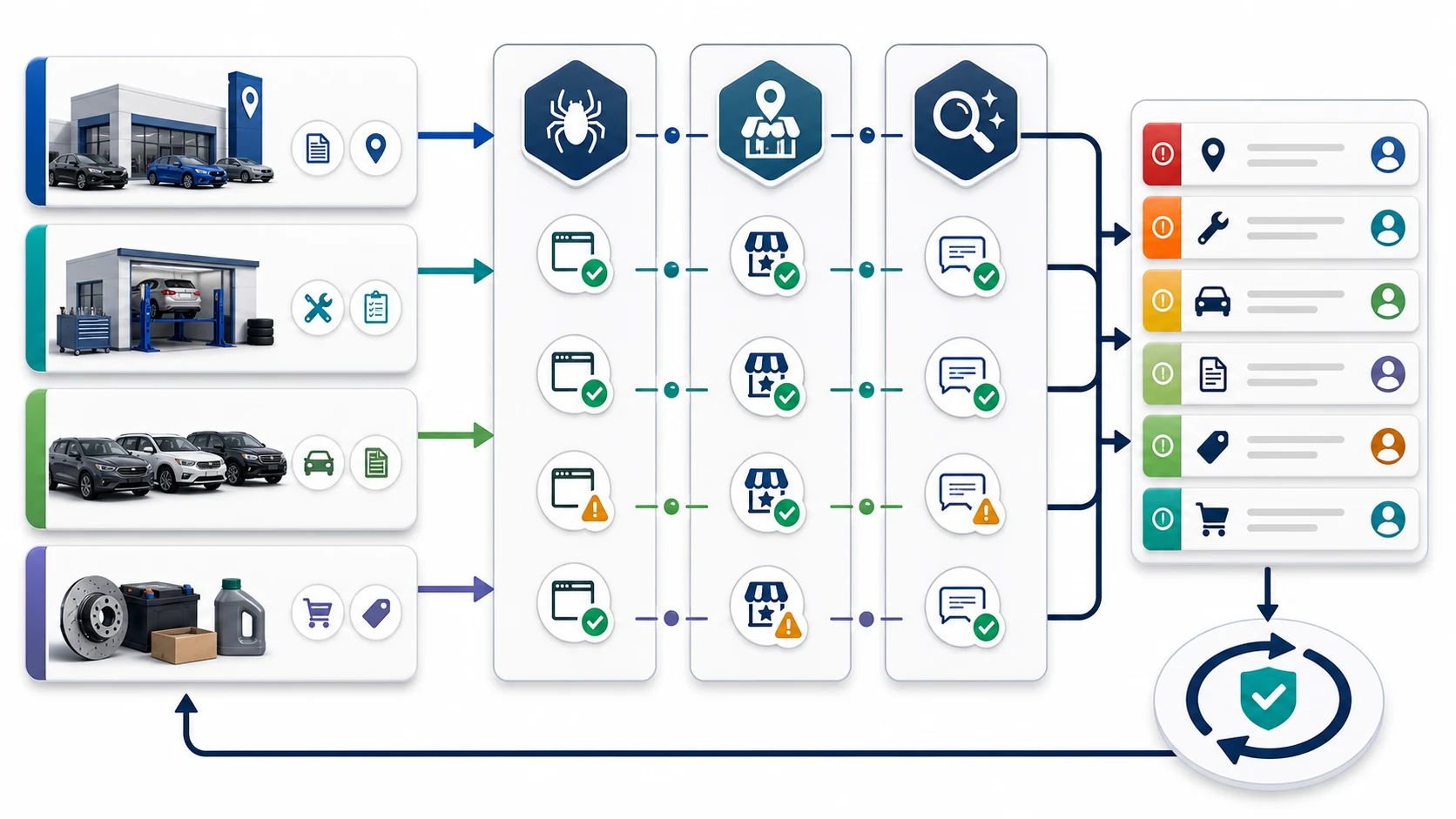
Crawl By Template Before Fixing Individual URLs
Automotive sites change too often for a one-time audit. Crawl the templates and directories that create the largest footprint:
- Segment location, service, inventory, vehicle detail, category, product, filter, editorial, and support URLs.
- Check status codes, indexability, canonicals, sitemap inclusion, titles, H1s, internal links, crawl depth, and rendered main content.
- Group problems by template instead of exporting a flat list of URLs.
- Join the crawl with demand and business value so a blocked high-value service page outranks a harmless duplicate title on a retired filter URL.
- Re-crawl after release and compare the affected segment, not only the sitewide totals.
A practical issue register looks like this:
| Issue cluster | Example | Priority signal | Likely owner |
|---|---|---|---|
| Access failure | Important inventory or service templates return errors or are blocked | Revenue-bearing page family is unavailable | Engineering |
| Indexation conflict | Canonical points away from a unique location or category | Search engines receive contradictory ownership signals | SEO and engineering |
| Page-type gap | A real service has demand but no useful page | Existing generic page cannot satisfy the task | Content and local operations |
| Lifecycle failure | Sold inventory remains thin and indexable indefinitely | URL count grows while useful coverage stays flat | Product and engineering |
| Internal-link weakness | Location pages do not link to relevant services or inventory | Important pages are deep or orphaned | SEO and content |
| Evidence gap | Page claims local expertise without staff, process, location, or service proof | Reader cannot verify the business fit | Operations and content |
For the full diagnostic layer, use the technical SEO workflow to separate discovery, eligibility, meaning, priority, and validation.
Turn Demand Into A Content And Page Queue
Automotive content should support decisions that commercial pages cannot answer alone. Examples include:
- comparisons between vehicle classes or ownership options;
- maintenance schedules and symptom-based repair explainers;
- financing, warranty, trade-in, and delivery questions;
- parts compatibility and installation guidance;
- local driving, weather, regulation, or ownership considerations;
- model-specific support content with a durable maintenance plan.
Do not create every possible make-model-service-location combination. Instead, score the opportunity:
| Question | High-confidence evidence |
|---|---|
| Is there a distinct user task? | The query requires a different answer, page type, or conversion path |
| Can the business add first-party value? | Technicians, inventory data, compatibility rules, local process, or original media improve the answer |
| Is there a durable owner? | Someone can update stock, pricing context, policies, or technical details |
| Does an existing page already own the task? | Same core keyword, same page type, and same user job means update rather than add |
| Can the result be validated? | The team can track crawl state, impressions, clicks, leads, bookings, and page-family movement |
This keeps the editorial program attached to real business evidence instead of producing interchangeable automotive articles.
Prioritize A Fix Queue That Can Ship
Use a simple impact model rather than arguing about a universal SEO score:
priority = demand × business value × template footprint × confidence ÷ effort
The inputs do not need false precision. A three-level scale is enough if the team documents why each score was chosen.
Run the queue in this order:
- Fix access and indexation failures on valuable page families.
- Correct entity, location, and contact inconsistencies.
- repair page-type gaps for services, categories, inventory, and locations.
- Improve internal links and crawl paths.
- Add evidence, compatibility, process, and decision support.
- Publish supporting content only after the target page and next action are clear.
- Re-crawl and measure the affected segment.
The queue should name the owner, expected outcome, release surface, validation method, and recheck date. "Improve automotive SEO" is not an assignable task.
Measure Classic And AI Search Visibility Together
Automotive discovery is not limited to ten blue links. People may compare vehicles, diagnose symptoms, ask for local providers, or research parts through generative search experiences. That does not require a separate set of invented technical hacks.
Google's guidance for generative AI features says foundational SEO still applies: useful non-commodity content, crawlable and indexable pages, clear technical structure, good page experience, and accurate local or ecommerce details. It also recommends using Search Console reporting rather than assuming visibility from third-party promises.
Measure automotive SEO by page family:
- location and service impressions, clicks, calls, directions, forms, and bookings;
- category, inventory, and product visibility with stock or lifecycle context;
- non-brand discovery for problems, services, makes, models, and local modifiers;
- crawl and indexation health by template;
- AI-search citations, mentions, referral evidence, and query groups where reliable data exists;
- completed fixes and their validation windows.
Separate observation from attribution. A new AI citation, a ranking change, and a booked service can occur in the same period without proving one caused the other.
Use Crawl Evidence To Keep The Queue Honest
The Searvora SEO Spider Crawler is the best product fit when the site needs repeatable checks across location, service, inventory, category, and content templates. It can help surface crawl, indexability, metadata, canonical, link, and sitemap signals, then support a prioritized implementation queue.
Run A 30-Day Automotive SEO Cycle
Week 1
- Map business models, locations, services, inventory, categories, and content.
- Confirm Business Profile ownership and entity accuracy.
- Crawl the site and segment findings by template.
Week 2
- Fix blocking access, status, canonical, robots, and sitemap problems.
- Define inventory and expired-page lifecycle rules.
- Choose one or two high-value page-type gaps.
Week 3
- Improve location, service, category, or inventory evidence.
- Repair internal links between discovery, evaluation, and conversion pages.
- Create supporting content only where the target page and user task are distinct.
Week 4
- Re-crawl changed templates.
- Check Search Console and local outcomes by page family.
- Record what shipped, what changed, and what remains uncertain.
- Re-rank the next queue using the same evidence model.
Automotive SEO becomes manageable when every signal leads to a page decision, an owner, and a validation step. The goal is not a larger checklist. It is a smaller queue of work the business can actually ship.