

A backlink gap analysis finds websites and pages that link to your competitors but not to you. The useful result is not a longer outreach list. It is a defensible decision about which gaps point to a missing asset, a relevant editorial prospect, a reclaimable relationship, or nothing worth pursuing.
Start with true search competitors, compare referring domains and pages, verify why each link exists, inspect the page you would ask people to cite, filter unsafe or irrelevant patterns, and assign one measurable next action. That sequence turns a backlink export into SEO work a team can review and ship.
What A Backlink Gap Analysis Should Produce
The Ahrefs backlink gap analysis workflow shows a clear starting method: identify competitors, find domains linking to them but not to you, filter the results, assess relevance, and move qualified prospects into a working template.
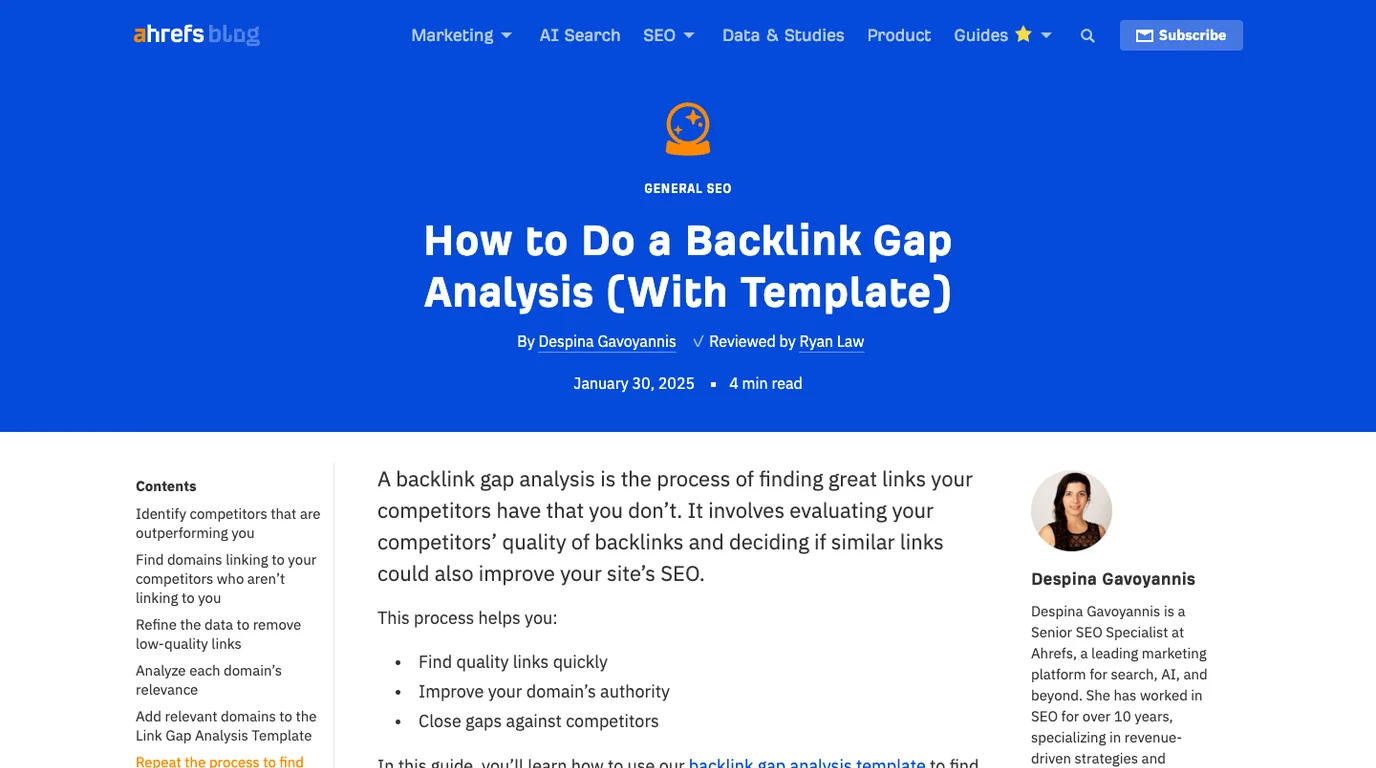
That public workflow proves the search task is article-shaped. The Searvora information gain begins where a typical export or template can become too mechanical: a domain shared by three competitors is evidence, but it is not automatically a good outreach target.
A useful analysis should produce one of these outcomes for every reviewed gap:
| Outcome | Use it when | Next action |
|---|---|---|
| Build or improve an asset | Competitors earned links because they have a statistic, tool, template, definition, or example you lack | Create or strengthen the page before outreach |
| Pursue an editorial link | A relevant source page would genuinely help its readers by citing your asset | Prepare page-specific outreach with a clear reader benefit |
| Reclaim or redirect | The source already mentions you, or a useful link points to an obsolete destination | Fix the path or request a better destination |
| Develop a relationship | The source is an association, partner, publication, community, or expert resource | Assign PR, partnerships, or subject-matter outreach |
| Monitor | The opportunity looks promising but the page, relationship, or target asset is not ready | Record the condition that would make it actionable |
| Ignore | The source is irrelevant, low-value, manipulative, inaccessible, or impossible to serve well | Document the reason and remove it from the queue |
Choose Competitors That Reveal A Real Gap
The wrong competitor set produces misleading link opportunities. A famous domain may share your category while serving a different audience, business model, geography, or search task. Its links can be impressive and still be useless to your site.
Build the comparison set in layers:
- Business competitors sell a similar product or service to a similar customer.
- Search competitors rank for the queries and page jobs you need to win, even if they sell something different.
- Page competitors have a specific asset competing with the page you want to improve.
- Citation competitors repeatedly earn links or mentions from sources your audience trusts.
Use two to five competitors for a focused first pass. Include at least one competitor close to your size and one strong page-level benchmark. If every comparison domain is dramatically larger, the gap report may mostly describe brand reach, newsroom access, or years of accumulated authority rather than a campaign you can reproduce.
This selection step is narrower than a full SEO competitor analysis. The broader analysis decides which rival pages matter. Backlink gap analysis asks which external sources and citation patterns reveal a realistic next move.
Separate Referring Domains From Referring Pages
Domain-level overlap is useful for prioritization. Page-level evidence explains the opportunity.
Suppose three competitors receive links from the same industry publication. The domain overlap looks strong, but the referring pages may reveal three very different reasons:
- one competitor supplied original survey data;
- one was listed in a maintained tool directory;
- one contributed an expert quote;
- your existing page is a sales landing page with no equivalent citation value.
The domain is not the strategy. The exact page, surrounding text, destination, and editorial reason tell you what would have to be true for your site to earn a comparable link.
Keep both levels in the working table:
| Field | What to record | Why it matters |
|---|---|---|
| Referring domain | Root domain and site purpose | Supports grouping and relationship review |
| Referring page | Exact URL, title, and page type | Reveals the citation context |
| Competitor target | The page receiving the link | Shows which asset type earned attention |
| Link context | Anchor, surrounding sentence, list position, or attribution | Explains the reader benefit |
| Competitor count | How many selected competitors appear | Helps rank repeated patterns without treating them as proof |
| Source status | Live, redirected, removed, gated, or stale | Prevents work on dead evidence |
| Candidate target | Your best existing or planned destination | Forces target-page clarity before outreach |
If you need a broader discovery and target-validation workflow first, use the guide to finding backlinks worth acting on. The backlink gap process assumes you already have access to a backlink index or export; Searvora does not claim to replace that data source.
Qualify The Source Before You Score It
Authority and traffic metrics are useful filters, but they cannot answer the most important question: why would this page cite you?
Review every high-priority source against five dimensions:
| Dimension | Strong evidence | Warning sign |
|---|---|---|
| Topical relevance | The source page serves an audience that needs your asset | The domain is broadly popular but the page is unrelated |
| Editorial reason | Your page adds evidence, explanation, utility, or a current example | The only pitch is that competitors already have a link |
| Source quality | The page is maintained, indexable, readable, and clearly owned | Thin directories, copied pages, or abandoned content |
| Link pattern | Citations are earned in useful editorial context | Paid placements, excessive exchanges, or forced anchors |
| Attainability | You can create a credible equivalent or better contribution | The link depends on a private partnership, award, event, or proprietary study |
Google defines link spam as links created primarily to manipulate rankings and lists paid ranking links, excessive exchanges, automated link creation, low-quality directories, and optimized distributed links among the risky patterns in its spam policies. Use that policy as a boundary, not as a reason to panic over every unfamiliar domain.
The safest queue is usually smaller after qualification. That is a feature. Removing weak prospects protects the brand, reduces wasted outreach, and makes the remaining work easier to defend.
Check Whether Your Target Page Deserves The Link
A backlink gap can expose a page gap. If competitors earn citations with calculators, original data, templates, technical references, or maintained examples, sending outreach to a generic homepage does not close the real gap.
Review the proposed target before anyone contacts a source:
- Confirm the target satisfies the same reader job as the competitor asset.
- Check that its evidence, examples, and update date are strong enough to cite.
- Verify the page returns a clean status and does not rely on an avoidable redirect chain.
- Confirm the canonical, robots directives, and indexability are intentional.
- Make sure important images, tables, downloads, and interactive elements work.
- Add relevant internal links so the page is not isolated from the rest of the site.
- Define what would make the page meaningfully better than the current cited option.
Google's link best practices explain how crawlable anchors help search systems discover and understand destinations. Your own crawl checks should extend that principle: a link opportunity is weaker when the destination is broken, ambiguous, blocked, duplicated, or disconnected from the site architecture.
Do not schedule outreach while the target page is still incomplete. Create, refresh, redirect, or re-crawl first.
Route The Gap By Why The Competitor Earned The Link
The fastest way to improve a gap analysis is to classify the citation mechanism. Different reasons require different owners and assets.
| Citation mechanism | What the competitor likely earned | Better Searvora-side response |
|---|---|---|
| Original data | A citation to a statistic, benchmark, or study | Research brief, maintained dataset, or transparent methodology |
| Practical utility | A link to a tool, calculator, template, or checklist | Build the useful asset before promoting it |
| Expert contribution | A quote, interview, or authored explanation | Subject-matter outreach or digital PR |
| Resource inclusion | Placement in a maintained guide or directory | Confirm category fit and propose a genuinely useful destination |
| Broken or stale destination | A link that no longer serves the reader | Offer a current replacement only when it is a close fit |
| Brand relationship | Partner, client, association, event, or community evidence | Partnerships or PR, not cold SEO outreach |
| Manufactured pattern | Paid, exchanged, automated, or low-value placement | Ignore, monitor, or escalate for risk review |
This prevents a common category mistake: treating every gap as link-building outreach. Some gaps require content, product, engineering, research, PR, or no action at all.
When the opportunity truly belongs in an outreach campaign, continue with the link building workflow and risk controls. Keep the gap analysis focused on evidence and routing rather than turning it into a second generic outreach guide.
Score Opportunities With Evidence, Not One Metric
Use a small scoring model that a reviewer can understand. Avoid hiding the decision inside a proprietary-looking number.
Score each dimension from 0 to 2:
| Dimension | 0 | 1 | 2 |
|---|---|---|---|
| Audience relevance | Unrelated | Adjacent | Direct match |
| Editorial fit | No clear reason | Possible with changes | Clear reader benefit |
| Target readiness | Missing or weak | Needs refresh | Citation-ready |
| Attainability | No realistic path | Relationship or asset required | Plausible next step |
| Business value | Little connection | Supports authority | Supports a priority page or market |
| Risk | Manipulative or unsafe | Needs review | Clean editorial pattern |
Do not simply total the cells and sort. Treat risk and target readiness as gates. A high-value source with an unready destination belongs in the asset queue, not the outreach queue. A high-metric source with a manipulative pattern belongs outside the campaign.
Then record confidence:
- High confidence: the source context, target asset, owner, and next action are all clear.
- Medium confidence: the opportunity is relevant but needs a page refresh, relationship check, or better evidence.
- Low confidence: the gap is driven mostly by metrics or domain overlap.
Turn The Analysis Into An Owner-Ready Queue
The final handoff should be short enough for a weekly SEO review. Each row needs:
| Queue field | Example decision |
|---|---|
| Evidence | Two competitors are cited in a maintained industry checklist |
| Reader reason | Our validation template would help readers complete the same task |
| Target | Existing template page after examples and update notes are added |
| Recommended action | Refresh asset, re-crawl, then contact the checklist editor |
| Owner | Content for refresh, SEO for validation, PR for outreach |
| Risk note | No payment, exchange, or requested exact-match anchor |
| Confidence | Medium until the refreshed asset is live |
| Validation | Target page is healthy; outreach sent; placement or editorial feedback recorded |
Measure the decisions, not just acquired links. Useful outcomes include assets improved, broken destinations repaired, irrelevant prospects removed, relationships identified, qualified outreach sent, editorial feedback received, and links or mentions earned.
Where Searvora Fits
Searvora does not provide a third-party backlink index or promise link acquisition. Its role begins after you have the evidence and need to turn mixed signals into prioritized, owner-ready work.
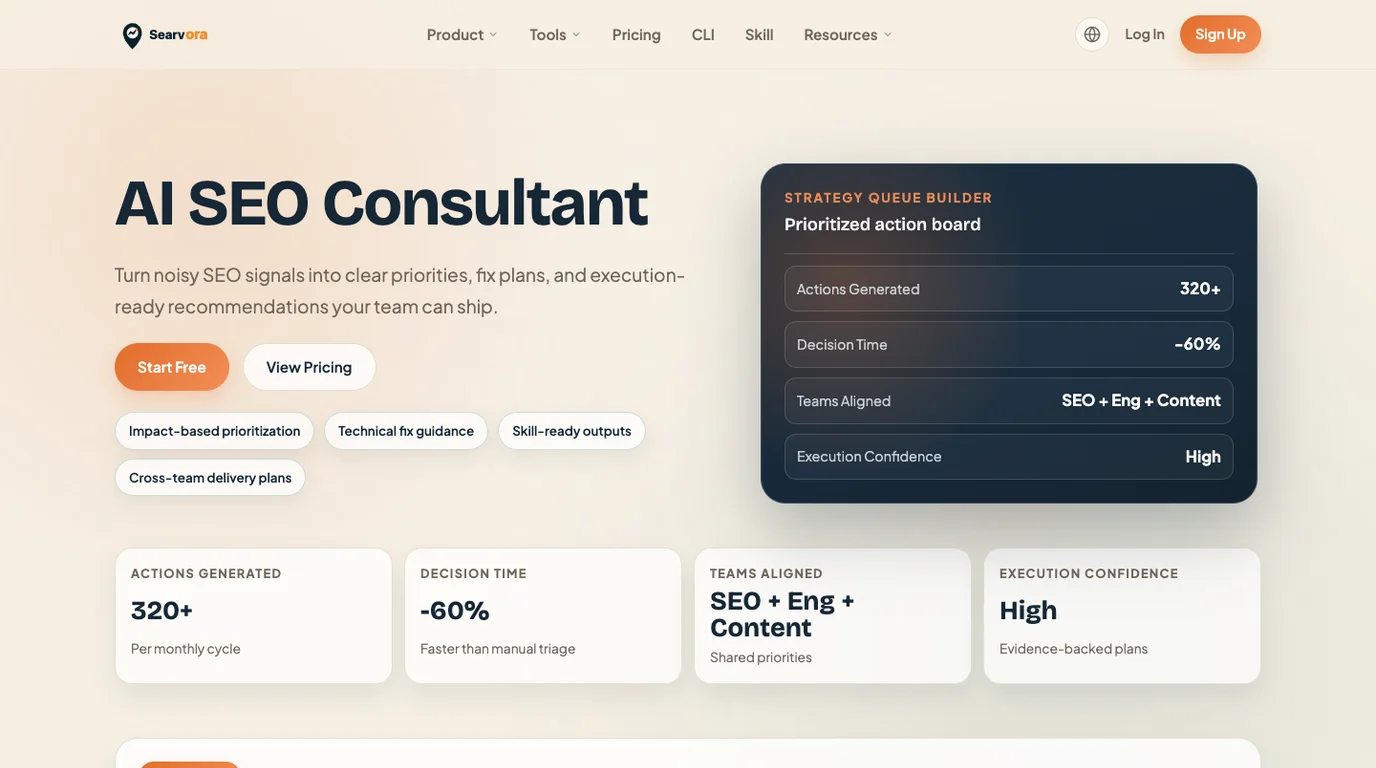
The AI SEO consultant is the primary fit for this workflow because its local product surface is built around pattern-based diagnosis, impact-and-effort prioritization, fix-ready guidance, and cross-team handoff. Use it to structure the asset, technical, content, PR, and no-action decisions that a backlink gap report creates.
Backlink Gap Analysis Checklist
Before handing the queue to a team:
- Select business, search, page, and citation competitors deliberately.
- Compare referring domains, then inspect the exact referring pages.
- Record why each competitor earned the link.
- Remove irrelevant, stale, inaccessible, and manipulative patterns.
- Identify the best target page for every qualified opportunity.
- Check target-page status, redirects, canonical, indexability, assets, and internal links.
- Route each gap to asset work, outreach, reclamation, PR, monitoring, or no action.
- Treat risk and target readiness as gates, not minor scoring fields.
- Assign an owner, confidence level, and validation signal.
- Review the queue on a fixed cadence and close rows that no longer have a credible reader benefit.
A backlink gap analysis is complete when the team knows what to build, what to fix, whom to contact, what to avoid, and how it will recognize a useful outcome. The export is only the evidence.