

If you want to know how to find backlinks, start with the goal. You are not looking for a bigger export. You are trying to find source pages, target pages, anchors, mentions, and broken paths that can become useful SEO decisions.
The basic workflow is simple: collect backlink evidence, remove noise, qualify the source and target, check whether the linked page is still healthy, and only then decide whether the next action is learning, reclamation, outreach, monitoring, or risk review.
The Ahrefs article on finding backlinks that surfaced this opportunity focuses on competitor link discovery and replication. Searvora's information gain is the operating layer after discovery: how to turn backlink data into a short action queue that respects crawl health, page quality, and link-risk boundaries.
Start With The Backlink Sources You Can Verify
Backlink tools differ because they crawl different parts of the web. Treat each report as evidence, not as a complete truth. A useful backlink review usually starts with more than one source:
| Source | What it is good for | First question to ask |
|---|---|---|
| Google Search Console Links report | Links Google reports for your verified property | Which pages earn links and which anchors appear most often? |
| A broader backlink index | Additional discovery across your site and competitors | Which source pages are relevant enough to sample? |
| Referral analytics | Links that actually send visits | Which links bring useful readers, not only metrics? |
| Server logs or crawl data | Whether linked target pages are reachable and crawlable | Are valuable links pointing through broken, redirected, blocked, or stale URLs? |
| Manual SERP review | Pages that rank for the same task and may cite similar resources | Which assets are competitors earning links with? |
Google's Search Console Links report documentation is the cleanest official starting point for your own site. Use third-party backlink indexes to expand discovery, but sample the source pages before trusting a score or raw count.
Build A Backlink Triage Map
Once you have a link export, separate the evidence into a triage map. This keeps link building, link reclamation, and risk review from collapsing into the same messy spreadsheet.
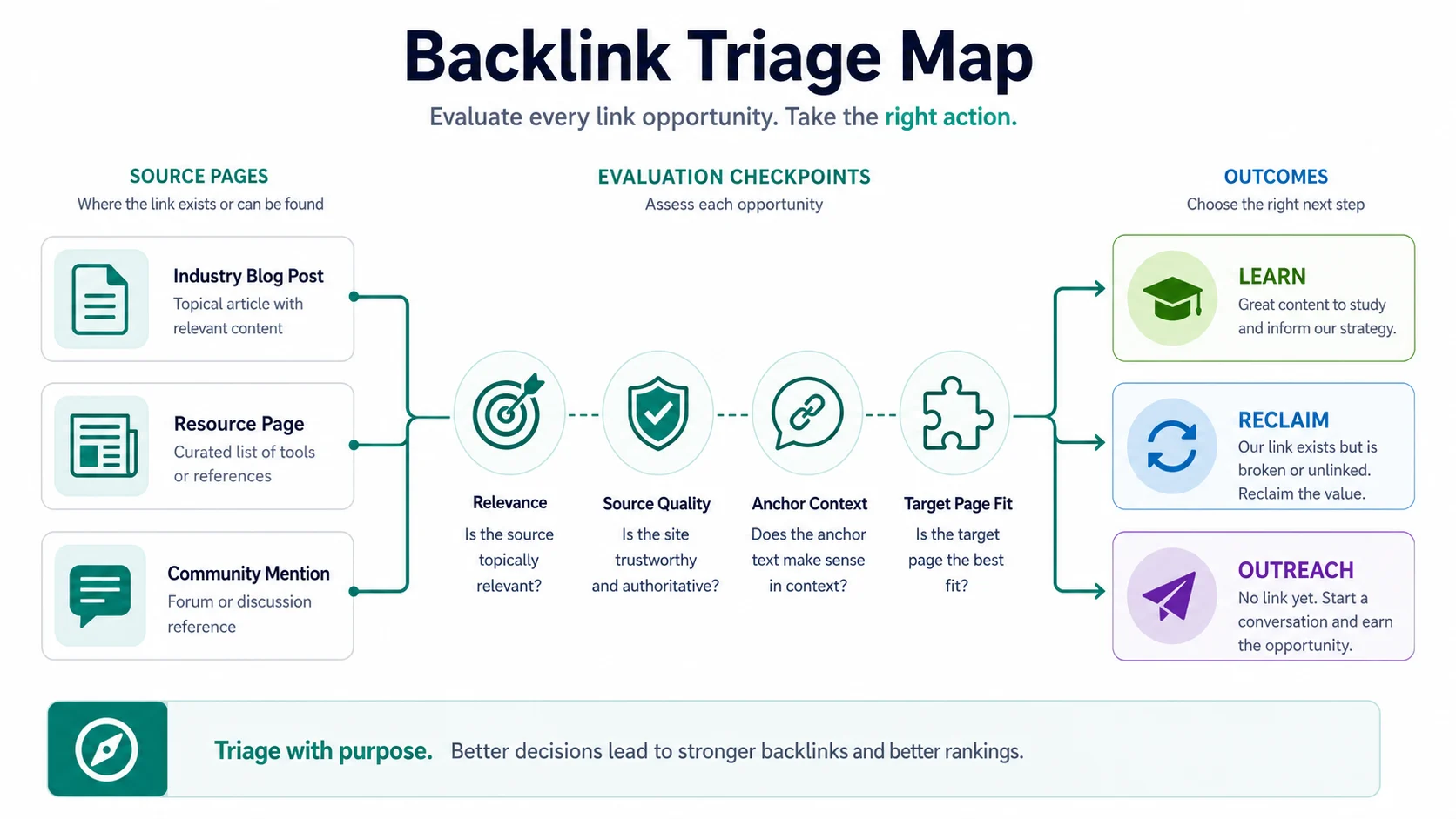
Use these checkpoints before adding anything to an action queue:
| Checkpoint | What to inspect | Why it matters |
|---|---|---|
| Source relevance | Topic, audience, page type, and surrounding context | Relevant source pages are more likely to send useful signals and readers |
| Source quality | Maintained content, real purpose, indexability, and editorial context | Weak directories and copied pages rarely deserve action |
| Anchor context | The sentence around the link and whether the anchor describes the destination | Natural anchors are safer and more useful than forced exact-match text |
| Target page fit | Whether your linked page still matches the source page's reader need | Outreach is wasted if the target asset is thin or outdated |
| Technical path | Status code, redirect chain, canonical, noindex, robots, and internal links | A good external link can leak value if your own page path is broken |
| Risk pattern | Paid placement, exchange, automated source, suspicious anchors, or vendor history | Risky patterns need evidence before cleanup or disavow discussion |
This is where the article differs from a generic "copy competitor backlinks" playbook. Competitor links can teach you what earns citations, but blindly replicating them can create low-quality outreach, weak guest posts, or unsafe anchor pressure.
If the team needs the beginner definition first, use the backlinks explainer. If the campaign is ready to move from evidence into outreach, use the link building for SEO workflow.
Turn Discovery Into A Validation Loop
The fastest way to waste backlink work is to pursue links before checking the target page. A valuable mention, broken backlink, or competitor citation should trigger a validation loop.
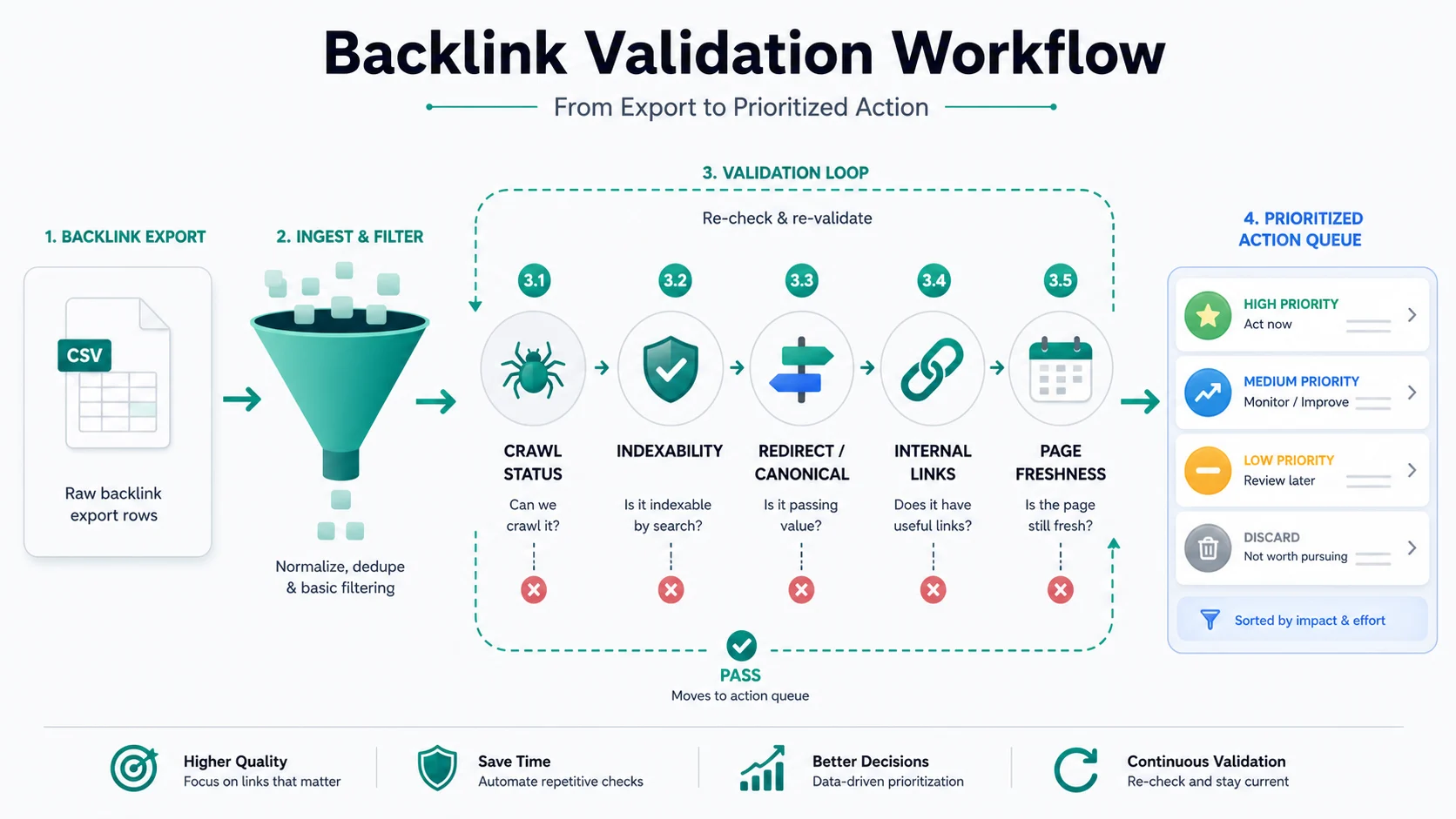
Run this sequence:
- Normalize the backlink export so duplicate source-target pairs are not counted as separate opportunities.
- Group links by target page, page type, source type, and anchor pattern.
- Check whether the target page returns a clean status code and avoids unnecessary redirect chains.
- Confirm the target page is indexable, canonical to itself when appropriate, and not blocked by robots rules.
- Review whether the page is internally linked from relevant hubs or supporting articles.
- Check whether the page is current enough to deserve citations.
- Score the next action by impact, effort, confidence, and risk.
Searvora's SEO spider crawler fits this part of the workflow because it can crawl technical signals, page structure, links, redirects, canonicals, and sitemap behavior. That matters when a backlink points to an old URL, a redirected asset, an orphan page, or a page that no longer matches the source context.
Google's crawlable links guidance is a useful technical baseline: links should be implemented in a way that search systems can discover and understand. Your validation loop should apply the same idea to your own target pages.
Decide What Each Backlink Means
Not every found backlink should become outreach. Use a small set of outcomes so the team can act without arguing over every URL.
| Evidence pattern | Better outcome | What to do next |
|---|---|---|
| Strong source already links to a useful page | Learn | Study why the page earned the link, then strengthen the asset and internal links |
| Valuable source links to an old or redirected URL | Reclaim | Fix the redirect path or ask for an updated destination when the request helps the source page |
| Competitor earns links from pages that cite resources | Build asset | Improve your resource before outreach so the link would help the source page's reader |
| Brand mention exists without a link | Outreach | Ask only when the linked destination would add clear context |
| Weak random domains link to mixed pages | Monitor | Record the pattern but avoid panic work |
| Paid, exchange-heavy, automated, or exact-match anchor patterns appear | Review risk | Sample evidence, check ownership history, and compare with Google's spam policies |
Google's spam policies are the safety boundary for link work. Links intended to manipulate rankings can create risk, especially when patterns involve paid links that pass ranking credit, excessive exchanges, automated link creation, or unnatural anchors.
If the evidence suggests cleanup risk, do not jump straight from "found suspicious links" to "disavow everything." Use the toxic backlinks triage workflow to separate background spam from patterns your team or a vendor may have created.
Use A Short Backlink Action Queue
A backlink action queue should be small enough to review in a weekly SEO meeting. It should also explain why each task exists.
| Queue field | What to record |
|---|---|
| Source URL | The page that links, mentions, or could reasonably cite your asset |
| Target URL | The page on your site that receives or should receive the link |
| Evidence type | Existing backlink, lost backlink, unlinked mention, competitor citation, or risk pattern |
| Reader reason | Why the link would help the source page's audience |
| Target health | Status, canonical, indexability, internal links, page freshness, and content fit |
| Risk flag | Paid, exchange-heavy, irrelevant, automated, hacked, suspicious anchor, or unknown |
| Recommended action | Learn, reclaim, refresh asset, add internal links, outreach, monitor, or risk review |
| Owner and validation | SEO, content, engineering, or PR owner plus the signal that proves the task worked |
This structure prevents backlink work from becoming a side quest. A found link may lead to a content refresh. A lost link may reveal a redirect mistake. A competitor citation may show that your page needs better examples. A suspicious pattern may need a decision note, not emergency cleanup.
Where Searvora Fits
Searvora does not replace backlink indexes, guarantee link acquisition, or recommend buying links. It fits after the evidence exists and the team needs a calm path from signal to action.
Use Searvora AI SEO Consultant when backlink findings need to become assigned work:
| Backlink job | What Searvora helps structure |
|---|---|
| Prioritize opportunities | Rank link reclamation, outreach, asset refresh, and monitoring work by impact and confidence |
| Connect technical checks | Keep crawl status, redirects, canonicals, internal links, and content quality in the same decision |
| Reduce risky shortcuts | Keep outreach tied to reader value and natural anchors instead of raw link pressure |
| Create handoff notes | Turn backlink findings into owner-ready SEO, content, engineering, or PR tasks |
Backlink discovery is useful when it changes the next decision. Find the source, qualify the context, validate the target page, choose the safest action, and keep the queue short enough to ship.
Backlink Discovery Checklist
Use this checklist before acting on a backlink report:
- Define whether the task is learning, reclamation, outreach, risk review, or monitoring.
- Pull your own-site data from Search Console and at least one broader backlink index when available.
- Deduplicate source-target pairs before reading totals.
- Sample source pages by pattern, not only by domain score.
- Check source relevance, source quality, anchor context, and target page fit.
- Crawl target pages for status codes, redirects, canonicals, indexability, robots rules, and internal links.
- Refresh weak target assets before outreach.
- Avoid outreach when the link would not help the source page's reader.
- Escalate risky paid, exchange-heavy, automated, or exact-match patterns only with evidence.
- Record the owner, next action, and validation signal before work begins.
The useful question is not "how many backlinks can we find?" It is "which backlink evidence should change what we do next?"