

ChatGPT copywriting prompts are most useful when they turn an approved brief into a clearer draft without letting the model invent the brief, the evidence, or the final decision. A generic request for “better copy” usually creates a generic response. A controlled prompt gives the model a narrow task, the reader context, the allowed source material, and a review rule.
That makes this a different job from a general SEO copywriting workflow. The workflow decides whether a page should exist and what it must accomplish. The prompts below help an editor draft, revise, and QA the approved page without losing that decision.
OpenAI’s public ChatGPT prompt guidance emphasizes clear, specific context and iterative refinement. For an SEO team, the practical translation is simple: give every prompt a page job and a quality gate, then review the output as an editable proposal rather than a finished asset.
Start With The Page Job
Before writing a prompt, describe the page’s job in one sentence. That sentence keeps the draft anchored when the wording starts to drift.
For example, a page about a technical SEO audit has a different job from a product category page, a comparison, or a Shopify blog post. The first needs a diagnosis and validation sequence. The second may need buying criteria. A good prompt does not hide that distinction under a list of keywords.
| Brief field | What to provide | Why it matters |
|---|---|---|
| Reader task | The question or decision the reader needs to complete | Keeps the opening and headings useful |
| Page type | How-to, explainer, comparison, or landing page | Stops a generic article from serving the wrong intent |
| Evidence boundary | Approved source notes, product facts, and claims that need review | Prevents plausible but unsupported copy |
| Required action | What the reader should be able to do next | Gives the draft a practical outcome |
| Review owner | The person or team that must approve claims and positioning | Keeps a fluent draft from bypassing accountability |
Use search intent to decide the page type before you ask for prose. If the query needs a comparison table, tell the prompt that. If the article needs a step sequence, request the steps and the validation check after each one. The best prompt cannot rescue a brief that has no reader job.
Build A Prompt Brief Before You Draft
The most reliable prompt is not necessarily the longest one. It gives the model the right constraints in a reusable order, then asks for one bounded deliverable.
Start each prompt with this input block:
Page job: [one-sentence reader task]
Audience: [role, level of knowledge, and situation]
Page type: [how-to, explainer, comparison, or other approved type]
Primary keyword: [approved keyword]
Evidence you may use: [approved facts, source notes, product facts]
Do not invent: [claims, benchmarks, integrations, quotes, or results]
Required output: [one bounded deliverable]
Review rule: [what a human must check before use]
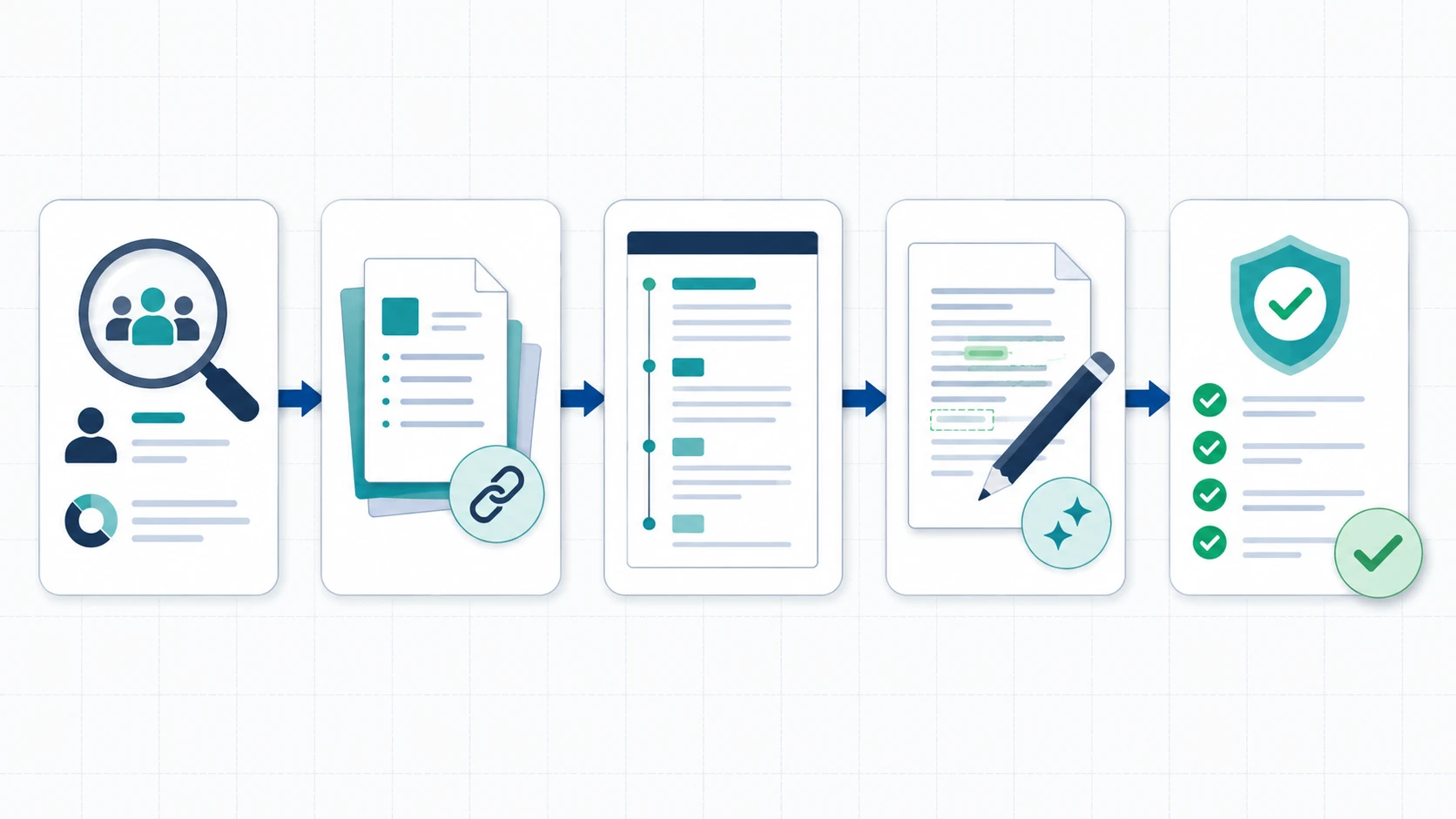
Then request one layer at a time. Ask for an outline before a draft, a draft before a rewrite, and a rewrite before metadata. This preserves the ability to reject one layer without rebuilding the entire article.
Use Prompt Patterns That Reduce Rewrites
The following patterns are not magic words. They are small assignments that make review easier because each output has a defined purpose.
Create An Intent-Checked Outline
Use this when the brief is approved but the article structure is still open.
Using only the approved brief below, propose an H2-led outline for a [page type].
The reader needs to [page job].
Each H2 must represent a decision, step, or validation check.
Include one markdown table or checklist that helps the reader act.
Do not add product claims or statistics that are not in the approved evidence.
After the outline, list the evidence each section still needs from a human editor.

[approved brief]
The last instruction matters. It turns missing proof into a visible editor task instead of letting a polished paragraph conceal it.
Draft One Section With Its Proof Boundary
Ask for one section at a time when accuracy or product positioning matters.
Draft the section titled "[H2]" for the approved page brief.
Answer the reader’s immediate question in the first two sentences.
Use only these approved facts: [facts].
Where evidence is missing, write [EDITOR REVIEW NEEDED] instead of guessing.
End with one practical validation step the reader can perform.
Keep the tone direct and avoid hype, guarantees, or first-person testing claims.
Replace the review marker before publication. It is a drafting control, not a sentence for readers to see.
Rewrite For Clarity Without Changing The Claim
This pattern helps when the draft is correct but difficult to scan.
Rewrite the passage below for a busy SEO operator.
Preserve every approved factual claim and remove no meaningful caveat.
Make the reader action explicit, reduce repetition, and use short paragraphs.
Do not add new examples, metrics, integrations, or promises.
Return the rewrite followed by a short list of wording changes that need human approval.

[approved passage]
Check The Page Promise Against The Draft
Use this after the body exists and before metadata is finalized.
Compare this approved title, meta description, and article draft.
Identify any promise in the title or description that the body does not support.
Identify any important reader task that the introduction delays or misses.
Recommend the smallest fix for each mismatch.
Do not rewrite the article unless asked.

[title]
[meta description]
[draft]
This prompt is especially useful for preventing an attractive headline from promising a list, benchmark, or outcome that the body cannot deliver.
Review Every Output Through Four Gates
AI-assisted copy can be readable and still fail the page. Review the output against the same standards that applied before the prompt was written.

| Gate | Editor question | If the answer is no |
|---|---|---|
| Source | Can every material claim be traced to approved evidence or clearly framed as advice? | Remove, source, or rewrite the claim |
| Intent | Does the opening answer the search task and does the structure match the page type? | Rework the outline before polishing prose |
| Reader value | Does each section add a decision, method, example, or check? | Cut filler and add the missing operational detail |
| Publish readiness | Do metadata, internal links, visuals, and CTA match the completed article? | Fix the page package before routing it to review |
The gates make iterative refinement useful rather than endless. A revision prompt should name the failed gate and ask for the smallest correction. “Make this better” produces uncontrolled variation. “Rewrite the opening so it states the diagnostic step before the tool recommendation, using only the approved source notes” gives the editor something concrete to approve.
Move The Validated Draft Into A Publishing Workflow
Once the draft passes review, it still needs a stable route to publication. Blogify is designed for Shopify teams that need to plan, draft, enrich, and move structured SEO blog content into a reviewable Shopify draft workflow. Use it after the brief and human review rules are clear, not as a substitute for them.
For this topic, the useful handoff is:
- Approve the page job and evidence boundary.
- Use bounded prompts to create the outline and draft sections.
- Apply source, intent, reader-value, and publish-readiness gates.
- Add the correct internal links, metadata, visuals, and product context.
- Route the completed article into the responsible Shopify review and publishing path.
Keep This Checklist Beside The Prompt
Before you use an AI-assisted section, check the following:
- The prompt states the reader task and the correct page type.
- The approved facts and the prohibited assumptions are explicit.
- The request is limited to one deliverable such as an outline, section, rewrite, or QA pass.
- The draft does not introduce unsupported benchmarks, product behavior, or customer stories.
- The opening answers the query before asking the reader to do extra work.
- Each H2 supports a decision, step, or validation check.
- The title and description promise only what the body delivers.
- Internal links take the reader to the next useful action rather than pad the page.
- Visuals explain the workflow or provide factual source context.
- A human owner has reviewed material claims, product positioning, and the final publishing package.
ChatGPT copywriting prompts work best as part of an editorial system. Give them a clear input, a narrow task, and a visible quality gate. The result is not automatic publishing. It is a faster path to a draft that a responsible editor can verify, improve, and ship.