

Quality content is content that earns its place in a publish queue. It answers a defined search task, gives the reader something useful to do next, supports important claims with the right level of evidence, and reaches search systems in a form they can crawl and understand.
That is a much more useful standard than “well written.” Before a draft goes live, run it through a quality content QA gate. The gate should make one decision clear: publish, revise, change the page type, or stop.
What quality content means in an SEO workflow
A polished draft can still be low quality if it solves the wrong task, repeats an existing page, buries its answer, or ships with technical problems. Treat quality as a set of observable checks rather than a subjective final read.
| Question | Evidence of quality | A reason to pause |
|---|---|---|
| Does it match the search task? | The opening answers the specific question and the format fits the intent. | The draft is a generic explainer for a how-to, comparison, tool, or buyer task. |
| Does it add something useful? | It includes a decision rule, example, checklist, or method the reader can apply. | It restates familiar advice without a concrete next step. |
| Can a reader trust the important claims? | Recommendations, examples, and facts have appropriate supporting evidence. | The page relies on vague assertions, unsupported product claims, or recycled opinions. |
| Is the page usable by search systems? | The answer, headings, links, and supporting details are clear and the published page is crawlable. | The important information is hidden, duplicated, or technically inaccessible. |
| Can the team improve it later? | The owner, update trigger, and post-publish signal are known. | Nobody knows what success looks like or who responds when the page underperforms. |
This makes quality content a release decision. It is not a promise that every page will rank, and it is not a demand for the longest possible article.
Start with the search task, not the topic label
“Quality content” is a broad label. The useful work starts when the team turns it into a narrower reader job. A new article may need an explainable framework. A product page may need proof that helps a buyer choose. A support page may need the shortest reliable fix sequence.
Ask these questions before the outline is locked:
- What is the reader trying to decide, fix, learn, compare, or complete?
- What page type is most likely to serve that job: article, tool, landing page, comparison, or hub?
- What would make this page more useful than an existing Searvora URL on the same cluster?
- Which claims need first-party evidence, a current public source, a screenshot, or a product owner review?
This is where quality prevents cannibalization. A content team should not create another article just because a broad keyword is nearby. If the same core keyword, page type, and user task already have a canonical Searvora page, improve that page instead.
For a deeper way to make subject coverage clear without repeating the same page, use the principles in semantic SEO. The goal is not to add more related words. It is to make the page's purpose, entities, and proof easy for a reader and a search system to understand.
Use an evidence ladder instead of a word-count target
Word count is a weak proxy for quality. A better test is whether each layer of the page supports the layer above it.

Start at the bottom with the search task. Then check whether the draft provides a usable answer, enough evidence for the claims that matter, and a page structure that keeps the answer accessible. A detailed page with no reliable support is still fragile. A well-sourced page that never answers the task is still unhelpful.
Use this ladder to decide the level of effort:
- A basic explanatory page may need a concise definition, examples, and clear internal links.
- A technical workflow may need a reproducible sequence, expected signals, failure modes, and a validation check.
- A review, roundup, comparison, or support article may need official public-source verification and factual product screenshots near the relevant recommendation.
- A strategy page may need explicit tradeoffs, owners, and a measurement plan so the reader can turn advice into work.
The key is proportional evidence. Do not turn every article into a research paper, but do not ask readers to accept a major recommendation on a thin assertion.
Run the pre-publish quality content checklist
Give the editorial owner a checklist that can lead to a real decision. Each item should be easy to mark as pass, revise, or escalate.

| Gate | Pass condition | Owner when it fails |
|---|---|---|
| Intent | The first section answers the target task and the article type matches it. | SEO or content strategist |
| Information gain | The page has a framework, example, checklist, or angle that adjacent pages do not already own. | Content lead |
| Evidence | Important facts and recommendations are current, supportable, and framed fairly. | Subject-matter reviewer |
| Page experience | Headings, tables, images, and links help scanning rather than hide the answer. | Editor or designer |
| Search readiness | The canonical, metadata, internal links, crawlability, and page type are ready to validate. | SEO or web owner |
| Release ownership | A person owns approval, an update trigger, and the first post-publish review. | Publishing owner |
The checks also make it easier to distinguish a content-quality problem from a content-performance problem. A page can pass the gate and still need iteration after it earns impressions. That is normal.
Keep pre-publish QA separate from the content audit
Pre-publish QA protects new work before it compounds. A content audit looks backward across existing URLs to find pages that should be refreshed, consolidated, redirected, or removed.
Use both. The QA gate stops avoidable weak pages from entering the site. The audit identifies where the existing library has changed intent, become outdated, or started competing with itself. Together they give the team a cleaner content backlog:
- New draft fails the intent or evidence gate: revise the brief or change the page type.
- New draft passes but performance is weak: inspect query fit, page experience, distribution, and technical signals.
- Existing page has the right task but stale proof: refresh the evidence and revalidate the page.
- Two URLs serve the same task: choose one canonical owner and redirect, consolidate, or differentiate the other.
Quality is therefore a workflow, not a one-time editorial judgment.
Put the gate where the team already ships work
The QA gate should travel with the brief and draft rather than live in a forgotten checklist. That makes intent, metadata, internal links, product context, and owner review visible before the content reaches a publishing queue.
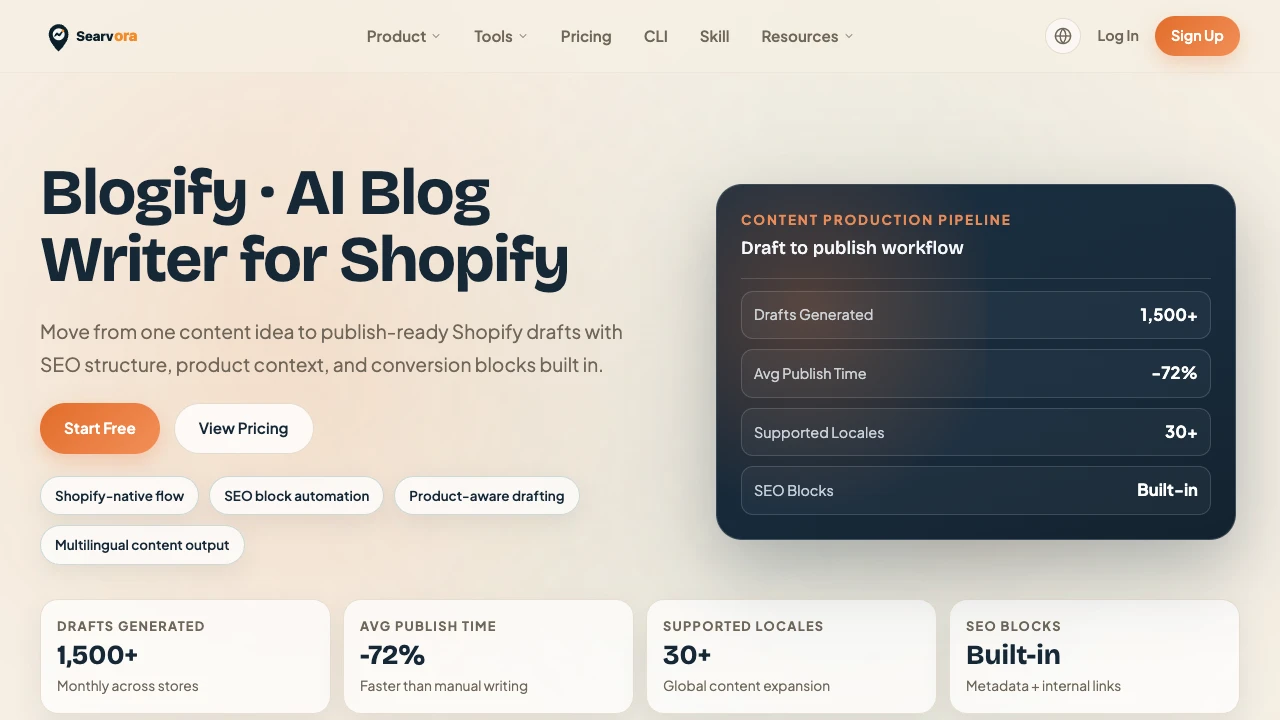
For Shopify content teams, Blogify provides a surface for structured SEO drafting, editorial controls, metadata and internal-link enrichment, and a Shopify draft workflow. Use it to keep the production process organized; keep the final quality decision with the editor and subject-matter owner.
Before you press publish, make one last decision: does this page give the right reader a useful, supportable answer in a form the site can maintain? If yes, ship it and measure. If not, the quality gate has already done its job.