

Can you steal competitors traffic on organic keywords? Not literally, and you should not try to copy another site's pages, links, or brand angles. What you can do is study the public search jobs your competitors already satisfy, then build a better, safer plan for the queries where your site can add real value.
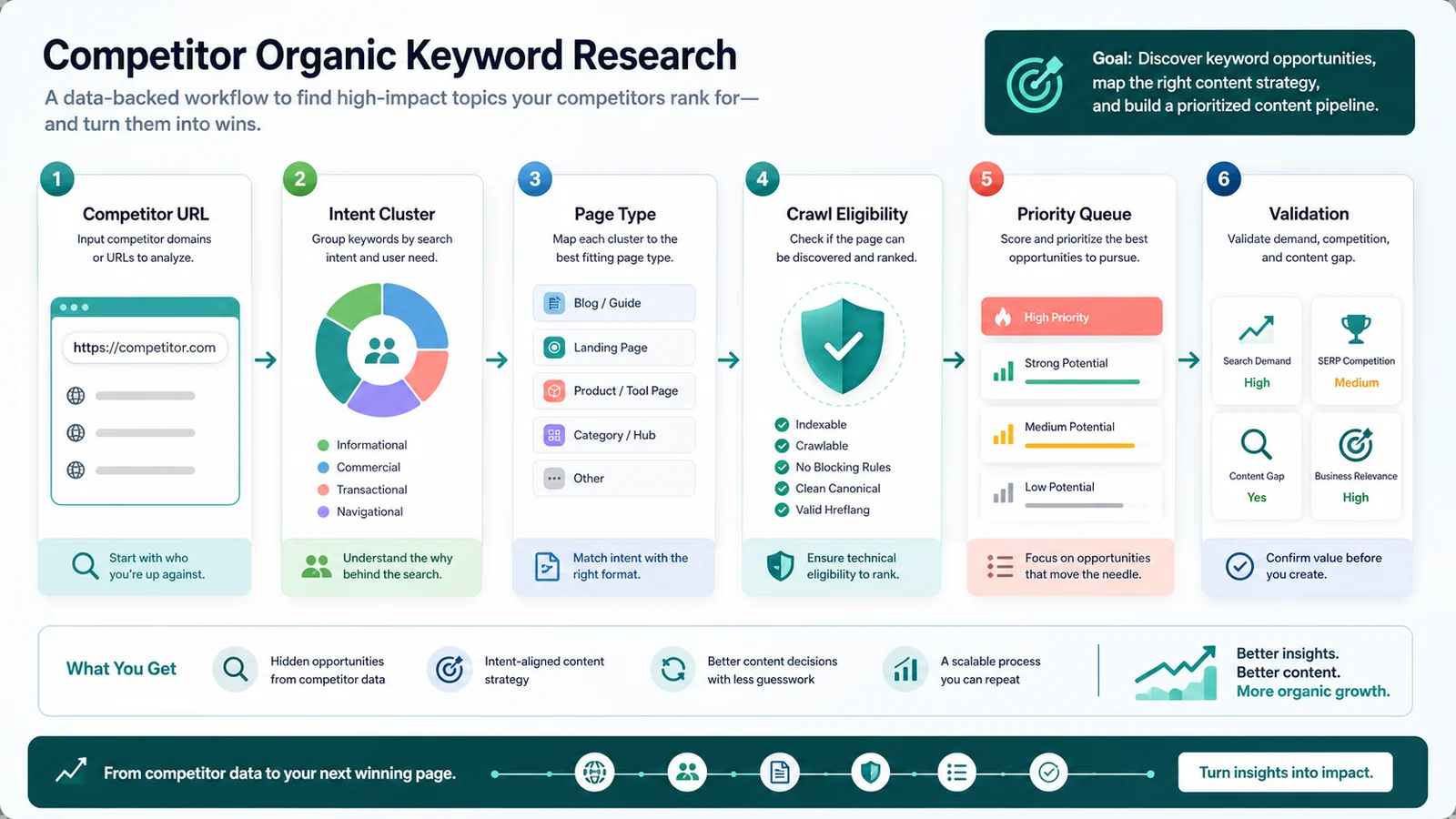
The useful workflow is simple: collect competitor URLs, group the keywords by intent, choose the right page type, check whether your site can technically support the page, and only then assign the work. Competitor traffic is a research signal. It is not permission to imitate.
Start With Public Search Demand, Not Copying
Competitor keyword research gets risky when the team treats a ranking URL as a template to clone. That creates thin me-too pages, weak brand differentiation, and avoidable spam risk.
Use competitor traffic data to answer better questions:
| Question | What to inspect | Safe output |
|---|---|---|
| Why does this page get traffic? | Query set, page type, SERP shape, and search task | Intent hypothesis |
| Could our site answer it better? | Product evidence, expertise, examples, and source depth | Differentiated angle |
| Is the page technically eligible? | Crawl path, canonical, indexability, speed, and internal links | Launch checklist |
| Should we create a new page? | Existing coverage, cannibalization, and page-type fit | Article, landing page, hub, refresh, or no-op |
| How will we prove it worked? | Baseline queries, impressions, clicks, ranking movement, and shipped fixes | Validation plan |
Google's people-first content guidance is the right guardrail here. A competitor URL can reveal demand, but your page still has to help the searcher more clearly than the available results.
Turn Competitor Keywords Into Intent Clusters
Start by grouping competitor keywords by the job behind the search, not by exact phrase. A single competitor article may rank for definitions, how-to searches, alternatives, cost questions, and tool queries. Those do not all deserve the same response.
Use this first-pass routing table:
| Competitor keyword pattern | Likely user job | Safer Searvora response |
|---|---|---|
| "what is", "definition", "examples" | Understand a concept | Explainer with examples and links to deeper workflows |
| "how to", "checklist", "audit" | Execute a task | How-to article with validation checks |
| "best", "tools", "software" | Compare options | Real roundup or comparison, not a disguised essay |
| "cost", "pricing", "agency" | Budget or evaluate buying paths | Decision guide or commercial page |
| "checker", "generator", "extractor" | Perform an action now | Tool page, not a blog post |
| Branded competitor query | Understand a named tool or alternative | Fair intercept article only when public evidence supports it |
The search intent in SEO workflow is useful at this point because it prevents teams from turning every competitor keyword into another blog post. Some opportunities need a product page, a tool, a hub, or an update to an existing URL.
Check Cannibalization Before You Build
The biggest mistake is not choosing the wrong competitor. It is writing a new page that splits your own site.
Before you approve a topic, compare the candidate against:
| Coverage check | What can block the new page | Decision |
|---|---|---|
| Existing article | Same user job, same page type, same intent | Refresh or consolidate |
| Product or tool page | SERP expects a product, checker, generator, or app | Route to landing or tool |
| Parent hub | Topic needs navigation across many child pages | Build hub architecture first |
| Adjacent article | Same topic family but different job | Keep if the intent split is clear |
| Competitor URL lane | Similar inferred keyword already drafted elsewhere | Reuse the stronger angle |
This is where content gap analysis matters. A gap is not "a competitor has a page and we do not." A real gap means a searcher has a job your site can satisfy better than your current URL set.
Score Opportunity With Crawl And Execution Reality
A competitor may rank because the topic fits them, not because it fits you. Before writing, check whether your site can support the page.
Use a simple scorecard:
| Signal | Strong opportunity | Weak opportunity |
|---|---|---|
| Intent fit | The query maps to your product, expertise, or workflow | The topic is only loosely related |
| Information gain | You can add a clearer process, data, examples, or decision aid | You would mostly summarize the SERP |
| Technical readiness | The page can be crawled, linked, indexed, and validated | The template or cluster is not ready |
| Internal route | There is one natural next step for the reader | The CTA would feel forced |
| Measurement | Baseline query/page tracking is possible | No clean way to judge the result |
For Searvora, a competitor organic keyword becomes attractive when it can connect search demand to crawl evidence, page-type judgment, and an owner-ready action queue. If the topic only creates another generic SEO article, leave it alone.
Use Searvora To Convert Research Into A Work Queue
Competitor research is most valuable when it becomes a short list of work the team can ship. The SEO competitor analysis process can find the gap, but the final handoff still needs priority, owner, acceptance criteria, and validation.
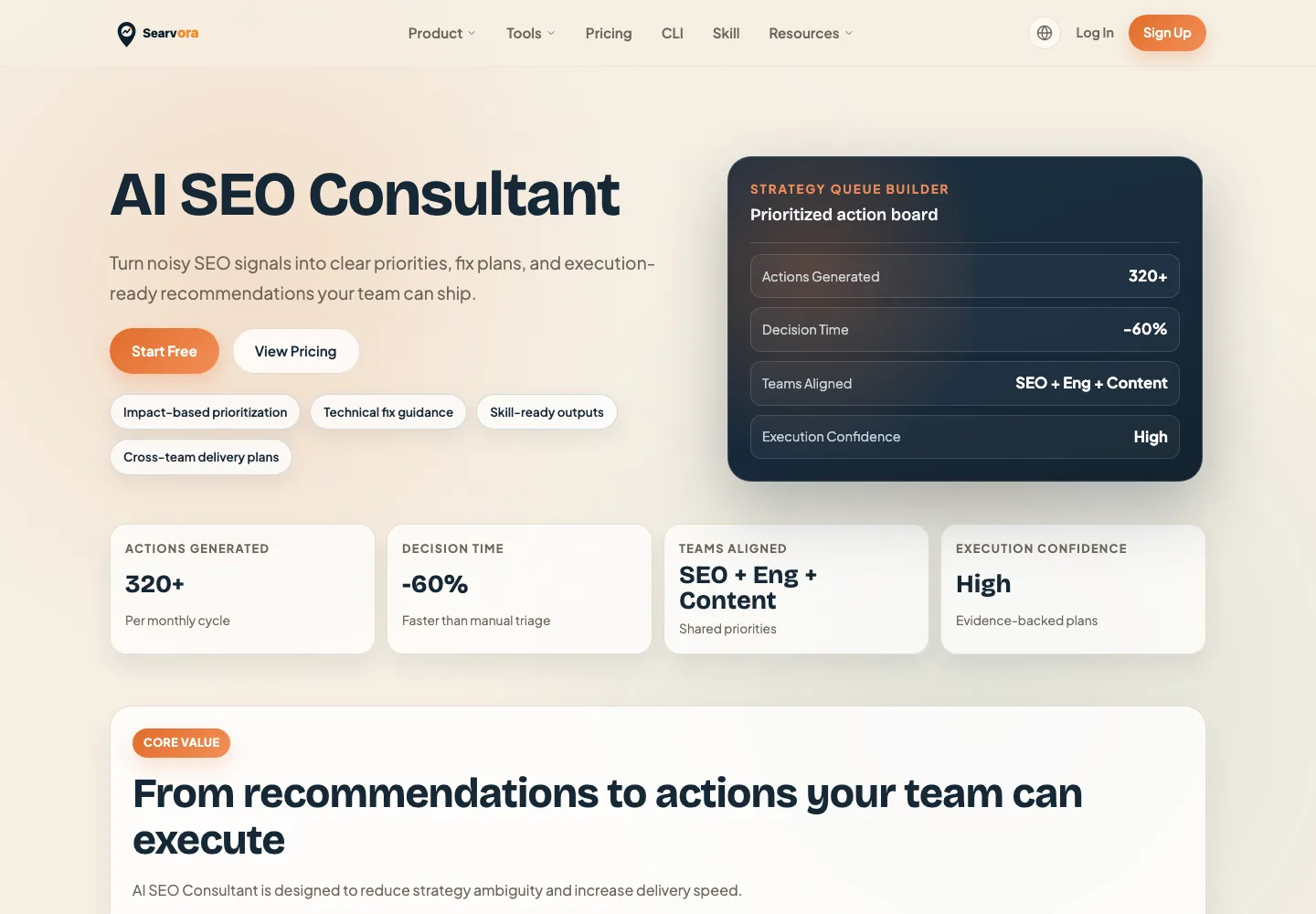
Use the AI SEO Consultant when competitor keyword research produces too many possible actions. It is designed to turn noisy SEO signals into priorities, fix plans, and execution-ready recommendations your team can ship.
A Safe Workflow For Competitor Organic Keywords
Use this sequence before any writer touches a brief:
- List the competitor URLs and the keywords they rank for.
- Group the keywords by user job and page type.
- Remove queries that are off-brand, too broad, or already covered by your site.
- Check the SERP to confirm whether the demand is article, product, tool, hub, or comparison shaped.
- Pick one information-gain angle your site can prove.
- Validate crawl eligibility, canonical behavior, sitemap inclusion, and internal links.
- Assign the work with a target URL, owner, launch criteria, and review date.
- After publication, compare impressions, clicks, query mix, internal links, and crawl state.
Competitor traffic can help you see what the market already rewards. The win comes from building a page that deserves to be chosen for its own reasons.