

A keyword strategy is the decision layer that turns keyword research into an SEO roadmap. Research tells you what people search for. Strategy decides which terms deserve a page, which existing URLs should be refreshed, what order the work should ship in, and how the team will measure progress.
The useful output is not another keyword list. It is a governed queue of page jobs, priorities, internal links, owners, and validation checks. That is what keeps SEO planning from becoming a spreadsheet that everyone respects and nobody ships.
What Keyword Strategy Should Decide
A strong keyword strategy answers five production questions before a brief reaches a writer or developer:
| Decision | What to decide | Why it matters |
|---|---|---|
| Page job | What task should the searcher complete? | Prevents generic articles that do not satisfy intent |
| Page type | Should this be an article, hub, tool, landing page, comparison, or refresh? | Keeps the asset matched to search demand |
| Priority | Which opportunity should ship first? | Protects limited content and engineering capacity |
| Support | Which internal links, proof, visuals, and crawl checks are needed? | Gives the page a better chance to perform after launch |
| Measurement | Which signal tells the team whether the decision worked? | Turns strategy into a review loop, not a one-time plan |
This is different from ranking keywords by volume. A low-volume topic can be strategic if it supports a product workflow or closes a clear cluster gap. A high-volume topic can wait if the best page type is a tool you cannot build yet.
Separate Research From Strategy
Keyword research collects and organizes demand. Keyword strategy chooses what to do with that demand.
The keyword research workflow is where you gather seed topics, competitor gaps, Search Console queries, and intent clues. The strategy step starts after that: it decides whether each cluster becomes a new page, an existing-page refresh, a supporting internal link, a tool idea, or a defer.
Use this split when the keyword list gets noisy:
| Signal from research | Strategy question | Likely action |
|---|---|---|
| Many similar beginner phrases | Do we already have one page for the beginner job? | Refresh or strengthen the parent page |
| A competitor article wins a distinct task | Can we add a better workflow or proof layer? | Create a new article |
| A keyword includes template, calculator, or generator | Does the reader need an output? | Build a resource or tool page |
| Search Console shows impressions for an existing URL | Does the current page satisfy the query mix? | Refresh, expand, or improve links |
| A technical topic depends on crawl access | Can the page be indexed, linked, and measured? | Pair content work with technical checks |
Google's SEO starter guide is a useful baseline here because it frames SEO around helping search engines understand content and helping users decide whether to visit. A keyword strategy should make both jobs easier.
Score Opportunities Before They Enter The Roadmap
Once the user job is clear, score each opportunity before it enters the roadmap. The score does not need to be mathematically perfect. It needs to be consistent enough that the team can explain why one page ships before another.
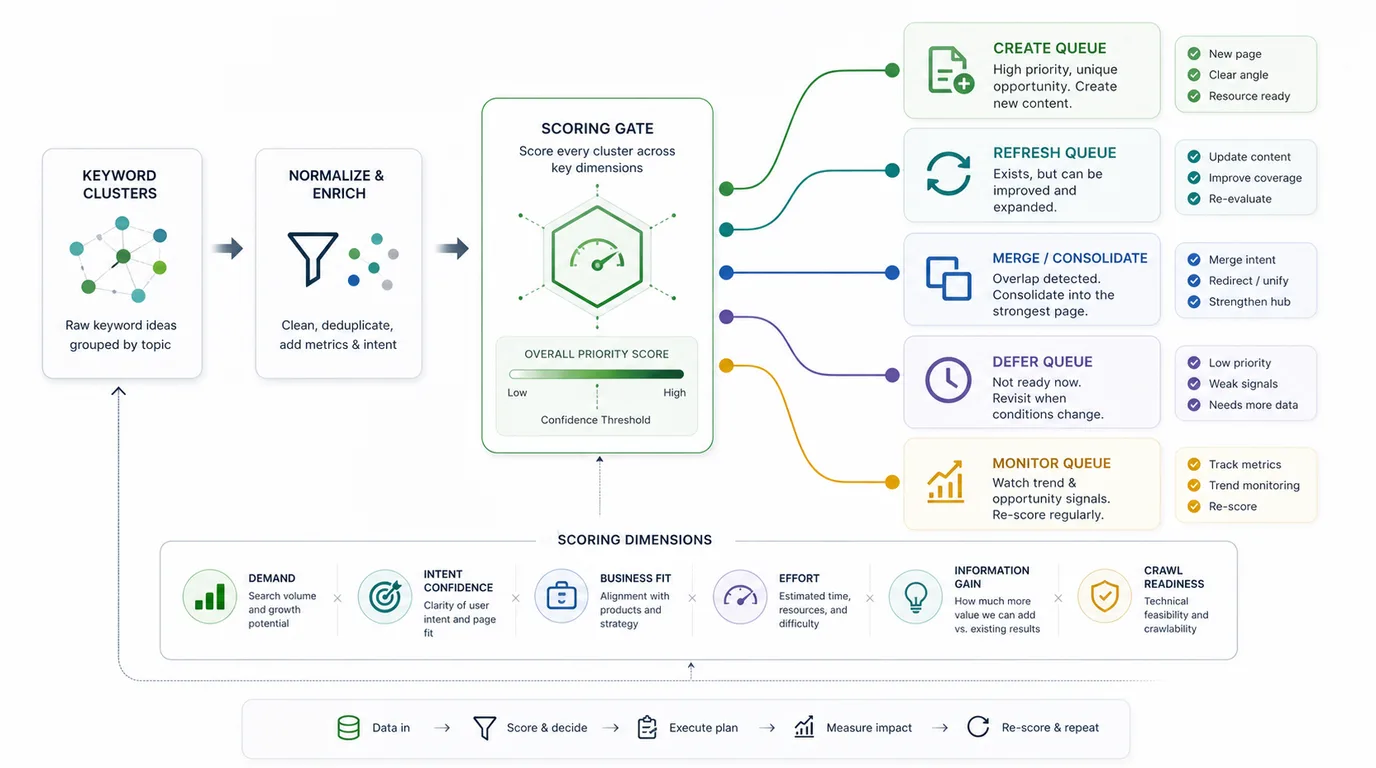
Use these dimensions:
| Dimension | High score looks like | Low score looks like |
|---|---|---|
| Demand | Competitor traffic, keyword breadth, or Search Console impressions show a real query family | One isolated phrase with weak evidence |
| Intent confidence | Query, competitor page, and existing SERP shape point to the same page type | Mixed article, tool, local, and brand intent |
| Business fit | The page supports SEO, GEO, content operations, reporting, crawling, or strategy | Traffic would not help Searvora's audience |
| Information gain | You can add a better workflow, decision table, proof layer, or validation path | You would mostly rewrite what already ranks |
| Effort | The page can be shipped with known owners and assets | The work depends on unresolved product, legal, data, or design decisions |
| Crawl readiness | The URL can be discovered, indexed, canonicalized, linked, and measured | The template or site architecture blocks performance |
This score should change the queue. If the information gain is weak, defer even if the keyword looks popular. If the crawl or internal-link support is missing, fix that before asking content to carry the whole outcome.
Turn Clusters Into A Quarterly Roadmap
A keyword strategy becomes useful when it maps clusters to a time-bound roadmap. Quarterly planning is a practical cadence because it gives the team enough room to ship, measure, and adjust without rebuilding the plan every week.
Build the roadmap in this order:
- Group keywords by user job, not exact wording.
- Match each group to an existing Searvora URL or a missing page job.
- Assign a page type before writing a title.
- Score demand, fit, information gain, effort, and readiness.
- Choose a create, refresh, merge, defer, or monitor action.
- Add the internal links and validation signal the page will need.
- Assign an owner and expected publish or refresh window.
For example, "keyword research" and "keyword strategy" can live in the same cluster without doing the same job. Research is about finding and qualifying terms. Strategy is about governance: which opportunities belong in the roadmap, how they are sequenced, and how the team knows whether the plan is working.
That distinction is also why the search intent in SEO workflow matters. If the job changes, the page type or page owner may change too.
Protect The Roadmap From Cannibalization
Keyword strategy often fails because teams approve every adjacent topic. The safer rule is strict: a new page is a duplicate only when the same core keyword, same page type, and same user job are already covered.
Use this overlap test before creating a new URL:
| Test | Duplicate when yes | Safe when |
|---|---|---|
| Core keyword | Both pages target the same primary phrase | One page is a parent, child, or adjacent workflow |
| Page type | Both are the same asset type | One is a tool, one is an article, or one is a product page |
| User job | Both solve the same reader task | One educates, one routes, one compares, one executes |
| Information gain | The new page adds no sharper framework or evidence | The new page adds a decision path the existing page does not have |
When the overlap is real, do not force a new draft. Refresh the stronger URL, merge weak pages, add internal links, or route the idea into a later child article. When the overlap is only parent-child coverage, use the relationship. A keyword strategy article can link back to keyword research, search intent, and topical authority without replacing any of them.
Add AI Search And Crawl Readiness
Modern keyword strategy has to account for classic search, AI answer systems, and technical eligibility at the same time. A page cannot become visible if it is blocked, confusing, unsupported, or too generic to cite.
Add these readiness checks to every approved roadmap item:
| Readiness check | What to inspect | Strategy decision |
|---|---|---|
| Direct answer | Does the intro answer the primary job quickly? | Rewrite the opening before publishing |
| Entity clarity | Are page types, tools, products, sources, and tasks named plainly? | Add definitions or examples |
| Useful structure | Are tables, steps, and checklists extractable in text? | Move decision logic out of images only |
| Crawl access | Is the intended URL indexable, canonical, linked, and in the sitemap? | Fix technical blockers first |
| Source quality | Are claims grounded in public docs, product pages, or visible evidence? | Add sources or remove unsupported claims |
| Measurement | Can the team monitor queries, pages, and segments after launch? | Define the review view before shipping |
Google's guidance on helpful, reliable, people-first content is a good quality check because it pushes teams toward original value instead of search-engine-first volume. For page-level performance, the Search Console performance report can help compare queries, pages, countries, devices, clicks, impressions, CTR, and position after the page is live.
Measure The Strategy As A Loop
Keyword strategy is not done when the roadmap is approved. The plan should create a measurement loop that feeds the next planning cycle.
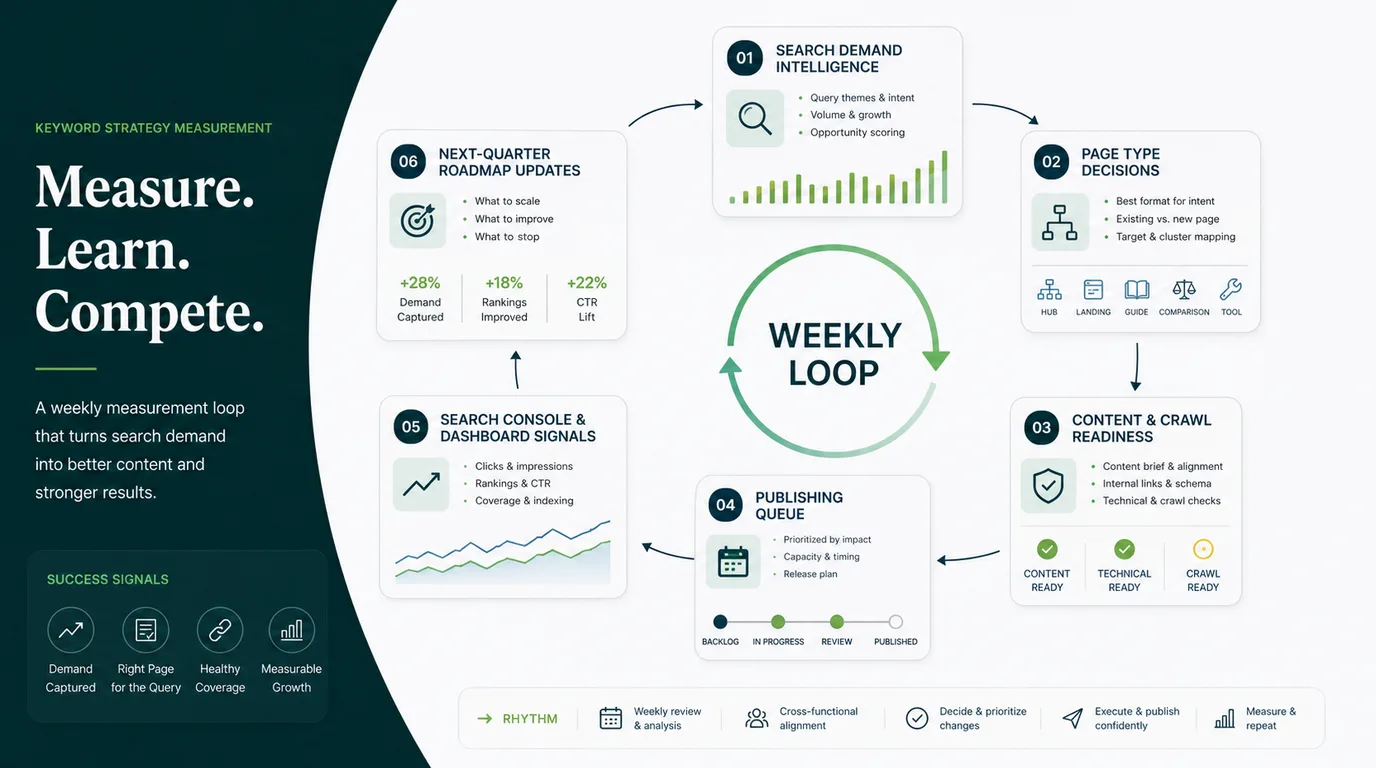
Use a weekly or monthly review cadence:
- Check whether newly published pages are crawlable, indexable, canonical, and internally linked.
- Review impressions and query mix once enough data exists.
- Compare the page's actual queries against the intended user job.
- Mark whether the next action is monitor, refresh, expand, merge, or support with links.
- Feed learnings back into the next roadmap batch.
For technical validation, Google's URL Inspection tool documentation is useful because it keeps the team focused on what Google knows about a specific URL instead of assuming a shipped page is eligible.
The strategy gets stronger when every page teaches the next decision. A page that attracts the wrong query mix may need a title and H1 rewrite. A page with impressions but weak clicks may need a clearer promise. A page with no discovery may need internal links or crawl fixes before another article is added to the roadmap.
Where Searvora Fits
Searvora AI SEO Consultant is the natural product layer for keyword strategy because the local product page positions it around pattern-based diagnosis, impact-based prioritization, fix-ready guidance, and execution alignment.
Use the AI SEO consultant when the team has too many keyword options and needs a defensible action queue:
| Input | Searvora strategy role | Output |
|---|---|---|
| Keyword clusters | Group by page job and business fit | Create, refresh, merge, defer, or monitor decisions |
| Competitor URL gaps | Confirm page type and information gain | Briefs that do not simply copy competitors |
| Crawl and content signals | Check eligibility and support | Fix-ready technical and content actions |
| Dashboard evidence | Prioritize by impact and confidence | Roadmap items with owners and review signals |
A Practical Keyword Strategy Checklist
Use this checklist before approving the next roadmap batch:
- Name the primary keyword and close variants.
- Write the user job in one sentence.
- Decide the page type before drafting the title.
- Check existing Searvora URLs for same-keyword, same-type, same-job overlap.
- Score demand, intent confidence, business fit, information gain, effort, and crawl readiness.
- Decide whether the action is create, refresh, merge, defer, or monitor.
- Pick one primary internal-link source and one to three supporting links.
- Define the title, H1, meta description, visual needs, and source evidence.
- Confirm the target URL can be indexed, canonicalized, linked, and measured.
- Assign an owner and review date.
- Re-check Search Console and crawl evidence after publishing.
- Feed the result into the next roadmap decision.
A keyword strategy works when it turns search demand into choices your team can defend. Keep the research, page job, priority score, and validation signal connected, and the roadmap becomes easier to ship and easier to improve.