

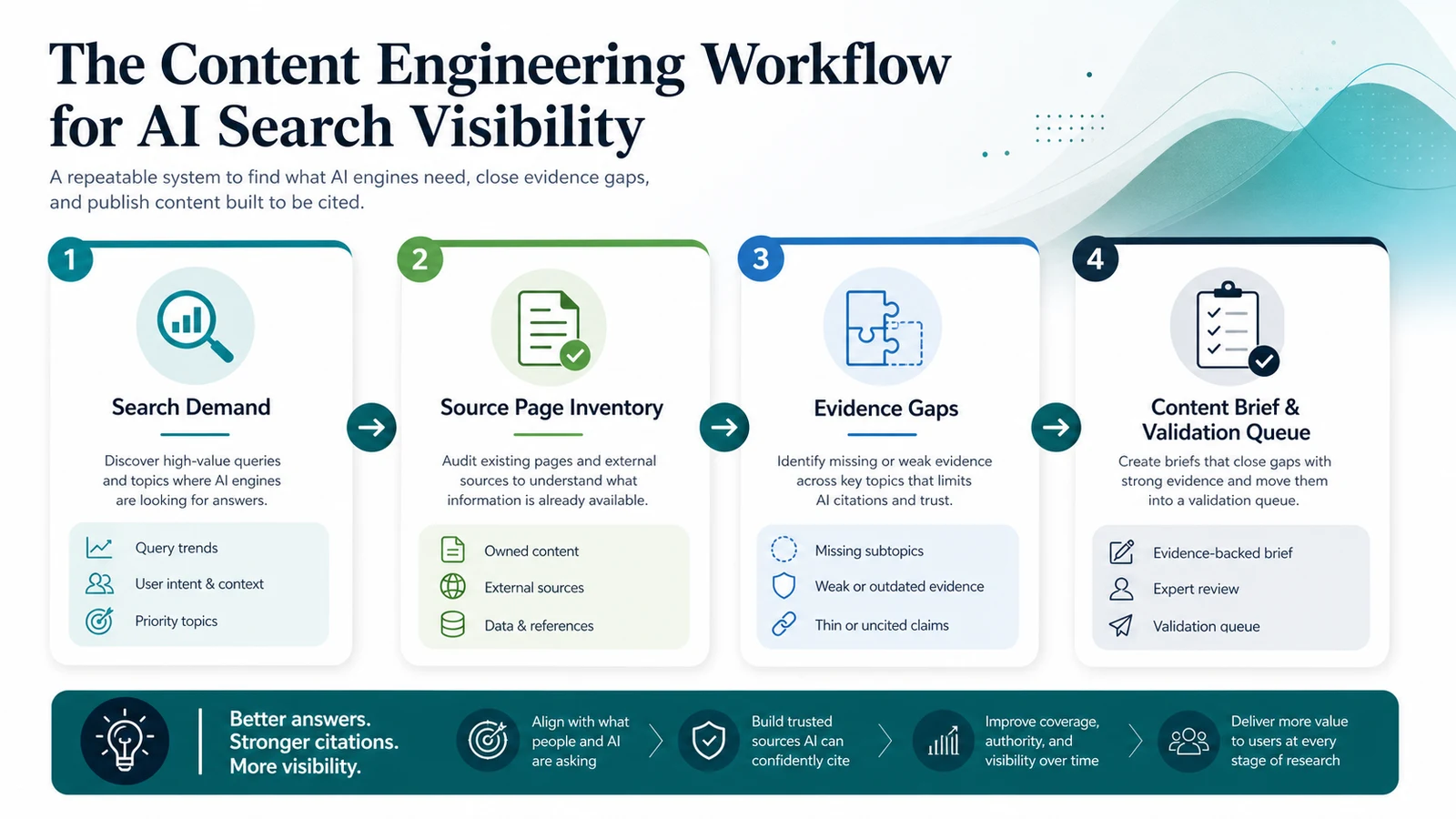
Content engineers drive AI search visibility by turning answer evidence into pages that can be found, understood, cited, and improved again. If you are asking how content engineers drive AI search visibility, the answer is not just writing more copy. It is connecting search demand, source pages, crawl access, structured evidence, content briefs, and validation checks into one repeatable workflow.
That matters because AI-search visibility often changes before a normal traffic report explains why. A content engineer gives the team a practical way to decide which page should answer the query, what proof is missing, who owns the fix, and when the change will be checked again.
Start With The Page Job
A content engineer starts by assigning a page job. That means choosing the owned URL that should answer a query group or deciding that no current page deserves the job yet.
Use this first-pass map:
| Input | Content engineering question | Output |
|---|---|---|
| Query group | What task is the searcher asking an answer system to perform? | Page job and search intent |
| Existing source page | Which URL should be cited or summarized? | Keep, refresh, merge, or create |
| AI answer evidence | Which brands, URLs, and claims appear repeatedly? | Citation and entity gap list |
| Crawl signal | Is the page discoverable, indexable, canonical, and rendered clearly? | Technical eligibility check |
| Internal support | Which parent pages and related guides point to the source page? | Link and cluster update |
| Validation window | How will the team know the fix worked? | Recheck plan and owner |
This keeps the work grounded. Without a page job, teams drift into vague instructions like "write about AI visibility" or "add more authority signals." A page job turns the same observation into a concrete asset decision.
Inventory Source Pages Before Writing
The fastest way to waste a content sprint is to approve a new article when an existing source page only needs a better section, table, example, or internal link.
Review the current source-page set first:
- List the product, feature, comparison, guide, support, and glossary pages that could answer the query group.
- Check whether each page has a clear title, H1, intro, examples, table, and next-step link.
- Confirm the page is crawlable, canonical, indexable, and present in the sitemap when it should be.
- Compare the page against the URLs already appearing in AI answers or organic results.
- Decide whether the work is refresh, consolidation, child page creation, technical fix, or no action.
This is where the AI visibility evidence loop and the AI crawlability workflow meet. AI visibility shows whether the page is winning or losing presence. Crawlability shows whether the page is even eligible to be used as a reliable source.
Close Evidence Gaps
AI-search visibility work is easier to assign when gaps are named precisely. "Improve the article" is too broad. "Add the missing comparison table and cite-ready constraints to the source page" is something a team can ship.
Use this gap table:
| Gap type | What it looks like | Content engineering fix |
|---|---|---|
| Missing answer | The page does not answer the query directly in the intro or H2 structure | Add a concise answer section and route to deeper details |
| Thin proof | Claims are true but unsupported by examples, tables, screenshots, or constraints | Add visible proof blocks and specific use cases |
| Weak entity context | The brand, product category, audience, or alternative set is unclear | Standardize category language across product and source pages |
| Hidden evidence | Key content depends on fragile rendering, tabs, images, or vague UI copy | Make useful text visible in rendered HTML |
| Fragmented cluster | Several pages partially answer the same job | Merge, differentiate, or choose one canonical source page |
| No validation | The team ships changes but never rechecks the query group | Add a recheck date and baseline evidence |
The useful output is a brief that names the page, the gap, the fix, and the proof needed after publication.
Turn Findings Into Briefs
Content engineers do not hand writers a keyword and hope for the best. They hand over evidence-backed briefs.
A strong brief includes:
| Brief field | What to write |
|---|---|
| Target query group | The prompts, keywords, and search tasks being reviewed |
| Source page | The URL that should answer, support, or convert the demand |
| Existing gap | Missing answer, weak proof, crawl problem, cluster conflict, or stale messaging |
| Required sections | H2s, tables, screenshots, examples, constraints, or comparison points |
| Internal links | One primary product page and one to three supporting articles |
| CTA role | What the reader should do after the page answers the task |
| Validation plan | Recrawl, answer recheck, Search Console review, or dashboard watchlist |
That brief is different from a generic content outline. It tells the writer what the page must prove and tells the SEO lead how the work will be judged later. The AI search analytics content planning workflow is the broader planning layer when multiple query groups need to become briefs.
Connect Content Work To Crawl Checks
Content engineering is not only editorial. A page can have the right answer and still fail if crawl paths, canonicals, noindex rules, internal links, or rendered content are weak.
Before publishing or refreshing the page, run a crawl-aware QA pass:
| Check | Why it matters for AI search visibility |
|---|---|
| Status and redirects | The intended source URL should resolve cleanly |
| Canonical target | Answer systems and search engines need the same representative URL |
| Robots and noindex | Blocked pages are weak source candidates |
| Sitemap and internal links | The page should be discoverable from the cluster that explains it |
| Rendered body content | The answer, examples, and tables should be visible without guessing |
| Metadata and headings | The page job should be obvious from title, H1, and H2 structure |
If the crawl check fails, fix access before assigning another rewrite. If access passes but the source evidence is thin, then the brief belongs with content.
Where Searvora Fits
Searvora AI SEO Dashboard fits the monitoring and handoff layer of this workflow. The local product page positions it around page-type cohorts, locale drill-down, anomaly and trend detection, opportunity scoring, cross-team reporting, Google Search Console signals, crawl diagnostics, and structured exports.
Use the AI SEO dashboard to keep content engineering tied to a weekly operating cadence:
| Workflow layer | Dashboard role | Team output |
|---|---|---|
| Signal watch | Monitor page-type, locale, and directory movement | A focused review set |
| Cause isolation | Compare affected templates, query groups, and crawl context | A likely source-page gap |
| Opportunity scoring | Rank pages by upside, effort, and confidence | A shorter fix queue |
| Cross-team reporting | Document decisions with evidence and owners | A handoff the team can recheck |
Validate The Change
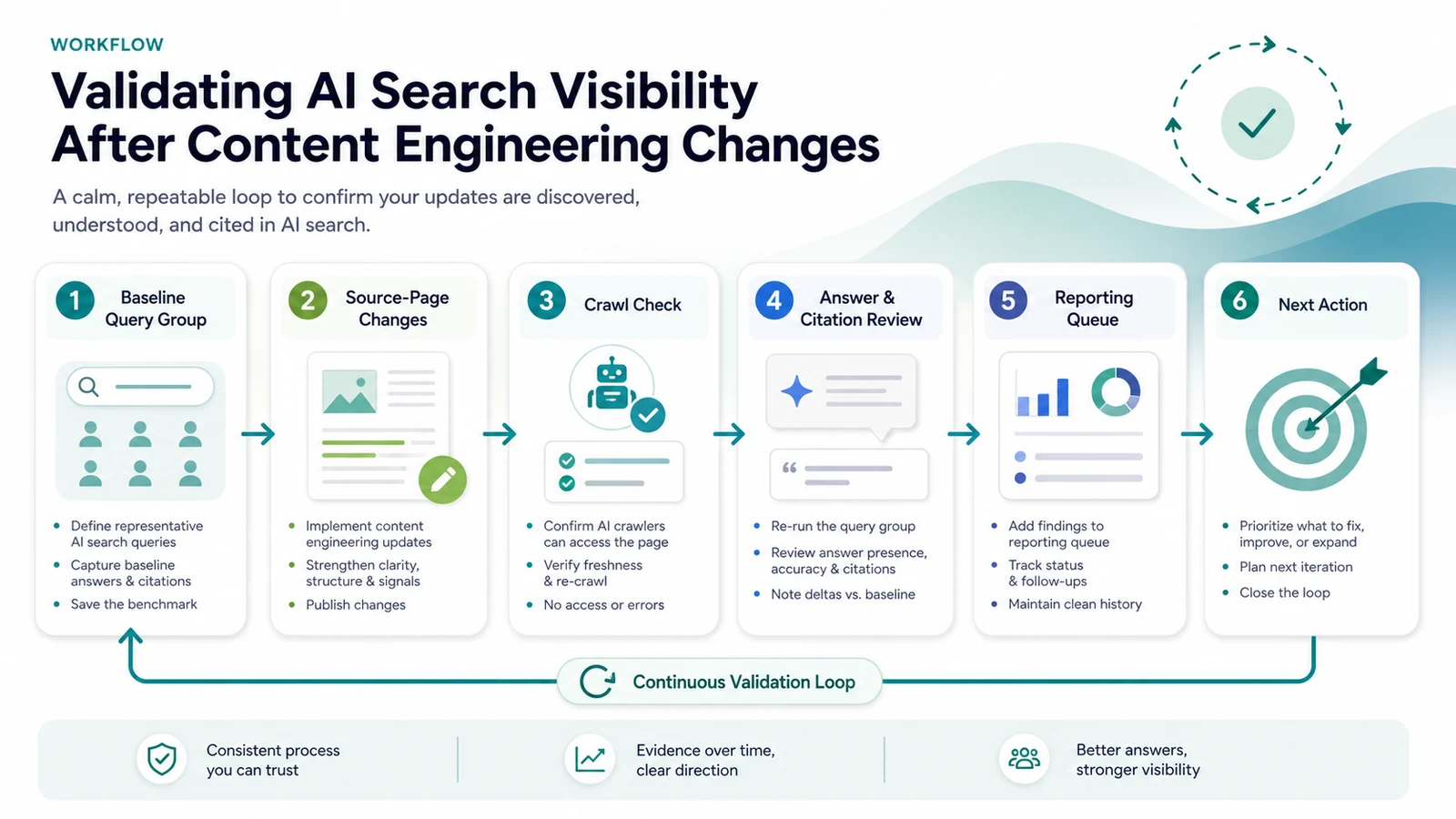
The validation loop is what makes content engineering different from one-off content production. The team records the baseline, ships the page change, and checks whether the source page became easier to find, understand, cite, and act on.
Use this sequence:
- Save the baseline query group and the expected source URL.
- Publish the source-page update or new page.
- Recrawl the URL and affected template peers.
- Confirm canonical, sitemap, rendered content, headings, and internal links.
- Recheck the same AI-answer query group after a meaningful window.
- Compare Search Console page and query movement.
- Record the outcome as improved, flat, worse, or inconclusive.
- Decide the next action: expand, consolidate, fix access, monitor, or stop.
The content losing visibility workflow is useful when the validation loop finds a slipping page and the team needs a diagnosis path.
A Weekly Content Engineering Cadence
Run this once a week for one topic cluster:
| Step | What to do | Done when |
|---|---|---|
| 1 | Pick one query group and one page cohort | The team knows what demand is being reviewed |
| 2 | Inventory source pages | Each query has a candidate URL or a no-page decision |
| 3 | Check crawl eligibility | Blocking access issues are assigned before editorial work |
| 4 | Name evidence gaps | Every fix has a specific missing answer, proof, link, or structure |
| 5 | Write the brief | The writer receives page job, sections, CTA, and validation plan |
| 6 | Publish and recheck | The same query group and page are reviewed after the change |
Content engineers drive AI search visibility when they make the work repeatable. They connect the vague signal of "we need to show up in AI answers" to a source page, a brief, a crawl check, a shipped fix, and a recheckable result.