
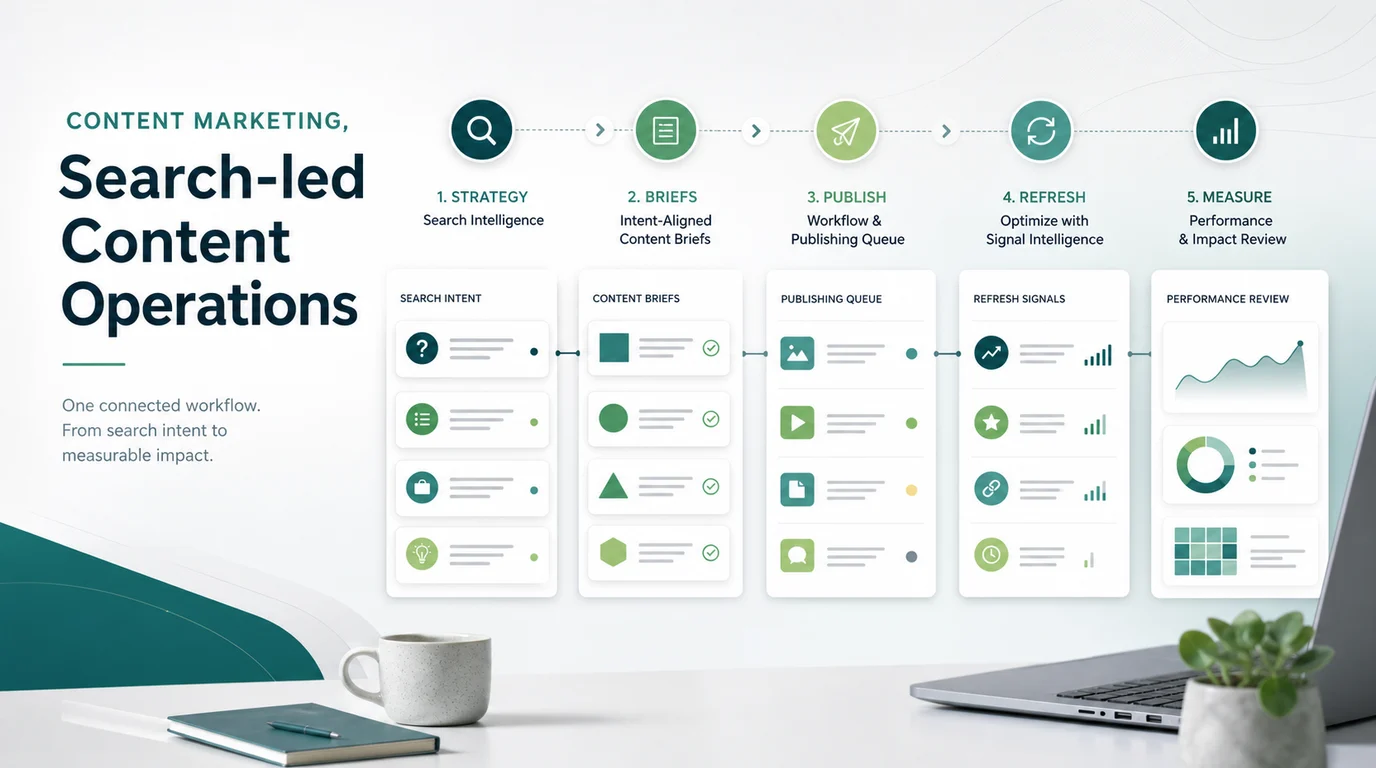
Content marketing is the practice of planning, creating, distributing, and improving content so it can attract the right audience and support business growth. That definition is useful, but it is not enough to run a content program.
The practical question is this: how does a team turn search demand, customer problems, product context, and performance data into content that actually ships? A good content marketing workflow answers that question before the calendar fills up.
The public Ahrefs content marketing guide frames the topic around attracting, engaging, converting, and retaining customers. Searvora's angle starts one layer lower, with the operating system behind that promise: page jobs, briefs, publishing queues, refresh cycles, and measurable SEO work.
Start With The Job Content Must Do
Most content calendars fail because they begin with topics instead of page jobs. A topic says what the article is about. A page job says what the page must help the reader do and what the business expects from it.
Use this first-pass map before approving a brief:
| Content job | Best page type | What to validate first |
|---|---|---|
| Explain a concept | Article or hub | Is the searcher trying to learn, compare, or act? |
| Capture a repeatable process | How-to article | Can the process be broken into steps and checks? |
| Support product evaluation | Landing page or comparison | Does the reader need proof, pricing, or product detail? |
| Serve a broad cluster | Parent hub | Can the hub route readers to useful child pages? |
| Fix declining performance | Refresh or consolidation | Is the existing page still the best canonical target? |
| Help a store publish faster | Content operations workflow | Can product context and internal links be reused safely? |
This is also where cannibalization gets misunderstood. Two pages can live in the same topic cluster without competing. They become a problem only when they target the same core keyword, same page type, and same user task.
Build The Workflow Before The Calendar
A calendar is a scheduling layer. It should not be the strategy layer.
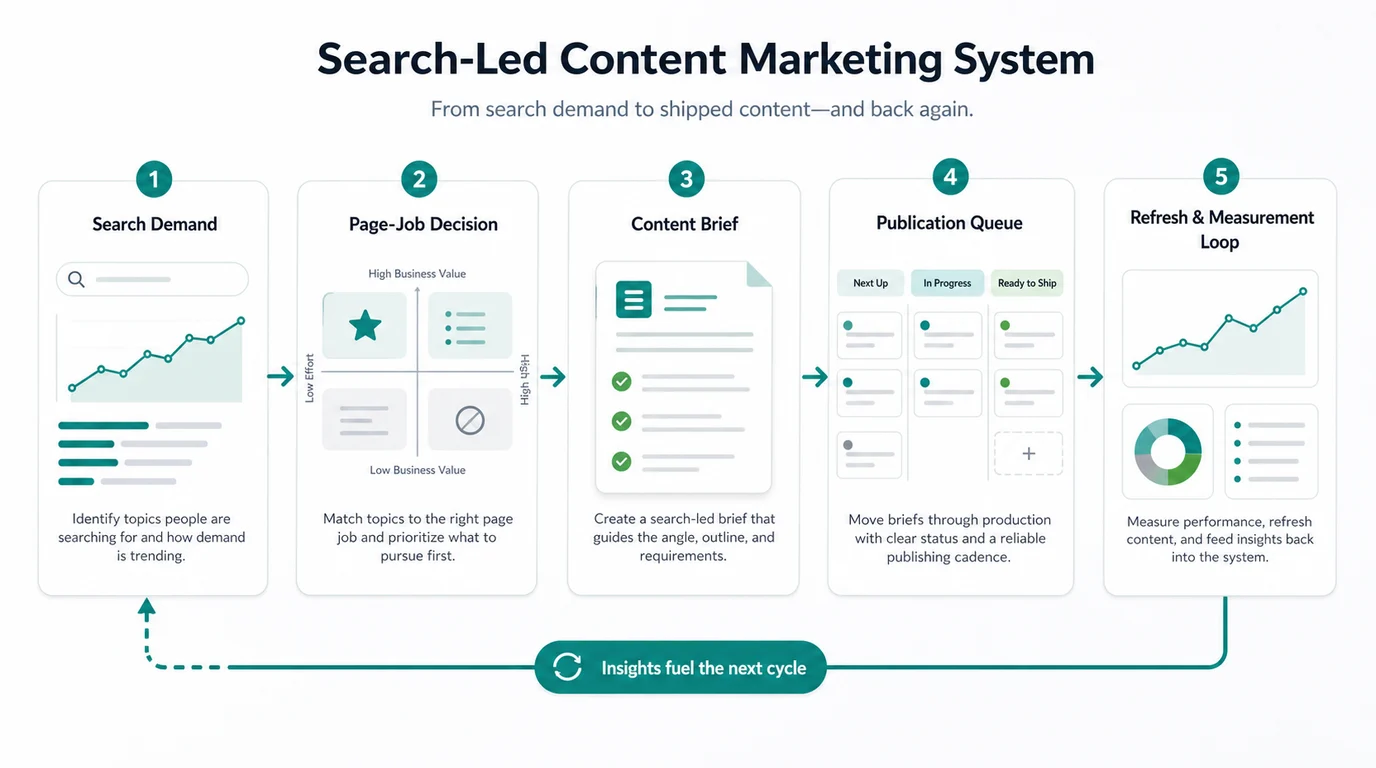
Build the workflow in this order:
- Gather search demand, customer questions, product priorities, and existing page evidence.
- Group ideas by user job, not just keyword similarity.
- Decide whether each opportunity needs a new article, a refreshed page, a hub section, a landing page, or no page.
- Write the brief with angle, structure, internal links, proof requirements, and visual needs.
- Move the approved brief through drafting, review, enrichment, and publication.
- Measure the page against the job it was supposed to do.
That sequence keeps content marketing from becoming a volume game. It also prevents a team from publishing a new article when an existing page only needs a better section, stronger internal links, or cleaner technical eligibility.
Use Search Demand Without Letting It Run The Program
Search demand is a signal, not a command. High-volume topics deserve review, but they do not automatically deserve a new page. Low-volume topics can still matter when they match a product task or a high-intent customer problem.
For each opportunity, ask five questions:
| Planning question | Why it matters |
|---|---|
| What is the core search task? | Prevents vague articles that cannot satisfy intent. |
| What page type does the task imply? | Keeps articles, hubs, tools, and landing pages from blurring together. |
| What existing URL is closest? | Finds update opportunities before creating duplicate content. |
| What information gain can we add? | Forces the brief to improve the result, not rewrite it. |
| What evidence will prove it worked? | Connects publishing to measurement and refresh decisions. |
For deeper competitor and topic gap work, use a structured content gap analysis before the brief is written. The goal is not to copy the competitor's page. The goal is to decide whether Searvora can answer the job with clearer structure, better workflow detail, stronger source grounding, or a more useful next step.
Turn Strategy Into Briefs That Can Ship
A content brief should make execution easier. It should not be a mini strategy document that writers have to decode.
Every search-led brief needs:
- primary keyword and reader job
- recommended page type
- angle and information gain
- H2 outline that matches the intent
- internal links and supporting pages
- external sources or screenshots when claims need public grounding
- product CTA only when it fits the reader's next action
- visual plan for cover and section assets
- publish and refresh criteria
If your team uses reusable structures, connect the brief to a template early. A definition article, comparison article, how-to guide, and Shopify campaign article should not share the same skeleton. The blog post templates workflow is useful when your team needs repeatable structure without turning every post into the same article.
This is where content marketing becomes operational. The brief translates strategy into decisions a writer, editor, designer, SEO lead, and product owner can review without guessing.
Keep Publishing And Refreshing In The Same System
Publishing is not the finish line. It is the first point where the page can collect real evidence.
Track the page by job:
| Page job | Early signal | Refresh trigger |
|---|---|---|
| New educational article | Impressions and query variety | Queries drift away from the intended job |
| Parent hub | Child-page clicks and internal link paths | Readers do not reach the right next pages |
| Product support article | Engagement with product CTA | The page attracts the wrong audience |
| Content refresh | Recovered impressions, CTR, or rankings | Old sections still hold back intent fit |
| Shopify content campaign | Published cadence and collection support | Posts ship, but do not support product pages |
Refresh work should start with evidence. A content audit helps separate pages that need a rewrite from pages that need consolidation, internal links, technical fixes, or a better canonical target.
Where Searvora Fits
Searvora fits when content marketing needs to move from plan to production. Blogify is the strongest fit for the content execution layer because it is built around Shopify blog drafting, SEO structure, product-aware content, multilingual output, and a direct draft workflow.
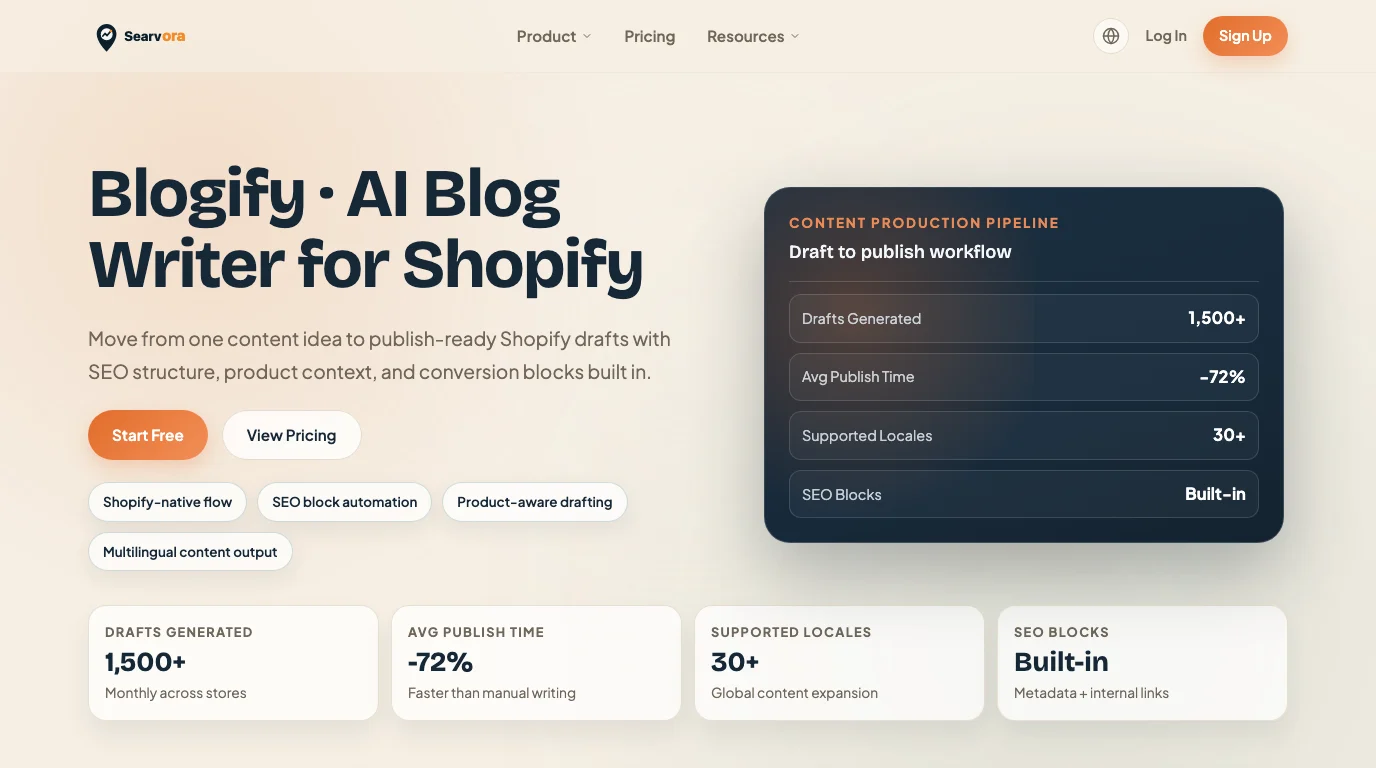
Use Blogify when the approved opportunity is ready to become a draft:
- the search task is clear
- the page type is approved
- product or collection context matters
- internal links and metadata need to stay consistent
- the team needs a reliable review-to-publish path
The broader Searvora stack can support the surrounding loop. Use dashboard evidence to spot what changed, consultant-style prioritization to choose the next action, crawler checks when technical eligibility matters, and Blogify when the answer is approved content production.
A Content Marketing Checklist For Operators
Before a topic enters production, run this checklist:
- The core keyword and reader job are clear.
- The page type matches the search task.
- Existing pages were checked for duplicate user jobs.
- The brief states a real information gain angle.
- Internal links support the cluster without stuffing anchors.
- Product mentions are relevant to the reader's next step.
- Visuals explain the workflow or prove the product/source context.
- The publish owner and refresh trigger are defined.
- Success will be reviewed by page job, not only by total traffic.
That is content marketing as an operating workflow. It still needs judgment, creative work, and editorial standards. The difference is that each article, hub, refresh, and campaign moves through the same decision system, so the team can ship useful work without losing the thread.