

If you need to know how to improve gemini visibility for ai search results, start with the pages and evidence Gemini can use, not with prompt tricks. The useful work is to choose the query groups where your brand or page should appear, strengthen the source page, confirm Google can crawl and index it, then recheck whether the answer surface changes.
Gemini visibility is not a separate SEO universe. Google's own AI features guidance says the same foundational Search work still applies: technical eligibility, crawl access, useful content, visible text, internal links, and structured data that matches the page. The difference is that AI answers make weak source ownership easier to notice.
Start With Gemini Query Jobs
Do not track every prompt someone can invent. Start with query jobs that map to a page, buyer stage, or support need.
Use this split:
| Query job | Example | Page that should support it |
|---|---|---|
| Category discovery | "best tools for AI search visibility" | Category, comparison, or product source page |
| Problem diagnosis | "why is my brand missing from Gemini results" | Troubleshooting article or dashboard workflow |
| Source ownership | "which page should Gemini cite for this topic" | Canonical explainer, product, or use-case page |
| Technical eligibility | "why can Google not use this page" | Crawl, indexability, sitemap, and rendered-content checks |
| Branded verification | "what does this company do" | Homepage, product page, about page, and trusted references |
The first decision is page type. A broad product query may need a landing page. A direct tool query may need a utility. A practical optimization query like this one can work as a how-to article because the reader needs a process before they can choose a tool or page.
The AI visibility evidence loop is the parent process. This article is narrower: it turns Gemini-specific checks into source-page, crawl, and monitoring actions.
Build Source Pages Gemini Can Use
A page is more likely to support Gemini visibility when it answers one job clearly and gives systems enough visible evidence to understand the entity, topic, and action.
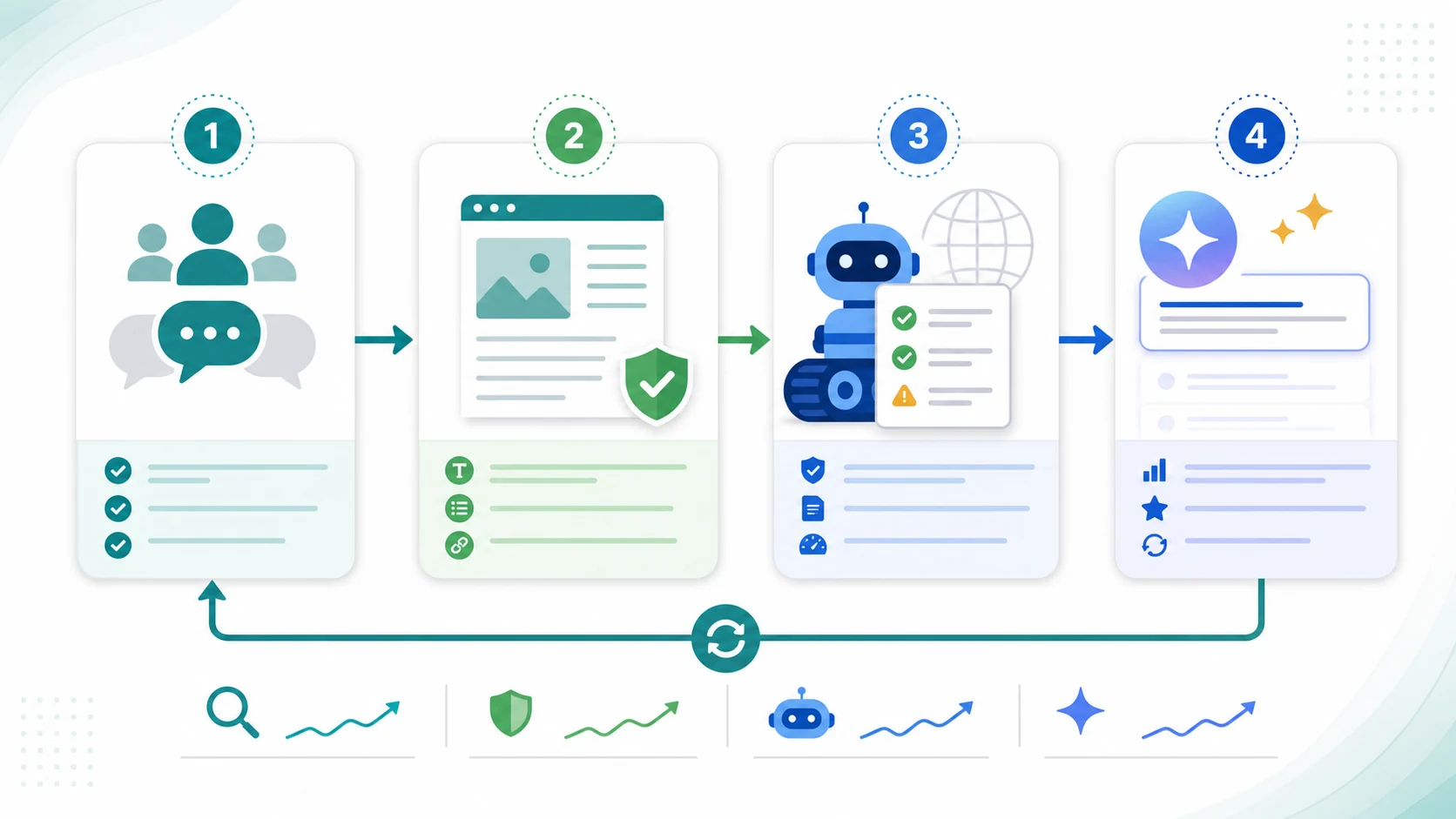
Start with the page that should be cited or summarized:
| Source-page layer | What to improve | Why it matters for Gemini visibility |
|---|---|---|
| Direct answer | Put the practical answer near the top | AI answers need a clear extractable point |
| Entity clarity | Name the brand, product, category, audience, and use case consistently | Gemini needs stable context, not scattered synonyms |
| Evidence depth | Add examples, tables, screenshots, constraints, and definitions | Thin pages are harder to trust or cite |
| Internal support | Link from parent articles, product pages, and related workflows | Search systems need a clean path to the source |
| External proof | Use credible public references where the claim needs support | Source diversity can reinforce the owned page |
Google Search Central's guidance on AI experiences in Search keeps the advice grounded in useful content and technical access. That is the right mental model: make the page worth using first, then make it easy to discover.
Avoid creating a page that only says "Gemini visibility" in more places. If the page does not answer a real query job, clarify a source, or route the reader to a next action, it is unlikely to become a stronger AI-search source.
Check Crawl And Index Eligibility
Gemini visibility work often gets blamed on content when the real blocker is technical access. Before rewriting a page, confirm that Google can find, crawl, index, and understand the source.
Google's AI features documentation says pages need to be indexed and eligible for Google Search with a snippet to be supporting links in AI Overviews or AI Mode. It also notes there are no extra technical requirements beyond normal Search eligibility.
Run this technical pass:
| Check | Pass condition | Fix when weak |
|---|---|---|
| Status | The source URL returns a clean 200 response | Remove redirect chains, errors, or blocked assets |
| Indexability | The page is not noindexed or canonicalized away | Fix robots, noindex, canonical, or duplicate handling |
| Internal links | Important pages have crawlable links from related pages | Add descriptive links from hubs, product pages, and articles |
| Visible text | The useful answer is present in rendered HTML | Move critical copy out of hidden or client-only fragments |
| Structured data | Markup matches what readers can see on the page | Remove mismatched schema and validate the remaining markup |
| Sitemap coverage | The canonical URL appears in the intended sitemap | Refresh sitemap output and confirm the canonical path |
If the issue is technical, use a crawl before assigning content work. The AI crawlability and GEO workflow is the right companion when eligibility, rendering, canonical rules, and source evidence all need to be checked together.
Turn Gemini Evidence Into Actions
Once the source page is eligible, review the answer surface like an evidence row. The goal is not to prove that one edit caused one answer. The goal is to decide what should ship next.
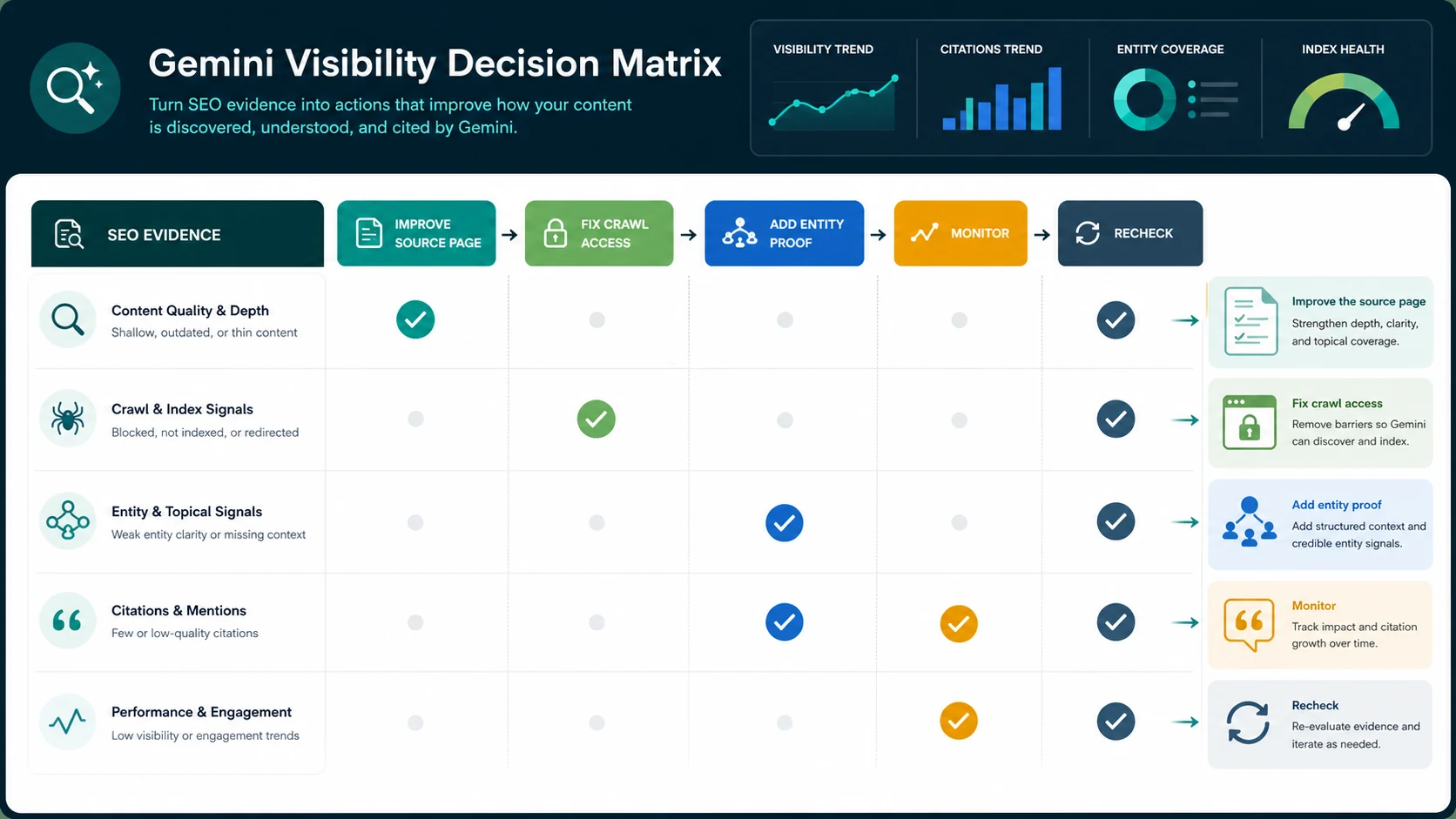
Use this routing table:
| Gemini finding | Likely meaning | Better next action |
|---|---|---|
| Brand missing, competitors named | Entity or category evidence is weak | Strengthen owned source pages and credible external proof |
| Brand named, no owned URL cited | Source ownership is weak | Improve the canonical page and internal links |
| Wrong URL cited | Similar pages may be splitting intent | Choose one source page and differentiate or consolidate the rest |
| Third-party source cited for your topic | External pages explain the job better | Add clearer examples, proof, and source-ready sections |
| Answer changes every check | Query group may be unstable | Monitor before committing large rewrites |
| Page is strong but never appears | Technical or citation evidence may be weak | Crawl the page and audit citation presence |
The AI search citation audit helps when the main question is source ownership. The AI search visibility gap workflow for B2B helps when the same pattern needs to be mapped across buyer stages and competitor mentions.
Where Searvora Fits
Searvora AI SEO Dashboard fits the monitoring and handoff layer. The product page positions it around page-type cohorts, locale drill-down, anomaly detection, opportunity queues, and executive-ready summaries. Those are the views a team needs when Gemini visibility checks need to become repeatable work instead of a loose screenshot folder.
Use the AI SEO dashboard to keep query groups, source pages, and next actions together:
| Workflow layer | Dashboard role | Team output |
|---|---|---|
| Query grouping | Track priority topics by page type, locale, and buyer job | A stable set to recheck |
| Visibility watch | Separate mentions, citations, missing sources, and competitor presence | Cleaner evidence rows |
| Opportunity queue | Rank source-page and crawl fixes by upside, confidence, and effort | A shorter action list |
| Reporting | Document what changed, who owns it, and when to recheck | A weekly SEO handoff |
The dashboard should not pretend that every AI answer is stable or every mention is valuable. It should help the team decide whether the page needs content, crawl, entity, citation, or monitoring work.
Gemini Visibility Checklist
Use this checklist before approving a Gemini visibility rewrite:
- Choose one query group and one market.
- Name the page that should support the answer.
- Record whether Gemini names the brand, cites the owned page, cites competitors, or gives no useful source.
- Confirm the page has a direct answer, visible evidence, examples, and internal links.
- Check crawl status, indexability, canonical, rendered text, sitemap coverage, and snippet eligibility.
- Compare the page against competing sources in the current SERP.
- Assign one fix: improve source page, fix crawl access, add entity proof, consolidate overlap, monitor, or create a new page.
- Recheck the same query group after the page has time to be crawled and reused.
Improving Gemini visibility is strongest when the work is boring in the right way: better source pages, clean crawl access, clearer entity evidence, and a repeatable recheck loop. Start there before inventing a new optimization ritual.