
Google AI Overviews are AI-generated summaries in Google Search that appear when Google's systems decide an AI answer can help the query. For SEO teams, the useful response is not a magic optimization trick. It is a workflow that makes important pages crawlable, specific, evidence-rich, and easy to monitor.
The practical goal is to earn eligibility and visibility in the places where AI answers may cite, summarize, or reshape demand. That means classic SEO still matters, but it has to be connected to source quality, answer-ready structure, and a weekly review loop.
Start With What Google Actually Says
Google's Search Central guidance for AI features says there are no extra technical requirements beyond being eligible for Google Search and following Search Essentials. Google's Search help page for AI Overviews and AI Mode also makes the core user promise clear: generative AI can summarize information, but the feature can make mistakes and should be used with source checking.
That combination gives SEO teams a clear operating rule: do not invent a separate playbook that ignores fundamentals. Build pages that deserve to be used as supporting sources, then verify whether those pages are technically accessible and useful enough to stand on their own.
| Official signal | SEO implication | Team action |
|---|---|---|
| No special AI Overview markup requirement | Eligibility starts with normal search access | Keep crawl, indexability, canonical, robots, and sitemap signals clean |
| Source quality still matters | Thin or vague pages are weak candidates | Add original explanation, examples, data, and visible evidence |
| AI answers can be imperfect | Pages need clear context and correction-resistant detail | Define terms, scope claims, and cite official sources |
| Performance is still measured through Search Console | AI visibility work needs segment-level monitoring | Track affected queries, pages, snippets, CTR, and content changes together |
Decide Whether The Query Deserves AI-Search Work
Not every page needs an AI Overview plan. Start with the query job. Informational, comparison, troubleshooting, and definition queries are usually better candidates for answer-ready structure than narrow navigational or transactional pages.
Use this quick routing table before rewriting anything:
| Query situation | AI Overview opportunity | Better next action |
|---|---|---|
| The query asks what something means | High | Put the definition near the top and support it with examples |
| The query compares options or workflows | Medium to high | Add a clear comparison table and decision criteria |
| The query asks how to fix a problem | High | Show symptoms, likely causes, fix sequence, and validation checks |
| The query is brand navigational | Low | Protect entity clarity, but do not force an explainer |
| The query wants a product page or login | Low | Improve the landing page, not a blog article |
| The query is newsy or unstable | Variable | Add update dates, source links, and a maintenance owner |
This is also where cannibalization judgment matters. A broad page about AI search visibility and a narrow page about Google AI Overviews can support each other when they serve different jobs. The broader GEO SEO foundations workflow is the strategic loop; this article is the Google-specific execution layer.
Build Pages That Deserve To Be Supporting Sources
AI-search visibility depends on whether a page can be understood, trusted, and summarized without losing its meaning. A long article is not automatically stronger. The page needs extractable proof.
Use this source-quality checklist:
- Define the topic in plain language before adding nuance.
- State who the advice is for and when it does not apply.
- Use tables, steps, examples, and short summaries where they clarify the answer.
- Link to official sources when discussing search features, policies, or diagnostics.
- Keep important claims visible in text, not locked inside decorative images.
- Add author, product, company, or methodology context where it improves trust.
- Update sections that depend on changing Google surfaces.
Google's helpful content guidance is still the right baseline here. Pages should be written for people first, show real usefulness, and avoid recycling what already ranks with no added value.
For Google AI Overviews, the information gain should be especially concrete. Instead of saying "optimize for AI," explain the entity, the task, the evidence, the limitations, and the next step a searcher should take.
Keep Technical Eligibility Boring And Clean
An answer-ready page still cannot help if Google cannot access, render, canonicalize, or understand it. AI-search work should therefore include a technical pass before editorial rewrites get approved.
| Technical check | Why it matters for AI-search visibility | Fix path |
|---|---|---|
| Indexable canonical URL | The right page has to be eligible for Search | Remove accidental noindex, blocked robots, or canonical conflicts |
| Stable internal links | Google needs discovery paths and context | Link from hubs, related articles, and relevant product pages |
| Clean title, H1, and intro alignment | The page promise should match the answer task | Rewrite mismatched metadata and opening copy |
| Visible structured evidence | Tables, lists, examples, and schema help interpretation | Keep useful facts in HTML text and validate markup |
| Fresh sitemap behavior | Important URLs should be submitted and consistent | Confirm sitemap URLs match canonical final URLs |
| Template health | One template issue can weaken many candidate pages | Group crawl issues by page type and directory |
This is where AI Overview work overlaps with technical SEO. A page can have a strong explanation and still be a poor source if it is orphaned, canonicalized away, blocked from crawling, or surrounded by contradictory metadata. When structured data is part of the evidence layer, the schema markup workflow is a useful companion.
Monitor Visibility Without Pretending The Data Is Perfect
Google Search Console does not give every AI Overview impression as a separate standalone report. Google's Search performance report remains the baseline for pages, queries, clicks, impressions, CTR, countries, devices, and average position.
That does not make AI-search work unmeasurable. It means the team needs to monitor directional signals instead of chasing one perfect number.
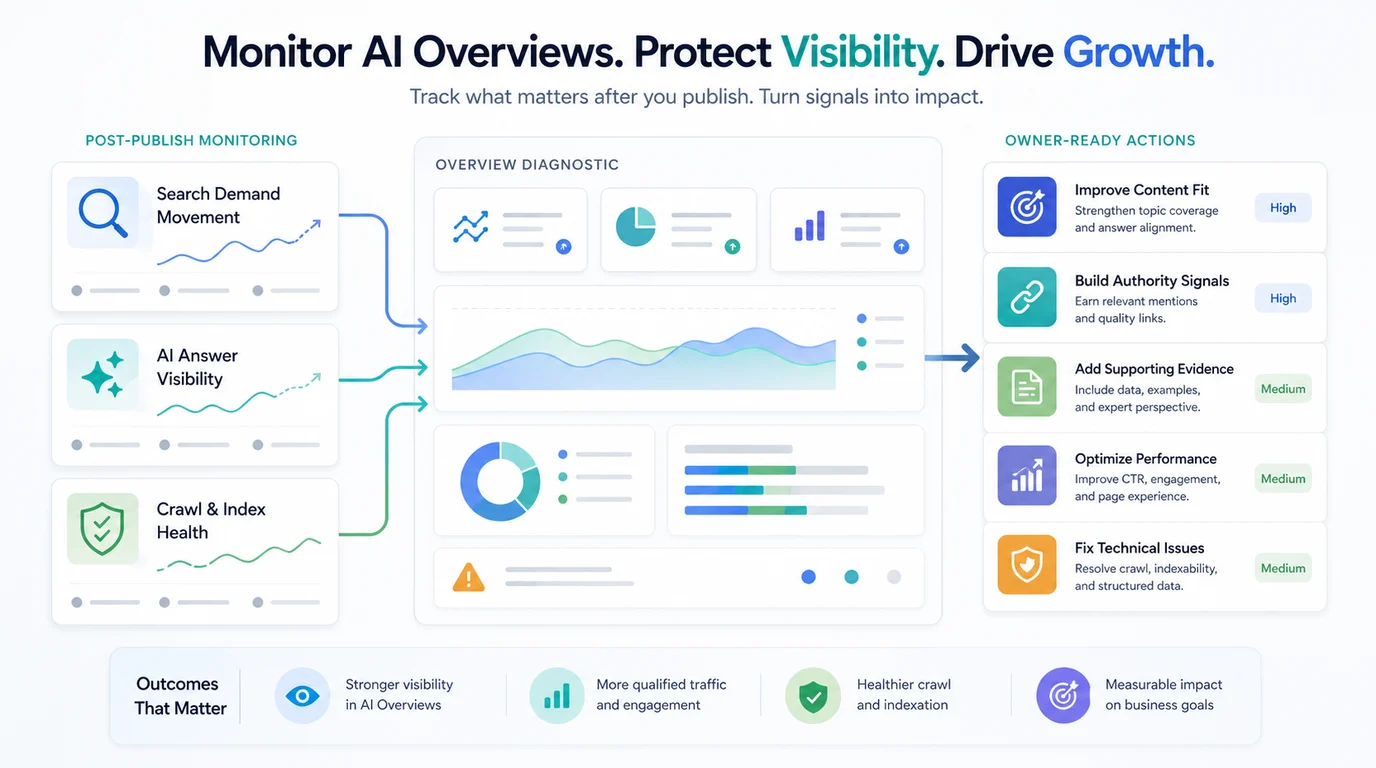
Track these signals together:
| Signal | What to watch | What it can trigger |
|---|---|---|
| Query mix | Are pages being matched to broader or more answer-like queries? | Add definitions, comparisons, or missing subtopics |
| CTR movement | Did clicks fall while impressions stayed healthy? | Re-check SERP layout, snippet promise, and answer satisfaction |
| Page group trend | Are article hubs, product pages, or templates moving together? | Diagnose content, crawl, or market-level changes |
| Crawl/index health | Did eligibility change before visibility moved? | Fix technical blockers before rewriting copy |
| Source coverage | Are official facts, examples, and evidence easy to extract? | Add tables, citations, examples, or better sections |
| AI answer spot checks | Are target topics represented accurately in AI-style results? | Update unclear sections and strengthen entity context |
For a broader metric model, use the SEO metrics to track workflow. Google AI Overviews should become one signal inside a weekly SEO review, not a standalone obsession that pulls teams away from shipping fixes.
Where Searvora Fits
Searvora AI SEO Dashboard is the natural product layer when Google AI Overviews work needs to move from observation to repeatable monitoring. The local product page positions the dashboard around page-type and locale performance, anomaly detection, opportunity scoring, cross-team reporting, and action queues.
Use the dashboard to group candidate pages by topic cluster, page type, directory, and locale. Then monitor whether answer-readiness work changes the right signals: demand, snippet behavior, crawl health, source coverage, and assigned actions.
The AI SEO Consultant layer can then help turn mixed evidence into priorities, but the monitoring baseline should stay disciplined. Start with the page groups most likely to appear in AI-style answers, verify technical eligibility, improve source quality, and review movement on a regular cadence.
Run The Workflow Every Week
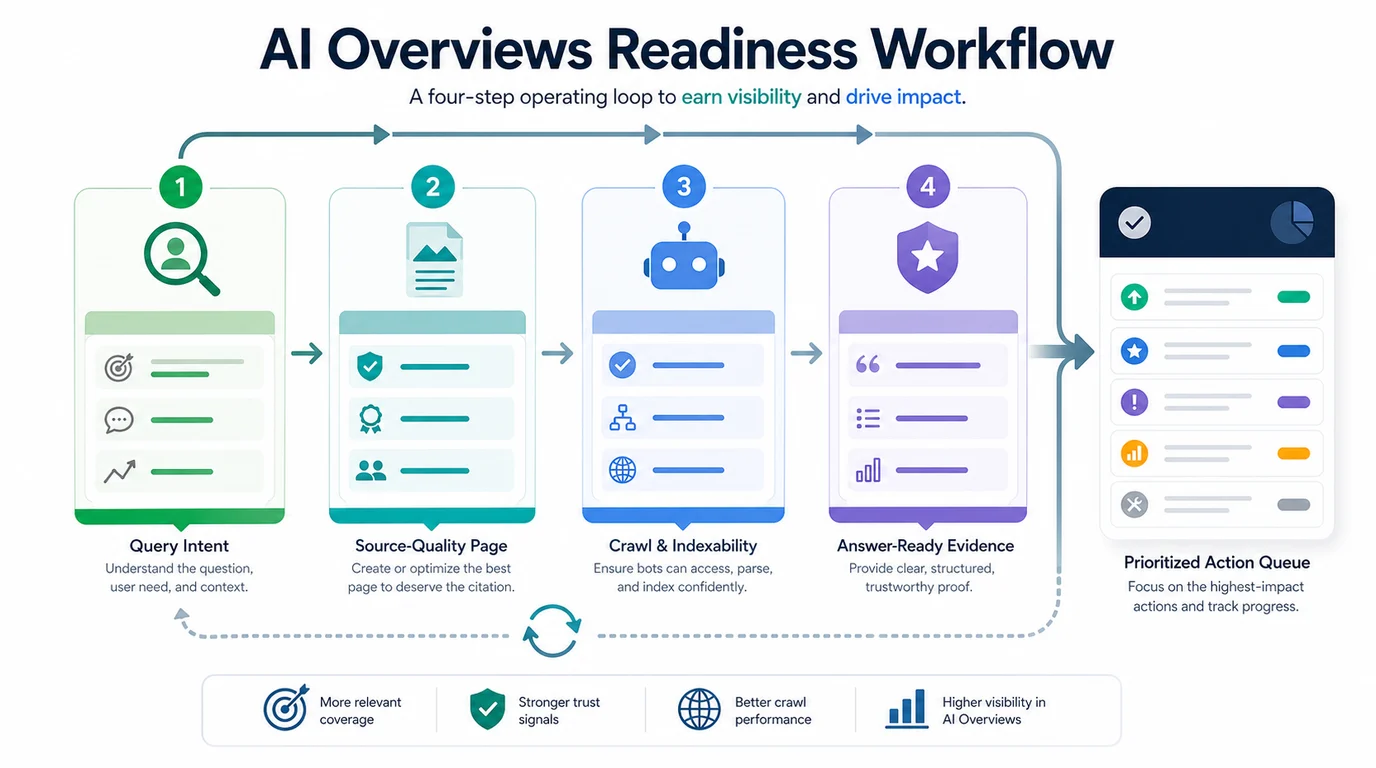
Google AI Overviews will keep changing, so the workflow has to be durable. Use this weekly sequence:
- Choose one topic cluster with real business value.
- Identify the queries that are informational, comparative, or diagnostic.
- Pick the page that should be the canonical source for each query job.
- Check crawl, indexability, canonical, sitemap, metadata, and internal links.
- Improve the page with definitions, evidence, examples, tables, and source links.
- Record the change date and expected movement.
- Monitor query mix, CTR, page-group trend, and crawl health.
- Decide whether the next action is refresh, merge, internal link, technical fix, or new supporting page.
Google AI Overviews reward the same discipline good SEO already needed: clear pages, trustworthy evidence, clean technical access, and measured follow-through. The teams that win will not be the ones chasing every rumor. They will be the ones turning AI-search visibility into an operating rhythm.