
Google manual action recovery is the process of fixing a Search Console manual action, proving the violation has been addressed, submitting a reconsideration request when required, and monitoring the affected pages after the action is revoked.
The workflow should start with the exact manual action message, not a backlink export or a traffic chart. Google's Manual actions report explains that a human reviewer applies these actions when pages violate search spam policies. That makes recovery an evidence job: identify scope, fix the violation, document the work, and validate the site after review.
The Ahrefs manual penalty case study that surfaced this topic focuses on removing bad links. Searvora's angle is broader: treat manual action recovery as a controlled SEO operation that separates link risk, content quality, technical access, and business-impact monitoring.
Confirm The Manual Action Before You Diagnose
Do not start by asking whether the site "has a penalty." Start by checking whether Search Console actually reports a manual action, what type it names, and whether the scope is sitewide or partial.
| Evidence to capture | Why it matters | Recovery decision it changes |
|---|---|---|
| Manual action type | Names the policy problem Google wants fixed | Link cleanup, content cleanup, spam removal, structured data repair, or security escalation |
| Scope | Shows whether all pages or only selected URLs are affected | Sitewide program cleanup versus URL cohort remediation |
| Example URLs | Gives starting points, not the whole problem set | Build patterns instead of fixing only the examples |
| Discovery date | Anchors the recovery timeline | Separate manual action impact from unrelated releases or updates |
| Affected page role | Explains business priority | Protect revenue, lead, hub, or authority pages first |
Manual actions are not the same as algorithmic volatility. If the dashboard shows a traffic drop but Search Console has no manual action, use a broader traffic-loss triage path such as why organic traffic dropped. If Search Console names a manual action, keep the team focused on the issue Google has actually flagged.
Separate Manual Actions From Other SEO Problems
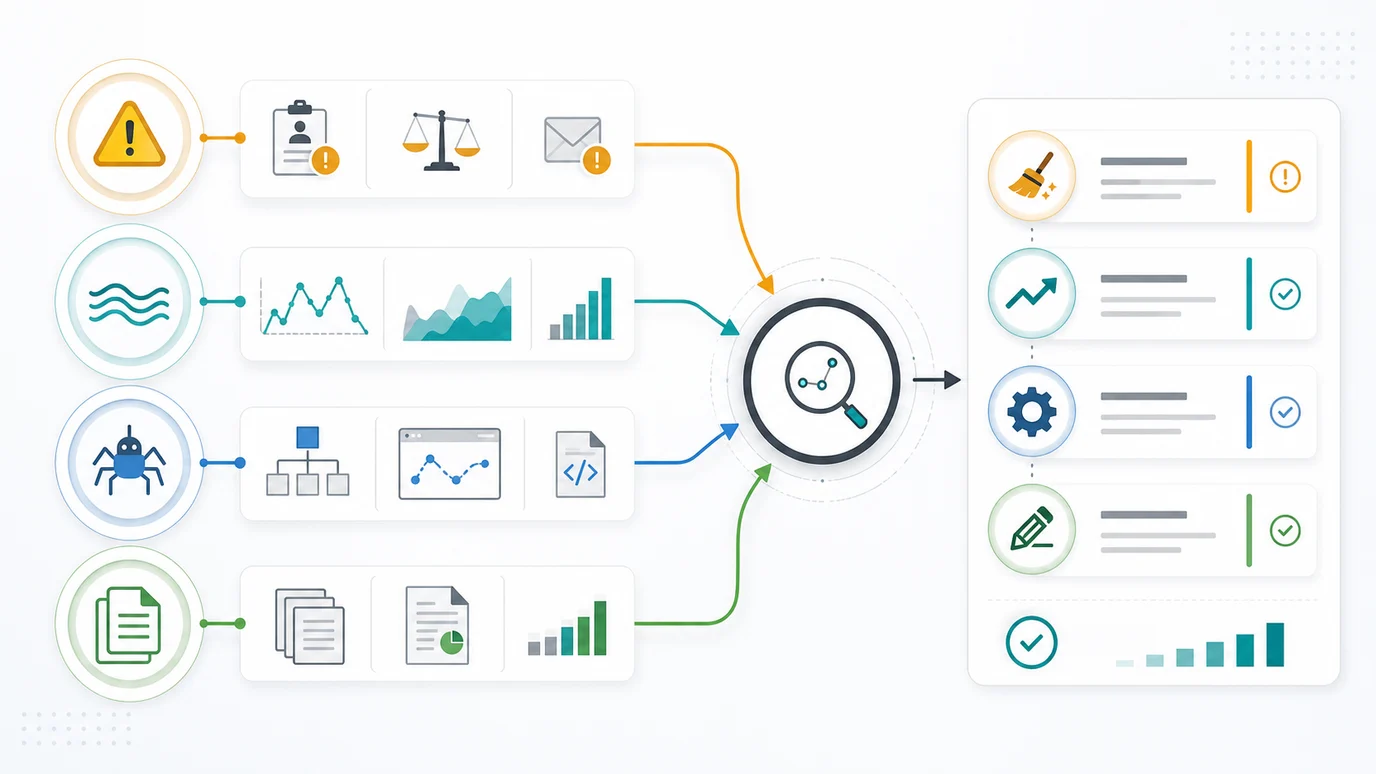
The risky part of manual action work is that the symptoms can look like every other SEO decline: fewer clicks, lost rankings, weaker snippets, or pages disappearing from valuable queries. The fix path changes depending on the cause.
Use this diagnostic split before writing a recovery plan:
| If the evidence shows | Treat it as | First action |
|---|---|---|
| Search Console manual action message | Manual action recovery | Read the policy issue, scope affected URLs, and create a remediation log |
| No manual action but a known spammy link pattern | Link-risk triage | Review toxic backlinks and decide whether disavow is even justified |
| No manual action but crawl/indexing failures | Technical SEO issue | Fix canonical, robots, redirect, sitemap, or rendering blockers first |
| No manual action but broad traffic decline | Performance diagnosis | Compare demand, SERP layout, content updates, and technical releases |
| Manual action plus technical problems | Compound recovery | Fix the policy violation and remove technical blockers that slow validation |
Google's spam policies are the reference layer for this decision. They help the team distinguish manipulative behavior from normal weak pages, random low-quality links, or ordinary search volatility.
Build A Recovery Inventory
Once the manual action type is clear, build an inventory that can survive review. The inventory should group affected URLs and evidence patterns, not just list the sample URLs Google provided.
Start with these fields:
- Manual action type and exact Search Console wording.
- Affected scope: whole site, directory, template, page group, or sample URLs.
- URL cohorts by page type, owner, revenue role, and traffic value.
- Evidence pattern: unnatural links, thin content, pure spam, cloaking, structured data abuse, user-generated spam, or another named issue.
- Fix owner: SEO, content, engineering, legal, agency, or site admin.
- Required proof: removed content, cleaned links, changed templates, policy notes, screenshots, or crawl exports.
- Validation window after fixes ship.
For link-related manual actions, do not let the whole plan collapse into "upload a disavow file." Google's disavow links guidance frames disavow as an advanced tool for serious unnatural-link risk. Your recovery inventory should show removal attempts, documented patterns, and why disavow is necessary if it is used at all.
For content or spam-related manual actions, the inventory should show what changed on the page: removed doorway sections, rewritten thin content, cleaned hacked or user-generated spam, fixed structured data, or retired URLs that cannot be made useful.
Fix The Violation Before The Reconsideration Request
A reconsideration request is not a pitch deck. It should be a concise account of what happened, what changed, and why the site now complies.
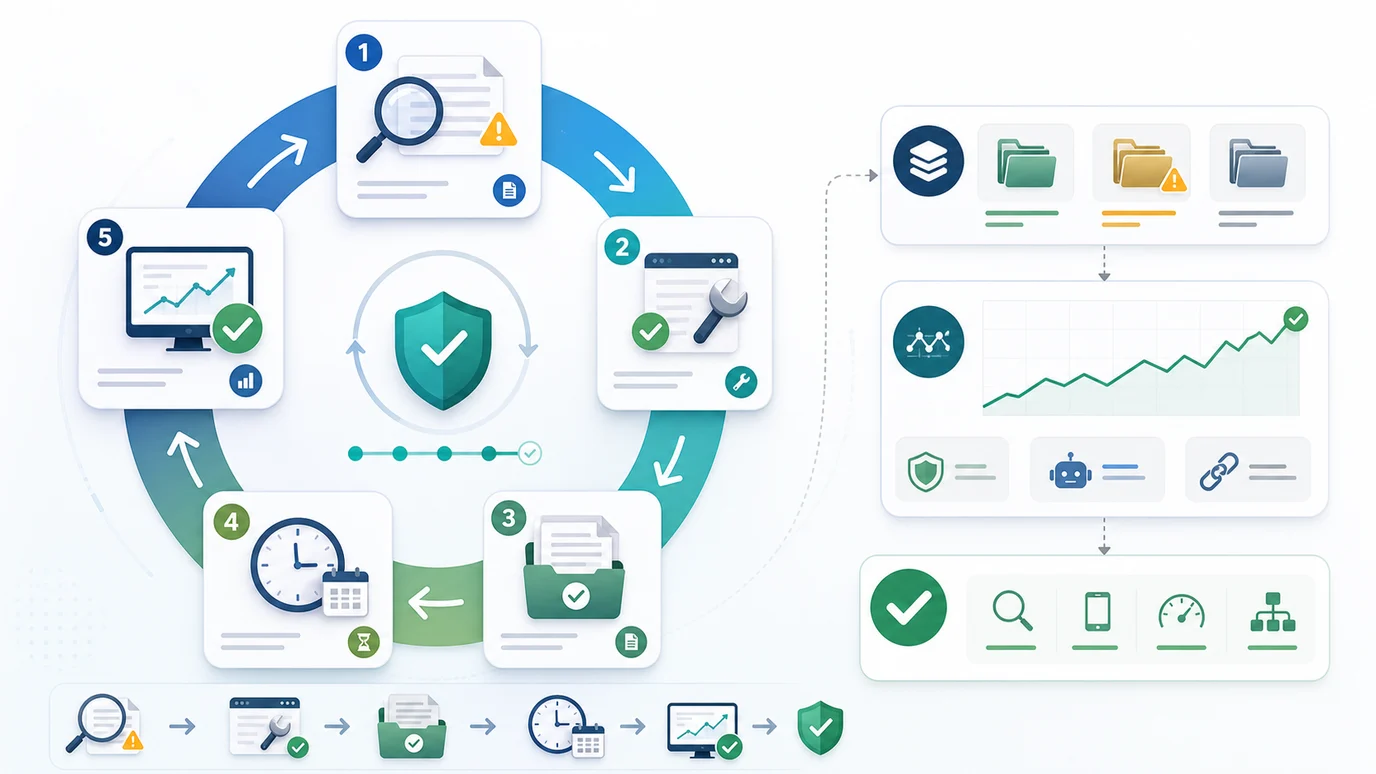
Use this fix sequence:
| Step | What to do | Evidence to keep |
|---|---|---|
| Scope the issue | Map affected URL cohorts and policy category | Manual action screenshot, URL list, issue notes |
| Remove or repair | Clean the actual violation, not just the example URLs | Before/after URLs, removed pages, outreach logs, template changes |
| Validate crawl access | Confirm important pages are crawlable and canonical | Crawl export, indexability checks, sitemap state |
| Check content quality | Confirm pages now satisfy the search task | Edited sections, reviewer notes, internal approval |
| Prepare request | Summarize cause, cleanup, and prevention | Short evidence packet and owner log |
The request should avoid blame shifting. If a previous vendor, old CMS workflow, affiliate content model, hacked section, or link campaign caused the issue, name the control that prevents it from returning.
Write A Reconsideration Request That Reviewers Can Audit
The strongest reconsideration request is specific enough to be checked and short enough to be read. It should not promise guaranteed rankings, bury the reviewer in exports, or ask for sympathy before the actual fix is complete.
Include:
- The manual action type and the affected area.
- The likely cause, stated plainly.
- The cleanup work completed.
- The evidence available if Google reviews examples.
- The process change that prevents recurrence.
- A request for review after the violations have been addressed.
Avoid:
- Submitting before the fixes are live.
- Sending a giant spreadsheet with no summary.
- Claiming "negative SEO" without evidence.
- Saying the site is fixed while important templates still produce the same issue.
- Treating disavow as the only proof of cleanup.
Monitor Recovery After Revocation
Manual action recovery does not end when the notice is removed. Revocation means the explicit manual action is gone. It does not guarantee that rankings, crawl eligibility, content quality, or trust signals are back where they were.
Track recovery in cohorts:
| Signal | What it can prove | What it cannot prove alone |
|---|---|---|
| Manual action status | The explicit action was revoked or remains active | Organic performance has fully recovered |
| Indexed canonical URLs | Important pages can re-enter the index | The pages deserve previous rankings |
| Clicks and impressions | Demand and visibility are returning | The manual action was the only cause |
| Query mix | The right page jobs are resurfacing | All content quality issues are solved |
| Crawl health | Technical blockers are not slowing recovery | Policy compliance by itself |
| Owner queue | Remaining fixes are assigned | Google has processed every change |
This is where Searvora's SEO metrics workflow becomes useful. Manual action recovery needs a validation window, affected page groups, and a calm decision log. Otherwise the team will keep relitigating the same drop every week.
Where Searvora Fits
Searvora AI SEO Consultant fits the planning layer after the manual action evidence exists. The local product positioning is about turning noisy SEO signals into prioritized, implementation-ready action plans across SEO, content, and engineering.
Use it to structure the recovery queue:
| Recovery input | Searvora handoff |
|---|---|
| Manual action type and URL scope | Convert the issue into owner-ready remediation tasks |
| Crawl and indexability findings | Separate technical blockers from policy cleanup |
| Content or link evidence | Group fixes by pattern, page role, and confidence |
| Reconsideration notes | Keep the cause, cleanup, and prevention plan audit-ready |
| Post-revocation monitoring | Route remaining visibility gaps into a weekly action queue |
Google Manual Action Recovery Checklist
Use this checklist before, during, and after the reconsideration request:
- Confirm the manual action exists in Search Console.
- Record the manual action type, scope, sample URLs, and discovery date.
- Match the issue to Google's spam policy category.
- Build URL cohorts by page type, directory, template, owner, and business value.
- Separate manual action work from algorithmic, technical, and content-performance problems.
- Fix the underlying violation across the affected pattern, not only the examples.
- Keep proof of removed links, rewritten content, cleaned templates, or retired URLs.
- Validate crawl, canonical, robots, sitemap, and important page status after fixes ship.
- Submit a concise reconsideration request only after the cleanup is live.
- Monitor manual action status, indexed URLs, clicks, impressions, query mix, and remaining owners after revocation.
Google manual action recovery is not a panic sprint. It is a controlled SEO remediation workflow. Start with the named issue, fix the pattern, make the evidence auditable, and keep measuring until the affected pages have a new baseline.