

LSI keywords are not a special set of related terms that Google expects you to add to a page. Latent semantic analysis is a real information-retrieval method, but the SEO idea of an "LSI keyword list" turns that method into a fictional optimization rule.
Use a better workflow instead: define the searcher's task, map the entities and subtopics needed to complete it, add evidence and examples, connect useful internal links, confirm the page can be crawled and indexed, then validate how the page performs in search and AI answers. There is no useful LSI score or term quota at the end.
The Ahrefs article that surfaced this competitor opportunity also treats LSI keywords as an SEO myth. Searvora's information gain is the replacement system: a practical content-evidence workflow that teams can audit, assign, and recheck.
What LSI Actually Means
Latent semantic analysis, often shortened to LSA or LSI in information retrieval, comes from research published in 1990. The original Indexing by Latent Semantic Analysis paper describes a mathematical method that reduces a term-by-document matrix into a smaller concept space. The goal was to improve retrieval when the words in a query and the words in a relevant document do not match exactly.
That history does not produce an SEO checklist. The paper does not tell writers to find a list of related words, place them a certain number of times, or optimize a page for an LSI score. It also does not prove that Google's current ranking systems use that specific 1990 method.
| Concept | What it actually is | What it does not justify |
|---|---|---|
| Latent semantic analysis | A historical information-retrieval technique using relationships across terms and documents | A claim about Google's current ranking stack |
| Semantic relationships | Meaningful connections among entities, concepts, tasks, and language | A universal list of words every page must contain |
| Related terms | Words that may appear naturally when a topic is explained well | A density target or ranking formula |
| Topic coverage | The evidence and subtopics required to complete the reader's task | Copying every term suggested by a content tool |
In 2019, Google Search Advocate John Mueller stated in a public post about the SEO term that there is no such thing as LSI keywords. Treat that as a historical clarification of the phrase, not as a disclosure of every semantic system Google uses.
Why LSI Keyword Advice Fails
The advice feels plausible because useful pages often contain related language. A page about canonical tags may naturally mention duplicate URLs, indexing, redirects, and sitemaps. That does not mean those phrases came from an LSI list or that inserting them will make the page useful.
The shortcut fails in four ways:
- It starts with words instead of the user task. A term can be related to the topic while being irrelevant to the decision the reader needs to make.
- It confuses presence with coverage. Naming an entity is not the same as explaining its relationship, constraint, example, or next step.
- It rewards repetition. Google's current spam policies describe keyword stuffing as unnatural or out-of-context repetition intended to manipulate rankings.
- It hides page-type mistakes. A perfect term list cannot rescue an article when the query really needs a tool, product page, comparison, support page, or maintained data resource.
Google's people-first content guidance points in a more useful direction: original information, substantial value, clear sourcing, and a page that leaves the reader satisfied. Those qualities require editorial and operational judgment, not a vocabulary quota.
Use Content Evidence Instead
Replace the LSI keyword hunt with evidence that supports one clear page job.
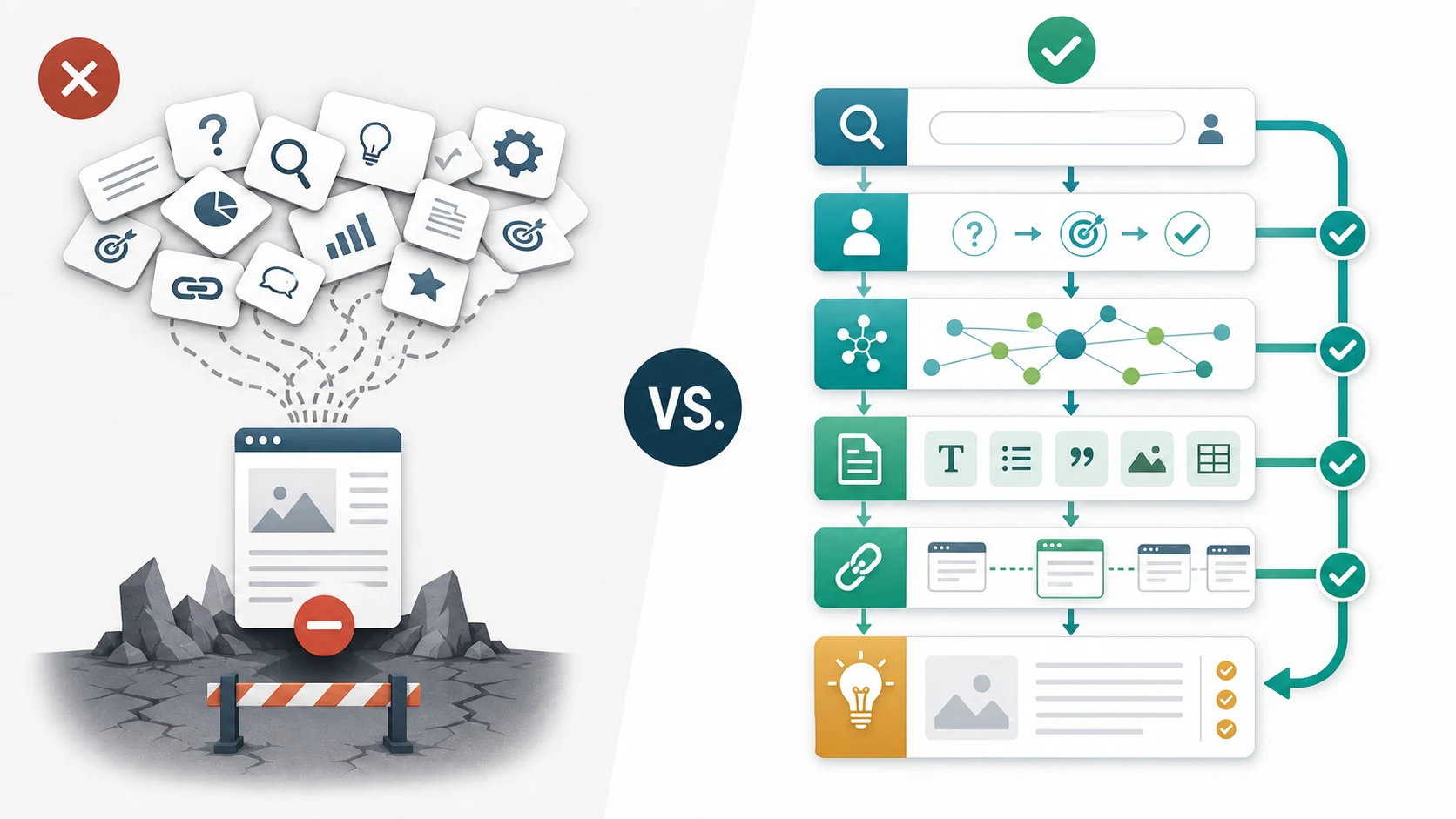
| Evidence layer | Question to answer | Useful output |
|---|---|---|
| Search task | What must the reader understand, decide, compare, or fix? | A one-sentence user job |
| Page type | Which asset best completes that job? | Article, landing page, tool, hub, comparison, or update |
| Entity map | Which people, products, concepts, places, or standards matter? | A short relationship map, not a word dump |
| Required coverage | Which questions, constraints, examples, and failure modes must the page address? | An outline tied to decisions |
| Source evidence | Which claims need primary documentation, data, screenshots, or examples? | A source plan and proof gaps |
| Internal context | Which parent, child, or sibling pages help the reader continue? | Descriptive, non-duplicative internal links |
| Technical eligibility | Can the target URL be crawled, indexed, canonicalized, and discovered? | A pre-publish technical check |
| Validation | Did the page attract the intended queries and provide extractable answers? | A measured revision queue |
Start with search intent and page-type routing. Then use semantic SEO as a page-evidence workflow to map entities, examples, headings, schema, and technical signals. For larger clusters, topical authority helps separate a parent topic from the child jobs that deserve their own pages.
Google's link guidance reinforces the same principle. Anchor text should be descriptive, concise, and relevant to both pages. Internal links help users and Google discover important pages and understand how they relate; they are not a place to force every related phrase.
Build Coverage Around Decisions
A useful brief should tell the writer what the reader needs to do, not which words a scoring tool wants to see.
Use this sequence:
- Write the primary question in the reader's language.
- Define the user job in one sentence.
- Choose the page type before creating the outline.
- Check whether an existing URL already serves the same keyword, page type, and job.
- Map the entities and concepts needed to explain the task accurately.
- Add decision points, examples, constraints, and failure cases.
- Mark claims that need primary sources or product evidence.
- Add internal links only where they support the next task.
- Confirm title, H1, canonical, indexability, sitemap, and crawl paths agree.
- Publish, measure, and revise from observed evidence.
This approach still produces related language. The difference is causal: the terms appear because the page explains the subject well. The writer is not reverse-engineering a fictional semantic score.
Validate Without an LSI Score
Do not finish the workflow when a content tool turns green. Validate whether the page is clear, eligible, and useful in the real environment.
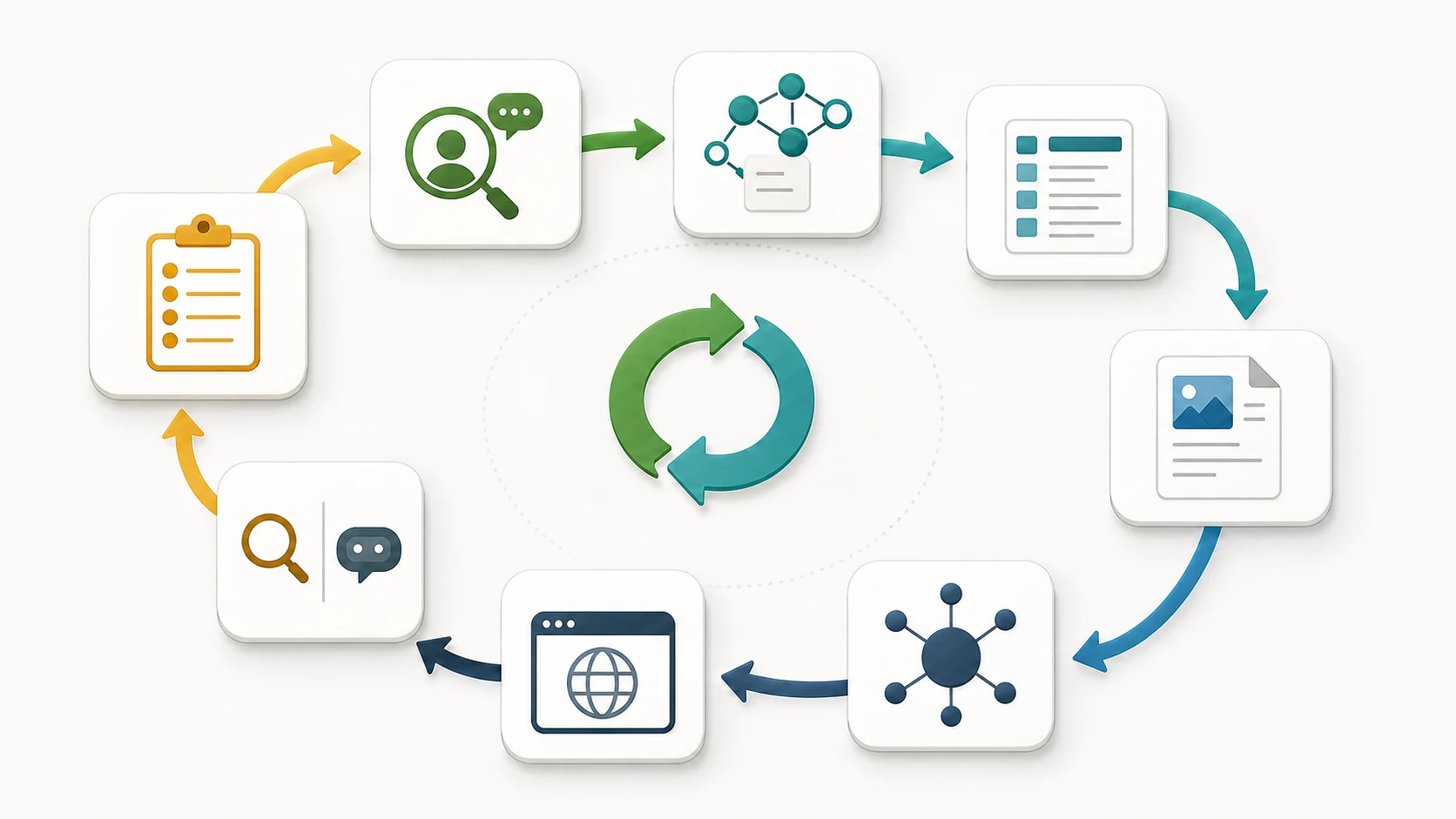
Run the validation loop in layers:
| Layer | Check | Revision trigger |
|---|---|---|
| Intent | The intro answers the primary task immediately | Readers still need another page to understand the basic answer |
| Coverage | Each section supports a decision, example, constraint, or action | Sections exist only to include a phrase |
| Evidence | Important claims link to current primary sources | The page depends on unsupported SEO folklore |
| Internal links | Links describe a genuine next task | Anchors are repetitive, vague, or point to competing pages |
| Crawl signals | Status, canonical, indexability, sitemap, and inlinks agree | The page is strong but technically ineligible or isolated |
| Search evidence | Query mix and landing-page performance match the intended job | The page attracts a different task or competes with a sibling URL |
| AI-answer evidence | The answer is concise, attributable, and supported | AI results omit the page while citing clearer primary sources |
Google says its AI search features do not require special optimization beyond the same foundational SEO practices used for Search. The page should be crawlable, indexable, eligible for snippets, and genuinely helpful. There is no extra LSI file, score, or schema required for AI Overviews or AI Mode.
Where Searvora Fits
LSI keyword advice is attractive because it promises a simple score. Real content decisions involve mixed evidence: query intent, existing-page overlap, source quality, crawl risk, business value, and delivery effort.
Searvora AI SEO Consultant is the primary fit for this workflow. Its current product surface is designed to group signals into patterns, rank opportunities by impact, effort, and confidence, and turn recommendations into assignable actions for SEO, content, and engineering teams.
Use that operating model to:
- reject term suggestions that do not support the page job;
- separate content gaps from technical and internal-link problems;
- prioritize the evidence that will materially improve the page;
- assign the change to the right owner;
- preserve a validation step after the update ships.
Common Questions About LSI Keywords
Are LSI Keywords Real?
Latent semantic analysis is real. The SEO idea that every page has a special list of LSI keywords to include is not a verified ranking tactic.
Does Google Use LSI?
Google does not publish every detail of its retrieval and ranking systems, so do not make an unsupported claim about a specific internal implementation. What can be said safely is that Google's current public guidance does not prescribe LSI keyword lists. It emphasizes helpful content, natural language, crawlability, descriptive links, and clear page structure.
Are Related Keywords Still Useful?
Related phrases can be useful when they reveal a missing user question, entity, example, constraint, or subtopic. Ignore them when they are merely topical neighbors that do not help the page complete its job.
How Many Related Terms Should a Page Include?
There is no universal quota. Include the language required to explain the task accurately and naturally. Stop when the page is complete, not when a tool reaches an arbitrary term count.
LSI keywords offer false precision. A stronger page comes from clear intent, the right page type, meaningful entity and topic coverage, primary evidence, natural internal links, aligned crawl signals, and a validation loop that turns observed results into the next revision.