

Non-200 hreflang URLs are alternate-language targets that return a redirect, client error, server error, blocked response, or no usable response instead of a normal success response. The practical fix is not to silence the crawler warning. It is to replace the annotation with the final, indexable, canonical URL—or restore that URL when it is supposed to exist.
Treat the problem as a cluster failure. One bad target can be repeated across every locale page, an XML sitemap, and several templates. Fixing a single tag while leaving the generator unchanged only postpones the next crawl error.
What a Non-200 Hreflang Error Actually Means
Google expects each localized version to list itself and the other valid alternates, and the pages should point back to one another. Its localized-version documentation also requires fully qualified alternate URLs and explains that incomplete return links may be ignored.
An HTTP status problem breaks the operational assumptions behind that cluster:
- A
3xxtarget is not the final page named by the annotation. - A
4xxtarget is missing, forbidden, or otherwise unavailable to the request. - A
5xxtarget is failing at the server or edge layer. - A blocked target may not expose the content and directives a crawler needs.
- A timeout or DNS/TLS failure gives the crawler no dependable page to evaluate.
Google's HTTP status documentation says 2xx responses can move into processing, while crawlers follow redirects and Search Console reports failed redirects plus 4xx and 5xx errors. That does not make every 200 page indexable, but it does make a successful response the first gate.
The original Screaming Frog issue reference groups redirects, blocked URLs, no responses, 4xx, and 5xx targets under this same technical symptom.
Triage the Status Before Choosing a Fix
Do not send every non-200 result to the same owner. Group the affected URLs by response class first, then decide whether the target moved, disappeared, is blocked, or is temporarily unhealthy.
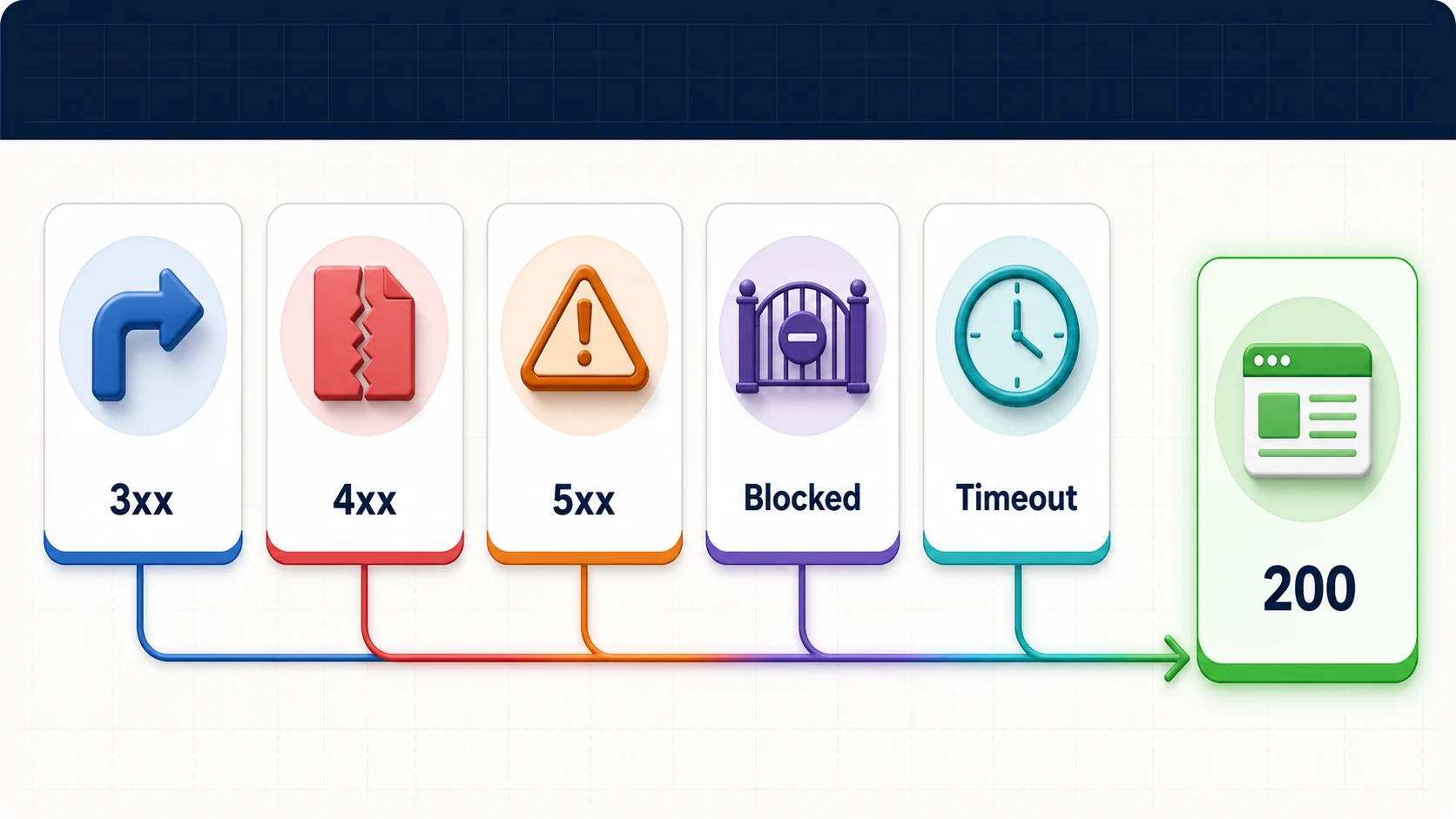
| Signal | What it usually means | First check | Typical owner |
|---|---|---|---|
301 or 308 | The locale URL moved permanently | Confirm the final destination and its canonical | SEO plus platform engineering |
302, 303, or 307 | The target is temporarily redirected or routing is unstable | Confirm whether the move is truly temporary | Platform engineering |
404 or 410 | The translated page was removed, renamed, or never published | Check the locale inventory and CMS record | Content operations |
401 or 403 | Authentication, firewall, CDN, or bot policy blocks access | Reproduce with an anonymous crawl | Infrastructure or security |
429 | Rate limiting is throttling the crawl | Review crawl rate and edge limits | Infrastructure |
5xx | Application, origin, proxy, or edge service is failing | Compare affected templates, hosts, and time windows | Engineering or infrastructure |
| Timeout, DNS, or TLS failure | The crawler cannot complete a reliable request | Test host resolution, certificates, and response latency | Infrastructure |
The status code is a routing clue, not the whole diagnosis. For each target, retain the source page, locale code, implementation method, canonical, sitemap membership, and return-link result. Without that context, teams tend to patch URLs individually and miss the template that created them.
Find the Publishing Source Before Editing Tags
A bad alternate URL may be published from HTML, an HTTP Link header, or an XML sitemap. Google treats these as equivalent implementation methods, but maintaining several methods at once creates more places for them to drift.
Build a working table with one row per failing relationship:
| Source URL | Hreflang | Target URL | Status | Final URL | Target canonical | Published by |
|---|---|---|---|---|---|---|
| English product page | de-de | Old German path | 301 | New German path | Self | Product template |
| German product page | en | English page | 200 | Same | Self | Product template |
| XML sitemap entry | de-de | Old German path | 301 | New German path | Self | Sitemap generator |
Then answer three questions:
- Is the failing URL supposed to exist?
- If it moved, which final URL owns the localized page job?
- Which system must change so every source stops publishing the old target?
This source-first approach separates a content inventory problem from a routing problem. A deleted translation should usually be removed from the cluster. A renamed translation should be replaced with its final URL. A temporarily unhealthy page should be restored before it is advertised as a dependable alternate.
Replace Redirecting Hreflang Targets With Final URLs
Google follows server-side redirects, and permanent redirects are canonicalization signals. Its redirect guidance distinguishes permanent moves from temporary routing. Hreflang annotations should still point directly to the intended final locale URL.
For each redirecting alternate:
- Follow the chain and record every hop.
- Confirm that the final page matches the same language, region, and user task.
- Check that the final page returns
200, is indexable, and has the expected self-canonical. - Replace the old URL in every hreflang source.
- Keep the redirect for users and stale external references when appropriate.
- Re-crawl both the source pages and the final alternate.
Do not mechanically swap the target when a redirect lands on a homepage, language selector, unrelated category, or default locale. That can hide a missing localized page behind a technically successful destination. Decide whether the alternate should be restored, removed, or mapped to a genuinely equivalent page.
For migration-specific redirect planning, use the redirects for SEO workflow alongside this cluster check.
Repair 4xx, 5xx, Blocked, and Timeout Targets by Cause
Non-redirect failures need different recovery paths.
Restore or remove 4xx targets
If a translated page should exist, restore it at the referenced URL or publish the correct replacement and update the cluster. If the locale version was intentionally retired and no equivalent page exists, remove that alternate from every member of the cluster and from the sitemap source.
Do not redirect every missing translation to a locale homepage. A broad fallback rarely serves the same page job, and it makes the cluster look complete when the content is not.
Stabilize 5xx targets
Segment failures by hostname, template, deployment, region, CDN rule, and time window. A single intermittent check can be noise; a repeated failure across one locale host or template is an operational defect. Fix the application or delivery layer, then confirm sustained 200 responses before reintroducing the target if it was temporarily removed.
Reproduce blocked responses anonymously
Test the URL without a session, allowlist, or privileged browser. Compare robots rules, CDN bot controls, authentication middleware, geo restrictions, and origin access. Google notes that blocked crawling can prevent it from seeing page-level indexing rules, so a URL that only works for an authenticated operator is not a healthy public alternate.
Treat timeouts as availability failures
Retry from more than one location and at more than one time. Check DNS, TLS, origin latency, render-heavy templates, and edge timeouts. The goal is not one successful retry; it is a reliably fetchable localized page.
Reconcile Canonicals, Sitemaps, and Return Links
Turning the target green is only half of the fix. The localized page must still belong in the cluster.
Check each repaired target for:
- a self-referencing canonical unless there is a deliberate, documented exception;
- reciprocal hreflang links back to the source and other maintained alternates;
- the same final URLs in HTML, headers, and sitemap output;
- a locale code that matches the visible language and regional experience;
- no
noindexdirective or other indexability conflict; - no second redirect introduced by protocol, hostname, slash, or casing normalization.
Google's canonical guidance describes canonicals, redirects, sitemaps, and hreflang clusters as signals that should agree. If the alternate points to URL A but URL A canonicals to URL B, determine which final URL should represent that locale and make the signals consistent.
The broader hreflang tags implementation guide covers cluster design and method selection. This article stays focused on the non-200 failure path.
Prioritize by Cluster Impact, Not Raw Error Count
Ten broken targets repeated across 50,000 pages can represent one template bug. Ten unrelated failures across ten CMS records can require ten separate content decisions. Count both affected relationships and distinct root causes.
Use this priority order:
- Locale-wide server, DNS, TLS, or blocking failures.
- Shared templates publishing an obsolete alternate across many clusters.
- Redirect chains introduced by a migration or routing rule.
- High-value page clusters with missing or retired translations.
- Isolated low-value URLs that can be removed or corrected during normal maintenance.
Add an owner and validation condition to every issue group. “Update hreflang” is not a useful ticket. “Replace the old German product path in the product template and sitemap generator, confirm self-canonical output, and re-crawl 200 affected clusters” is executable.
Validate the Repair With a Cluster-Level Recrawl
Run the same checks after the fix that exposed the defect before it. A partial crawl can prove one target works; only a cluster-level recrawl proves the relationship is healthy everywhere it is published.
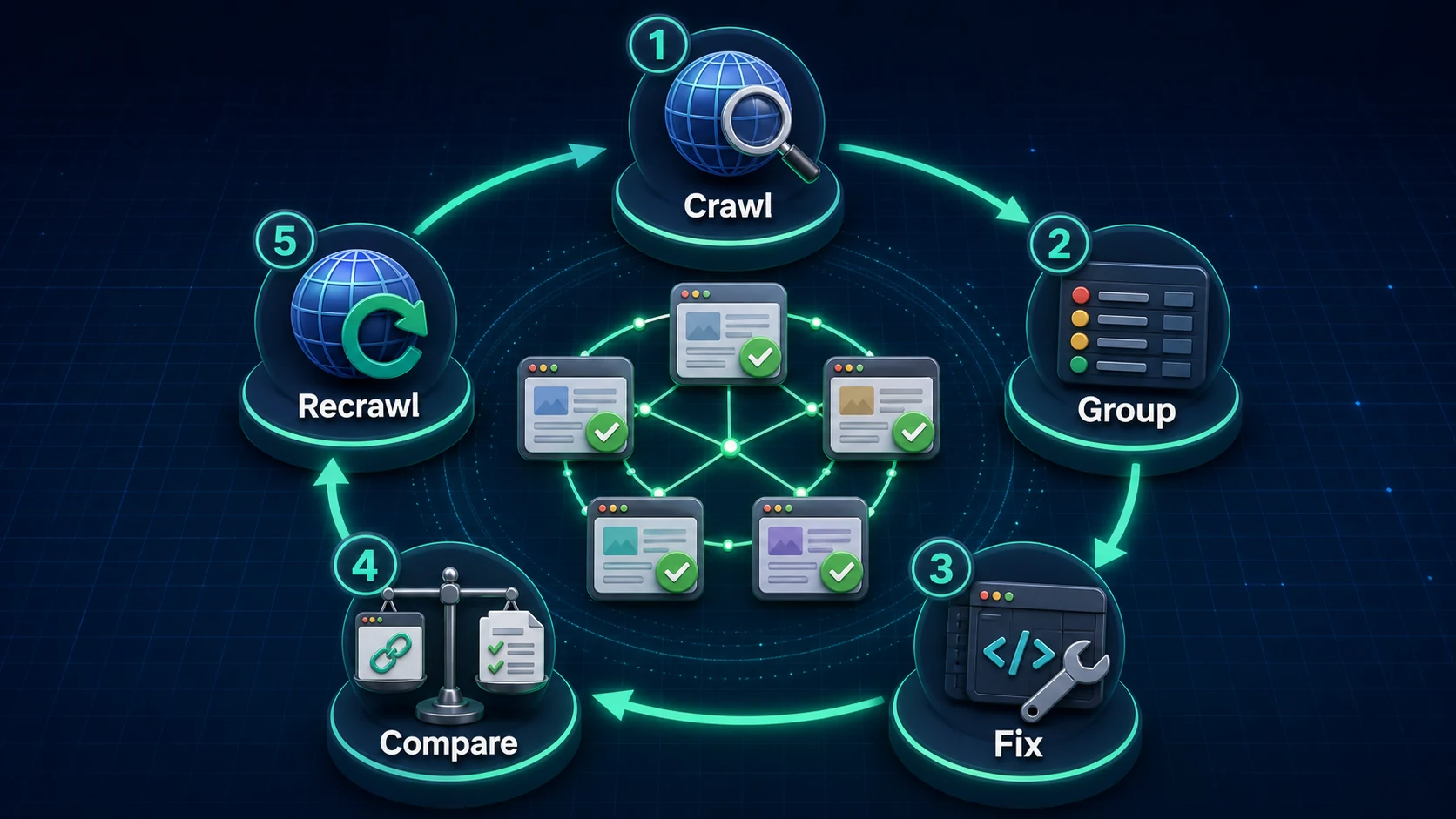
| Validation step | Pass condition |
|---|---|
| Crawl every alternate | Every maintained target returns a stable 200 response |
| Compare final URLs | No annotation relies on a redirect chain |
| Inspect canonicals | Each localized canonical agrees with the intended cluster URL |
| Compare implementation sources | HTML, headers, and sitemap output do not disagree |
| Test reciprocal links | Every maintained alternate participates in the expected return-link set |
| Check indexability | No target is blocked, noindex, or otherwise excluded by mistake |
| Re-run after deployment | Production output matches the tested fix, not only the code change |
This is where a technical crawler earns its place in the release workflow. Searvora SEO Spider Crawler is positioned to inspect status codes, redirect chains, canonicals, hreflang mapping, return links, and sitemap behavior, then group findings into a fix queue.
Prevent the Same Hreflang Failure From Returning
Add these checks to locale publishing and migration workflows:
- Resolve every proposed alternate URL before release.
- Reject non-final URLs from the hreflang generator.
- Compare canonical, hreflang, and sitemap URL normalization rules.
- Remove retired translations from every cluster member in the same deployment.
- Test anonymous access through the public CDN path.
- Run a full cluster crawl after routing, CMS, or localization changes.
- Monitor failures by locale host, template, and response class.
The durable fix is not a cleaner issue report. It is a publishing system that only emits final, healthy locale URLs—and a release check that proves those URLs remain canonical, reciprocal, and crawlable after they go live.