

If your actual question is how can i promote my product online, start by choosing the page job before choosing the channel. A product can be promoted with search, email, social, paid media, partners, affiliates, marketplaces, and communities, but those channels only work when the destination page answers the buyer's next question.
The search-led workflow is simple: decide which page should own the demand, create the content asset that explains the product honestly, link that asset to the right product or collection page, then measure whether qualified visitors continue the path. That keeps promotion from becoming random posting.
Start With The Buyer Question
Product promotion gets messy when every tactic is treated as equal. A launch announcement, product page, comparison article, how-to guide, and collection page should not carry the same keyword or promise.
Use this first decision table:
| Buyer question | Best online asset | First quality check |
|---|---|---|
| What is this product for? | Product page or launch page | Clear positioning, proof, images, and next step |
| Which product should I choose? | Collection page or comparison guide | Useful criteria and links to the right products |
| How do I solve this problem? | How-to article or buying guide | Practical steps before the product mention |
| Is this product trustworthy? | Review, case proof, FAQ, or support content | Verifiable claims and objections answered |
| What is new or seasonal? | Campaign page plus durable support content | Expiration, canonical, and refresh plan |
This table matters because a product can attract attention for the wrong reason. If a how-to searcher lands on a thin product page, the page feels too sales-heavy. If a purchase-ready searcher lands on a broad educational post with no route to the product, the article wastes demand.
Build The Search-Led Promotion Map
Before writing, map demand to page types. You are not trying to publish more content. You are trying to decide which asset deserves to exist and how it should help the reader move forward.
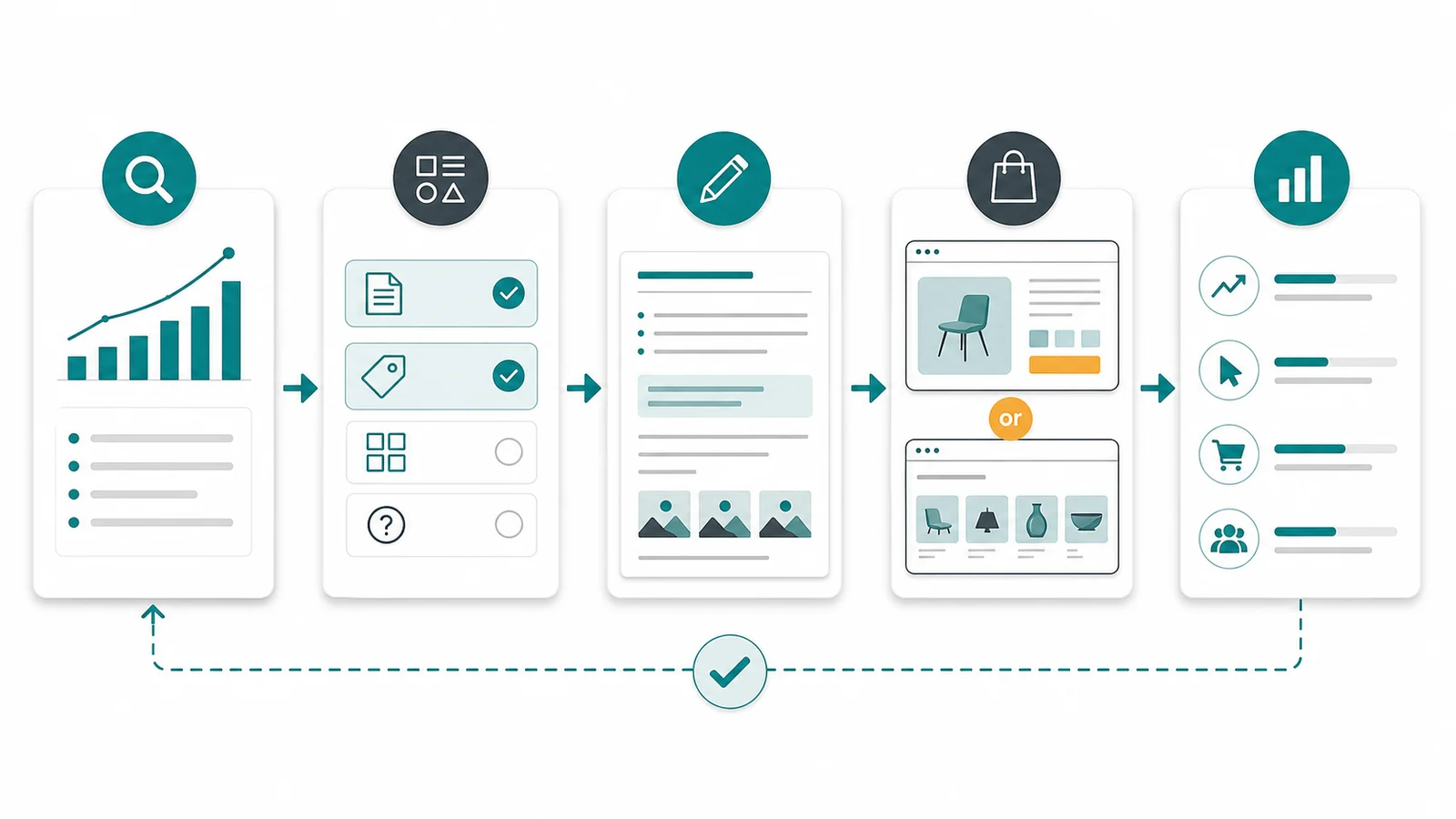
For an ecommerce or SaaS product, the map usually looks like this:
- Gather search queries, customer questions, sales objections, product use cases, and seasonal angles.
- Group them by buyer job instead of shared words.
- Choose the canonical asset for each group: product page, collection page, article, comparison, support page, or campaign page.
- Write the brief with the product context, proof requirement, internal links, and measurement signal.
- Publish or update the asset, then route promotion toward that URL.
- Review the same query group, page, and product path after the validation window.
The content marketing workflow is useful when the team needs a broader operating rhythm. For product promotion, the extra rule is that every content asset must know which product, collection, or campaign it supports.
Use Content To Earn The Click Before The Pitch
Many product-promotion articles fail because they sell before they help. The SERP for this topic is full of channel lists and marketing tactics. A stronger article or guide answers the customer's immediate job first, then introduces the product only where it naturally helps.
Use this brief format:
| Brief field | What to write |
|---|---|
| Primary product | The exact product, collection, or feature being promoted |
| Search task | What the reader is trying to learn or decide |
| Page type | Product page, comparison, how-to, buying guide, FAQ, or campaign page |
| Proof | Screenshots, specs, examples, compatibility, use cases, or outcomes |
| Internal route | One product route and one to three supporting links |
| Validation | Query movement, assisted product clicks, qualified sessions, or signups |
Google's product structured data documentation is a useful reminder that product facts should be visible and supported on the page. Structured data can help search systems understand product information, but it cannot rescue weak copy, missing proof, or a page that answers the wrong job.
For stores, the ecommerce SEO workflow gives the page-type baseline. Product promotion works better when collection pages, product pages, guides, and campaign pages each have their own search role.
Pick Channels After The Destination Is Ready
Once the destination page is clear, channel choices become easier. You are not asking "where should we post?" You are asking "which channel can send the right audience to the right asset?"
| Channel | Use it when | Watch out for |
|---|---|---|
| Organic search | The query has durable demand and the page can satisfy intent | Slow validation and cannibalization with existing URLs |
| You already have subscribers who match the product use case | Sending to everyone instead of segmenting by need | |
| Social | The product has a visual, timely, or community-friendly angle | Treating attention as purchase intent |
| Paid search or paid social | The offer and landing page are already proven | Buying traffic before the page explains the product |
| Partners and affiliates | The product fits another audience's trust path | Weak tracking, thin disclosure, or poor asset control |
| Marketplace content | The buyer starts on a platform such as Amazon or TikTok Shop | Platform rules, support intent, and weaker ownership |
The channel should not change the truth of the page. It should change the framing, creative, and timing. A product page still needs proof. A guide still needs useful steps. A comparison still needs fair criteria.
Turn Promotion Into A Publishing Queue
Promotion becomes repeatable when the team treats each asset like a small production job. That means topic approval, page-type choice, product context, metadata, internal links, visual requirements, and review state all move together.
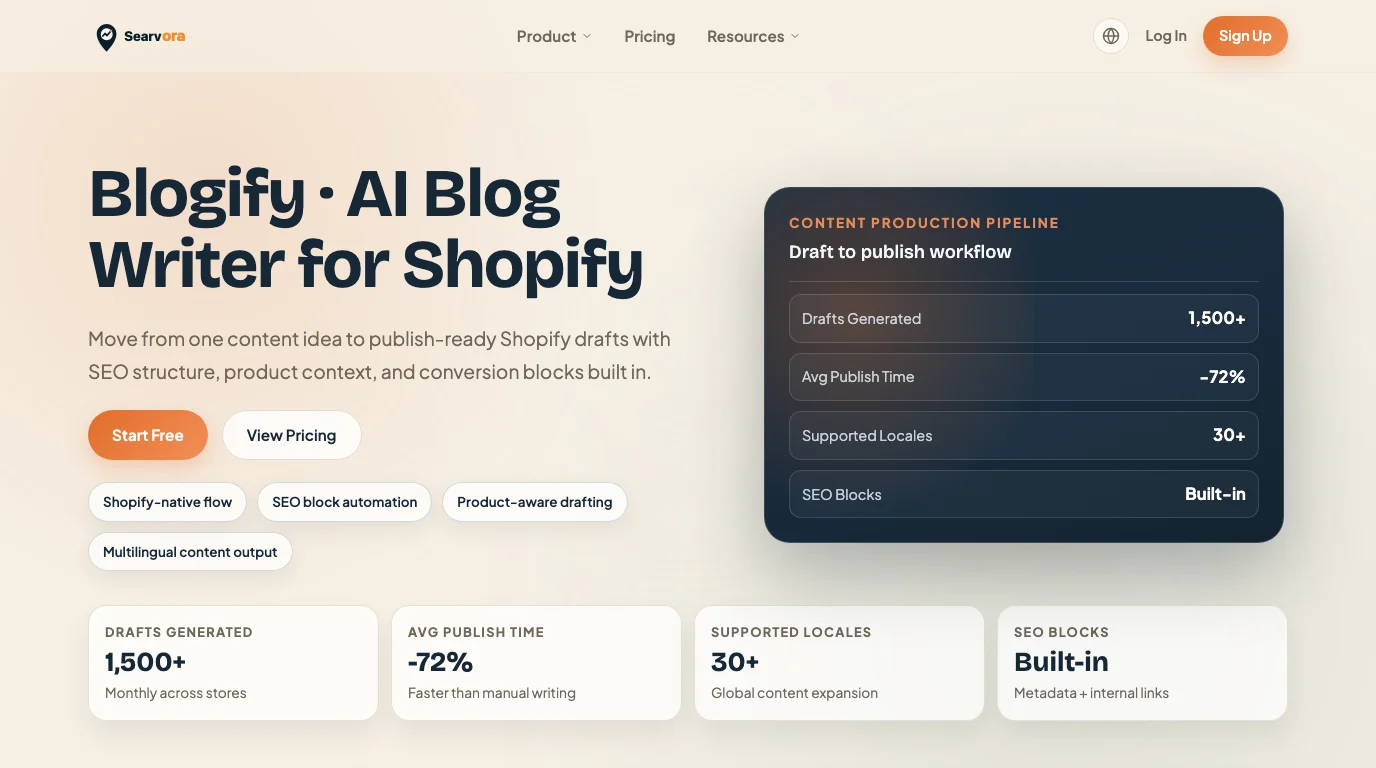
Shopify's store blog documentation shows that Shopify blogs can support SEO, audience building, and search listing controls. The stronger operating question is how the team turns a product idea into a structured draft that includes the right product context before it reaches review.
This is where Searvora Blogify fits. Blogify is positioned around store-aware topic intelligence, structured SEO drafting, product references, metadata, multilingual workflow, and Shopify draft publishing. Use it when the product-promotion asset should become a review-ready article, guide, or campaign support post instead of another loose document.
Measure Promotion By The Page Job
Do not measure every promotion asset by the same number. A product page, buying guide, and launch article should have different proof.
Use this measurement ledger:
| Page job | Useful signal | Next decision |
|---|---|---|
| Product page | Qualified product clicks, add-to-cart events, demo starts, or signups | Improve proof, FAQs, media, or offer clarity |
| Buying guide | Assisted product clicks and internal link paths | Add better criteria or stronger product context |
| How-to article | Query impressions, engagement, and product route clicks | Add examples, steps, or clearer next action |
| Campaign page | Campaign sessions, conversions, and expiration behavior | Keep, refresh, redirect, or noindex when stale |
| Collection page | Category impressions, product exploration, and filter use | Improve copy, internal links, and crawl access |
Promotion is not finished when traffic arrives. It is finished when the team knows whether the destination page helped the reader continue the right path. If the asset attracts attention but no useful next action, revise the page job before amplifying it again.
Product Promotion Checklist
Use this checklist before promoting a product online:
- Name the exact buyer question behind the promotion.
- Choose the page type that should answer that question.
- Check whether an existing URL already owns the same job.
- Write a brief with product proof, internal links, visuals, metadata, and validation.
- Create the content asset before scaling channel activity.
- Link naturally from educational content to product or collection pages.
- Keep external claims tied to visible product facts or official sources.
- Review search, assisted product clicks, and page engagement after launch.
- Refresh, consolidate, or stop the asset when the page job no longer fits.
That is the practical answer to promoting a product online: build the destination first, route demand deliberately, and let each channel amplify a page that already knows what job it is supposed to do.