

Republishing content for SEO means updating an existing page enough that it deserves a new editorial review, a fresh crawl check, and a new measurement window. It is not changing the date on an old article and hoping search systems treat it as new.
The useful version starts with evidence. Find pages where demand, intent, links, crawl state, or AI-search visibility changed. Decide whether the page needs a light refresh, a rewrite, a merge, or no action. Then republish with a validation plan so the team can see whether the update actually helped.
When Republishing Content Is Worth It
Republishing is worth doing when the page still owns a useful search job but the current version no longer earns trust, clicks, or citations. The page may still be indexable and relevant, yet its examples, structure, internal links, metadata, or answer format have fallen behind.
Do not start with age alone. A five-year-old page can still be the best answer on the site. A six-month-old page can already be obsolete if the SERP changed, the product changed, or competitors now answer the task with better evidence.
| Signal | What it suggests | Better action |
|---|---|---|
| Impressions are steady but clicks are falling | The promise may be stale or less compelling | Refresh title, meta description, intro, and section order |
| Rankings slipped for the same query group | Competitors may now answer the task more completely | Rewrite or expand the sections that decide the query |
| AI answers cite competitors instead of your page | The page may lack extractable definitions, steps, or evidence | Add concise answers, tables, examples, and source clarity |
| The page has crawl or indexability warnings | The content may not be the main blocker | Fix technical access before rewriting |
| Two pages serve the same job | Authority and user signals may be split | Merge, redirect, or differentiate before republishing |
| The topic no longer supports a business or audience need | A refresh would only create activity | Monitor, retire, or noindex instead |
Google's people-first content guidance is a good guardrail here: improve the page because it helps the user complete the task, not because the calendar says the article is old. Pair that editorial judgment with data from the Search Console performance report, crawl output, and your own product or customer context.
Build A Refresh Queue Instead Of Editing Random Pages
A republishing program needs a queue. Without one, teams either refresh the biggest traffic losers first or rewrite whichever article someone noticed in a meeting. Both habits create busywork.
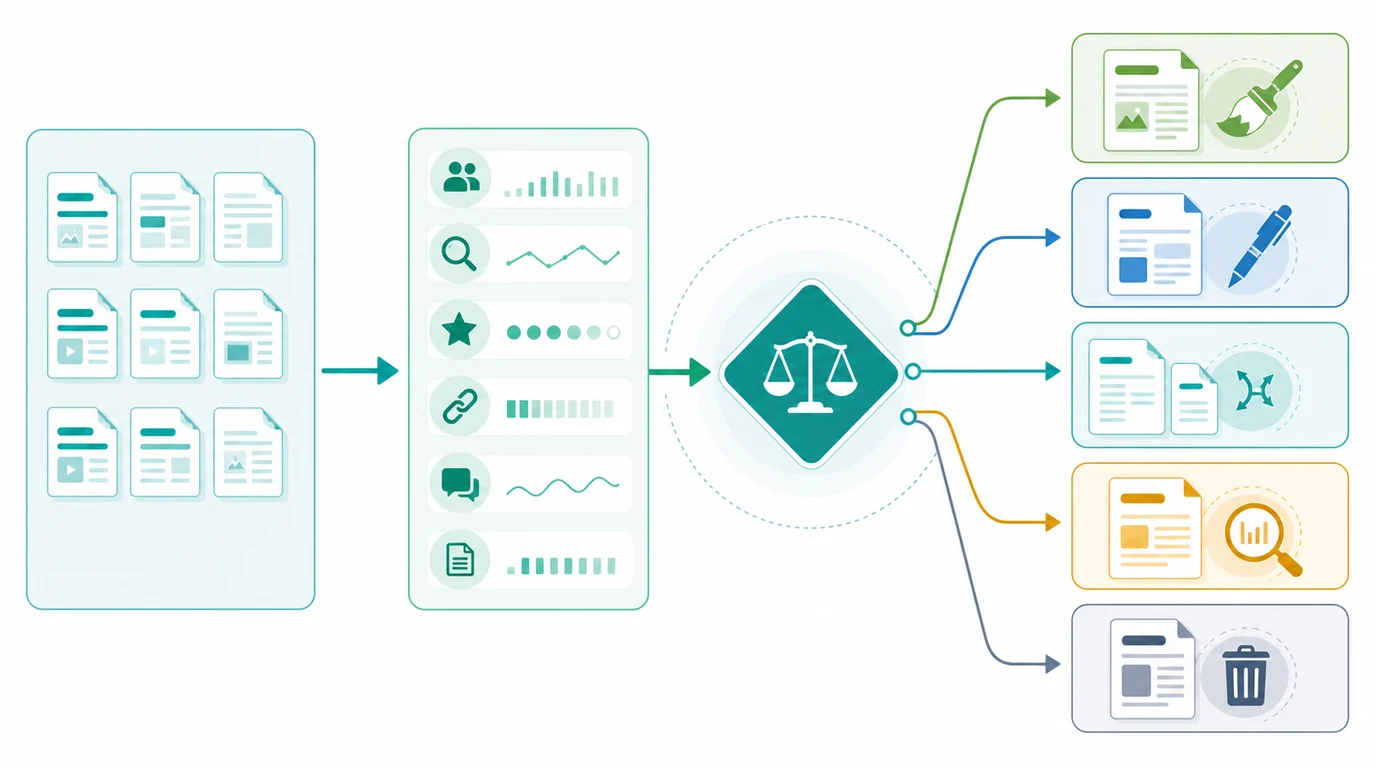
Start by pulling candidate URLs from five sources:
- Performance movement: pages with falling clicks, CTR, or rankings in a meaningful query group.
- Search opportunity: pages with impressions, near-page-one rankings, or weak snippet performance.
- Content decay: pages with outdated facts, old examples, missing screenshots, stale product language, or thin sections.
- Crawl and index state: pages with canonical, status, sitemap, noindex, internal-link, or rendered-content issues.
- AI-search evidence: pages that should be cited or summarized but are missing clear definitions, entities, tables, or source-backed steps.
The content audit workflow is the better starting point when the site has hundreds or thousands of URLs. Use it to build the inventory, classify page jobs, and remove pages that should never enter a republishing queue.
Then score each candidate by impact, confidence, effort, and risk. A low-traffic page can still be worth republishing if it supports a commercial cluster or an AI-search answer path. A high-traffic page can be the wrong first target if the decline is seasonal, the intent moved to another page type, or the page is technically blocked.
Choose The Right Page Action
Not every old article needs a rewrite. Use a small action vocabulary so editors, SEOs, and engineers understand what kind of work is being assigned.
| Action | Use when | What changes |
|---|---|---|
| Refresh | The page still matches intent but needs better examples, metadata, links, screenshots, or recent details | Update targeted sections and preserve working parts |
| Rewrite | The topic is still valuable but the structure no longer answers the current task | Rebuild the outline, intro, H2s, examples, and decision support |
| Expand | The page is strong but missing important subtopics or AI-search clarity | Add sections, definitions, tables, examples, FAQs only when useful, and supporting links |
| Merge | Another URL serves the same core keyword, page type, and user job | Consolidate into the stronger URL and redirect or clearly differentiate |
| Monitor | The signal is real but confidence is too low | Track another window before assigning production work |
| Retire | The page has no search role, user value, or strategic purpose | Remove, noindex, or leave it outside the SEO queue |
This is where republishing content differs from ordinary editing. The action must match the evidence. If a page lost rankings because another page on your site now answers the same job, a rewrite may make the problem worse. If the page is canonicalized elsewhere, new copy will not fix eligibility. If the page still ranks but does not earn clicks, metadata and first-screen clarity may matter more than adding 1,000 words.
For pages that already have the right job but weak execution, use the content optimization workflow as the companion process. It keeps the update focused on visible page quality, internal links, crawl eligibility, and measurement instead of turning every refresh into a full rebuild.
Write A Republishing Brief
A republishing brief should be shorter than a net-new article brief, but it must be more specific about what changed and how success will be measured. The URL already has history, links, and expectations. Treat those as assets, not clutter.
Use this brief structure:
| Brief field | What to include |
|---|---|
| URL and canonical | The live page that will be updated and measured |
| Current job | What the page appears to answer today |
| Target job | What the republished version should answer |
| Evidence | Query movement, crawl state, competitor gap, internal links, AI-search findings, and product changes |
| Action | Refresh, rewrite, expand, merge, monitor, or retire |
| Required edits | Sections, examples, visuals, metadata, links, schema, screenshots, or redirects |
| Owner | Content, SEO, engineering, design, product, or legal |
| Guardrails | Working sections, rankings, links, claims, or conversion paths that should not be damaged |
| Validation | Crawl check, index check, rendered HTML check, query segment, AI-search check, and review date |
The guardrails matter. A page that still earns valuable long-tail queries should not be flattened into a generic new article. A page with strong backlinks should not be moved or redirected casually. A page that supports a product path should not lose its CTA because the writer focused only on informational depth.
For AI-search visibility, add one extra field: citation readiness. List the definitions, named entities, concise steps, tables, examples, and evidence blocks that make the page easier to quote or summarize. The AI visibility workflow is useful when the refresh needs to improve both classic organic search and answer-engine presence.
Update The Page Without Faking Freshness
Republishing fails when the visible freshness signal is stronger than the actual update. If you change the publish date, the page should have materially changed. If the update is small, use an updated date, changelog note, or internal editorial record instead of pretending the article is new.
Before changing the date or pushing the update, check:
- The main answer is more useful than before.
- Old examples, screenshots, statistics, and product claims are corrected or removed.
- The title, H1, meta description, and intro all describe the same search task.
- Important sections are easier to scan and quote.
- Internal links point to the right product pages, hubs, and supporting articles.
- External facts are tied to current public sources.
- The canonical, noindex, sitemap, schema, and redirects still match the intended URL.
- Any AI-generated or AI-assisted work has been reviewed for accuracy and originality.
Google's documentation on creating helpful content asks publishers to consider whether a page adds original value and whether the main heading gives a descriptive, helpful summary. That is a practical standard for republishing: the new version should make the page more useful on its own, not just newer.
Validate The Live Update
The republished page is not done when the CMS says published. It is done after the live URL is checked and the team has a baseline for measuring the next window.

Run this validation sequence after the update ships:
- Re-crawl the URL and affected template peers.
- Confirm the rendered page includes the intended copy, links, headings, images, and metadata.
- Check status code, canonical, robots directives, sitemap inclusion, hreflang when relevant, and structured data.
- Confirm internal links were added from relevant source pages and not only from the article itself.
- Test that important images have useful alt text and load from local or approved sources.
- Review the page's first section for direct answers, definitions, and decision support that AI systems can extract.
- Compare Search Console query groups after a meaningful window, not the next morning.
- Record the result: improved, flat, worse, or inconclusive.
Google's sitemap documentation is a reminder that discoverability and eligibility still matter after an editorial update. If the page cannot be found, crawled, parsed, or trusted as the canonical URL, the best rewrite may not be evaluated the way the team expects.
Where Searvora Fits
Searvora fits republishing work when the team needs to move from mixed signals to assigned actions. Use AI SEO Dashboard to spot pages, templates, locales, or clusters that changed. Use crawl evidence to avoid rewriting pages with technical blockers. Then use AI SEO Consultant to turn the evidence into a prioritized refresh, rewrite, merge, or monitor queue.
For Shopify teams, Blogify can take the approved brief and help turn it into a structured draft with metadata, internal links, and product context. That execution step should happen after the page action is clear. Republishing should not become a content factory for pages that really need a redirect, a technical fix, or no action at all.
Republishing Checklist
Use this checklist before a page enters the republishing queue:
- Confirm the page still has a useful search and audience job.
- Compare the current query mix with the title, H1, intro, and section structure.
- Check crawlability, indexability, canonical state, sitemap inclusion, and internal links.
- Decide whether the action is refresh, rewrite, expand, merge, monitor, or retire.
- Preserve useful sections, links, rankings, examples, and conversion paths.
- Add missing evidence, examples, definitions, tables, visuals, or source-backed steps.
- Update metadata only when the current snippet promise is weak or mismatched.
- Keep core advice in searchable text, not only inside images.
- Re-crawl and inspect the rendered live page after publishing.
- Review classic search performance and AI-search visibility after a meaningful data window.
- Record the result so the next content cycle starts from evidence.
Republishing content works when it protects what still performs and improves what has a real reason to change. The point is not to make old pages look new. The point is to give useful URLs a better chance to be crawled, understood, cited, clicked, and acted on.