

Resource page link building is the process of earning a citation from a page that curates useful links for a specific audience. The useful version starts with an asset worth recommending, finds maintained pages where that asset improves the reader experience, qualifies each opportunity by editorial fit, sends a page-specific pitch, and measures the result.
The shortcut version starts with a domain-metric export and a bulk email template. That is where the tactic becomes noisy, easy to ignore, and vulnerable to link-spam risk. Treat resource page link building as a small editorial campaign, not a link-count exercise.
What Resource Page Link Building Means
A resource page exists to help a defined audience find useful references, tools, guides, datasets, templates, or organizations. It may be a dedicated /resources/ page, a library maintained by an association, a university guide, a nonprofit reference list, or a useful-links section inside a broader article.
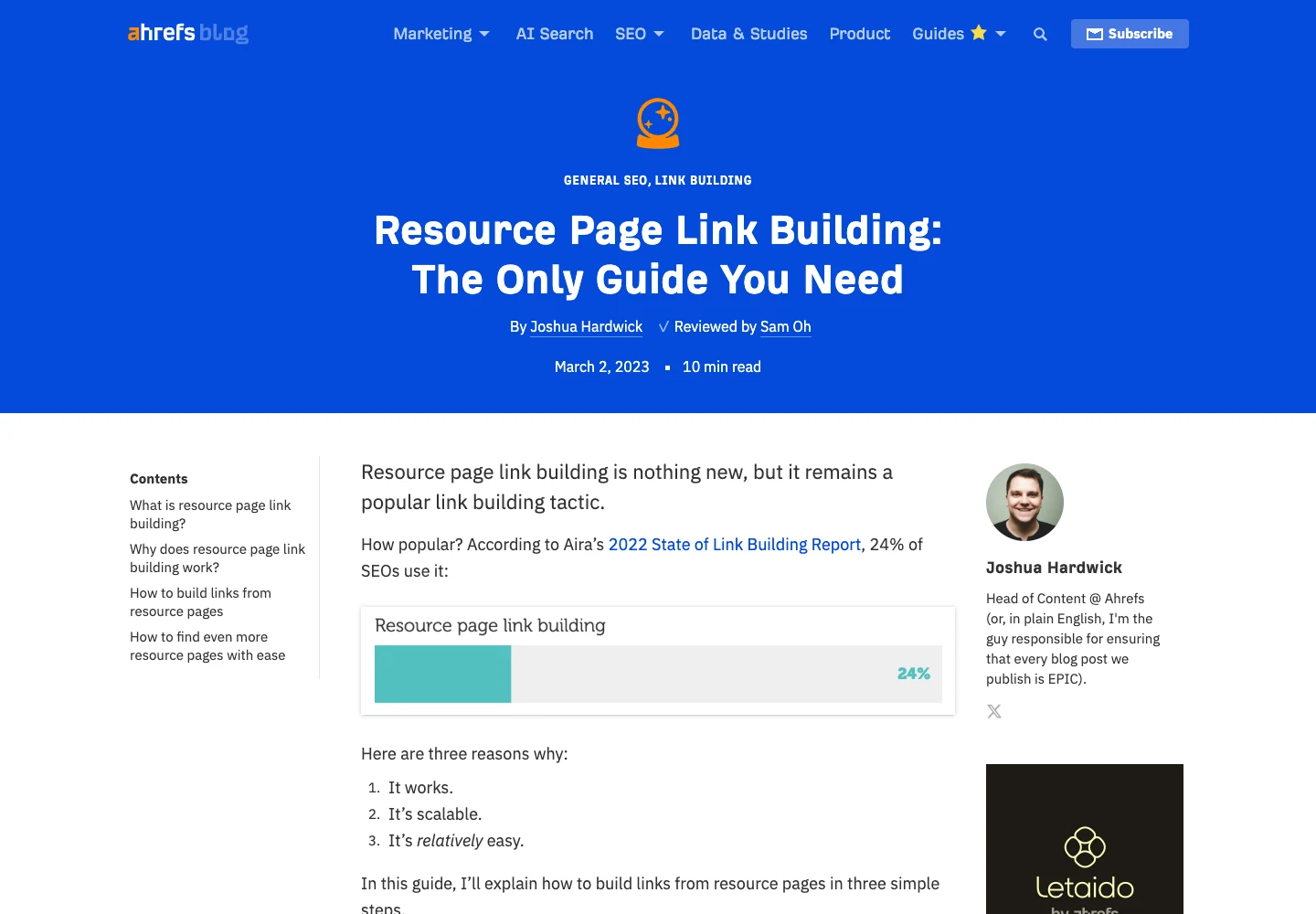
The Ahrefs article that surfaced this opportunity presents a straightforward sequence: find resource pages, vet them, and suggest a useful resource. Searvora's information gain is the operating layer around those steps: decide whether the asset is ready, separate editorial opportunities from weak directories, record why the link belongs, assign outreach ownership, and validate whether the campaign produced a useful outcome.
Use this distinction before building a prospect list:
| Resource-page opportunity | Directory or link-selling pattern |
|---|---|
| Serves a clear audience and topic | Lists unrelated sites across many categories |
| Includes useful editorial descriptions | Uses thin, repeated, or keyword-stuffed descriptions |
| Appears maintained and removes dead resources | Contains many broken, abandoned, or low-quality links |
| Has a clear reason to include your asset | Offers placement mainly for payment or exchange |
| Would still help readers without SEO value | Exists primarily to pass ranking signals |
Pass the Asset-Readiness Gate
Resource page outreach fails early when the asset has no citation reason. A generic commercial page, a lightly rewritten article, or an unsupported claim gives an editor little reason to update a maintained list.
Audit the asset before searching for prospects:
| Readiness question | Ready signal | Fix before outreach |
|---|---|---|
| What does the asset help someone do? | It answers a narrow task, provides evidence, or saves work | The value is only "learn more about our company" |
| Why is it worth citing? | Original data, a useful template, a clear workflow, a maintained tool, or a strong reference | The page repeats advice already available everywhere |
| Who needs it? | A named audience with a specific job | "Anyone interested in marketing" |
| Is the page trustworthy? | Sources, authorship, dates, limitations, and visible evidence are clear | Claims are unsupported or presented as guaranteed outcomes |
| Is the page technically ready? | Stable canonical, crawlable content, working links, useful title, and indexable status | The page redirects, is orphaned, or hides the useful content |
| Can the team maintain it? | An owner and refresh trigger exist | The asset will become stale as soon as the campaign ends |
If the asset still needs a stronger citation reason, improve it before outreach. The linkable assets workflow helps separate pages that deserve promotion from pages that only want links.
This gate also protects the campaign from a common measurement mistake. A resource-page link cannot rescue a page whose search task, page type, or product promise is unclear. Fix the asset first, then use outreach to introduce it to the right editorial context.
Find Resource Pages With Search Operators
Start discovery with broad topical phrases, then combine them with footprints that commonly appear on curated pages. Google's official search operator guidance confirms that operators such as quotes, site:, and exclusions can refine a search. Resource-page discovery extends that logic with page-title and URL footprints.
Examples:
technical seo intitle:resources
technical seo inurl:resources
"technical seo" "useful links"
seo audit intitle:links
content operations "recommended resources"
shopify seo "further reading"
Use multiple topic phrases. Editors rarely describe a field with the exact keyword your asset targets. A page useful for "technical SEO automation" may sit under website quality, search marketing, ecommerce operations, developer resources, or content governance.
The Google search operators workflow gives a broader operator set and explains where manual review still matters.
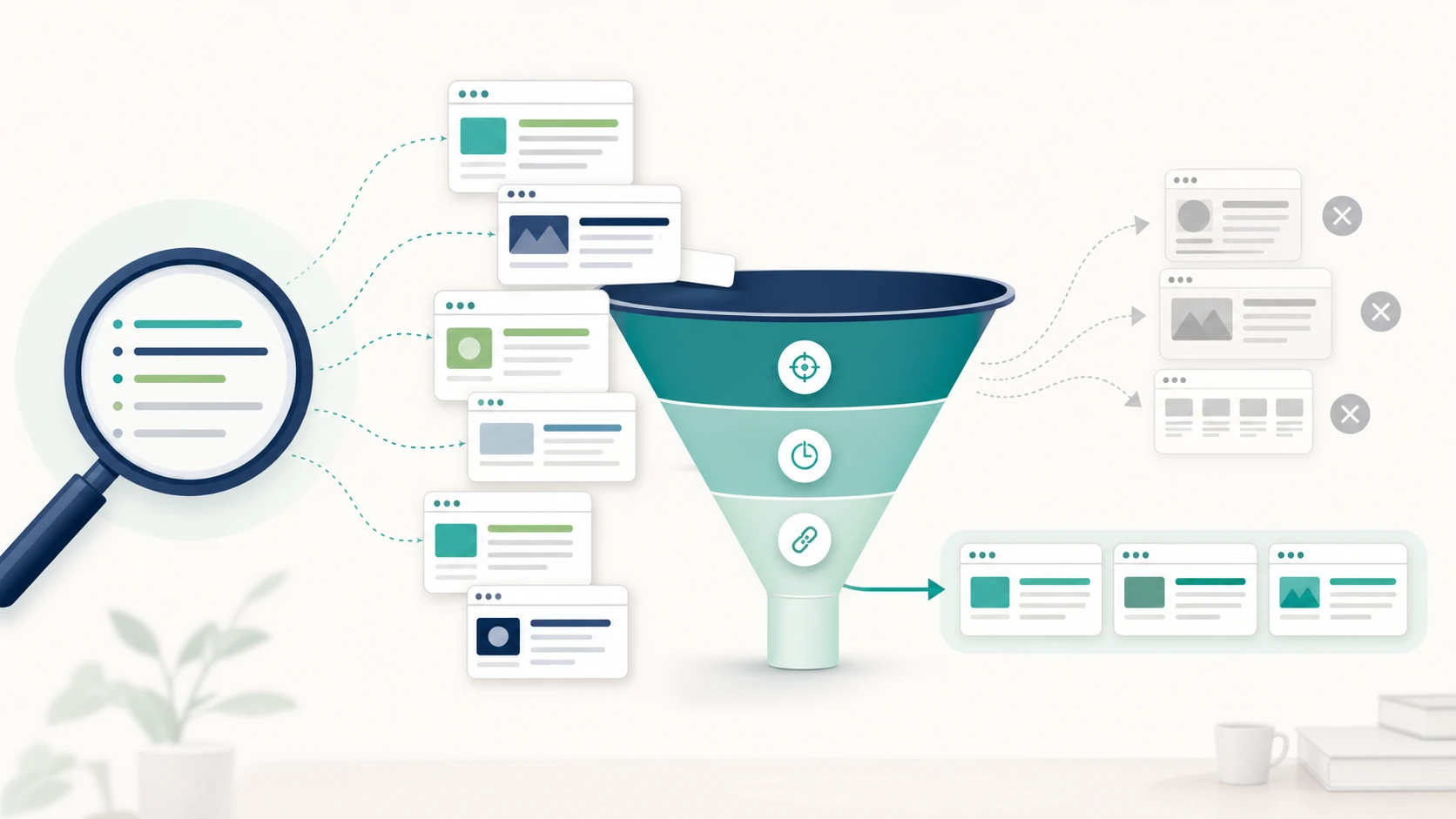
Capture enough context to make the next decision auditable:
- Prospect page URL and title.
- Topic and intended audience.
- Resource section or likely placement.
- Date or maintenance evidence when visible.
- Existing external resources and their quality.
- Broken or outdated references that genuinely need replacement.
- The exact reason your asset improves the page.
- Contact route and editorial owner, if public.
- Review status and reviewer.
Do not send outreach directly from the discovery export. Search operators produce candidates, not approved prospects.
Qualify Pages for Editorial Fit
The qualification pass should reduce the list sharply. A queue of 20 relevant pages is more useful than 500 URLs selected by a metric threshold.
Score each page across five layers:
| Layer | Good evidence | Stop signal |
|---|---|---|
| Topic fit | The page and asset serve the same audience or adjacent task | The only connection is a broad category such as "business" |
| Editorial value | The new resource adds a missing method, source, template, or current reference | The pitch would only add another similar link |
| Page quality | The page is readable, maintained, specific, and useful | Thin directory, scraped descriptions, or unrelated outbound links |
| Link context | A descriptive citation would fit naturally | The opportunity depends on exact-match anchor control |
| Ownership | A real organization, editor, or maintainer is visible | No accountable owner and obvious paid-placement patterns |
Metrics such as estimated traffic, authority, and referring domains can help order manual review. They should not make the keep-or-remove decision by themselves. A modest university guide that precisely serves the asset's audience may be a better editorial opportunity than a high-metric page that barely relates to the topic.
Google's current spam policies define link spam around links created primarily to manipulate rankings. That makes the operating rule simple: do not pay for inclusion, force anchor text, hide the commercial relationship, automate links, or treat unrelated pages as acceptable because a tool reports a strong score.
Remove a prospect when:
- the page sells links or invites undisclosed payment;
- the page is a general directory with no editorial focus;
- your asset duplicates resources already listed;
- the intended anchor would need to be manipulated;
- the page appears abandoned and the owner cannot be verified;
- the pitch would make the page worse for readers;
- the campaign record cannot explain the editorial reason in one sentence.
Write a Pitch Around the Reader
A resource-page pitch should make the editor's decision easier. It does not need inflated praise, a long introduction, or a claim that your asset is "the best." It needs page-specific context.
Use this structure:
- Name the resource page or section you reviewed.
- Identify the reader task it serves.
- Explain the gap your asset fills.
- Link to the asset once.
- Suggest a natural section only when it is genuinely helpful.
- Invite the editor to ignore the suggestion if it does not fit.
A concise draft might look like this:
I was reviewing your resource list for ecommerce content teams, especially the section on technical SEO checks. The list covers audits and crawling, but it does not include a practical workflow for validating localized category pages.

We maintain a guide that maps hreflang, canonicals, sitemaps, localized content, and post-launch monitoring into one checklist: [URL]

It may fit the international SEO section if you think it helps your readers. If it overlaps what you already have, no action needed.
The useful personalization is the reasoning, not a scraped first name or a generic compliment. The link building outreach workflow goes deeper on email review, follow-up limits, and campaign safety.
Set a follow-up policy before sending. One relevant reminder may be reasonable. Repeated messages, artificial urgency, or switching channels to pressure an editor turns a useful suggestion into spam.
Track Outcomes and Stop Bad Campaigns
Resource page link building needs a closed loop. Record what happened so the team can improve the asset, the qualification rules, or the outreach process.

Track:
| Campaign field | Why it matters |
|---|---|
| Asset and prospect page | Preserves the editorial relationship being tested |
| Qualification reason | Shows why the page entered the queue |
| Outreach date and owner | Prevents duplicate contact |
| Response category | Separates no response, decline, request, and acceptance |
| Placement URL and context | Confirms the earned citation exists where expected |
| Anchor and disclosure state | Catches risky or inaccurate placement |
| Referral and assisted outcomes | Measures reader value beyond raw link count |
| Review date | Detects removed links, broken assets, or stale claims |
| Next action | Improve asset, change targeting, stop campaign, or maintain |
Use stop conditions:
- Stop a discovery footprint when it mostly returns directories and link sellers.
- Stop an audience segment when editors consistently say the asset does not fit.
- Stop outreach when the asset becomes outdated.
- Stop measuring success by link count when the earned pages send no relevant readers and add no credible context.
- Stop follow-ups when the campaign policy says the contact is complete.
An accepted placement is not automatically a good outcome. Review the live page, confirm the citation is accurate, and make sure the linked asset still delivers the promised value.
Where Searvora Fits
Searvora AI SEO Consultant fits the planning and handoff layer. The public product surface is designed to turn mixed SEO signals into prioritized actions with impact, effort, confidence, owner context, rationale, and next steps. For resource page campaigns, that model helps keep asset improvements, prospect review, outreach, and measurement in one assignable queue.
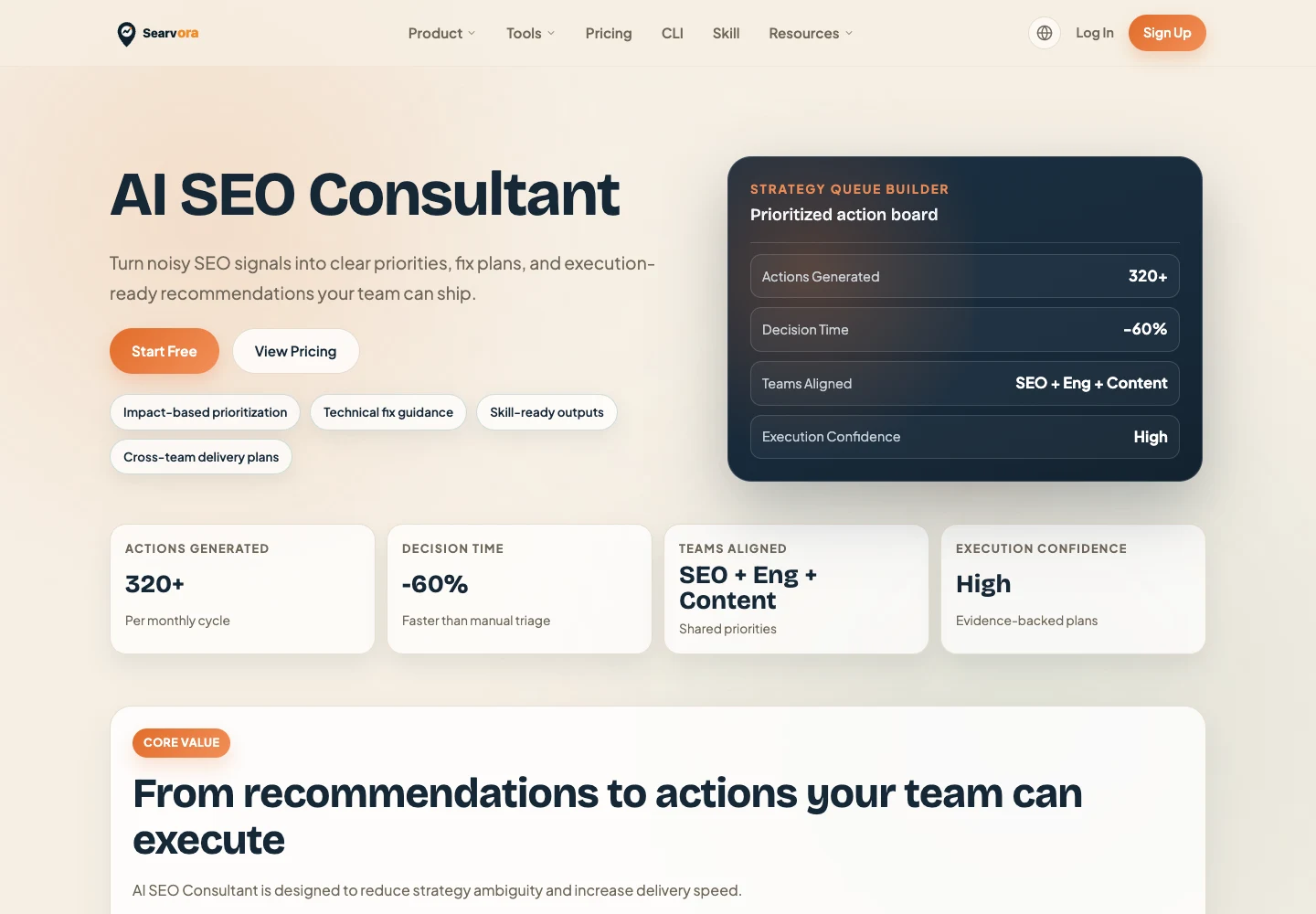
Use the AI SEO Consultant when the team needs to decide:
| Decision | Useful output |
|---|---|
| Which asset is ready for outreach | Ranked asset-improvement queue |
| Which prospect segment deserves review | Qualification criteria and reviewer ownership |
| Which risks block sending | Stop rules and required evidence |
| Who owns each campaign stage | Assigned discovery, review, outreach, and validation work |
| What to do after responses arrive | Improve, continue, pause, or retire the campaign |
Do not treat the product as a substitute for human editorial judgment or current page review. Its useful role is making the decision path explicit enough that a team can execute and audit it.
Resource Page Link Building Checklist
Use this sequence:
- Define the asset's reader, task, and citation reason.
- Confirm the asset is trustworthy, crawlable, current, and maintainable.
- Search several topic phrases with resource-page footprints.
- Save candidates with page context, not just URLs and metrics.
- Remove unrelated directories, abandoned pages, link sellers, and duplicate-resource opportunities.
- Write one sentence explaining why the asset improves each kept page.
- Review anchor expectations and link-spam risk before outreach.
- Send a short, page-specific suggestion with no pressure.
- Limit follow-ups and prevent duplicate contact.
- Verify accepted citations on the live page.
- Measure referral quality, editorial context, and assisted outcomes.
- Stop weak segments and improve the asset when the evidence says the campaign is not ready.
Resource page link building works best when the link is a side effect of a useful editorial update. Start with an asset worth citing, keep the prospect list small, document why every pitch belongs, and let reader value decide whether the campaign continues.