

If you are asking "how to scale organic traffic b2b 2025 or 2026" because your team needs a plan that still works now, the answer is not a larger blog calendar. It is a repeatable operating loop: choose the right buyer problem, match it to the right page type, prove the page can be discovered and trusted, assign one improvement, and validate the same cohort after it ships.
B2B organic growth breaks when every keyword becomes a new article. It scales when search demand, technical eligibility, content quality, AI-search visibility, and sales relevance are reviewed together.
Start With The B2B Traffic Constraint
B2B search demand is usually smaller, more fragmented, and closer to a buying committee than consumer search. A single account may touch a definition page, a comparison page, a product page, docs, and a pricing support article before anyone submits a form.
That means the first scaling question is not "What can we publish next?" It is "Which page cohort should earn more qualified discovery?"
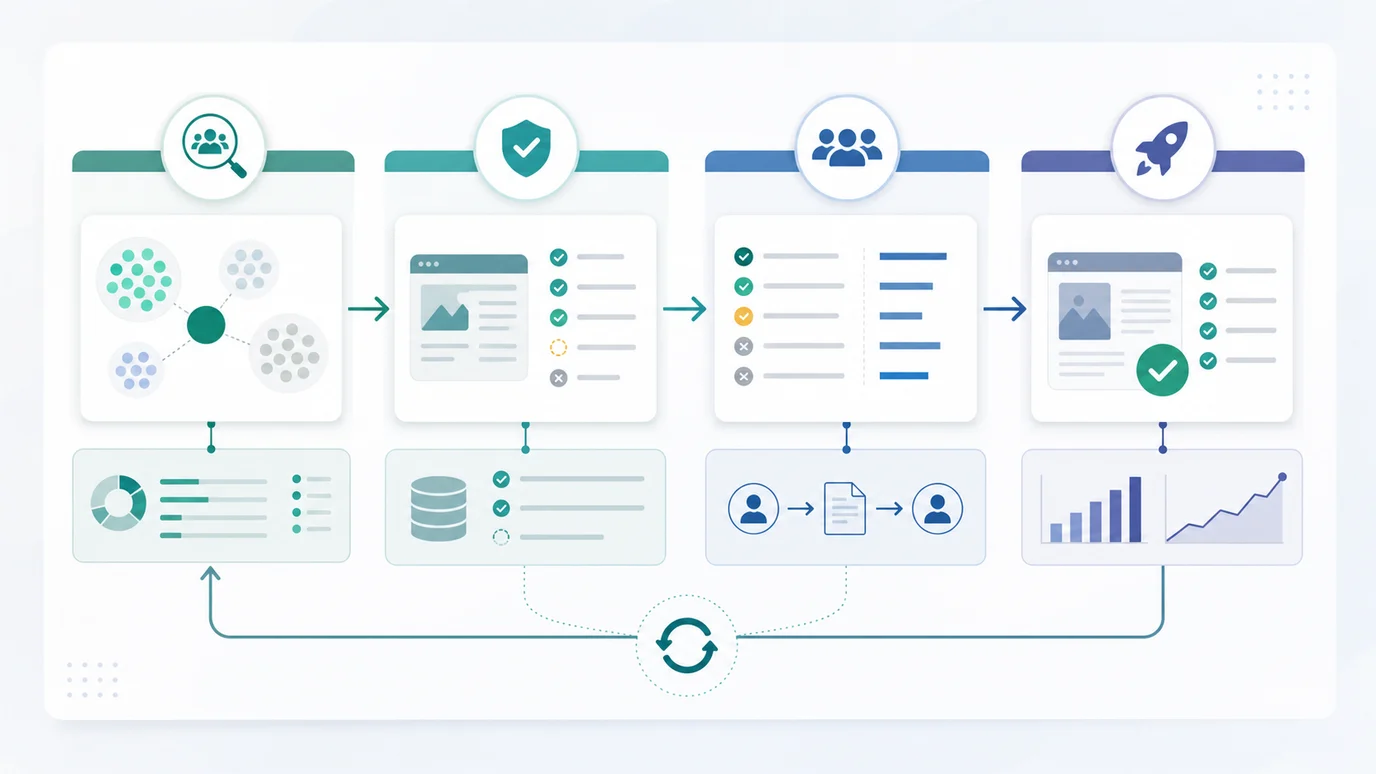
Use cohorts before topics:
| Cohort | Scaling job | Evidence to inspect |
|---|---|---|
| Product and feature pages | Capture category and solution demand | Non-branded impressions, CTA engagement, internal links, crawl eligibility |
| Use-case pages | Match a specific team problem | Query language, proof examples, page depth, route to product |
| Comparison pages | Help buyers choose between options | Fair criteria, current public facts, high-intent query coverage |
| Docs and implementation pages | Build technical confidence | Crawlable instructions, internal links, support demand, assisted conversions |
| Educational articles | Explain workflows before the buyer is ready | Search intent, internal routing, source evidence, refresh cadence |
This split keeps a B2B SEO program from treating a glossary query, a buyer comparison, and a technical implementation question as the same content job.
Build A Baseline Before More Pages
Scaling starts with a baseline. Without it, a team can publish more pages while the real blocker sits in internal links, canonicals, stale product copy, weak snippets, or low-quality traffic measurement.
Use these inputs for the baseline:
- Search Console queries, pages, clicks, impressions, CTR, and average position.
- Analytics sessions, engagement, assisted conversions, and account-fit signals.
- Crawl checks for indexability, canonical state, redirects, sitemap inclusion, internal links, and rendered content.
- Page-type groups for product, use case, comparison, docs, article, and hub pages.
- AI-search visibility observations, including cited URLs, brand mentions, and answer surfaces.
Google's Search Console and Google Analytics guidance is useful because it separates search demand from on-site behavior. B2B teams need both views. A page with rising impressions but weak engagement may need a sharper promise. A page with strong engagement but flat impressions may need eligibility, internal links, or better query coverage.
Choose Page Jobs Before Keywords
Keyword lists are useful for triage, but page jobs decide whether traffic can scale. The same keyword cluster can require a product page, a use-case page, a comparison article, a technical guide, or a hub. Publishing the wrong format often creates cannibalization instead of growth.
Use this decision table:
| Searcher need | Better page type | Scaling move |
|---|---|---|
| "What is this category?" | Explainer or category page | Define the problem and route to the right product page |
| "Can this solve my team workflow?" | Use-case page | Add examples, proof, integrations, and internal links |
| "Which tool or method should we choose?" | Comparison or decision guide | Use scenario-based criteria and current public facts |
| "How do we implement or validate it?" | Technical article or docs | Give steps, owner handoff, and validation checks |
| "Where do I start across a broad cluster?" | Hub | Organize child pages and reduce near-duplicate articles |
This is where broad traffic goals become specific SEO work. If the buyer problem is SaaS-specific, the SaaS organic traffic workflow can be the supporting model. If the team needs a definition-first baseline, start with what organic traffic means in practical SEO work. If the growth case needs budget, connect the cohort to SEO forecasting before assigning work.
Add AI Visibility Without Chasing Every Answer
In 2026, B2B organic traffic work also needs an AI-search layer. That does not mean every article needs AI-generated copy or every mention needs a new landing page. It means the team should know which owned pages are easy for search and answer systems to cite, summarize, and route back to a useful next step.
Use AI visibility as a diagnostic layer:
| AI-search signal | Useful interpretation | Bad interpretation |
|---|---|---|
| Owned page appears as a cited source | The page may be extractable and trusted for that query | The page will automatically drive visits |
| Competitor is cited for your category | Their page may answer the query more clearly | You need to copy their article structure |
| Brand is mentioned without a click | Awareness may be rising in zero-click surfaces | Organic traffic is solved |
| No owned page appears | Eligibility, entity clarity, or evidence may be weak | Publish another generic AI SEO article |
Searvora's AI SEO dashboard fits this monitoring layer because the product surface is built around page-type cohorts, locale drill-down, anomaly detection, opportunity queues, and shared evidence for SEO, content, and engineering teams.
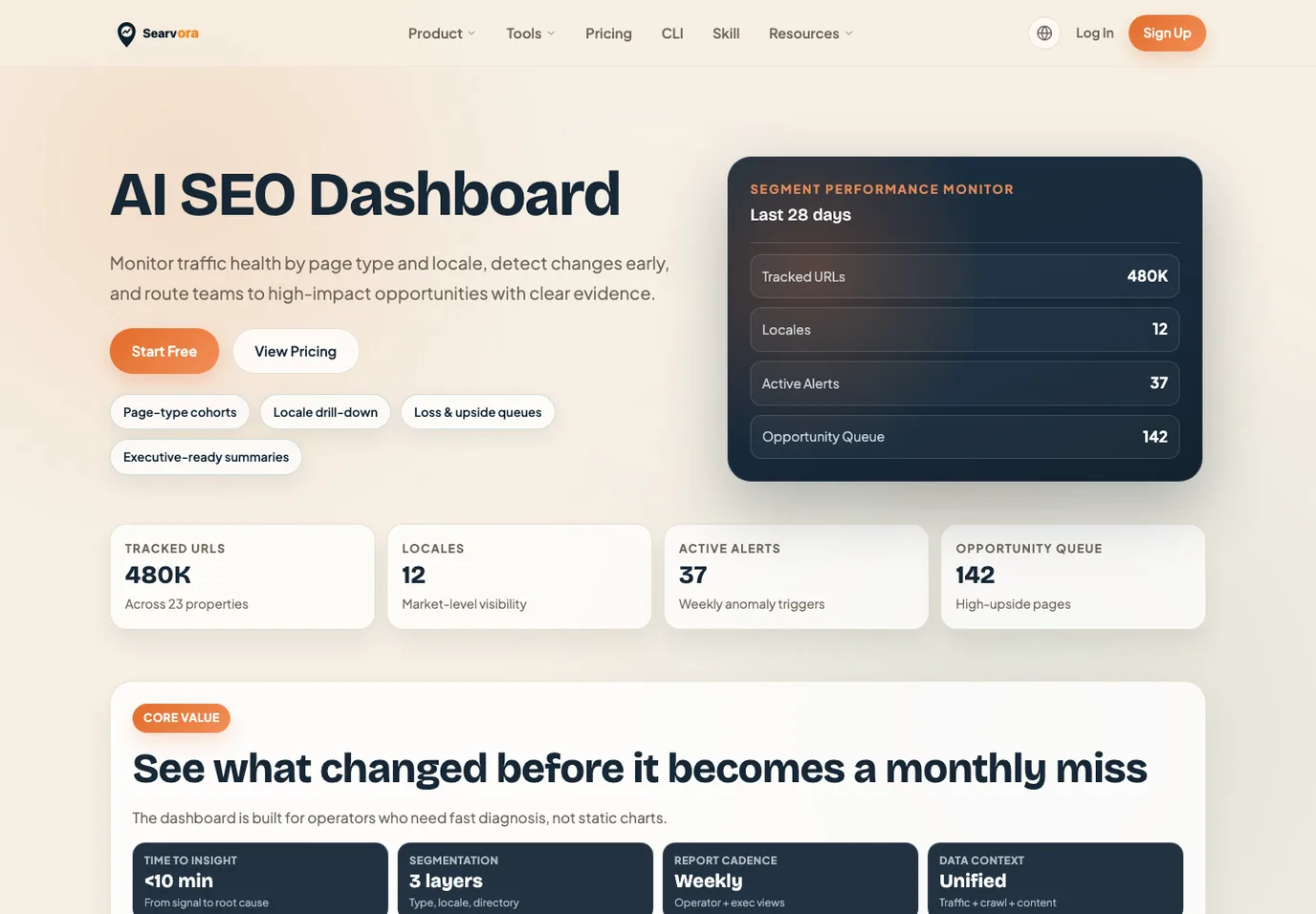
The practical question is whether the visibility signal changes the next action. A cited page may need a better CTA. A page with impressions but no AI citation may need clearer examples and source evidence. A product page with strong demand but weak crawl access needs technical work before more content.
Run A Two-Week Scaling Sprint
Organic traffic does not scale through quarterly rewrites alone. It scales through short review cycles that connect evidence to owners.
Use a two-week sprint:
- Pick one cohort, such as comparison pages, product pages, docs, or a topic cluster.
- Pull Search Console, analytics, crawl, and AI visibility signals for that cohort.
- Name one underserved search job and one target page.
- Decide whether the page needs a rewrite, new section, internal link, technical fix, consolidation, or a new supporting page.
- Assign the owner and acceptance check.
- Ship the change.
- Recheck the same cohort after the validation window.
The most important discipline is limiting the sprint. If the cohort is comparison pages, do not also rewrite every blog intro. If the blocker is crawl eligibility, do not ask writers to solve it with longer copy. If the page job is unclear, use an AI SEO consultant workflow to rank the options before assigning work.
Validate Growth By Account Fit
Total sessions are not enough for B2B organic traffic. A low-volume page that brings qualified evaluator visits can matter more than a broad article that never reaches product context.
Track by cohort:
| Cohort | Primary validation signal | Supporting signal |
|---|---|---|
| Product and feature pages | Non-branded discovery and qualified CTA engagement | Ranking query mix and internal route quality |
| Use-case pages | Visits from problem-aware queries | Movement to product, demo, pricing, or docs |
| Comparison pages | High-intent impressions and assisted conversions | Fairness, freshness, and bounce quality |
| Docs pages | Technical evaluator engagement | Links from product pages and support journeys |
| Educational articles | Relevant query coverage and downstream movement | Internal links to the best product or hub page |
That is how to scale organic traffic B2B teams can trust in 2026. Start with the cohort, prove the page is eligible, choose the right page job, add AI visibility where it changes action, and validate qualified movement before adding another page.