

SEO automation is useful when a repeated search task has clear inputs, predictable rules, and a review step before anything changes on the site. It is risky when automation turns noisy data into tickets nobody validates.
The practical goal is not to automate every SEO decision. It is to automate the repetitive collection, comparison, routing, and rechecking work so the team has more time for judgment. A good workflow still asks which page type should exist, whether the evidence is strong enough, who owns the next fix, and how the team will know the change worked.
The Ahrefs article that surfaced this competitor opportunity frames SEO automation as a set of time-saving tasks. Searvora's information gain is the operating layer after that list: automate only the steps that can be checked, connect them to crawl and reporting evidence, and turn the result into owner-ready work instead of another dashboard.
Start With The Job, Not The Tool
Before choosing a script, crawler, API, or AI assistant, name the SEO job the automation should improve.
| SEO job | Good automation output | What should stay reviewed |
|---|---|---|
| Crawl health monitoring | New status, canonical, sitemap, metadata, or link-pattern changes by page group | Whether the affected pages matter enough to fix now |
| Reporting | Segment movement, anomaly flags, and recurring summary tables | Cause, owner, and action priority |
| Content operations | Brief gaps, refresh candidates, internal-link candidates, and duplicate-risk checks | Page type, angle, source quality, and final editorial call |
| AI-search monitoring | Prompt/query observations, mentions, citations, and source-page gaps | Whether the page needs content, technical, entity, or link work |
| Indexing checks | Sampled URL groups with inspection, crawl, and sitemap evidence | Whether the fix is access, canonicalization, quality, or patience |
Automation should make the next decision clearer. If the output cannot change a priority, owner, fix path, or validation date, it is probably just scheduled noise.
Choose Tasks That Can Be Checked
The safest SEO automation tasks share three traits: the input is structured, the output is reviewable, and the result can be validated after the team acts.
Start with jobs like these:
- Compare crawl exports for new 4xx, redirect, canonical, sitemap, title, and description changes.
- Group affected URLs by template, directory, locale, page type, or owner.
- Monitor Search Console movement by query family and landing page group.
- Flag content refresh candidates from decaying clicks, missing answers, weak internal links, or stale sections.
- Pull URL samples for indexing checks instead of inspecting every URL.
- Track AI-search observations for priority prompts, cited sources, and missing owned pages.
- Recheck shipped fixes after the next crawl or reporting window.
The official Google Search Console Performance report remains a useful source for query, page, click, impression, CTR, and position evidence. But the automation should preserve the segment that matters. A sitewide traffic line does not tell a content owner which page to fix.
For code-heavy workflows, the Python for SEO workflow is a useful companion. The same safety rule applies: a script should produce evidence for review, not skip the review.
Build A Guardrailed Automation Loop
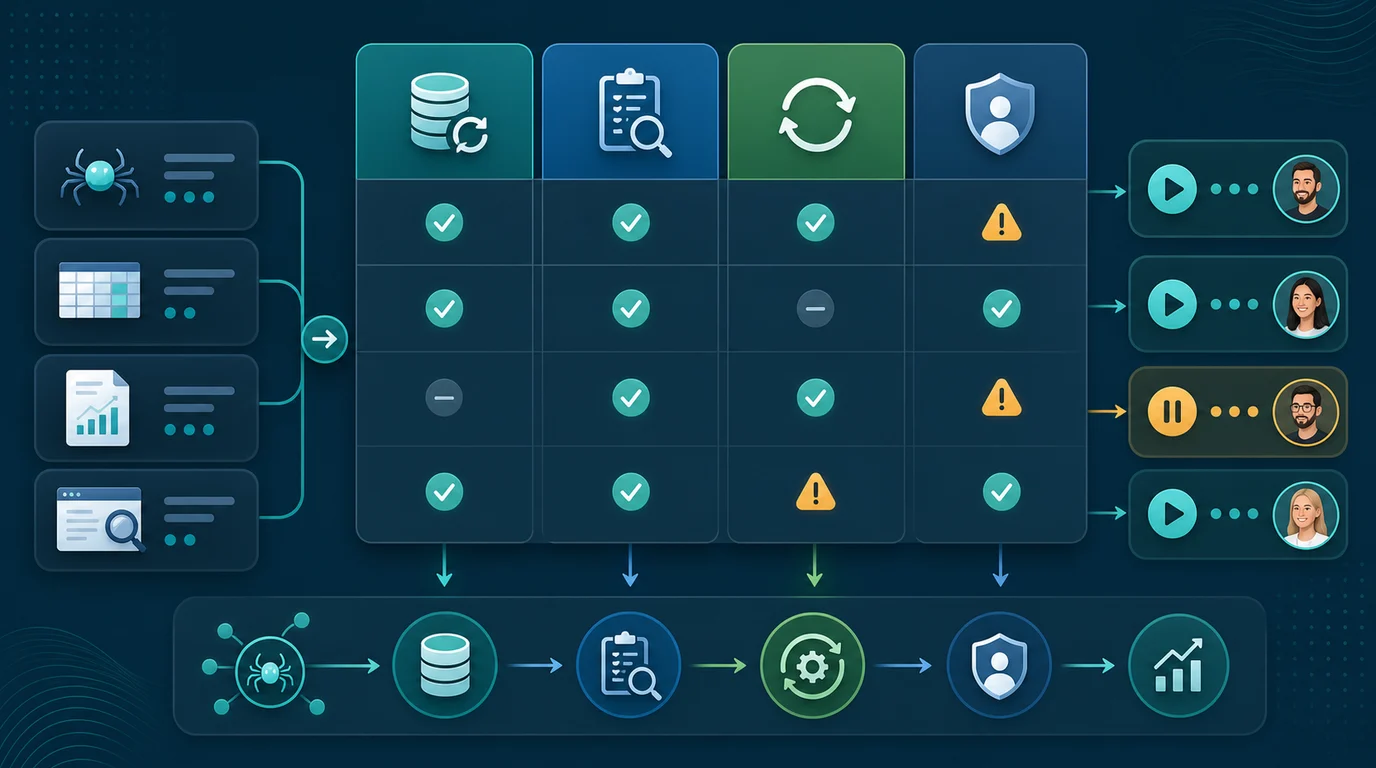
An SEO automation workflow should look more like a controlled operating loop than a one-click shortcut.
Use this sequence:
| Step | Automation can handle | Human or product review should confirm |
|---|---|---|
| Baseline | Crawl, export, dashboard snapshot, prompt log, or URL sample | The baseline covers the right page group |
| Rule | Threshold, comparison, grouping, deduplication, or classification | The rule matches a real SEO risk or opportunity |
| Flag | New issue, movement, content gap, citation change, or indexability mismatch | The flag is not seasonal, irrelevant, or a false positive |
| Route | Suggested owner, page group, severity, and next action | The owner and action are realistic |
| Ship | Ticket, brief, refresh, technical fix, or monitoring note | The change is small enough to validate |
| Recheck | Recrawl, Search Console review, dashboard window, or AI-answer sample | The result changed in the expected direction |

This loop prevents two common failures. The first is blind automation: a tool finds a pattern and floods the backlog. The second is decorative automation: a report refreshes every week but nobody can say what changed because of it.
For recurring reporting, pair this with automated SEO reporting. Reporting automation should end with a queue, not a chart gallery.
Keep AI Search Inside The Same Workflow
SEO automation now needs to include AI-search evidence, but it should not treat AI visibility as a separate magic system.
Google's AI features guidance for site owners points teams back to the same foundations: useful pages, Search eligibility, snippets, and source quality. That makes automation more useful, not less. The team needs repeatable observations for query groups, answer surfaces, cited URLs, and missing source evidence.
Track AI-search work with fields like:
- Query or prompt group.
- Surface observed, such as Google AI features, answer engines, or chatbot-style search.
- Whether the brand, product, or owned source page appears.
- Which external sources are cited or summarized.
- Whether the target page is crawlable, indexable, internally linked, and specific enough to support the answer.
- Next action, owner, and recheck date.
That is automation with judgment. The crawler or dashboard can collect signals. The team still decides whether the right fix is a clearer definition, a stronger comparison table, a technical access repair, a new internal link, or no action.
Turn Automation Into Owner-Ready Work
The final output of SEO automation should be a work queue that a content, SEO, engineering, or product marketing owner can actually close.
Each queue item should include:
| Field | Why it matters |
|---|---|
| Page group | Prevents one URL from hiding a template or cluster issue |
| Trigger | Shows what changed and why the item exists |
| Evidence | Keeps the recommendation traceable to crawl, reporting, content, or AI-search data |
| Risk | Separates urgent eligibility problems from low-impact cleanup |
| Owner | Makes the next step assignable |
| Acceptance criteria | Defines what done means |
| Validation window | Prevents the same issue from returning next week with no learning |
For indexation-specific automation, the URL Inspection API automation workflow shows how to combine URL samples, crawl evidence, and recheck windows. The broader principle is the same for every automation lane: collect the evidence, decide the fix, ship the smallest useful change, then validate.
Where Searvora Fits
Searvora's AI SEO Consultant fits the strategy and prioritization layer after automation finds signals. The product page positions it around signal intake, issue modeling, action ranking, and team handoff. That is the layer automation often misses.
Use Searvora when the team needs to turn repeated SEO signals into ranked work:
| Automation signal | Better Searvora handoff |
|---|---|
| Crawl changes increased in one template | Cluster the pattern, estimate impact, and route the fix |
| Reporting flagged a page group drop | Separate demand, snippet, technical, and content causes |
| Content refresh candidates piled up | Prioritize by intent, business value, and information gain |
| AI-search citations changed | Decide whether the source page, entity clarity, or crawl access needs work |
| A script produced a long export | Convert the export into evidence, owners, and validation criteria |
SEO Automation Checklist
Use this checklist before turning a repeated task into automation:
- The task has a clear SEO decision behind it.
- The input source is stable enough to trust.
- The automation preserves page type, directory, locale, or owner context.
- The output is reviewable before it becomes a site change.
- False positives can be sampled and explained.
- The next action has an owner and acceptance criteria.
- The fix can be validated with a crawl, reporting window, or AI-search observation.
- The workflow has a stop rule for low-value noise.
SEO automation works when it reduces repetitive work without hiding judgment. Automate the collection, grouping, comparison, and recheck steps. Keep the page decision, priority call, and final validation visible enough that the team can ship real fixes with confidence.