

SEO silo structure is a way of grouping pages by topic and linking heavily within each group. The problem starts when those groups become isolated. Useful topical organization can help readers and crawlers, but rigid walls between related sections can hide important pages, weaken contextual links, and make the site harder to navigate.
The better rule is simple: group pages with purpose, but let useful links cross the boundary. Then crawl the site to prove that priority pages are discoverable, page relationships are clear, and no cluster has become an island.
SEO Silos Are Not the Same as Useful Topic Groups
A topic group organizes related pages around a clear parent, audience, or job. A hard silo adds a second rule: pages should rarely or never link outside that group. That isolation is the risky part.
The Ahrefs article that surfaced this opportunity makes the same core distinction. Searvora's information gain is the audit and replacement workflow: identify when isolation is causing measurable crawl or navigation problems, fix the architecture without flattening every topic, and validate the result with a new crawl.
| Architecture choice | Useful behavior | Risky behavior |
|---|---|---|
| Topic grouping | Related pages share a parent promise and link to the most useful next steps | Pages are grouped only because their keywords look similar |
| Hierarchy | Important pages are reachable through clear navigation and contextual links | Folder depth becomes a proxy for importance |
| Cross-cluster links | Related tasks connect when the reader genuinely needs both | Links are blocked to preserve an artificial boundary |
| Parent pages | Hubs explain the topic and route readers to distinct child jobs | Hubs repeat every child page or collect links without guidance |
| Validation | A crawl confirms depth, inlinks, indexability, canonicals, and paths | The architecture is accepted because the diagram looks tidy |
Why Rigid SEO Silo Structure Breaks Down
Hard silos optimize for visual neatness instead of real information paths. A site may look organized in a folder tree while important relationships disappear from navigation and body copy.
Google's official crawlable link guidance explains that links help Google find pages and understand their relationships. It does not require related pages to stay inside one closed topic compartment. If a link is useful, descriptive, and points to the preferred destination, an artificial silo rule should not block it.
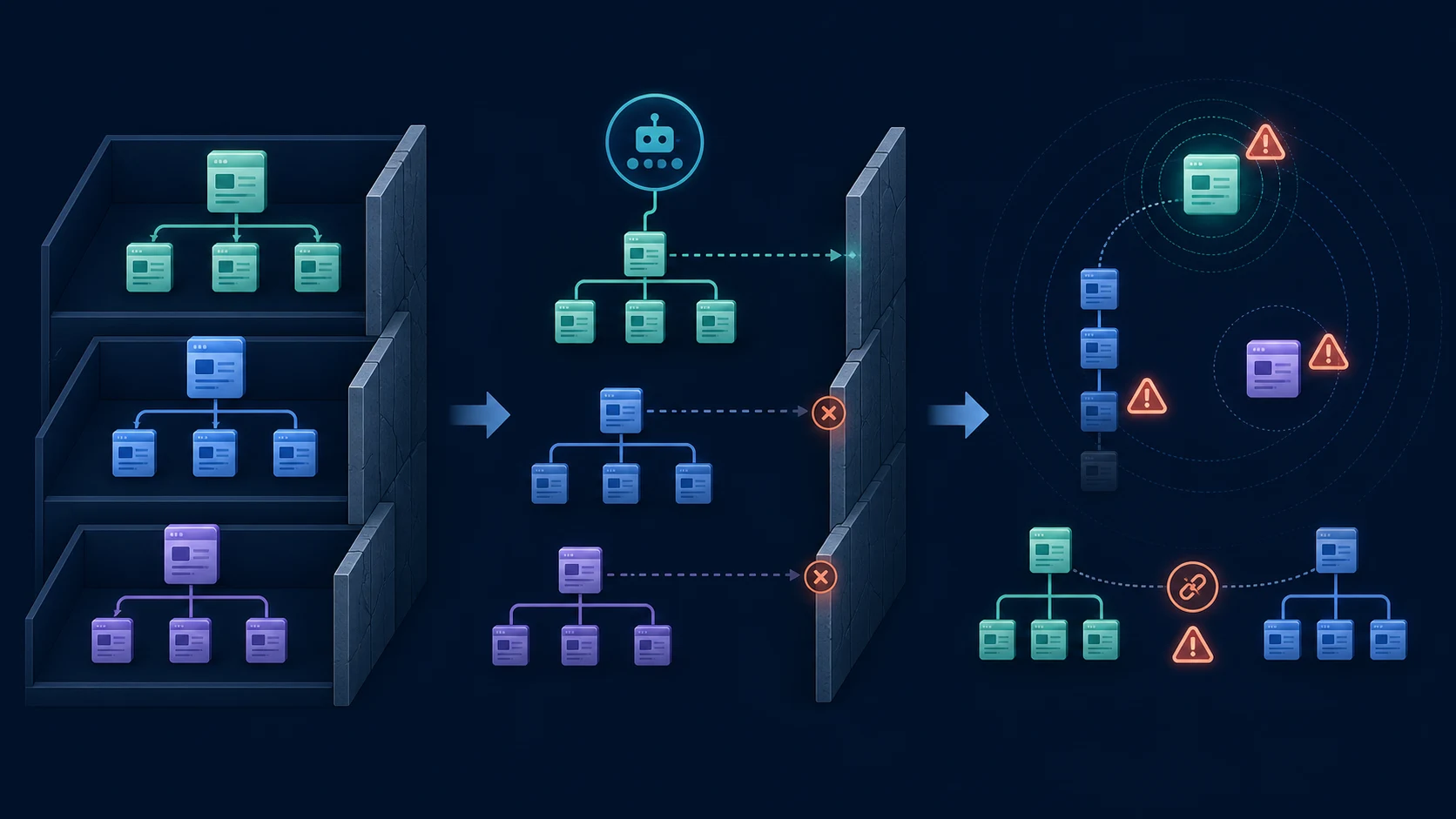
Rigid silos tend to create four operational problems:
- Discovery becomes fragile. A valuable page may depend on one parent path instead of receiving contextual links from every relevant section.
- Depth grows without purpose. Teams add category layers to protect the hierarchy even when those layers do not help a reader choose a page.
- Context gets weaker. A page about canonical consolidation may need links from migration, duplicate-content, ecommerce, and international SEO articles. One silo cannot express all those relationships.
- Maintenance becomes political. Editors avoid useful links because the destination belongs to another team, folder, or taxonomy.
The problem is not that pages form clusters. The problem is treating the cluster boundary as more important than discovery, reader movement, and page purpose.
Audit Whether a Silo Is Actually Harmful
Do not rebuild the architecture because someone labels it a silo. Start with crawl evidence and identify the sections where isolation changes outcomes.
Use this audit table to separate a harmless topic group from a harmful wall:
| Evidence to inspect | Healthy signal | Harmful isolation signal |
|---|---|---|
| Crawl depth | Priority pages sit within a reasonable path from strong entry points | Valuable pages become deep because only one branch can reach them |
| Inlinks | Important pages receive links from several relevant contexts | Links come almost entirely from one parent or navigation block |
| Orphan coverage | Canonical, indexable pages appear in the crawl and intended sitemap | Published pages exist in the sitemap or CMS but have no crawl path |
| Anchor context | Anchors explain why the destination helps with the current task | Cross-topic references are omitted or replaced with vague navigation |
| Page jobs | Parent, child, product, support, and utility pages serve distinct tasks | Several pages repeat one task to keep every silo self-contained |
| Canonical signals | Internal links, canonical tags, and sitemap URLs point to the same preferred page | A silo links to local duplicates instead of the canonical owner |
Start with a complete URL inventory. Segment it by template, folder, page job, business value, indexability, and topic. Then compare the planned hierarchy with the paths a crawler can actually follow.
The site architecture crawl visualization workflow is useful for spotting isolated branches, but the graph is only triage. Confirm every suspicious pattern with crawl depth, inlinks, status, canonical, robots state, sitemap coverage, and page value before approving a fix.
Replace Hard Silos With Open Architecture
The alternative is not a flat site where every page links to everything. Use four controlled stages.
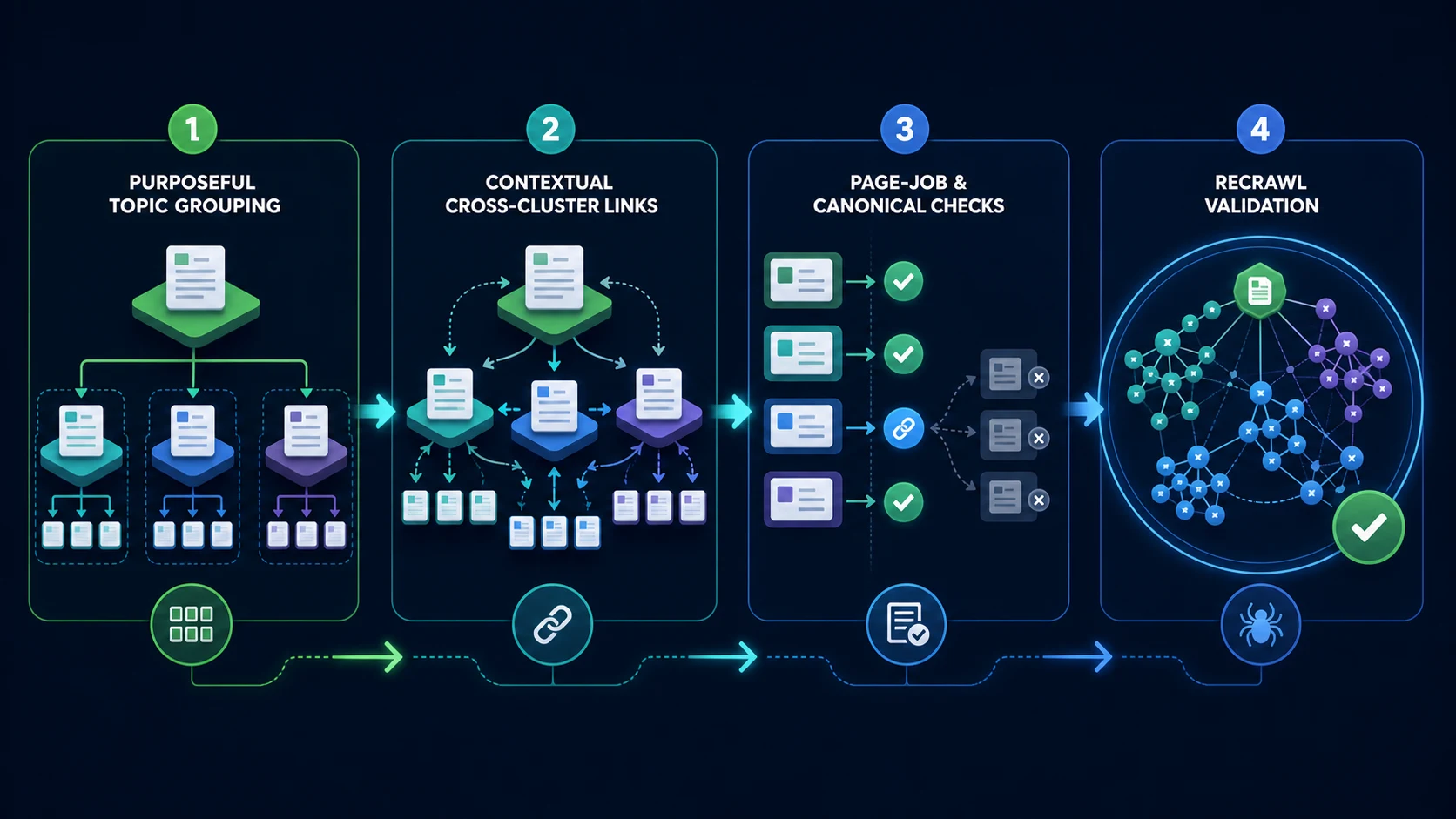
1. Group pages by purpose
Keep useful categories, parent hubs, and topic clusters. Give each page a distinct job and one canonical query family. The website structure for SEO workflow shows how to map money pages, hubs, articles, support pages, and utilities before changing folders or navigation.
2. Add contextual cross-cluster links
Link across groups when the destination helps the reader complete the current task. A content-refresh article can link to canonical checks. An ecommerce migration guide can link to redirects, internal links, and crawl validation. Those relationships are useful precisely because they cross category lines.
3. Align technical signals
Check that every important link points directly to the preferred, indexable URL. Canonical tags, sitemap entries, redirects, robots rules, and internal links should agree. Architecture work fails when a cleaner navigation path still sends crawlers through redirects or toward duplicate URLs.
4. Recrawl and compare
Measure the affected segment again. Confirm that important pages became easier to reach, isolated URLs gained relevant inlinks, and unwanted duplicates did not gain prominence. Keep a before-and-after export so the team can prove the architecture improved.
Build Cross-Cluster Links Without Creating Noise
Removing silo walls does not justify random internal-link volume. Every cross-cluster link should pass three tests:
- Task relevance: the destination helps the reader understand or perform the current job.
- Destination quality: the target is canonical, indexable, current, and the best page for that task.
- Placement clarity: the link appears where the relationship becomes useful and uses descriptive anchor text.
Use the crawl-backed internal links audit to find candidate source pages, but make the final placement decision in context. A crawler can reveal that a page has too few inlinks; it cannot decide that every mention deserves a link.
Avoid these two extremes:
- Closed silo: related pages cannot link because they sit in different folders or taxonomies.
- Link mesh: every page links to every vaguely related page, making priority and context harder to read.
The useful middle is a deliberate network: strong parent-child paths, selective sibling links, and cross-cluster links where one task naturally leads to another.
Validate the Architecture With Crawl Evidence
Architecture changes should end with a comparison, not a new diagram.
Record a baseline for the affected page set, ship the smallest useful changes, then recrawl under the same scope and settings. Compare:
| Validation field | What improvement looks like |
|---|---|
| Crawl depth | Priority pages move closer to trusted entry points without flattening the whole site |
| Unique inlinks | Important pages gain links from relevant sections, not sitewide boilerplate |
| Orphan status | Intended indexable pages become reachable through normal crawl paths |
| Redirect hops | Internal links resolve directly to preferred destinations |
| Canonical agreement | Links, canonicals, and sitemap URLs converge on the same page |
| Anchor distribution | Descriptive anchors reflect several real contexts without mechanical exact-match repetition |
| Duplicate tasks | One canonical page owns each job while supporting pages link to it |
Also review user paths. If the architecture is technically crawlable but a reader still cannot move from a broad question to a specific fix, product, or supporting explanation, the link plan is incomplete.
Where Searvora Fits
Searvora SEO Spider Crawler is the technical evidence layer for this workflow. The current product surface supports URL inventory, crawl depth and inlink analysis, indexability diagnostics, canonical checks, sitemap review, and repeatable recrawls. Use those signals to identify harmful isolation, prioritize the pages that matter, and verify that architecture changes landed.
SEO Silo Structure Decision Checklist
Before keeping or removing a silo pattern, confirm:
- Each parent and child page has a distinct user job.
- Priority pages are reachable through more than one relevant path when appropriate.
- Cross-cluster links are allowed when they help the reader complete a task.
- Important pages do not depend on sitemap discovery alone.
- Internal links point directly to canonical, indexable destinations.
- Folder depth is not being mistaken for topical authority.
- Parent hubs route readers instead of repeating every child article.
- A fresh crawl verifies depth, inlinks, orphan coverage, redirects, and canonical agreement.
SEO silo structure becomes harmful when organization turns into isolation. Keep the topical logic, open the useful paths, and let crawl evidence decide whether the architecture works.