

SEO is the work of making pages discoverable, useful, and competitive in search results. GEO, or generative engine optimization, is the work of making the right source pages, entities, and proof easier for AI answer systems to use, mention, and cite. The practical difference is not "old search versus new search." SEO still builds the source layer. GEO adds another evidence layer around AI answers, citations, and brand framing.
The Ahrefs SEO vs GEO comparison that surfaced this competitor opportunity explains the two disciplines as related but different. Searvora's information gain is the operating plan: keep SEO and GEO on one source-page map so content, technical SEO, and reporting teams do not run separate queues for the same page.
The Short SEO vs GEO Difference
SEO optimizes pages so search engines can crawl, index, rank, and show them to users. GEO optimizes the same source layer so AI-assisted search experiences can understand the answer, trust the source, mention the brand, or cite the page.
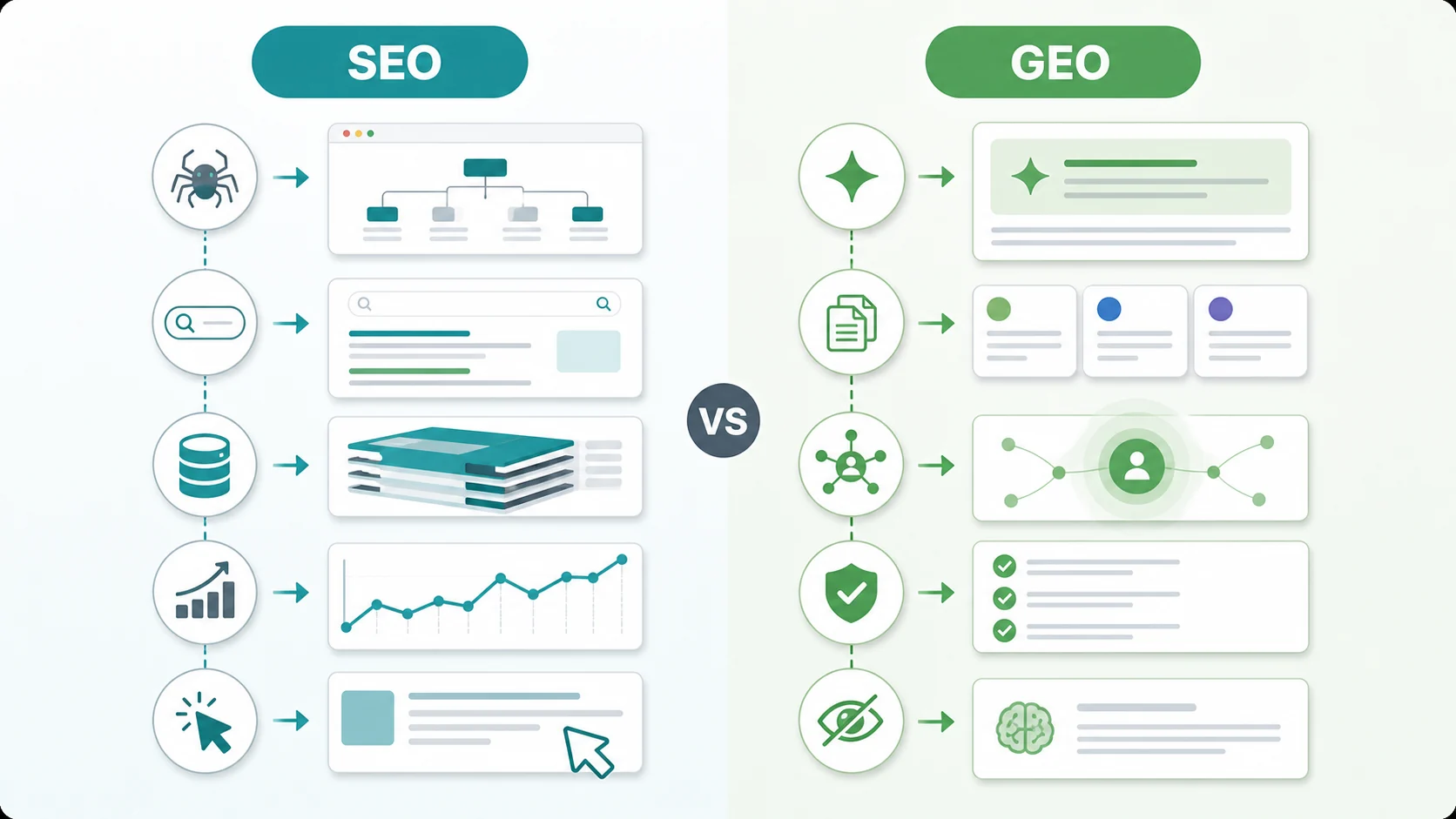
Use this comparison before changing a page:
| Dimension | SEO question | GEO question |
|---|---|---|
| Primary outcome | Can the page rank and earn qualified clicks? | Can the page or brand appear in AI answers with useful framing? |
| Core evidence | Crawling, indexing, rankings, impressions, CTR, clicks, conversions | Mentions, citations, source URLs, answer stability, referral traces, framing |
| Source page role | A canonical URL targets a search task | A canonical URL supports an answer task |
| Technical baseline | Crawl access, indexability, canonicals, links, rendering, metadata | The same baseline, plus source clarity and extractable proof |
| Content baseline | Search intent, helpful sections, examples, internal links | Direct answers, source evidence, entity clarity, constraints, reusable tables |
| Validation | Search Console, analytics, crawl recrawl, rank movement | Repeated query checks, cited source review, brand framing, crawl and traffic context |
What SEO Still Owns
SEO still owns the foundation. A page that is blocked, thin, buried, duplicated, or canonicalized away is a weak source for both search results and AI answer systems.
Keep these SEO checks in the first layer:
| SEO layer | What to verify | Why it still matters for GEO |
|---|---|---|
| Discovery | Internal links, crawl depth, sitemap inclusion, orphan risk | AI answer work cannot use source pages that are hard to find or poorly connected |
| Access | Status code, robots rules, noindex, redirects, rendering | Blocked or unstable pages are weak candidates for search and answer surfaces |
| Selection | Canonical target, duplicate variants, locale alternates | The right URL needs to represent the answer job |
| Relevance | Title, H1, page type, search intent, examples | The page needs a clear task before an answer system can summarize it |
| Performance | Impressions, rankings, CTR, clicks, conversions | Traffic signals show whether the source still earns demand from normal search |
Google's AI features documentation and guidance on succeeding in AI search keep the work grounded in familiar basics: make useful content available to search, keep pages technically accessible, and give users content worth visiting after a summary.
That means SEO is not replaced by GEO. SEO decides whether the source page deserves to exist, can be crawled, and has enough evidence to support a real user task.
What GEO Adds
GEO adds an answer-surface review layer. The question changes from "did the page get traffic?" to "did this source, brand, or competitor appear when the answer was generated?"
Track these ledgers separately:
| GEO ledger | What to record | Better next action |
|---|---|---|
| Mention ledger | Whether your brand, product, author, or competitor appears | Improve entity clarity, category language, and public proof |
| Citation ledger | Which owned or third-party URLs are cited | Strengthen the source page that should support the answer |
| Framing ledger | How the answer describes strengths, limits, audience, or use case | Fix positioning, examples, comparison context, and source evidence |
| Stability ledger | Whether the same query group produces a repeatable pattern | Act only when the evidence is stable enough to explain |
| Traffic ledger | Search Console movement, analytics, and recognizable AI referrals | Decide whether visibility changed user behavior or only answer framing |
OpenAI's ChatGPT Search help describes searched responses with sources and related panels, and the OpenAI crawler documentation makes crawler access a practical eligibility check. The exact answer surface will keep changing, but the operator job is stable: record the source, the framing, the crawl state, and the next page change.
This is where GEO becomes useful. It turns vague AI visibility anxiety into a source-page decision.
Run SEO And GEO From One Source Page Map
The worst way to run SEO vs GEO is to create two teams, two dashboards, and two backlogs for the same URL. Build one source-page map instead.
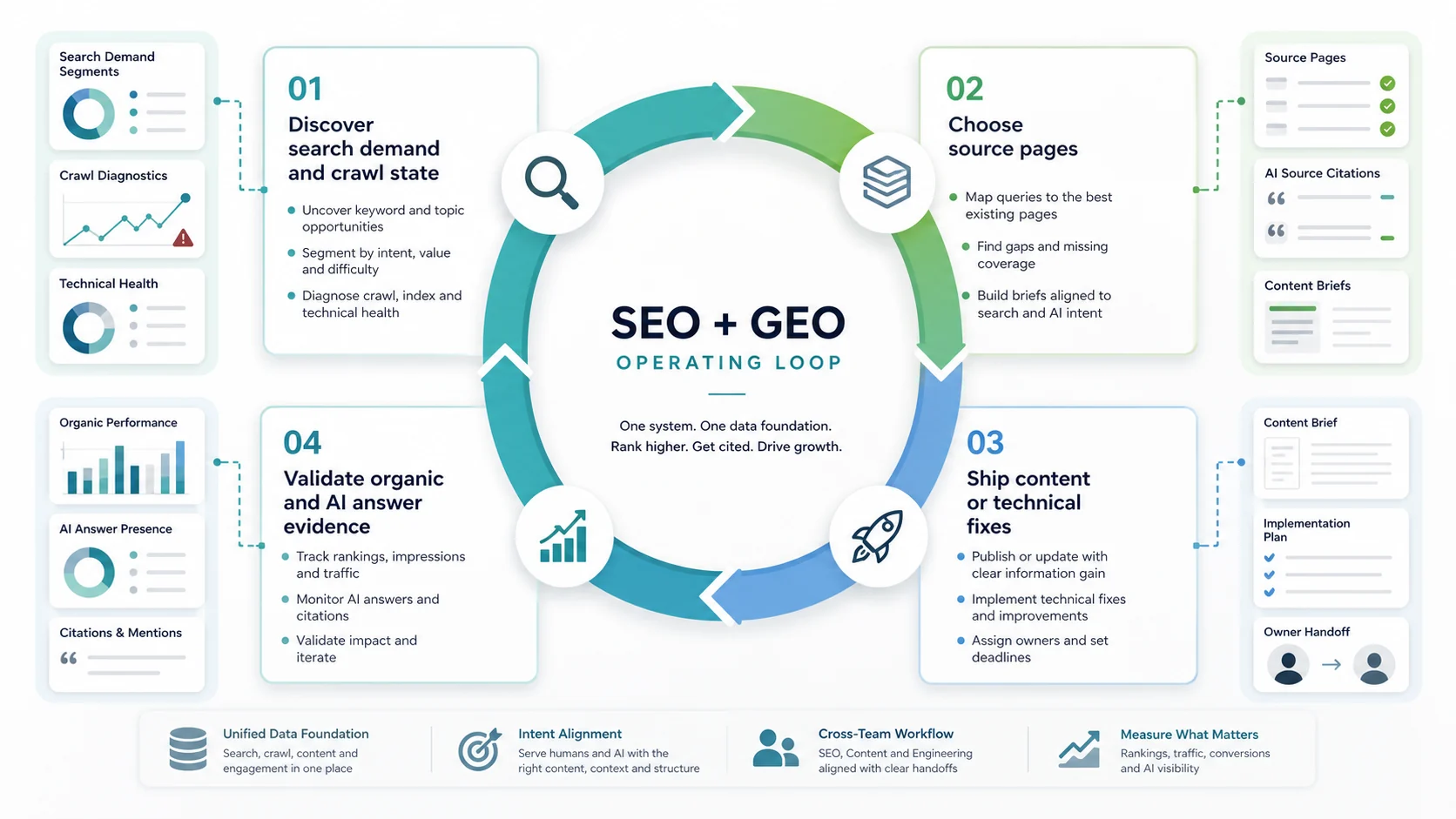
Use this routing table:
| Finding | Source-page decision | Owner |
|---|---|---|
| Page ranks but AI answers cite a competitor | Improve the existing source page with clearer answers, examples, and source evidence | Content owner |
| Page is cited but traffic and conversions are weak | Add deeper proof, next-step links, comparison context, or product fit | SEO and product marketing |
| AI answer mentions the brand but no owned URL appears | Choose or create the canonical source page for that query group | SEO lead |
| Competitor appears with stronger framing | Improve product language, public proof, and supporting internal links | Product marketing |
| Target page is blocked, duplicated, or hard to crawl | Fix technical eligibility before rewriting copy | Technical SEO or engineering |
| Several pages answer the same task | Consolidate, choose a parent and child role, or update internal links | SEO and content |
The GEO SEO foundations article is the broader operating loop. Pair this comparison with the AI visibility evidence loop when the team needs measurement structure, and use the AI crawlability workflow when the weak point is technical source eligibility.
Where Searvora Fits
Searvora AI SEO Dashboard is the primary fit when teams need SEO and GEO evidence in the same operating cadence. The current product page positions it around segment-first monitoring, anomaly and trend detection, opportunity scoring, and cross-team reporting. That is the layer teams need when a source page gains impressions, loses clicks, gets cited, disappears from AI answers, or starts competing with another owned page.
Use the AI SEO dashboard to keep SEO vs GEO work tied to page cohorts and actions:
| Searvora layer | Use it when | Output |
|---|---|---|
| AI SEO Dashboard | You need to monitor search and AI-answer evidence by page group, locale, directory, or owner | A reviewed evidence queue |
| SEO Spider Crawler | A source page may have crawl, indexability, canonical, metadata, or internal-link risk | A technical fix list |
| AI SEO Consultant | The team has competing SEO and GEO signals and needs prioritization | A ranked action plan |
| Blogify | Shopify content teams need to turn approved topics into structured drafts | A publishable content workflow |
Weekly SEO And GEO Checklist
Use this sequence for one topic cluster:
- Choose the query group and the source page that should own it.
- Confirm the page is crawlable, indexable, canonical, internally linked, and in the sitemap.
- Check whether the page answers the task directly with examples, tables, constraints, and useful next steps.
- Record organic search movement: impressions, clicks, CTR, rankings, and conversion context.
- Record AI-answer evidence: brand mentions, cited URLs, answer framing, and stability across repeated checks.
- Compare competitor sources only after your own source-page baseline is clear.
- Decide the action type: technical fix, content refresh, new child page, product copy update, internal links, consolidation, or watch.
- Assign one owner and one recheck date.
SEO vs GEO is not a choice between two channels. It is a choice between fragmented reporting and one source-page workflow. Start with the page that should answer the task, prove it can be crawled and understood, then measure whether search users and AI answer systems treat it as a stronger source.